Loading...
Fact-checked on Apr 7, 2026
VANPOWERCALC.COMYOUR ENERGY PROFILE
YOUR ENERGY PROFILE.
This document contains the sizing of your future electrical installation, calculated based on your appliances.
Minimum Daily Consumption
0 WH / DAY
Inventory:
SYSTEM SIZINGPage 2
Battery
To guarantee 0WH without damaging your bank (80% max discharge):
0 AH
LiFePO4 12V
Solar
Minimum power required to recharge your consumption:
0 W
via MPPT
220V AC
Maximum power (with 25% safety margin).
0 W
No Need
Safety & CablingPage 3
12V Cable Sizing Guide
Use this professional reference table to select the correct gauge (mm²) for your cables. For 12V in a van, the maximum tolerated voltage drop is 3%. Always use multi-stranded flexible automotive wire.
| Current (A) | Round trip < 2m | Round trip 4m | Round trip 6m |
|---|---|---|---|
| 5A (LEDs, USB) | 1.5 mm² | 2.5 mm² | 4 mm² |
| 10A (Fridge, Pump) | 2.5 mm² | 4 mm² | 6 mm² |
| 20A (Heater) | 4 mm² | 10 mm² | 10 mm² |
| 50A (DC/DC Booster) | 10 mm² | 16 mm² | 25 mm² |
| 100A (Inverter) | 25 mm² | 35 mm² | 50 mm² |
Fuse Sizing
The fuse protects the wire, not the appliance. Always place it as close to the power source as possible (battery or busbar).
- Wire 1.5 mm² → Max fuse 10A
- Wire 2.5 mm² → Max fuse 20A
- Wire 4 mm² → Max fuse 30A
- Wire 6 mm² → Max fuse 40A
- Wire 10 mm² → Max fuse 60A
SCHÉMA ÉLECTRIQUE
PANNEAUX SOLAIRES
0W
RÉGULATEUR MPPT
BATTERIE AUXILIAIRE
0 Ah
Lithium LiFePO4
FUSIBLE
FUSIBLE
BOÎTE À FUSIBLES 12V
Pompe, Leds, Frigo...
CONVERTISSEUR 220V
NON REQUI
PRO GEARPage 4
SHOPPING LIST
Where to find this equipment? Here is the community-approved selection.
12V 6-way Fuse Box
Mandatory protection
Digital Multimeter
Test your connections
Heavy Duty Crimping Tool
For perfect lugs
Heat Shrink Tubing
Insulation and safety
GENERATED BY VANPOWERCALC.COM
Inside. Almost always inside. LiFePO4 cells hate cold — the BMS cuts off charging below 0°C, and outdoor mounting in winter means your battery is useless for half the morning. The only reason to mount outside is severe space constraints.
Indoor mounting keeps the battery at cabin temperature — your diesel heater or body heat keeps it above 5°C through most winter nights. Outdoor (under the van floor) exposes it to ambient temps: at -10°C, the BMS blocks charging until the cells warm up naturally, which can take hours. You lose your entire morning solar window.
Expert tip
If you absolutely must mount outside (box van with no interior space), build an insulated battery box with a thermostat-controlled heating pad. 20mm XPS foam on all sides + a 50W silicone heater set to activate at 5°C. Total cost: $30-40 in materials. This turns an outdoor mount into a viable year-round solution.
Example calculation for your setup
Results based on a typical use case
| Appliance | Power | Usage/day | Wh/day |
|---|---|---|---|
| Compression fridge | 45W | 24h | 1080 |
| LED lighting | 20W | 4h | 80 |
| Water pump | 30W | 0.5h | 15 |
| Phone charging | 15W | 2h | 30 |
| Daily consumption | 1205 Wh | ||
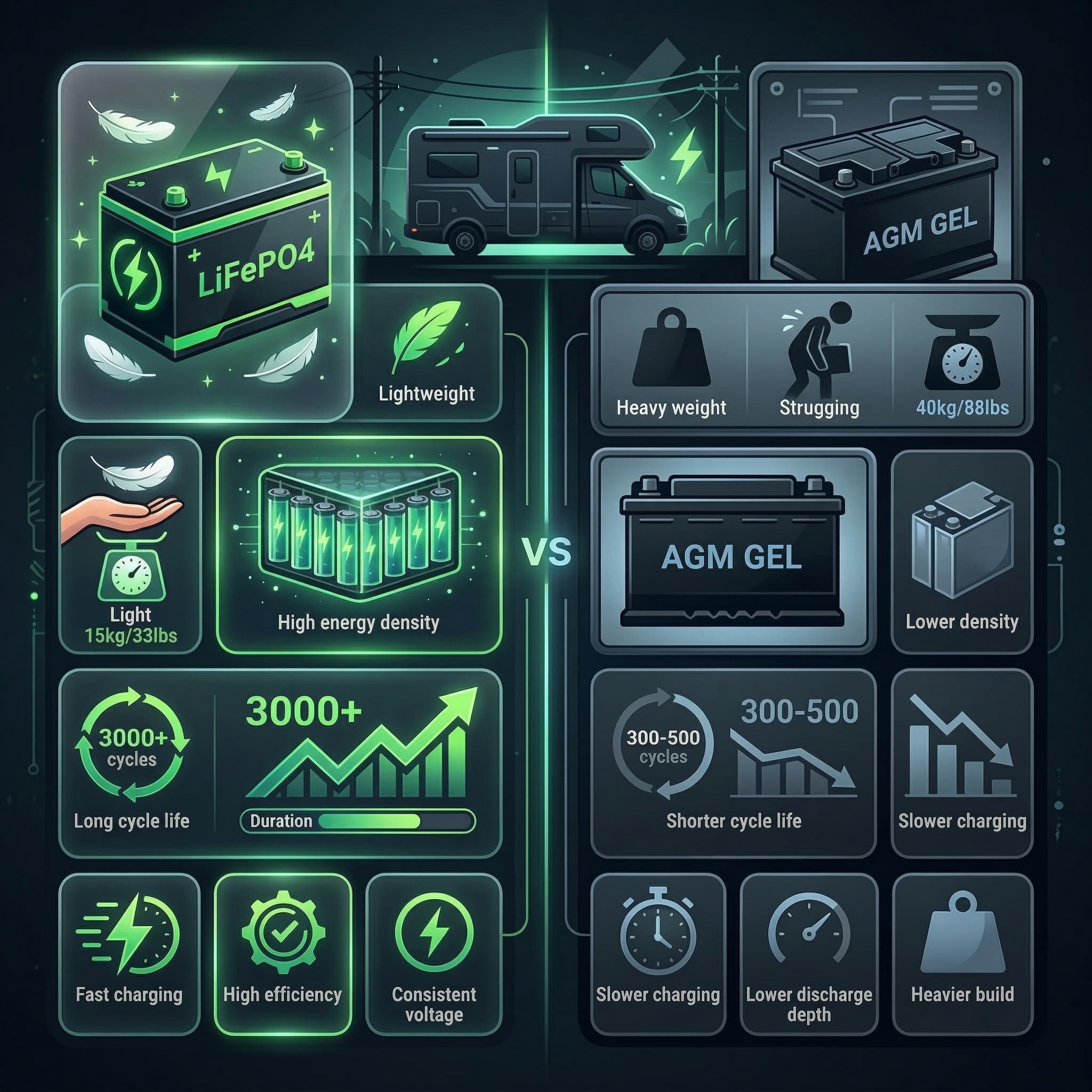
Recommended LiFePO4 battery
151 Ah
(80% depth of discharge)
Recommended AGM battery
241 Ah
(50% depth of discharge)
Adjust these values with the calculator below
About this tool
The trade-off is space and ventilation. LiFePO4 batteries don't off-gas during normal operation (unlike lead-acid), so ventilation isn't strictly required. But a thermal runaway event — extremely rare but not impossible with a faulty BMS — would release toxic fumes. Most builders compromise: mount inside in a semi-sealed box with a small vent to the outside. This gives you temperature control and safety ventilation. Popular mounting spots: under the rear bench (most common), behind the driver seat, in a custom box under the bed platform. Avoid mounting directly on the metal floor without insulation — the cold floor wicks heat from the battery overnight. A 20mm foam pad underneath makes a real difference.
Indoor Mounting: Maximizing Battery Performance#
LiFePO4 batteries perform best between 15°C and 35°C (59-95°F). Below 0°C, most BMS units cut off charging entirely to prevent lithium plating — your solar and DC-DC charger become useless until the battery warms up. This is the strongest argument for indoor mounting. Inside the van, ambient temperature rarely drops below 5°C even in winter if you're running a diesel heater. My battery sits under the rear bench in a plywood box lined with 10mm closed-cell foam on all sides. The foam serves double duty: thermal insulation and vibration dampening. I added a small 12V pad heater ($25, 15W) controlled by a thermostat that kicks on at 5°C — this keeps the battery chargeable even during cold nights. Total additional cost: about $40. The performance gain in winter is dramatic — without it, I'd lose 3-4 hours of morning charging time waiting for the battery to warm up naturally.
Outdoor/Underslung Mounting: When It Makes Sense#
Some builders mount batteries underneath the van in a sealed metal box, similar to how manufacturers mount factory auxiliary batteries. This frees up interior space — a real advantage in smaller vans like the VW Transporter or Renault Trafic. The box needs to be IP65 rated minimum (sealed against water jets and dust). Weld or bolt a steel enclosure to the chassis rail, line it with closed-cell foam, and add drainage holes at the lowest point in case water does get in. The downsides are real though: exposure to road spray, rocks, temperature extremes, and difficult access for maintenance. In cold climates (anywhere that regularly drops below -5°C), underslung mounting means your battery will refuse to charge on winter mornings. I've seen builds in Scandinavia where the underslung battery was essentially dead weight from November through February. If you're a summer-only traveler in mild climates, underslung works. For full-time vanlife in variable climates, mount inside.
Mounting Hardware and Safety Details#
However you mount, secure the battery for a crash scenario. A 25kg LiFePO4 at 50 km/h impact becomes a 750kg projectile. I use M8 threaded rod through the battery box base, bolted to the van floor with large fender washers and Nyloc nuts. The battery sits on anti-vibration pads inside the box and is strapped down with a ratchet strap rated for 500kg. Always mount the battery with terminals facing a direction where a tool can't accidentally bridge positive to negative — a dropped wrench across exposed terminals creates a dead short capable of 500+ amps. Cover terminals with rubber boots after connecting cables. And keep a Class D fire extinguisher within arm's reach — lithium fires won't respond to a standard ABC extinguisher. These cost $40-60 and they're a non-negotiable safety item in any van with lithium batteries.

Frequently asked questions
Is it safe to mount LiFePO4 inside a van?▼
Yes. LiFePO4 is the safest lithium chemistry — no thermal runaway under normal conditions, no off-gassing during regular charge/discharge. A semi-sealed box with a small vent to outside is best practice but more for peace of mind than strict necessity.
Will an outdoor-mounted battery work in winter?▼
Poorly. At -5°C the BMS blocks charging. Your solar and DC-DC charger produce power but the battery can't accept it until cells warm above 0-5°C. In an insulated box with a heating pad, outdoor mounting works year-round. Without insulation, you lose 3-5 hours of charging every cold morning.
Where do most van builders mount the battery?▼
Under the rear bench seat is the most popular spot. It's accessible, out of the way, and stays at cabin temperature. Behind the driver seat and under the bed platform are second and third choices.
Do LiFePO4 batteries need ventilation?▼
Not for normal operation — they don't produce hydrogen like lead-acid. A small vent is recommended as a safety precaution for the extremely unlikely event of a cell failure. A 20mm hole with a louvered cover to outside is plenty.
Can I mount the battery on its side?▼
Most LiFePO4 batteries work in any orientation — there's no liquid electrolyte to leak. Check your specific model's datasheet. Victron, SOK, and BattleBorn all state any-orientation mounting is fine.
Advertising
Independent and free thanks to your clicks
Links marked with * are affiliate links. If a purchase is made through them, I receive a commission at no extra cost to you. The editorial selection and product evaluation are not influenced by commission rates. Your click helps fund this free tool.
Recommended gear
Check price
LiTime 12V 100Ah Bluetooth LiFePO4 (Group 31)Leo's Pick
LiFePO4 12V 100Ah Group 31, Bluetooth monitoring, 100A BMS, low-temp cutoff protection. Up to 15000 deep cycles at 60% DoD. Marine, RV, off-grid use. 222 Amazon reviews. LiTime is a leading mainstream LiFePO4 brand on Amazon US.“This is the battery I've been using in my van for 2 years. Reliable, lightweight, and the best value for money out there.”View on Amazon* →Check price
LiFePO4 200Ah 12V Battery
200Ah true capacity, 200A built-in BMS, 5000+ cycles.“If you work remotely or run a fridge, go straight for 200Ah. You'll never regret having too much capacity.”View on Amazon* →$114Amazon
Victron BMV-712 Battery Monitor
Real-time SOC, history, Bluetooth alarms. Must-have.“Without a monitor, you're flying blind. This one gives you the exact battery % in real time — a total game-changer.”View on Amazon* →$56Amazon
Victron Orion DC-DC Charger 30A
Charges battery from alternator with correct Li profile.“Essential if you have a Euro 6+ vehicle. I've installed it on 3 different vans, zero issues. It charges your battery as soon as you drive.”View on Amazon* →