ELECTRICAL PLANNING :
THE COMPLETE GUIDE.
Battery, solar, alternator, 230V... Your electrical system is a system. Plan it like an engineer, not a weekend tinkerer.
1. Step 1 — Calculate Your Daily Energy Needs
Everything starts here. Before choosing a single battery or solar panel, you need to know your daily consumption in Wh (Watt-hours). Without this number, you are building on sand.
The formula is simple: Power (W) × Hours of use per day = Wh/day. List every appliance you will use in the van, without exception. Add everything up. This is your absolute reference number.
- Compressor fridge (50W) × 12h/day = 600 Wh: This is the biggest power draw. A compressor fridge runs about 50% of the time, meaning ~12 effective hours per day in summer.
- LED lighting (20W) × 5h/day = 100 Wh: LEDs draw little, but 4-5 spotlights on every evening adds up.
- Laptop (60W) × 6h/day = 360 Wh: For digital nomads, this is often the 2nd biggest consumption after the fridge.
- Phone charging + accessories (15W) × 4h/day = 60 Wh: Phone, tablet, drone, camera — all added together.
- Water pump (60W) × 0.5h/day = 30 Wh: Short duration, but non-negligible instantaneous power.
- Diesel heater fan (20W) × 8h/day = 160 Wh: The diesel heater fan runs continuously through winter nights.
- Typical total: 800 to 2,000 Wh/day depending on your profile. A weekender will be around 500-800 Wh, a full-time digital nomad will easily exceed 1,500 Wh.
2. Step 2 — Size Your Battery Bank
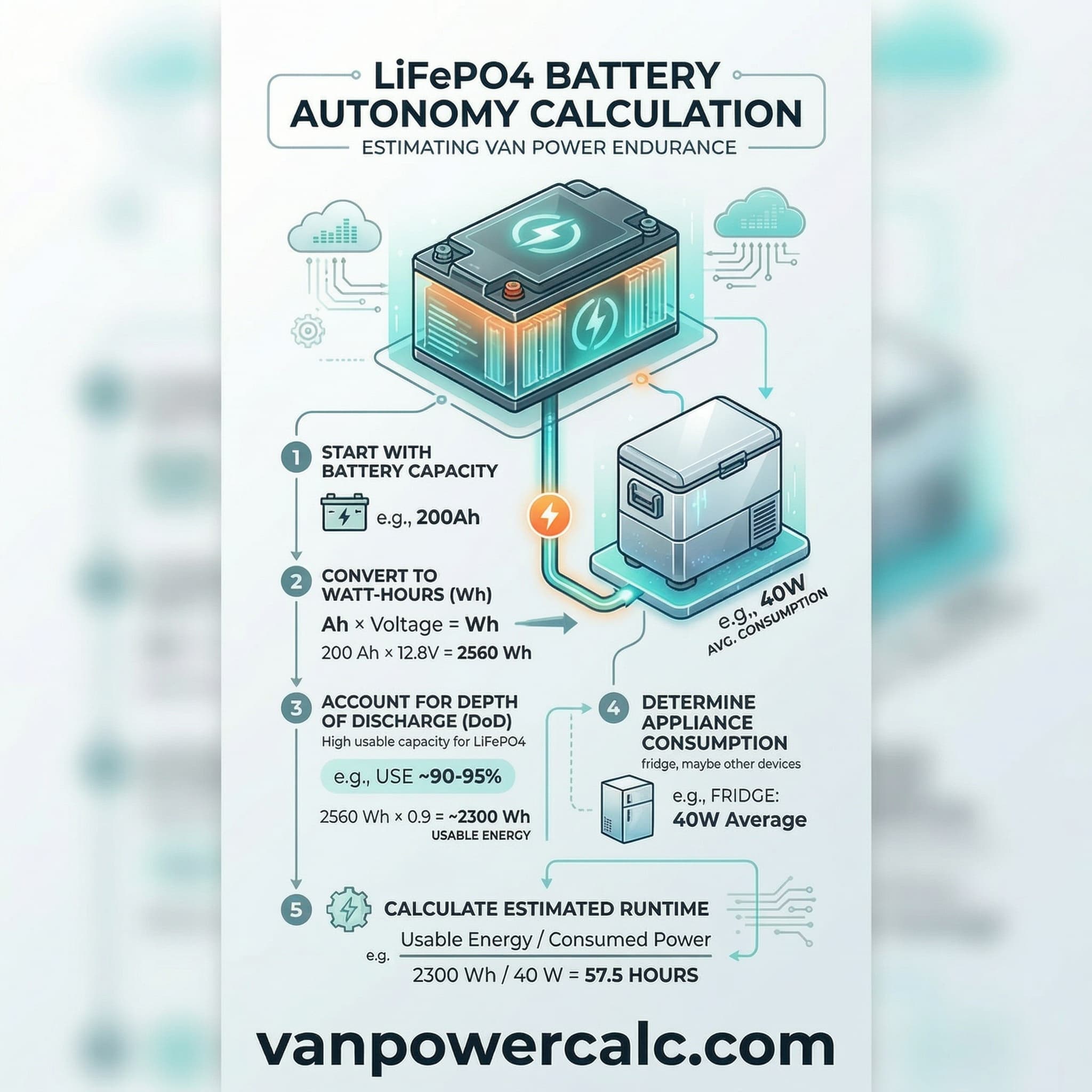
Your daily Wh directly determines your battery bank size. The conversion is immediate: Wh ÷ Voltage (12V) = Ah needed per day. But you then need to apply two crucial coefficients: depth of discharge (DoD) and days of autonomy.
With LiFePO4, you can use 80-90% of nominal capacity (80-90% DoD). With AGM/Lead, never exceed 50% or you will rapidly destroy them. For autonomy, plan 1 to 3 days without any charging depending on your use case.
3. Step 3 — Design Your Charging System
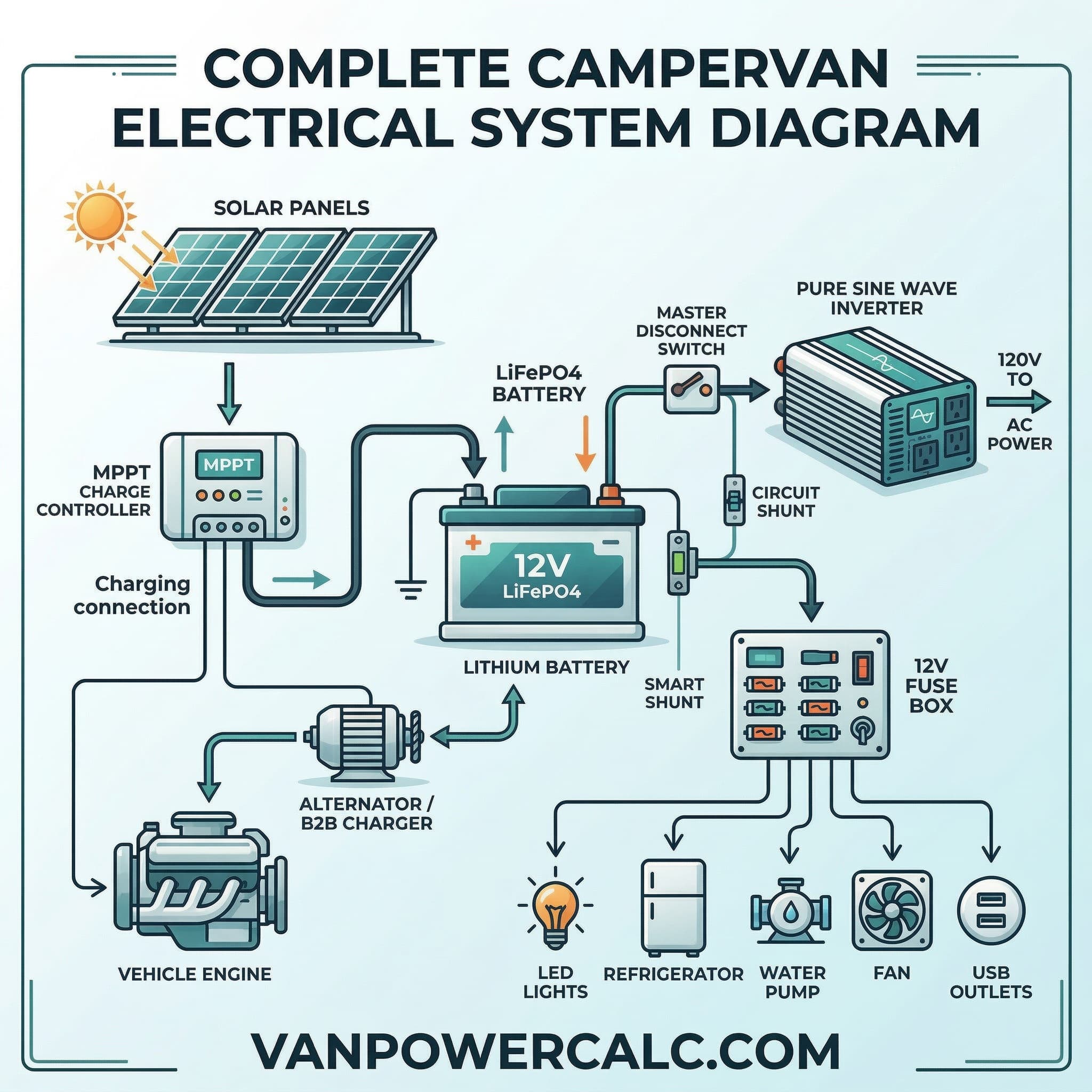
A battery without a proper charging system is a tank without a gas station. Your charging system rests on 3 complementary pillars that together must be capable of replenishing 100% of your daily consumption. If one pillar weakens (cloudy day, no driving), the other two pick up the slack.
The golden rule: your total charging capacity must be greater than or equal to your daily consumption. If you use 1,500 Wh/day, your combined system must be able to inject at least 1,500 Wh per day under normal conditions.
- Solar (main off-grid source): 200 to 600W of panels depending on your needs. In Europe, expect 4-5h of effective production per day in summer, 1.5-2h in winter. A 400W panel setup produces ~1,600 Wh/day in summer, ~600 Wh in winter. It is the only source that charges effortlessly while you are parked.
- DC-DC from alternator (driving days): A 30A DC-DC charger (booster) injects ~360W while driving, that is ~360 Wh per hour of driving. 3 hours of road = 1,080 Wh. Essential for rainy days and drives between spots. The perfect complement to solar.
- 230V charger / Shore power (campsites): An onboard 20-30A charger fully recharges your bank overnight on a campsite outlet. This is your safety net. Even the most autonomous vanlifers occasionally stop at a campsite.
- Complementarity is key: In sunny summer, solar does 80% of the work. In winter or overcast weather, the DC-DC takes over while driving. At the campsite, 230V brings you back to 100% overnight. A well-designed system never relies on a single source.
VERDICT
A well-planned electrical system always starts with accurate consumption data. First calculate your real Wh/day, size your battery bank with the right margin, then design a multi-source charging system that guarantees your autonomy even in the worst-case scenario.
Do not do it backwards: do not buy "a 200Ah battery because that is what everyone installs". Every van is unique. Use our calculator to get your exact numbers, then follow this guide component by component.

I'm Leo, an engineer and vanlifer since 2019. I've installed and tested the electrical systems in 3 different vans. Every recommendation on this site is based on hands-on experience, not copied spec sheets. I have no commercial ties with manufacturers — I only recommend what I use or would install in my own van.
Frequently Asked Questions
How much does a complete van electrical system cost?+
Expect between €1,500 and €5,000 for a complete LiFePO4 installation. The main expense is the battery (~30-40% of the budget). A typical kit: 200Ah LiFePO4 (€700), 400W solar + MPPT (€500), 30A DC-DC (€250), 230V charger (€150), 2000W inverter (€300), wiring and fuses (€200). Total: ~€2,100 in materials.
Can I install the electrical system myself?+
Yes, it is entirely doable for someone meticulous. 12V low voltage is not life-threatening (unlike 230V). However, wiring errors cause fires. Strictly follow cable gauge requirements, install a fuse on every circuit, and use crimped connections (never screw terminals). For the 230V section (inverter, campsite inlet), have an electrician verify your work if you are unsure.
12V or 24V — which should I choose for my van?+
12V in 95% of cases. All van equipment (fridge, lighting, pump, diesel heater) natively runs on 12V. 24V is only justified for very large systems (buses, converted trucks) with over 600Ah and long cable runs, as it reduces line losses and required cable gauges. For a standard van (Sprinter, Ducato, Transit), stick with 12V.
How many days of autonomy should I plan for?+
1 to 2 days for holiday use with solar. 2 to 3 days for a digital nomad or winter use. Autonomy is calculated as: usable battery capacity (Ah × DoD × 12V) ÷ daily consumption (Wh). Example: 200Ah LiFePO4 at 80% DoD = 1,920 Wh. If you consume 1,000 Wh/day, you last ~1.9 days. Solar considerably extends this autonomy under normal conditions.