220V INVERTER :
PURE SINE OR NOTHING.
Plugging a $2000 MacBook into a cheap inverter is an absolute guarantee to destroy it. Here are the only real rules.
1. Pure Sine Wave
The electrical grid in a house provides alternating current forming a perfect curve. The majority of cheap Amazon inverters (often called Modified Sine) spit out a 'staircase' wave.
If you plug a computer, an electric toothbrush, a blender, or an e-bike charger into it: it will hiss, heat up, and fry your motherboard. You absolutely need the certified label: Pure Sine Wave.
2. The Idle Power Draw Trap
"I'll get a 3000W inverter to be safe!" This is a massive rookie mistake.
An inverter connected to batteries, even with no appliance plugged in, consumes energy just to run and stay powered on (usually 1% to 3% of its max power). A 3000W inverter left on 24/7 can drain 60W continuously, or 1400Wh per day. It will literally drain your battery flat in 24 hours just by "existing".
3. Power Calculation (+25%)
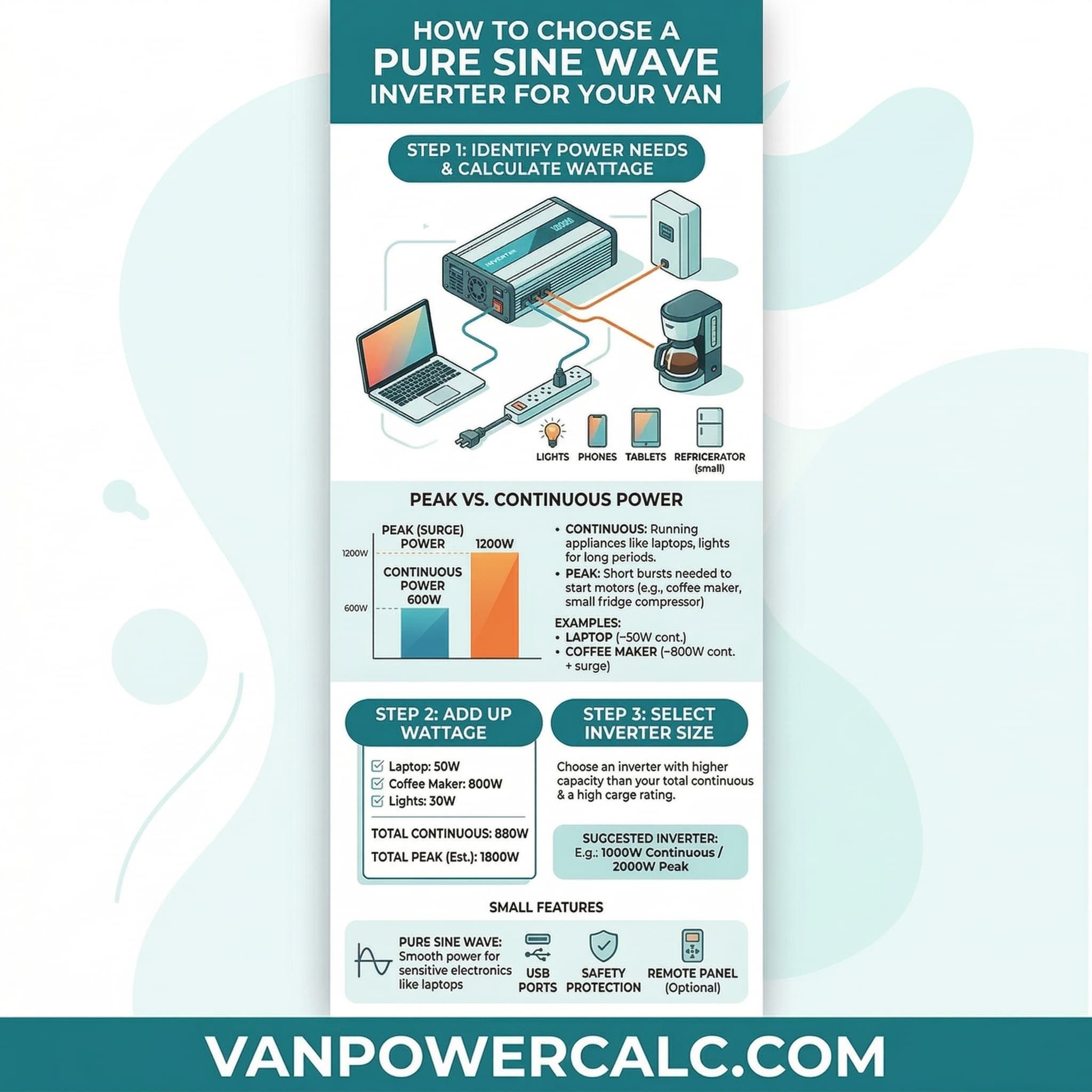
Does your biggest appliance draw 800W (e.g. boiler)? Never get an 800W inverter. Inverters suffer when pushed to their max. Apply the strict safety margin of +25%. For an 800W appliance, you need a nominal inverter of at least 1000W.

I'm Leo, an engineer and vanlifer since 2019. I've installed and tested the electrical systems in 3 different vans. Every recommendation on this site is based on hands-on experience, not copied spec sheets. I have no commercial ties with manufacturers — I only recommend what I use or would install in my own van.
Frequently Asked Questions
What size inverter do I need for a campervan?+
Take your most power-hungry appliance (e.g. kettle 1000W) and add 25% margin. For a 1000W kettle, you need at least a 1250W rated inverter. A 2000W covers all common uses.
Pure sine wave or modified sine wave?+
Pure sine wave is mandatory. Modified sine wave can damage sensitive electronics (chargers, laptops, electronic coffee makers). The price difference (€30-50) is negligible compared to the risk.
Does the inverter drain the battery on standby?+
Yes, an inverter draws 0.5 to 2A even on standby (no load). Always turn it off when not in use, or get a model with eco mode that auto-shuts below 5W consumption.