Loading...
Fact-checked on Jun 11, 2026
VANPOWERCALC.COMYOUR ENERGY PROFILE
YOUR ENERGY PROFILE.
This document contains the sizing of your future electrical installation, calculated based on your appliances.
Minimum Daily Consumption
0 WH / DAY
Inventory:
SYSTEM SIZINGPage 2
Battery
To guarantee 0WH without damaging your bank (80% max discharge):
0 AH
LiFePO4 12V
Solar
Minimum power required to recharge your consumption:
0 W
via MPPT
220V AC
Maximum power (with 25% safety margin).
0 W
No Need
Safety & CablingPage 3
12V Cable Sizing Guide
Use this professional reference table to select the correct gauge (mm²) for your cables. For 12V in a van, the maximum tolerated voltage drop is 3%. Always use multi-stranded flexible automotive wire.
| Current (A) | Round trip < 2m | Round trip 4m | Round trip 6m |
|---|---|---|---|
| 5A (LEDs, USB) | 1.5 mm² | 2.5 mm² | 4 mm² |
| 10A (Fridge, Pump) | 2.5 mm² | 4 mm² | 6 mm² |
| 20A (Heater) | 4 mm² | 10 mm² | 10 mm² |
| 50A (DC/DC Booster) | 10 mm² | 16 mm² | 25 mm² |
| 100A (Inverter) | 25 mm² | 35 mm² | 50 mm² |
Fuse Sizing
The fuse protects the wire, not the appliance. Always place it as close to the power source as possible (battery or busbar).
- Wire 1.5 mm² → Max fuse 10A
- Wire 2.5 mm² → Max fuse 20A
- Wire 4 mm² → Max fuse 30A
- Wire 6 mm² → Max fuse 40A
- Wire 10 mm² → Max fuse 60A
SCHÉMA ÉLECTRIQUE
PANNEAUX SOLAIRES
0W
RÉGULATEUR MPPT
BATTERIE AUXILIAIRE
0 Ah
Lithium LiFePO4
FUSIBLE
FUSIBLE
BOÎTE À FUSIBLES 12V
Pompe, Leds, Frigo...
CONVERTISSEUR 220V
NON REQUI
PRO GEARPage 4
SHOPPING LIST
Where to find this equipment? Here is the community-approved selection.
12V 6-way Fuse Box
Mandatory protection
Digital Multimeter
Test your connections
Heavy Duty Crimping Tool
For perfect lugs
Heat Shrink Tubing
Insulation and safety
GENERATED BY VANPOWERCALC.COM
Starting a van build electrical system from scratch is overwhelming. Battery? Solar? Inverter? Wire gauge? Our calculator walks you through the whole thing — just tell it what appliances you need.
The three pillars of a van electrical system are storage (battery), generation (solar + alternator), and distribution (fuse box + wiring). Size them in that order: first calculate your daily consumption, then pick a battery that covers 2-3 days of autonomy, and finally size solar and DC-DC charging to replenish the battery each day.
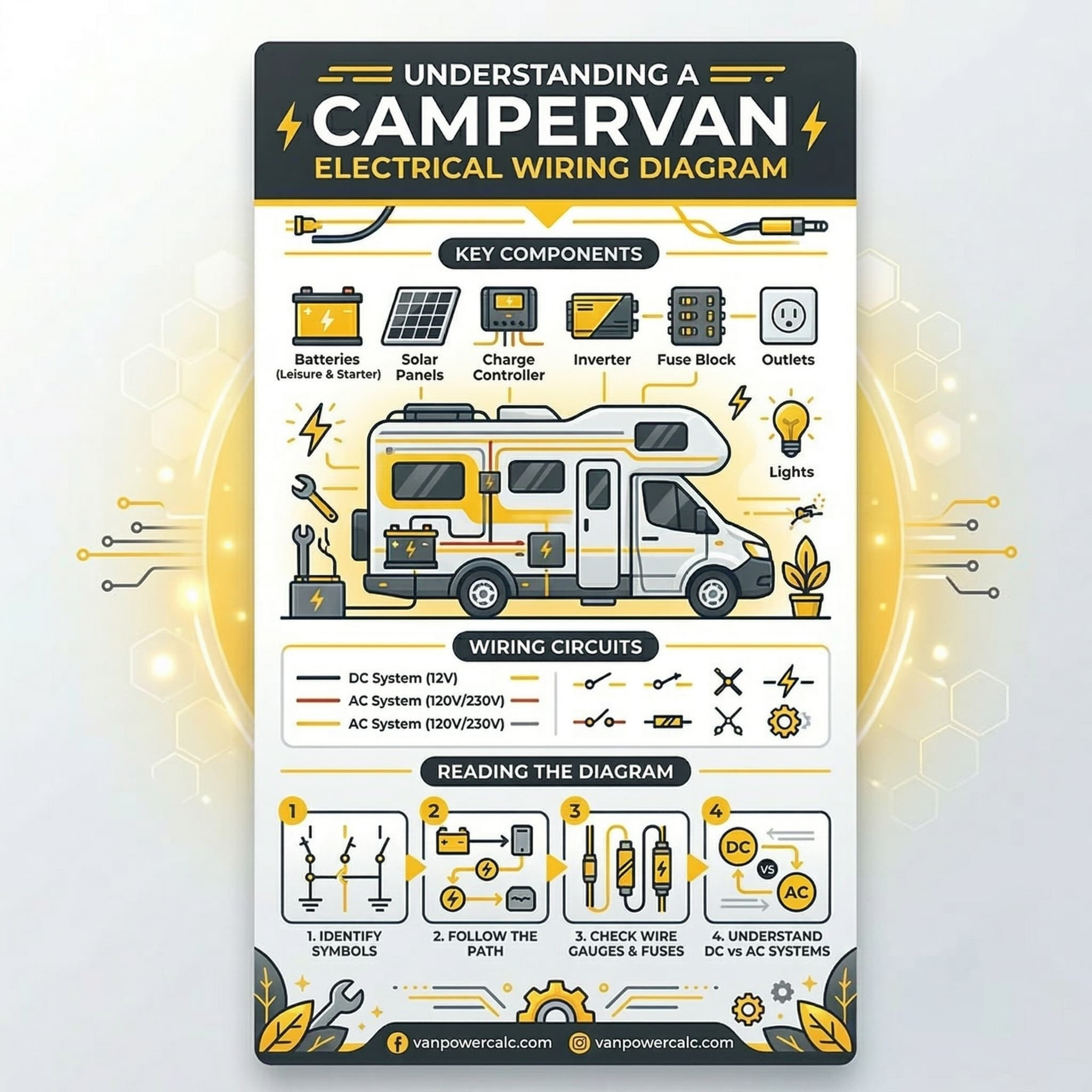
Expert tip
Draw your full electrical diagram before buying a single component. Even a rough hand-drawn schematic will highlight missing fuses, wrong cable routes, and sizing conflicts — saving you from expensive mistakes and ensuring the system passes a safety check.
Example calculation for your setup
Results based on a typical use case
| Appliance | Power | Usage/day | Wh/day |
|---|---|---|---|
| Compression fridge | 45W | 24h | 1080 |
| LED lighting | 20W | 4h | 80 |
| Water pump | 30W | 0.5h | 15 |
| Phone charging | 15W | 2h | 30 |
| Daily consumption | 1205 Wh | ||
Recommended LiFePO4 battery
151 Ah
(80% depth of discharge)
Recommended AGM battery
241 Ah
(50% depth of discharge)
Recommended solar panels
402 Wc
4h average sun hours
Recommended inverter
No 220V appliances — no inverter needed
Adjust these values with the calculator below
Comparison table
| Component | Entry budget | Mid budget | Premium budget |
|---|---|---|---|
| Battery 100-200Ah | $150-300 | $300-500 | $600-900 |
| Solar panel 100-200W | $60-100 | $100-180 | $200-350 |
| MPPT controller | $30-50 | $50-100 | $100-200 |
| Inverter 300-1000W | $40-100 | $100-180 | $200-350 |
| TOTAL | $280-550 | $550-960 | $1,100-1,800 |
About this tool
Van Build Electrical System: Beginner's Complete Guide#
Building a van electrical system from scratch feels overwhelming, but it breaks down into 6 clearly defined components. Understand each one and you'll be able to design a system confidently before buying a single cable.
The 6 Core Components#
1. Battery Bank — Stores your energy. LiFePO4 is the modern standard: 80% DoD, 10+ year lifespan, lightweight. Start with 100-200Ah for weekends, 200-400Ah for full-time.
2. Solar Panels — Your primary source of free energy. Budget 200-400W for weekends, 400-600W for full-time. Mounted flat or at 5-15° angle on the roof.
3. MPPT Regulator — Converts solar power efficiently into battery power. Always use MPPT (not PWM) above 200W. Victron SmartSolar is the benchmark. Sized by: (Solar watts ÷ Battery voltage) × 1.25.
4. DC-DC Charger (B2B) — Charges your leisure battery from the engine alternator while driving. Essential for winter or cloudy periods. A 30A unit provides 360Wh per hour of driving.
5. 230V Inverter/Charger — Converts 12V battery power to 230V for charging laptops, appliances. Also charges battery when connected to shore power. Pure sine wave only for sensitive electronics.
6. Wiring and Protection — The unsexy but mission-critical part. Correctly sized cables, fuses, and a negative busbars prevent fires. Under-sized cables can get hot enough to cause fires under sustained load.
Sizing Quick Reference#
| Component | Entry Level | Full-Time |
|---|---|---|
| Battery | 100-150Ah LiFePO4 | 200-400Ah LiFePO4 |
| Solar | 200W | 400-600W |
| MPPT | 20-30A | 40-60A |
| DC-DC B2B | 20A | 30-40A |
| Inverter | 1,000W pure sine | 2,000-3,000W |
The Right Order to Wire Your System#
Critical safety rule: Always connect batteries last and disconnect batteries first. Sequence for connecting: fuse holders → busbars → MPPT → inverter → B2B → solar panels → battery. Reverse for disconnection.
All positive cables need an appropriately sized fuse as close to the battery positive terminal as possible — this is your last line of defense against a wiring fire.
Biggest Beginner Mistakes#
- Undersized cables — use AWG/mm² charts based on current AND cable length
- No BMS on LiFePO4 — even branded LiFePO4 batteries need BMS protection
- PWM instead of MPPT — you lose 15-30% of solar production
- Fridge running directly off alternator via split-charge relay — this drains the starter battery; always use a proper B2B charger
Expert tip: Draw your electrical diagram before buying anything. Even a rough hand-drawn schematic will save you from buying wrong cable lengths, wrong-sized components, and ensure you haven't missed a fuse location.

Frequently asked questions
What electrical system do I need for a van build?▼
The 6 core components: battery bank (100-400Ah LiFePO4), solar panels (200-600W), MPPT regulator (20-60A), DC-DC charger (20-40A), pure sine wave inverter (1,000-3,000W), and correct wiring with fuses. Scale each component based on your daily energy consumption.
Can I build a van electrical system myself without experience?▼
Yes. The main risk is incorrect wiring (too small cables, missing fuses). Start by drawing a complete electrical diagram. Buy a good crimping kit, quality connectors, and correctly rated cables. Many forum communities (Reddit r/vandwellers, sprinter-source.com) can review your diagram before you start.
What is the first electrical component to install in a van build?▼
Install your negative busbar and cable from battery negative first, then your battery isolation switch. This ensures you can disconnect all power safely at any time during the build. Solar panels should be the last thing connected.
How much does a van electrical system cost?▼
Entry-level weekend build: $600-1,200 (100-150Ah LiFePO4 + 200W solar + basic MPPT). Full-time build: $2,000-5,000 (200-400Ah LiFePO4 + 400-600W solar + Victron MPPT + inverter-charger + B2B charger).
Advertising
Independent and free thanks to your clicks
Links marked with * are affiliate links. If a purchase is made through them, I receive a commission at no extra cost to you. The editorial selection and product evaluation are not influenced by commission rates. Your click helps fund this free tool.
Recommended gear
Check price
LiTime 12V 100Ah Bluetooth LiFePO4 (Group 31)Leo's Pick
LiFePO4 12V 100Ah Group 31, Bluetooth monitoring, 100A BMS, low-temp cutoff protection. Up to 15000 deep cycles at 60% DoD. Marine, RV, off-grid use. 222 Amazon reviews. LiTime is a leading mainstream LiFePO4 brand on Amazon US.“This is the battery I've been using in my van for 2 years. Reliable, lightweight, and the best value for money out there.”View on Amazon* →Check price
ECO-WORTHY 200W 12V/24V Solar Kit + 20A Bluetooth MPPTLeo's Pick
Complete 200W solar kit with Bluetooth-monitored MPPT controller. 12V/24V compatible, 20A charge controller with smartphone app. Ideal for vans, RVs, off-grid setups. Single-product solution covering both solar panel and charge controller.“The kit I recommend to every beginner. Plug it in, it works, and the included MPPT controller makes a real difference.”View on Amazon* →$107Amazon
Digital Multimeter
Measures voltage, current, resistance — essential for 12V wiring.“First tool to buy before you even start your install. You'll pull it out 100 times to check voltages and connections.”View on Amazon* →$41Amazon
12V Fuse Box
Protects each circuit independently, easy installation.“One fuse per circuit is the golden rule. This box keeps your install clean and every line independently protected.”View on Amazon* →