Loading...
Fact-checked on Mar 12, 2026
VANPOWERCALC.COMYOUR ENERGY PROFILE
YOUR ENERGY PROFILE.
This document contains the sizing of your future electrical installation, calculated based on your appliances.
Minimum Daily Consumption
0 WH / DAY
Inventory:
SYSTEM SIZINGPage 2
Battery
To guarantee 0WH without damaging your bank (80% max discharge):
0 AH
LiFePO4 12V
Solar
Minimum power required to recharge your consumption:
0 W
via MPPT
220V AC
Maximum power (with 25% safety margin).
0 W
No Need
Safety & CablingPage 3
12V Cable Sizing Guide
Use this professional reference table to select the correct gauge (mm²) for your cables. For 12V in a van, the maximum tolerated voltage drop is 3%. Always use multi-stranded flexible automotive wire.
| Current (A) | Round trip < 2m | Round trip 4m | Round trip 6m |
|---|---|---|---|
| 5A (LEDs, USB) | 1.5 mm² | 2.5 mm² | 4 mm² |
| 10A (Fridge, Pump) | 2.5 mm² | 4 mm² | 6 mm² |
| 20A (Heater) | 4 mm² | 10 mm² | 10 mm² |
| 50A (DC/DC Booster) | 10 mm² | 16 mm² | 25 mm² |
| 100A (Inverter) | 25 mm² | 35 mm² | 50 mm² |
Fuse Sizing
The fuse protects the wire, not the appliance. Always place it as close to the power source as possible (battery or busbar).
- Wire 1.5 mm² → Max fuse 10A
- Wire 2.5 mm² → Max fuse 20A
- Wire 4 mm² → Max fuse 30A
- Wire 6 mm² → Max fuse 40A
- Wire 10 mm² → Max fuse 60A
SCHÉMA ÉLECTRIQUE
PANNEAUX SOLAIRES
0W
RÉGULATEUR MPPT
BATTERIE AUXILIAIRE
0 Ah
Lithium LiFePO4
FUSIBLE
FUSIBLE
BOÎTE À FUSIBLES 12V
Pompe, Leds, Frigo...
CONVERTISSEUR 220V
NON REQUI
PRO GEARPage 4
SHOPPING LIST
Where to find this equipment? Here is the community-approved selection.
12V 6-way Fuse Box
Mandatory protection
Digital Multimeter
Test your connections
Heavy Duty Crimping Tool
For perfect lugs
Heat Shrink Tubing
Insulation and safety
GENERATED BY VANPOWERCALC.COM
The 4-Step Sizing Method#
Sizing a van electrical system isn't guesswork — it's arithmetic. Follow these four steps in order and you'll know exactly what to buy before spending a single dollar.
Step 1: Power Audit (→ Battery Size)#
List every device, its wattage, and daily usage hours. Multiply to get Wh/day. Divide by 12.8V for Ah/day. Multiply by 2 for two days of autonomy. That's your minimum battery capacity in Ah. Example: 1,000 Wh/day ÷ 12.8V = 78 Ah/day × 2 = 156 Ah minimum → buy a 200Ah LiFePO4.
Step 2: Battery Size → Solar Panel Wattage#
Your solar must replenish what you use each day. Take your daily Wh consumption and divide by the sun-hours for your typical location (4-6 in summer, 2-3 in winter for most US/EU locations). 1,000 Wh ÷ 4 sun-hours = 250W minimum panel wattage. Add 25% for real-world losses (heat, angle, partial shade): 250W × 1.25 = 313W → buy 400W of panels for comfortable margin.
Step 3: Solar Wattage → Charge Controller Size#
Take your total panel wattage, divide by battery voltage: 400W ÷ 12.8V = 31A charge current. Your MPPT must handle at least 31A output. A Victron 100/30 is right on the edge; a 100/50 gives headroom. For the input voltage: count your panels in series and multiply by Voc. 2 × 40V = 80V — within the 100V limit of the SmartSolar 100/50.
Step 4: Load Wattage → Inverter Size#
List every AC device you'll run simultaneously: laptop charger (65W), blender (600W for 30 seconds), small microwave (900W). The inverter must handle the largest simultaneous load plus a startup surge (typically 2× for motors). If you'll run a microwave and laptop together: 900 + 65 = 965W continuous, with a 1800W surge. A 2000W pure sine wave inverter covers this with margin. Don't buy a 3000W inverter "just in case" — larger inverters have higher idle consumption that drains your battery 24/7.
Expert tip
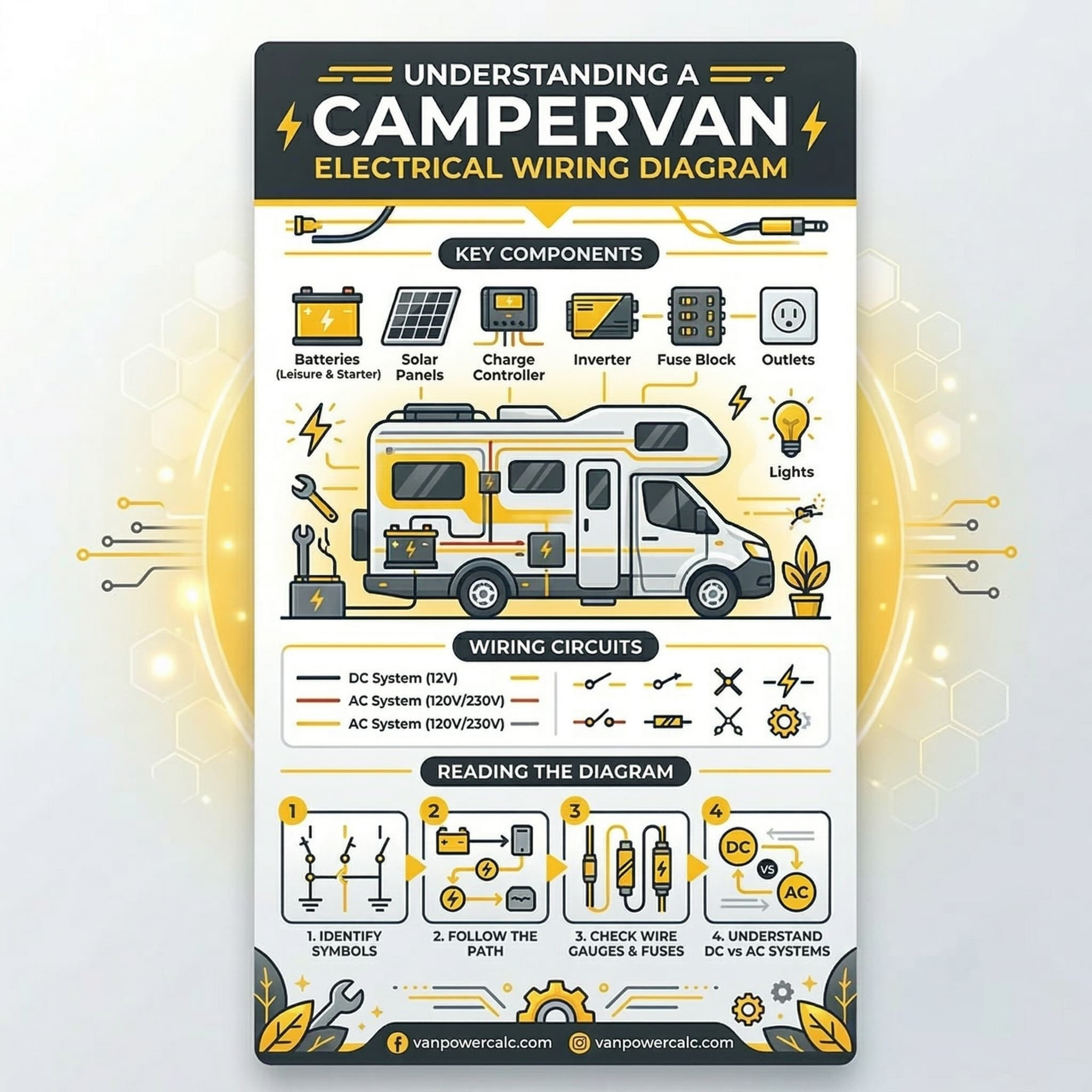
The most important component you cannot buy: a wiring diagram drawn before you cut a single cable. Professional van builders spend 2-4 hours drawing the complete diagram including cable sizes, fuse ratings, and connection points before buying materials. It catches every design flaw before it costs money to fix. VanPowerCalc generates this diagram automatically from your system inputs.
Example calculation for your setup
Results based on a typical use case
| Appliance | Power | Usage/day | Wh/day |
|---|---|---|---|
| Compression fridge | 45W | 24h | 1080 |
| LED lighting | 20W | 4h | 80 |
| Water pump | 30W | 0.5h | 15 |
| Phone charging | 15W | 2h | 30 |
| Daily consumption | 1205 Wh | ||
Recommended LiFePO4 battery
151 Ah
(80% depth of discharge)
Recommended AGM battery
241 Ah
(50% depth of discharge)
Recommended solar panels
402 Wc
4h average sun hours
Recommended inverter
No 220V appliances — no inverter needed
Adjust these values with the calculator below
Comparison table
| Component | Sizing Formula | Example (1000 Wh/day) | Recommended |
|---|---|---|---|
| Battery | Wh/day ÷ 12.8V × 2 | 156 Ah minimum | 200Ah LiFePO4 |
| Solar | Wh/day ÷ sun-hours × 1.25 | 313W minimum | 400W panels |
| MPPT Controller | Solar W ÷ battery V | 31A minimum | Victron 100/50 |
| Inverter | Max simultaneous AC load × 1.5 | 1500W | 2000W pure sine |
About this tool
Sizing a complete van electrical system combines three engineering disciplines: load analysis, energy storage chemistry, and electrical circuit design. Most van builders approach it backwards — buying panels because they look good on a roof, then wondering why the battery is always dead. The correct sequence is loads first, battery second, solar and charging third.
Load analysis starts with a spreadsheet. List every electrical device you plan to use: the brand and model (not generic) because a Dometic CFX3 45 fridge draws 2.5-3.5A average while a cheap no-name 45L draws 4-6A for the same cooling. Multiply watts by hours-per-day for each device to get Wh/day. Add all values. This is your design target.
Battery sizing: target 2× daily consumption for 2 days autonomy (standard), or 3× for 3-day autonomy (recommended for rainy-season van life). A 100Ah LiFePO4 = 1200Wh usable. If your daily total is 700Wh, 100Ah gives you 1.7 days autonomy — marginal. Step up to 150Ah (1800Wh) for a comfortable 2.5-day buffer.
Solar sizing: take daily consumption, divide by your location's average peak sun hours, multiply by 1.25 for real-world losses. 700Wh ÷ 4 PSH × 1.25 = 218W minimum. Two 120W panels give exactly 240W — sufficient. Two 200W panels give 400W — comfortable with headroom for cloudy days.
Charge controller: MPPT output amperage = solar watts ÷ battery voltage × 1.1 = 400 ÷ 12 × 1.1 = 36.7A. Use a 40A MPPT controller (Victron SmartSolar MPPT 100/50). Wire panels in series (if 12V nominal panels: open circuit 40V) — within the 100V controller limit.
DC-DC charger for driving: Victron Orion-Tr Smart 12-12|30 as standard. Install between starter and leisure battery. Adds 30A = 360W charging while engine running.
Distribution: positive busbar + ANL fuse + fused circuits per load. Negative busbar connected to battery negative only (no chassis ground for the leisure circuit — keeps the system clean and prevents galvanic corrosion).
Electrical system planning before you buy anything: the biggest efficiency gain in van electrical design happens before a single component is purchased. Map the physical location of every load in the van (sink = water pump, bed area = lighting + heater control, work desk = laptop + monitors + USB), then calculate the cable run from your battery bank location to each load. Shorter runs require thinner cable and smaller fuses — for a load circuit, cost savings of €5-15 per circuit add up across 8-12 circuits in a typical build.
Fuse and breaker strategy: The main ANL fuse (or class T fuse for high-current installs) protects the battery from a short circuit on the main bus. Size it for 125% of the maximum sustained load your system will draw simultaneously. Downstream circuit breakers protect individual circuits. A 15A circuit breaker for a 12V laptop circuit costs €8 and allows safe resettable protection — preferable to a blade fuse that requires a spare parts inventory.
Two things most VanLife beginners forget: 1) Grounding. Every load needs a return wire back to the battery negative — do not use chassis ground for 12V DC circuits in modern vehicles with CAN-bus electronics. 2) Shore power safety. If you install a 230V shore power inlet, include a 30mA RCD (residual current device) on the incoming line inside the van — a basic safety device for any AC installation.

Frequently asked questions
How do I size an entire van electrical system from scratch?▼
Use a three-step calculation: 1) Daily Wh consumption (all appliances × hours), 2) Battery: consumption × 2-3 days ÷ 0.9 LiFePO4 DOD, 3) Solar: consumption ÷ local PSH × 1.25. Example for a realistic setup: 800Wh/day → 200Ah LiFePO4 → 280W solar minimum. VanPowerCalc automates this with your specific appliances.
What is a realistic budget for a complete van electrical system?▼
Budget tiers: Basic (100Ah LiFePO4, 200W solar, MPPT, no inverter): €600-900. Standard (200Ah LiFePO4, 300W solar, MPPT, 1000W inverter, DC-DC charger): €1400-2000. Premium (300Ah LiFePO4, 500W solar, dual MPPT, 2000W inverter/charger, Cerbo GX monitoring): €3000-5000. Labour adds 20-40% if professionally installed.
What is the correct wire gauge for a 12V van system?▼
Wire gauge (mm²) for round-trip cable runs at 12V and max 3% voltage drop: 80W load 2m = 2.5mm², 80W 5m = 6mm², 500W 2m = 10mm², 2000W (inverter) 0.5m = 50mm². Always size for the circuit breaker rating, not just expected load — a 20A fused circuit should use minimum 2.5mm² cable regardless of actual load.
How many fuses do I need in a van electrical system?▼
Every positive cable leaving the battery needs a fuse: main ANL fuse within 30cm of battery positive (125-200A), DC-DC charger input fuse (40A within 30cm of starter battery), MPPT controller fuse (30-40A), individual circuit fuses per load. A typical system needs: 1 ANL fuse + 8-12 blade fuses for load circuits. Use a Blue Sea Systems fuse block with individual circuits for clean installation.
How do I test if my van electrical system is correctly installed?▼
Five-step test: 1) Insulation resistance test between positive bus and chassis ground (should be >1MΩ with multimeter on resistance mode), 2) Check all fuse continuity before energizing, 3) Verify MPPT output voltage matches battery bank voltage (±0.2V) before connecting battery, 4) Load test at 50% max current for 10 minutes — check for warm connections (thermal camera or touch test), 5) Monitor battery voltage for 24h to confirm charging and discharging behavior.
Advertising
Independent and free thanks to your clicks
Links marked with * are affiliate links. If a purchase is made through them, I receive a commission at no extra cost to you. The editorial selection and product evaluation are not influenced by commission rates. Your click helps fund this free tool.
Recommended gear
Check price
LiTime 12V 100Ah Bluetooth LiFePO4 (Group 31)Leo's Pick
LiFePO4 12V 100Ah Group 31, Bluetooth monitoring, 100A BMS, low-temp cutoff protection. Up to 15000 deep cycles at 60% DoD. Marine, RV, off-grid use. 222 Amazon reviews. LiTime is a leading mainstream LiFePO4 brand on Amazon US.“This is the battery I've been using in my van for 2 years. Reliable, lightweight, and the best value for money out there.”View on Amazon* →Check price
ECO-WORTHY 200W 12V/24V Solar Kit + 20A Bluetooth MPPTLeo's Pick
Complete 200W solar kit with Bluetooth-monitored MPPT controller. 12V/24V compatible, 20A charge controller with smartphone app. Ideal for vans, RVs, off-grid setups. Single-product solution covering both solar panel and charge controller.“The kit I recommend to every beginner. Plug it in, it works, and the included MPPT controller makes a real difference.”View on Amazon* →$107Amazon
Digital Multimeter
Measures voltage, current, resistance — essential for 12V wiring.“First tool to buy before you even start your install. You'll pull it out 100 times to check voltages and connections.”View on Amazon* →$41Amazon
12V Fuse Box
Protects each circuit independently, easy installation.“One fuse per circuit is the golden rule. This box keeps your install clean and every line independently protected.”View on Amazon* →