Loading...
Fact-checked on Mar 12, 2026
VANPOWERCALC.COMYOUR ENERGY PROFILE
YOUR ENERGY PROFILE.
This document contains the sizing of your future electrical installation, calculated based on your appliances.
Minimum Daily Consumption
0 WH / DAY
Inventory:
SYSTEM SIZINGPage 2
Battery
To guarantee 0WH without damaging your bank (80% max discharge):
0 AH
LiFePO4 12V
Solar
Minimum power required to recharge your consumption:
0 W
via MPPT
220V AC
Maximum power (with 25% safety margin).
0 W
No Need
Safety & CablingPage 3
12V Cable Sizing Guide
Use this professional reference table to select the correct gauge (mm²) for your cables. For 12V in a van, the maximum tolerated voltage drop is 3%. Always use multi-stranded flexible automotive wire.
| Current (A) | Round trip < 2m | Round trip 4m | Round trip 6m |
|---|---|---|---|
| 5A (LEDs, USB) | 1.5 mm² | 2.5 mm² | 4 mm² |
| 10A (Fridge, Pump) | 2.5 mm² | 4 mm² | 6 mm² |
| 20A (Heater) | 4 mm² | 10 mm² | 10 mm² |
| 50A (DC/DC Booster) | 10 mm² | 16 mm² | 25 mm² |
| 100A (Inverter) | 25 mm² | 35 mm² | 50 mm² |
Fuse Sizing
The fuse protects the wire, not the appliance. Always place it as close to the power source as possible (battery or busbar).
- Wire 1.5 mm² → Max fuse 10A
- Wire 2.5 mm² → Max fuse 20A
- Wire 4 mm² → Max fuse 30A
- Wire 6 mm² → Max fuse 40A
- Wire 10 mm² → Max fuse 60A
SCHÉMA ÉLECTRIQUE
PANNEAUX SOLAIRES
0W
RÉGULATEUR MPPT
BATTERIE AUXILIAIRE
0 Ah
Lithium LiFePO4
FUSIBLE
FUSIBLE
BOÎTE À FUSIBLES 12V
Pompe, Leds, Frigo...
CONVERTISSEUR 220V
NON REQUI
PRO GEARPage 4
SHOPPING LIST
Where to find this equipment? Here is the community-approved selection.
12V 6-way Fuse Box
Mandatory protection
Digital Multimeter
Test your connections
Heavy Duty Crimping Tool
For perfect lugs
Heat Shrink Tubing
Insulation and safety
GENERATED BY VANPOWERCALC.COM
This tool crunches all the numbers to give you a complete, safe, and balanced electrical system setup for your vanlife travels.
A balanced electrical system matches battery storage, solar generation, and alternator charging to your actual daily consumption. Over-sizing one component while under-sizing another leads to bottlenecks. This calculator ensures all three pillars are proportional to your specific appliance list and travel style.
Expert tip
The most overlooked component in van electrical planning: the negative (ground) return path. Most builders obsess over positive fusing and ignore that every amp flowing from the battery positive must return through the negative. Use equal-gauge negative cables back to a negative busbar, and ensure that busbar has a single, clean, thick connection back to the battery negative terminal.
Example calculation for your setup
Results based on a typical use case
| Appliance | Power | Usage/day | Wh/day |
|---|---|---|---|
| Compression fridge | 45W | 24h | 1080 |
| LED lighting | 20W | 4h | 80 |
| Water pump | 30W | 0.5h | 15 |
| Phone charging | 15W | 2h | 30 |
| Daily consumption | 1205 Wh | ||
Recommended LiFePO4 battery
151 Ah
(80% depth of discharge)
Recommended AGM battery
241 Ah
(50% depth of discharge)
Recommended solar panels
402 Wc
4h average sun hours
Recommended inverter
No 220V appliances — no inverter needed
Adjust these values with the calculator below
Comparison table
| Component | Entry budget | Mid budget | Premium budget |
|---|---|---|---|
| Battery 100-200Ah | $150-300 | $300-500 | $600-900 |
| Solar panel 100-200W | $60-100 | $100-180 | $200-350 |
| MPPT controller | $30-50 | $50-100 | $100-200 |
| Inverter 300-1000W | $40-100 | $100-180 | $200-350 |
| TOTAL | $280-550 | $550-960 | $1,100-1,800 |
About this tool
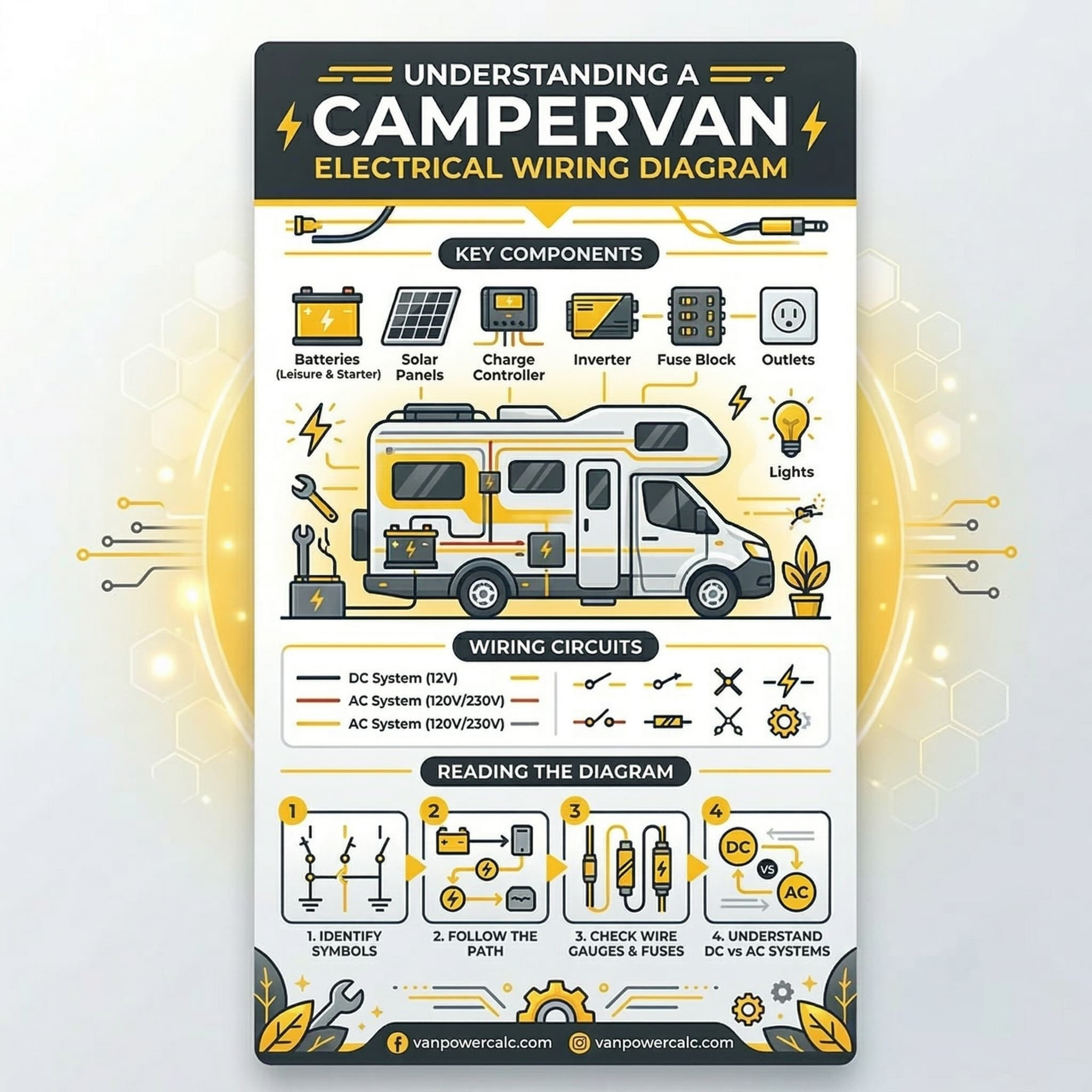
A complete campervan electrical system is more than panels and a battery — it's a circuit design exercise that determines whether your system is safe, efficient, and expandable. Understanding the function of each component prevents the most common (and expensive) installation mistakes.
The battery bank is the heart. LiFePO4 is now the default choice for serious builds: 100Ah to 400Ah capacity at 12V, with 80-95% depth of discharge usable, 3000+ cycle life, and Bluetooth monitoring available on all quality units (Victron, CATL-cell brands). Size to 2× your daily consumption in Wh.
Solar panels feed the MPPT charge controller. The controller's job is converting the higher panel voltage (17-40V depending on wiring) down to battery charging voltage (14.6V for LiFePO4) with maximum efficiency. Victron SmartSolar MPPT controllers (75/15 to 250/100) are the van-life standard, with Bluetooth integration and programmable charge profiles.
The DC-DC charger from the starter battery handles driving-based charging. This is essential for modern Euro 5/6 vans with smart alternators — without it, your LiFePO4 will never fully charge from driving. Victron Orion-Tr Smart 12-12|30 (30A = 360W) is sufficient for most builds; two in parallel gives 60A for faster charging.
The distribution board ties everything together. Use a central positive busbar with individual fuse holders per circuit (not a master breaker feeding everything — that defeats the purpose of circuit protection). Each load group gets its own fuse: fridge (20A), lights (10A), USB sockets (10A), water pump (15A), inverter via its own 200A ANL. Keep 230V circuits behind an RCD if shore power is installed.
Final safety check: all cables must be rated for the maximum potential current, not just typical use. 12V cable ratings assume 12V, 1m length — for actual wire sizing, use a voltage drop calculator with your actual cable run lengths. A 3m run at 100A needs 35mm² cable to stay under 3% drop.
Why does an accurate electrical system calculator matter? The penalty for under-sizing is either constant battery anxiety (running out of power) or expensive mid-build upgrades (replacing 100Ah with 200Ah after the system is already installed, often requiring fuse and cable upgrades too). The penalty for over-sizing is wasted money: a 400Ah LiFePO4 for a weekend camper who uses 200Wh/day is €600 sitting unused 90% of time.
Calculating your system systematically: 1) List every load with watts and daily hours, 2) Sum for Wh/day, 3) Battery = Wh/day × days autonomy ÷ (system voltage × DOD%). 4) Solar = Wh/day ÷ PSH × 1.25 losses, 5) MPPT = panel watts ÷ battery voltage × 1.25. These five steps produce a specification; VanPowerCalc automates them with local PSH data for European locations built in.
Iterating on the design: once you have numbers, question each load. Is the fridge necessary? A 50L LiFePO4 cooler (30W, 360Wh/day) can be replaced with high-quality cooler bags + daily ice replenishment for weekenders — saving 400Wh/day and €300-500 in system cost. Is Starlink necessary? In France and Italy, 4G covers 95% of van destinations — Starlink's 720Wh/day overhead may not justify itself outside of deep rural northern Europe.

Frequently asked questions
What does a complete campervan electrical system include?▼
A complete system has six components: battery bank (stores energy), solar panels (primary harvest), MPPT charge controller (converts solar to usable charge), DC-DC charger (alternator charging while driving), battery charger (shore power charging), and a distribution board with fuses/circuit breakers for all loads. Optional: inverter for 230V appliances, Cerbo GX for monitoring.
What order should I wire a van electrical system?▼
Wire in this order: 1) Battery → main fuse (ANL 125A within 30cm), 2) Battery → negative busbar (common negative point), 3) DC-DC charger from starter to leisure battery, 4) Solar MPPT controller output to battery (separate circuit), 5) Distribution board from battery with individual fused circuits per load group (lights, 12V sockets, fridge, pump). 6) Inverter last — it draws highest current.
How do I calculate the main fuse size for a van electrical system?▼
Main fuse = total maximum current draw × 1.25 safety margin. A typical system: inverter 2000W (166A at 12V) + fridge 5A + lights 5A + pump 5A + DC-DC charger 5A = 186A peak theoretical maximum. Main ANL fuse should be 200A. In practice with diversity factor (not everything runs simultaneously), 150A ANL is sufficient for most van builds under 2000W inverter.
Do I need a bus bar in a van electrical system?▼
Yes — a positive and negative bus bar simplifies wiring significantly and reduces connection points where faults can occur. Every load connects to the bus bars via its own fused circuit. The bus bars connect to the battery via thick cables (35mm² minimum for 200A systems). Popular choice: Blue Sea Systems 150A bus bars with integrated fuse holders — €40 each, marine grade, proven in van builds.
Should I use 12V or 24V for my van electrical system?▼
12V for most van conversions (under 300Ah and 300W solar): all 12V accessories work directly, most components are optimized for 12V, and system complexity is lower. 24V makes sense for solar arrays over 600W (halves cable current for same power), inverters over 2000W (safer, more efficient at 24V), and builds with over 400Ah battery capacity. Sprinter-based large motorhome conversions more frequently use 24V.
Advertising
Independent and free thanks to your clicks
Links marked with * are affiliate links. If a purchase is made through them, I receive a commission at no extra cost to you. The editorial selection and product evaluation are not influenced by commission rates. Your click helps fund this free tool.
Recommended gear
Check price
LiTime 12V 100Ah Bluetooth LiFePO4 (Group 31)Leo's Pick
LiFePO4 12V 100Ah Group 31, Bluetooth monitoring, 100A BMS, low-temp cutoff protection. Up to 15000 deep cycles at 60% DoD. Marine, RV, off-grid use. 222 Amazon reviews. LiTime is a leading mainstream LiFePO4 brand on Amazon US.“This is the battery I've been using in my van for 2 years. Reliable, lightweight, and the best value for money out there.”View on Amazon* →Check price
ECO-WORTHY 200W 12V/24V Solar Kit + 20A Bluetooth MPPTLeo's Pick
Complete 200W solar kit with Bluetooth-monitored MPPT controller. 12V/24V compatible, 20A charge controller with smartphone app. Ideal for vans, RVs, off-grid setups. Single-product solution covering both solar panel and charge controller.“The kit I recommend to every beginner. Plug it in, it works, and the included MPPT controller makes a real difference.”View on Amazon* →$107Amazon
Digital Multimeter
Measures voltage, current, resistance — essential for 12V wiring.“First tool to buy before you even start your install. You'll pull it out 100 times to check voltages and connections.”View on Amazon* →$41Amazon
12V Fuse Box
Protects each circuit independently, easy installation.“One fuse per circuit is the golden rule. This box keeps your install clean and every line independently protected.”View on Amazon* →