Loading...
Fact-checked on Jun 21, 2026
VANPOWERCALC.COMYOUR ENERGY PROFILE
YOUR ENERGY PROFILE.
This document contains the sizing of your future electrical installation, calculated based on your appliances.
Minimum Daily Consumption
0 WH / DAY
Inventory:
SYSTEM SIZINGPage 2
Battery
To guarantee 0WH without damaging your bank (80% max discharge):
0 AH
LiFePO4 12V
Solar
Minimum power required to recharge your consumption:
0 W
via MPPT
220V AC
Maximum power (with 25% safety margin).
0 W
No Need
Safety & CablingPage 3
12V Cable Sizing Guide
Use this professional reference table to select the correct gauge (mm²) for your cables. For 12V in a van, the maximum tolerated voltage drop is 3%. Always use multi-stranded flexible automotive wire.
| Current (A) | Round trip < 2m | Round trip 4m | Round trip 6m |
|---|---|---|---|
| 5A (LEDs, USB) | 1.5 mm² | 2.5 mm² | 4 mm² |
| 10A (Fridge, Pump) | 2.5 mm² | 4 mm² | 6 mm² |
| 20A (Heater) | 4 mm² | 10 mm² | 10 mm² |
| 50A (DC/DC Booster) | 10 mm² | 16 mm² | 25 mm² |
| 100A (Inverter) | 25 mm² | 35 mm² | 50 mm² |
Fuse Sizing
The fuse protects the wire, not the appliance. Always place it as close to the power source as possible (battery or busbar).
- Wire 1.5 mm² → Max fuse 10A
- Wire 2.5 mm² → Max fuse 20A
- Wire 4 mm² → Max fuse 30A
- Wire 6 mm² → Max fuse 40A
- Wire 10 mm² → Max fuse 60A
SCHÉMA ÉLECTRIQUE
PANNEAUX SOLAIRES
0W
RÉGULATEUR MPPT
BATTERIE AUXILIAIRE
0 Ah
Lithium LiFePO4
FUSIBLE
FUSIBLE
BOÎTE À FUSIBLES 12V
Pompe, Leds, Frigo...
CONVERTISSEUR 220V
NON REQUI
PRO GEARPage 4
SHOPPING LIST
Where to find this equipment? Here is the community-approved selection.
12V 6-way Fuse Box
Mandatory protection
Digital Multimeter
Test your connections
Heavy Duty Crimping Tool
For perfect lugs
Heat Shrink Tubing
Insulation and safety
GENERATED BY VANPOWERCALC.COM
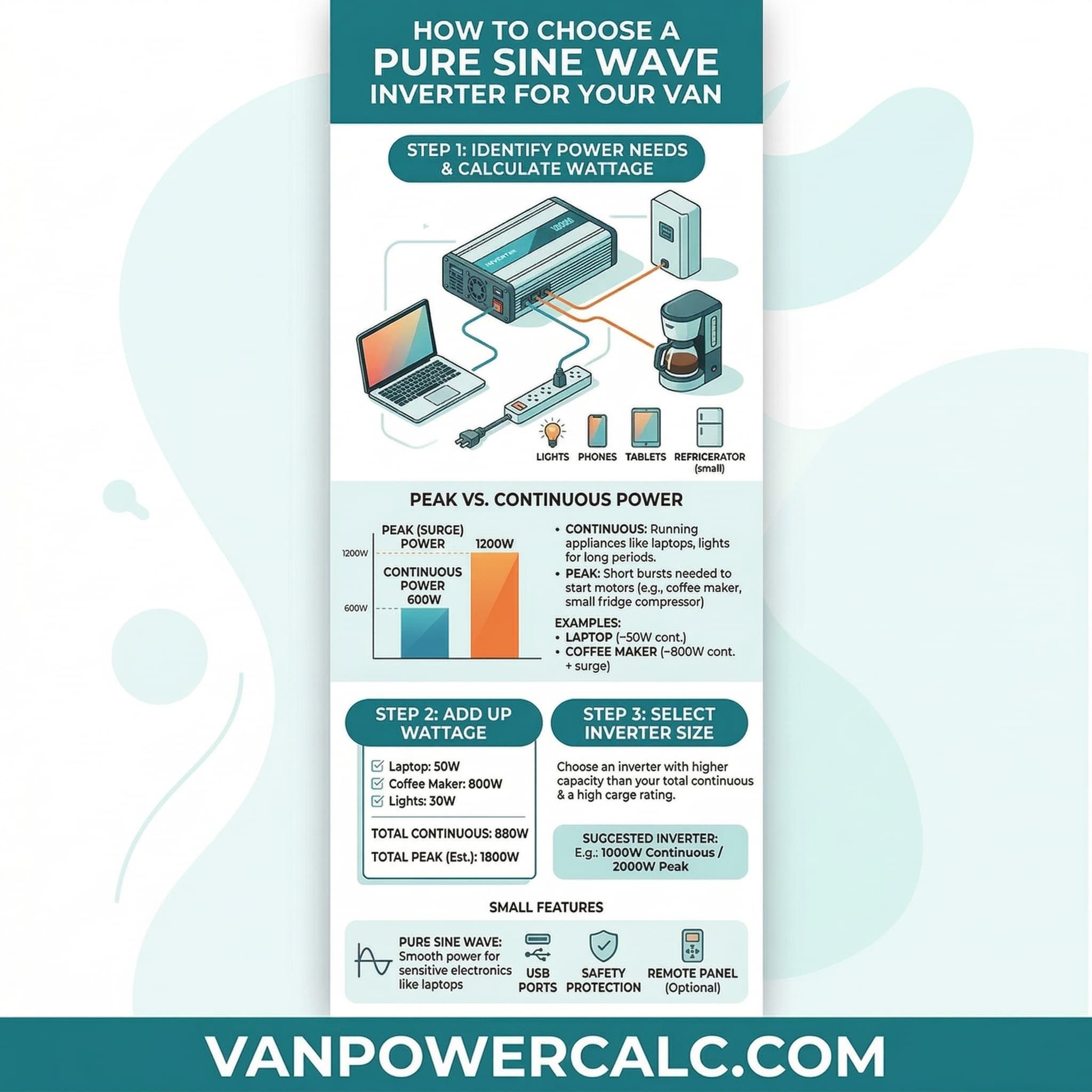
Choosing an inverter that's too small means constant overload shutdowns. Too large means wasted battery power and inefficiency. Find the sweet spot for your van build.
When sizing an inverter, add up the wattage of devices you will run simultaneously, not individually. A 1,000W coffee maker plus a 60W laptop charger needs a 1,500W inverter (with headroom for startup surge). Pure sine wave is mandatory for sensitive electronics — modified sine wave inverters cost less but can damage laptop chargers, CPAP machines, and battery tool chargers.
Expert tip
Most van builders buy a 2000W inverter "just in case" and run it at 50-100W daily. An inverter at 5% load has 10-15% efficiency — you lose 10-20W just keeping it on standby. Right-sizing to a 300W unit for daily use, with a separate 2000W for cooking, beats a single oversized inverter on efficiency.
Example calculation for your setup
Results based on a typical use case
| Appliance | Power | Usage/day | Wh/day |
|---|---|---|---|
| Compression fridge | 45W | 24h | 1080 |
| LED lighting | 20W | 4h | 80 |
| Water pump | 30W | 0.5h | 15 |
| Phone charging | 15W | 2h | 30 |
| Daily consumption | 1205 Wh | ||
Recommended inverter
No 220V appliances — no inverter needed
Adjust these values with the calculator below
Comparison table
| Power (W) | Device alimentable | Max 12V draw | Min wire gauge |
|---|---|---|---|
| 300W | Laptop + charges | 30A | 10 AWG |
| 600W | TV, small appliances | 60A | 6 AWG |
| 1,200W | Coffee maker, microwave | 110A | 2 AWG |
| 2,000W | Standard hair dryer | 180A | 1/0 AWG |
| 3,000W | Portable induction | 270A | 2/0 AWG |
About this tool
Inverter sizing for a campervan starts with a single question: what is the highest continuous wattage device you plan to plug in? That single number drives the specification. But there's a deeper layer — inrush current, idle consumption, and efficiency curves that can turn a reasonable inverter into an energy vampire.
The fundamental calculation: Inverter Watts needed ≥ Peak continuous load watts × 1.25 safety margin. For a coffee machine (800W) + laptop charger (90W) used simultaneously: (800 + 90) × 1.25 = 1112W. A 1500W inverter gives 35% headroom for safe operation. A 1000W inverter would run at 89% load continuously — thermally stressed and likely to shut down on hot days.
Inrush current reality: AC motors (coffee grinder, blender, angle grinder, compressor motor) draw 3-6× rated power for 20-50ms on startup. A 500W angle grinder's motor spikes to 1500-3000W at startup. Inverter surge rating matters — look for "peak/surge watts" specification: a good 1500W inverter has 3000W peak. Cheap inverters with the same continuous rating often have only 1.5-2× peak — insufficient for motor loads.
Idle consumption destroys batteries: measure the standby wattage of your specific inverter before integrating it. Cheap 2000W inverters often consume 18-25W at zero load — multiply by 24h = 432-600Wh/day of wasted energy. The Victron Phoenix 2000W at 15W idle is significantly more efficient but 3× the price. The economic calculation: if your inverter runs 12h on standby per day, 5W idle difference = 60Wh/day = 21.9kWh/year. At €0.25/kWh of battery round-trip (replacement costs included), that's €5.47/year in wasted energy — trivial. The real cost is the battery cycles and solar capacity needed to cover the waste.
Pure sine wave is mandatory for van builds: modified sine wave inverters cause audible hum in laptop PSUs, can damage CPAP motor windings over thousands of hours, and reduce efficiency in any load with reactive components (transformers, capacitors, inductors — which includes virtually all modern electronics). The €20-40 price difference for pure sine wave is never worth skipping.
Installation cable sizing for 12V systems: 1000W inverter at 12V = 83A; 2000W = 167A; 3000W = 250A. Cable must be rated for peak surge current. For a 2000W inverter: 50mm² for runs under 50cm, 70mm² for 50-100cm. The ANL fuse (not blade fuse) must be within 30cm of battery positive terminal, rated 20% above inverter's maximum current draw.
Remote on/off wiring: virtually all 300W+ inverters have a remote enable terminal. Wiring this to a dedicated 12V switch at your work desk means you can cut inverter power instantly — eliminating standby consumption while you sleep or when not actively using AC loads.

Frequently asked questions
What size inverter do I need for a campervan?▼
Size it for your largest single AC load plus 25%: laptop+phone chargers (200W): 300W inverter. Coffee machine (800W)+laptop: 1500W. Induction hob (1800W): 2000W+ with 3000W surge. A 2000W pure sine wave inverter handles 95% of van life use cases.
Should I get 1000W or 2000W inverter for van life?▼
If you will NEVER use an induction hob or anything above 800-900W: get a 1000W inverter — lighter and more efficient at partial load. If you want induction cooking: get 2000W. The most common regret is buying a 1000W then adding induction cooking later.
Pure sine wave vs modified sine wave — does it matter for van?▼
Always buy pure sine wave. Modified sine causes laptop PSU hum, can damage CPAP motors (important for users with sleep apnea), and reduces efficiency in motors and electronics. The €20-40 premium for pure sine is universally justified.
How do I connect a 2000W inverter to a 12V battery?▼
2000W÷12V = 167A continuous. Use 70mm² cable for up to 1m total cable length, 50mm² for under 50cm. Install an ANL fuse (200A rating) within 30cm of battery positive. Connect inverter chassis ground to battery negative busbar — not van chassis.
Why is my inverter getting hot?▼
Three causes: 1) Sustained load above 70% of rated capacity for extended periods, 2) Poor ventilation — inverters need 10cm clearance on all sides for airflow, 3) Oversize load causing sustained near-maximum operation. Thermal shutdown is the inverter protecting itself — reduce load or improve ventilation.
Advertising
Independent and free thanks to your clicks
Links marked with * are affiliate links. If a purchase is made through them, I receive a commission at no extra cost to you. The editorial selection and product evaluation are not influenced by commission rates. Your click helps fund this free tool.
Recommended gear
$104Amazon
Pure Sine Inverter 2000W 12V
Runs induction cooktop, hair dryer, coffee machine.“The 2000W version for those who want to plug in everything: induction plate, hair dryer, pro coffee machine. Make sure your cables are properly sized.”View on Amazon* →$33Amazon
Battery Cable 50mm² Red+Black
50mm² cable for 2000W+ inverter. Red and black, 1m each.“Between battery and inverter, you need heavy-duty cable. 50mm² handles big current draws without overheating.”View on Amazon* →$13Amazon
ANL Fuse 250A + Fuse Holder
Mandatory inverter protection. 250A with integrated fuse holder.“The ANL fuse protects your battery-to-inverter cable. It's a few bucks that can prevent a fire. Non-negotiable.”View on Amazon* →Check price
LiFePO4 200Ah 12V Battery
200Ah true capacity, 200A built-in BMS, 5000+ cycles.“If you work remotely or run a fridge, go straight for 200Ah. You'll never regret having too much capacity.”View on Amazon* →