Loading...
Fact-checked on Mar 15, 2026
VANPOWERCALC.COMYOUR ENERGY PROFILE
YOUR ENERGY PROFILE.
This document contains the sizing of your future electrical installation, calculated based on your appliances.
Minimum Daily Consumption
0 WH / DAY
Inventory:
SYSTEM SIZINGPage 2
Battery
To guarantee 0WH without damaging your bank (80% max discharge):
0 AH
LiFePO4 12V
Solar
Minimum power required to recharge your consumption:
0 W
via MPPT
220V AC
Maximum power (with 25% safety margin).
0 W
No Need
Safety & CablingPage 3
12V Cable Sizing Guide
Use this professional reference table to select the correct gauge (mm²) for your cables. For 12V in a van, the maximum tolerated voltage drop is 3%. Always use multi-stranded flexible automotive wire.
| Current (A) | Round trip < 2m | Round trip 4m | Round trip 6m |
|---|---|---|---|
| 5A (LEDs, USB) | 1.5 mm² | 2.5 mm² | 4 mm² |
| 10A (Fridge, Pump) | 2.5 mm² | 4 mm² | 6 mm² |
| 20A (Heater) | 4 mm² | 10 mm² | 10 mm² |
| 50A (DC/DC Booster) | 10 mm² | 16 mm² | 25 mm² |
| 100A (Inverter) | 25 mm² | 35 mm² | 50 mm² |
Fuse Sizing
The fuse protects the wire, not the appliance. Always place it as close to the power source as possible (battery or busbar).
- Wire 1.5 mm² → Max fuse 10A
- Wire 2.5 mm² → Max fuse 20A
- Wire 4 mm² → Max fuse 30A
- Wire 6 mm² → Max fuse 40A
- Wire 10 mm² → Max fuse 60A
SCHÉMA ÉLECTRIQUE
PANNEAUX SOLAIRES
0W
RÉGULATEUR MPPT
BATTERIE AUXILIAIRE
0 Ah
Lithium LiFePO4
FUSIBLE
FUSIBLE
BOÎTE À FUSIBLES 12V
Pompe, Leds, Frigo...
CONVERTISSEUR 220V
NON REQUI
PRO GEARPage 4
SHOPPING LIST
Where to find this equipment? Here is the community-approved selection.
12V 6-way Fuse Box
Mandatory protection
Digital Multimeter
Test your connections
Heavy Duty Crimping Tool
For perfect lugs
Heat Shrink Tubing
Insulation and safety
GENERATED BY VANPOWERCALC.COM
Wiring is the most critical safety part of a van conversion. Get the exact wire section (mm²) and fuse rating for every appliance in your build.
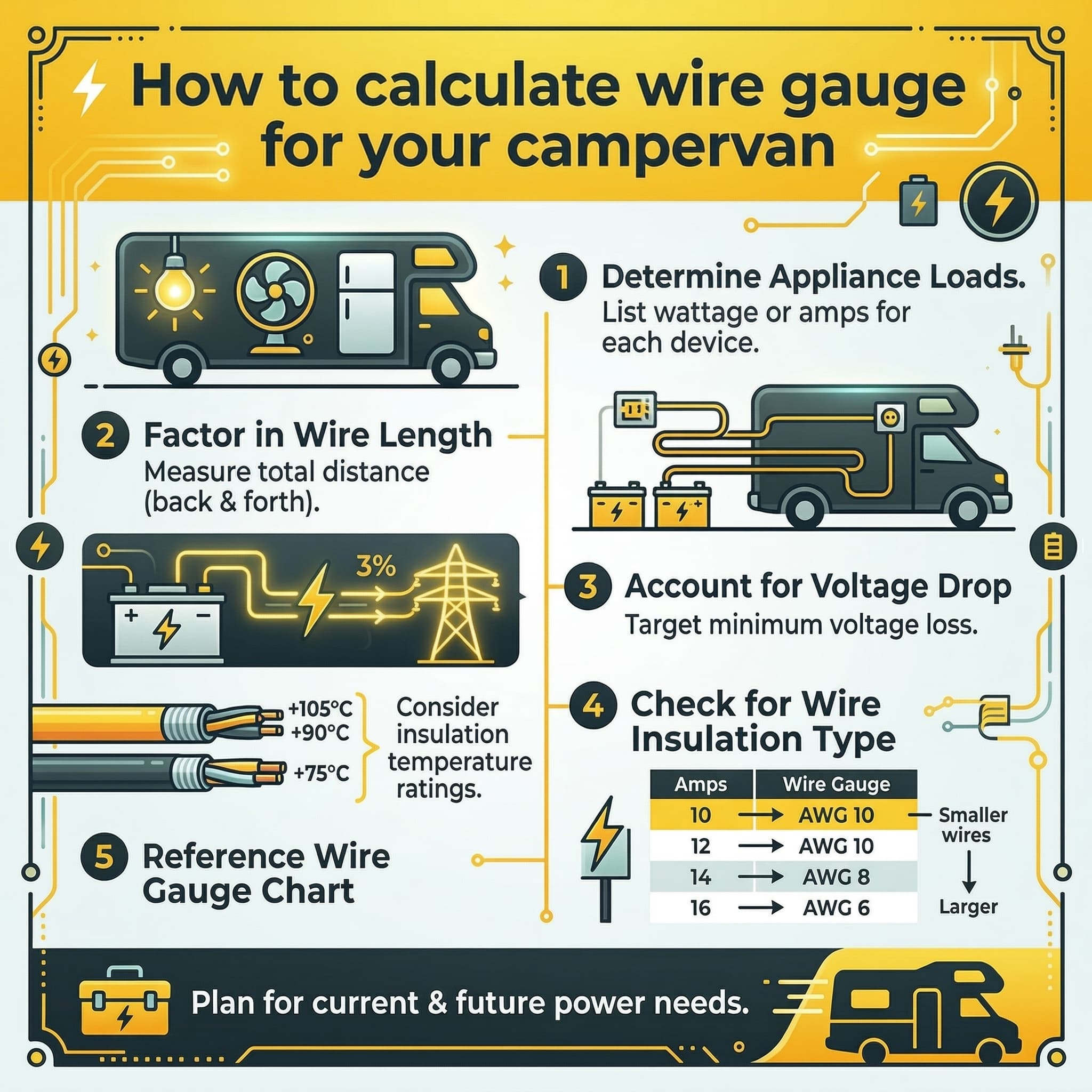
An undersized wire becomes a fire hazard from overheating, while an oversized one wastes money and space. The correct gauge depends on current draw and cable length — at 10A over 3m, 14 AWG (2.5mm²) suffices, but at 30A over the same distance you need 8 AWG (10mm²). Our calculator factors in the maximum allowable voltage drop of 3%.
Expert tip
Buy cable in bulk from an auto electrical supplier, not retail per-meter. Use marine-grade tinned copper cable — it resists corrosion in the humid van environment. The tinning layer preserves conductivity for 10+ years vs standard automotive cable that oxidizes.
Example calculation for your setup
Results based on a typical use case
| Appliance | Power | Usage/day | Wh/day |
|---|---|---|---|
| Compression fridge | 45W | 24h | 1080 |
| LED lighting | 20W | 4h | 80 |
| Water pump | 30W | 0.5h | 15 |
| Phone charging | 15W | 2h | 30 |
| Daily consumption | 1205 Wh | ||
Daily consumption
1205 Wh
4.2A average hours
recommended section
1.5 mm²
For a 3m cable at 12V with this current, use
Adjust these values with the calculator below
Comparison table
| Current | Length 1m | Length 2m | Length 5m | Length 10m |
|---|---|---|---|---|
| 10A | 18 AWG | 18 AWG | 16 AWG | 14 AWG |
| 20A | 16 AWG | 14 AWG | 12 AWG | 10 AWG |
| 30A | 14 AWG | 12 AWG | 10 AWG | 8 AWG |
| 50A | 10 AWG | 8 AWG | 6 AWG | 4 AWG |
| 100A | 6 AWG | 4 AWG | 2 AWG | 1/0 AWG |
About this tool
12V Wire Gauge Calculator for Van Life: AWG and mm² Sizing Guide#
Undersized wiring is the #1 cause of electrical fires in van builds. A cable that's too thin for its current load heats up — sometimes to the point of melting insulation. Here's how to get wire sizing right every time.
The Two Factors That Determine Wire Gauge#
- Maximum current (amps) — from the device or circuit
- Cable length (meters/feet) — longer cables = more resistance = more voltage drop
A cable that's fine for 3 meters might be dangerously undersized for 5 meters at the same current.
AWG to mm² Conversion and Current Ratings#
| AWG | mm² | Max Current (12V) | Typical Van Use |
|---|---|---|---|
| 18 AWG | 0.75 mm² | 7A | LED lighting, small fans |
| 16 AWG | 1.5 mm² | 13A | USB chargers, phones |
| 14 AWG | 2.5 mm² | 20A | Water pump, tablet charging |
| 12 AWG | 4 mm² | 30A | Fridge, laptop inverter |
| 10 AWG | 6 mm² | 40A | Solar MPPT output, DC-DC charger |
| 8 AWG | 10 mm² | 55A | Battery to inverter (short run) |
| 4 AWG | 25 mm² | 100A | Battery main positive/negative |
| 2/0 AWG | 70 mm² | 200A+ | Large inverter battery cables |
Current ratings for PVC-insulated cable at 40°C ambient. In hot engine bays or behind panels, derate by 20-30%.
The Voltage Drop Rule: Never Exceed 3%#
Formula: Voltage drop (%) = (Current × Cable length × Resistance per meter) ÷ Battery voltage × 100
For a 12V system, 3% drop = 0.36V maximum. More than this and your devices may malfunction or cycle off unexpectedly. Fridges and inverters are particularly sensitive to low voltage.
Quick rule of thumb:
- For runs under 3m: size for current alone
- For runs 3-6m: go up one cable size
- For runs over 6m: go up two cable sizes from the current-only recommendation
Fuse Sizing Rules#
Every positive cable needs a fuse or circuit breaker as close to the battery as possible:
- Fuse rating = 80-125% of expected cable current
- Always fuse the cable, not the device
Example: 10 AWG (6mm²) cable rated for 40A → use a 40A or 50A fuse.
Expert tip: In a van build, buy cable in bulk from an auto electrical supplier, not at retail per-meter. Quality marine-grade tinned copper cable is worth the premium over standard automotive cable — it resists corrosion in the humid van environment and maintains conductivity for years.

Frequently asked questions
What wire gauge do I need for a 30A MPPT in my van?▼
For a 30A MPPT with a typical 3-5 meter run between MPPT and battery, use 6mm² (10 AWG) cable. For runs over 5m at 30A, step up to 10mm² (8 AWG) to keep voltage drop under 3%.
What AWG cable do I need for a 1000W inverter in a van?▼
A 1000W inverter draws ~90A at 12V peak. Use 25mm² (4 AWG) for runs under 1m, 35mm² (2 AWG) for runs 1-2m. Inverter battery cables are always short — mount your inverter as close to your battery as possible.
Can I use household lighting cable for van wiring?▼
No. Household cable (single-stranded, PVC rated for 230V AC) is not rated for the DC current levels in a 12V van system and is not flexible enough for vehicle use. Use flexible multi-strand automotive or marine-grade cable.
How do I calculate voltage drop for a long cable run?▼
Voltage drop (V) = Current (A) × Cable length (m, one-way) × Resistance per meter (from specs). For 6mm² copper: 0.00327 Ω/m. A 30A run over 5m one-way: 30 × 5 × 0.00327 = 0.49V = 4.1% drop — exceed 3%, so step up to 10mm².
Does cable length include the return (negative) path?▼
Yes — always calculate total round-trip length. A fridge 3m from the battery means 6m total wire (3m positive + 3m negative). The voltage drop formula uses this total length. This is the most common mistake in DIY cable sizing — people measure one-way and end up with double the expected voltage drop.
Advertising
Independent and free thanks to your clicks
Links marked with * are affiliate links. If a purchase is made through them, I receive a commission at no extra cost to you. The editorial selection and product evaluation are not influenced by commission rates. Your click helps fund this free tool.
Recommended gear
$33Amazon
Battery Cable 50mm² Red+Black
50mm² cable for 2000W+ inverter. Red and black, 1m each.“Between battery and inverter, you need heavy-duty cable. 50mm² handles big current draws without overheating.”View on Amazon* →$41Amazon
12V Fuse Box
Protects each circuit independently, easy installation.“One fuse per circuit is the golden rule. This box keeps your install clean and every line independently protected.”View on Amazon* →$25Amazon
Electrical Crimping Tool
Reliable crimp connections on 0.5mm²–16mm² cables, no soldering.“Forget soldering in a van — crimping is more reliable and vibration-proof. This one covers all the gauges you'll need.”View on Amazon* →$107Amazon
Digital Multimeter
Measures voltage, current, resistance — essential for 12V wiring.“First tool to buy before you even start your install. You'll pull it out 100 times to check voltages and connections.”View on Amazon* →