Loading...
Fact-checked on Jun 11, 2026
VANPOWERCALC.COMYOUR ENERGY PROFILE
YOUR ENERGY PROFILE.
This document contains the sizing of your future electrical installation, calculated based on your appliances.
Minimum Daily Consumption
0 WH / DAY
Inventory:
SYSTEM SIZINGPage 2
Battery
To guarantee 0WH without damaging your bank (80% max discharge):
0 AH
LiFePO4 12V
Solar
Minimum power required to recharge your consumption:
0 W
via MPPT
220V AC
Maximum power (with 25% safety margin).
0 W
No Need
Safety & CablingPage 3
12V Cable Sizing Guide
Use this professional reference table to select the correct gauge (mm²) for your cables. For 12V in a van, the maximum tolerated voltage drop is 3%. Always use multi-stranded flexible automotive wire.
| Current (A) | Round trip < 2m | Round trip 4m | Round trip 6m |
|---|---|---|---|
| 5A (LEDs, USB) | 1.5 mm² | 2.5 mm² | 4 mm² |
| 10A (Fridge, Pump) | 2.5 mm² | 4 mm² | 6 mm² |
| 20A (Heater) | 4 mm² | 10 mm² | 10 mm² |
| 50A (DC/DC Booster) | 10 mm² | 16 mm² | 25 mm² |
| 100A (Inverter) | 25 mm² | 35 mm² | 50 mm² |
Fuse Sizing
The fuse protects the wire, not the appliance. Always place it as close to the power source as possible (battery or busbar).
- Wire 1.5 mm² → Max fuse 10A
- Wire 2.5 mm² → Max fuse 20A
- Wire 4 mm² → Max fuse 30A
- Wire 6 mm² → Max fuse 40A
- Wire 10 mm² → Max fuse 60A
SCHÉMA ÉLECTRIQUE
PANNEAUX SOLAIRES
0W
RÉGULATEUR MPPT
BATTERIE AUXILIAIRE
0 Ah
Lithium LiFePO4
FUSIBLE
FUSIBLE
BOÎTE À FUSIBLES 12V
Pompe, Leds, Frigo...
CONVERTISSEUR 220V
NON REQUI
PRO GEARPage 4
SHOPPING LIST
Where to find this equipment? Here is the community-approved selection.
12V 6-way Fuse Box
Mandatory protection
Digital Multimeter
Test your connections
Heavy Duty Crimping Tool
For perfect lugs
Heat Shrink Tubing
Insulation and safety
GENERATED BY VANPOWERCALC.COM
Start With Your Power Audit, Not the Panels#
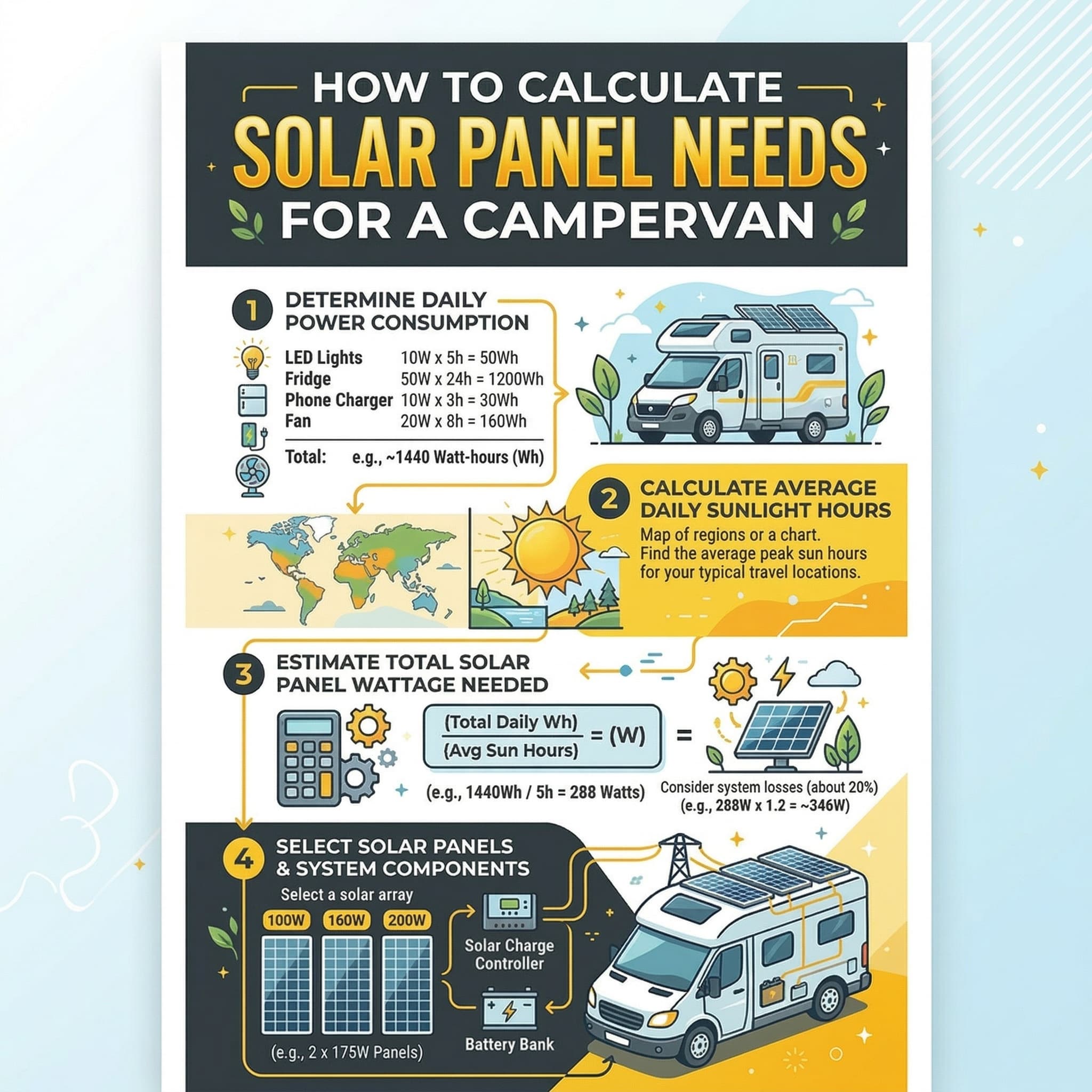
The most common mistake in van solar is working backwards — buying panels first, then hoping they produce enough. Instead, start by listing every device you run and its daily consumption in watt-hours. A compressor fridge typically uses 40-60W for 8-10 hours (400-600 Wh/day), diesel heater fans draw 20-30W for 8 hours (200 Wh/day), LED lighting adds 60-100 Wh, and device charging another 50-100 Wh. A realistic daily total for a well-equipped van is 700-1200 Wh/day.
Converting Wh/Day to Panel Wattage#
Solar panels don't produce their rated wattage all day. In real-world van conditions (panel angle, partial shade, temperature losses), a 200W panel produces about 600-800 Wh per day in summer and 200-400 Wh in winter, depending on your latitude. The rule of thumb: divide your daily Wh needs by your expected Wh-per-watt yield (typically 3-4 Wh per watt in summer). For 1000 Wh/day: 1000 ÷ 3.5 = ~285W of panels minimum. Round up to 300-400W for cloudy-day margin.
Panel Count by Van Type#
A standard 200W rigid panel measures roughly 1600 × 1000 mm. A short-wheelbase van (Sprinter 144, Transit 130) fits 2-3 panels max on the roof (400-600W). A long-wheelbase van fits 3-4 panels (600-800W). If your roof has a fan, AC unit, or Starlink, subtract that area. Flexible panels are thinner but degrade faster — use rigid panels with tilt mounts whenever possible for maximum output.
Matching Panels to Your Charge Controller#
Your MPPT charge controller must handle both the combined voltage and amperage of your panel array. For a 12V battery system with panels in series: 3 × 200W panels at 40V Voc = 120V input — your MPPT must accept at least 120V. In parallel: 3 × 200W at 10A Isc = 30A — your MPPT must handle 30A input. The Victron SmartSolar 100/30 handles up to 100V input and 30A output, perfect for 2-3 panels in series on a 12V system. For 4+ panels, size up to the 150/35 or 150/45.
Expert tip
Flexible solar panels (brand names: Sunman eArc, Solbian) have half the lifespan of rigid panels — their efficiency drops 2-3% per year vs 0.3-0.5% for glass panels. After 5 years, a "flexible 200W" delivers 170W. Budget €100/m² more for rigid framed panels and they'll outlast two van builds.
Example calculation for your setup
Results based on a typical use case
| Appliance | Power | Usage/day | Wh/day |
|---|---|---|---|
| Compression fridge | 45W | 24h | 1080 |
| LED lighting | 20W | 4h | 80 |
| Water pump | 30W | 0.5h | 15 |
| Phone charging | 15W | 2h | 30 |
| Daily consumption | 1205 Wh | ||
Recommended solar panels
402 Wc
4h average sun hours
Adjust these values with the calculator below
Comparison table
| Daily Consumption | Recommended Solar (W) | Panels (200W) | Battery (Ah @ 12V) |
|---|---|---|---|
| 500 Wh (minimal) | 200-300W | 1-2 | 100-150Ah |
| 800 Wh (standard) | 400-500W | 2-3 | 200Ah |
| 1200 Wh (heavy use) | 600-800W | 3-4 | 300Ah |
| 1500+ Wh (digital nomad) | 800-1000W | 4-5 | 400Ah |
About this tool
Calculating how many solar panels a camper van needs is a three-step process: determine your daily energy consumption, account for real-world solar production, and then divide to find the panel count. Most guides give you a number without the math — here's the derivation.
Step 1: Measure your actual consumption. Don't use manufacturer specs — they're measured in ideal lab conditions. A plug-in power meter (€15 from Amazon) on your van's 12V positive bus, or individual clamp measurements on each circuit, reveals the truth. Typical findings: fridge uses 30-50% more than spec, laptop charges use 15-25% more due to power factor, LED lights use close to spec.
Step 2: Determine effective peak sun hours (PSH) for your travel area. PSH is the equivalent hours per day of 1,000W/m² irradiance. This already incorporates weather patterns and location into a single, usable number. European PSH averages: Scotland 2.2h, London 2.8h, Paris 3.4h, Lyon 4.2h, Marseille 5.1h, Barcelona 5.3h, Rome 4.9h. For van travelers moving around, use 3.5h for year-round reliability.
Step 3: Calculate array size. Formula: Panel Watts needed = Daily Wh consumption ÷ PSH × 1.25 losses factor. Example for a working nomad in France using 1200Wh/day: 1200 ÷ 3.5 × 1.25 = 428W. Choose 400W-500W array (two 200W or one 400W bifacial panel).
Panel count consideration: modern high-efficiency monocrystalline half-cut panels range from 100W (0.62m²) to 400W (2.15m²). A standard Transit L2 roof offers about 2m² of usable south-facing area after roof vent and antenna clearance — accommodating one 400W panel or two 200W panels. A larger Sprinter L3 offers 3-4m² — fitting up to three 400W panels in theory, though practical cable routing and structural mounting limit most DIY installs to 600W-800W maximum.
Series vs parallel wiring math: wiring two identical 200W panels in series doubles voltage (36V Vmp) while maintaining current (10A Imp). The advantage: higher voltage = lower current in roof cables for a given power level = can use thinner, cheaper 4mm² cable instead of 6mm². The MPPT controller must accept the combined series Voc (44-48V for 24V Voc panels).
Expected annual production: 400W array × 3.5 PSH average × 365 days × 0.8 system efficiency = 408kWh per year. At van life usage patterns of 10 months per year, that's 340kWh of free solar energy — enough to make a meaningful difference in total energy cost over the system's 25-year rated lifespan.

Frequently asked questions
How many solar panels do I need for a camper van?▼
Calculate: Daily Wh consumption ÷ peak sun hours ÷ 0.8 efficiency = Watts needed ÷ your panel wattage = number of panels. Example: 800Wh/day ÷ 4 PSH ÷ 0.8 = 250W needed → 2× 130W panels or 1× 300W panel. VanPowerCalc does this automatically.
Is 200W solar enough for van life?▼
For basic van life (fridge 380Wh + lights 50Wh + phone 20Wh = 450Wh/day): 200W is sufficient in summer (4+ PSH) but insufficient in winter UK (2h PSH, produces only 280Wh/day after losses). For year-round independence, add a 30A DC-DC alternator charger as backup.
What is the most efficient solar panel for a van roof?▼
Monocrystalline half-cut cell panels (2024 models): 21-24% efficiency. Jinko Tiger Neo, Canadian Solar TOPCon, Risen bifacial — all achieve 200W in approximately 1m× 0.67m footprint. Avoid flexi panels (degrade 3%/year vs 0.3%/year for rigid), polychristalline (18% efficiency, uses 30% more space).
Can I install solar panels myself on a camper van?▼
Yes — van solar is accessible for DIY. Key requirements: 4mm² or 6mm² roof cable in protective conduit, waterproof cable entry glands (2-hole, silicone sealed), MC4 connectors properly crimped with the right tool, MPPT controller and battery connection per manufacturer wiring diagram.
How long before solar panels pay for themselves on a van?▼
Solar for van life is different from home solar — it replaces campsite electricity (€5-8/night), fuel costs, and provides independence. A 400W setup costs ~€500 installed and saves 4+ campsite nights/month = €240-320/year → break-even in 18-24 months of active van life use.
Advertising
Independent and free thanks to your clicks
Links marked with * are affiliate links. If a purchase is made through them, I receive a commission at no extra cost to you. The editorial selection and product evaluation are not influenced by commission rates. Your click helps fund this free tool.
Recommended gear
$130Amazon
200W Rigid Solar Panel
Mono 200W, 22%+ efficiency, rigid aluminum frame for van roof.“I tested 4 panels before this one. Great efficiency even in overcast weather, and it sits well on a van roof.”View on Amazon* →Check price
ECO-WORTHY 200W 12V/24V Solar Kit + 20A Bluetooth MPPTLeo's Pick
Complete 200W solar kit with Bluetooth-monitored MPPT controller. 12V/24V compatible, 20A charge controller with smartphone app. Ideal for vans, RVs, off-grid setups. Single-product solution covering both solar panel and charge controller.“The kit I recommend to every beginner. Plug it in, it works, and the included MPPT controller makes a real difference.”View on Amazon* →$115Amazon
Victron MPPT Controller 100/30
Extracts 97% solar power, Li & AGM compatible.“The Victron is pricey, but you install it once and forget about it. The Bluetooth app is a real plus for tracking solar output.”View on Amazon* →$38Amazon
Solar Cable 6mm² MC4 10m
6mm² solar cable with pre-crimped MC4 connectors, 10m.“Don't cheap out on solar cables. 6mm² between panels and controller is the minimum to avoid power losses.”View on Amazon* →