Loading...
Fact-checked on Mar 16, 2026
VANPOWERCALC.COMYOUR ENERGY PROFILE
YOUR ENERGY PROFILE.
This document contains the sizing of your future electrical installation, calculated based on your appliances.
Minimum Daily Consumption
0 WH / DAY
Inventory:
SYSTEM SIZINGPage 2
Battery
To guarantee 0WH without damaging your bank (80% max discharge):
0 AH
LiFePO4 12V
Solar
Minimum power required to recharge your consumption:
0 W
via MPPT
220V AC
Maximum power (with 25% safety margin).
0 W
No Need
Safety & CablingPage 3
12V Cable Sizing Guide
Use this professional reference table to select the correct gauge (mm²) for your cables. For 12V in a van, the maximum tolerated voltage drop is 3%. Always use multi-stranded flexible automotive wire.
| Current (A) | Round trip < 2m | Round trip 4m | Round trip 6m |
|---|---|---|---|
| 5A (LEDs, USB) | 1.5 mm² | 2.5 mm² | 4 mm² |
| 10A (Fridge, Pump) | 2.5 mm² | 4 mm² | 6 mm² |
| 20A (Heater) | 4 mm² | 10 mm² | 10 mm² |
| 50A (DC/DC Booster) | 10 mm² | 16 mm² | 25 mm² |
| 100A (Inverter) | 25 mm² | 35 mm² | 50 mm² |
Fuse Sizing
The fuse protects the wire, not the appliance. Always place it as close to the power source as possible (battery or busbar).
- Wire 1.5 mm² → Max fuse 10A
- Wire 2.5 mm² → Max fuse 20A
- Wire 4 mm² → Max fuse 30A
- Wire 6 mm² → Max fuse 40A
- Wire 10 mm² → Max fuse 60A
SCHÉMA ÉLECTRIQUE
PANNEAUX SOLAIRES
0W
RÉGULATEUR MPPT
BATTERIE AUXILIAIRE
0 Ah
Lithium LiFePO4
FUSIBLE
FUSIBLE
BOÎTE À FUSIBLES 12V
Pompe, Leds, Frigo...
CONVERTISSEUR 220V
NON REQUI
PRO GEARPage 4
SHOPPING LIST
Where to find this equipment? Here is the community-approved selection.
12V 6-way Fuse Box
Mandatory protection
Digital Multimeter
Test your connections
Heavy Duty Crimping Tool
For perfect lugs
Heat Shrink Tubing
Insulation and safety
GENERATED BY VANPOWERCALC.COM
Truck campers have unique electrical challenges: limited roof space for solar, small interiors that heat up fast, and the need for self-sufficiency on remote dirt roads. Getting the sizing right matters.
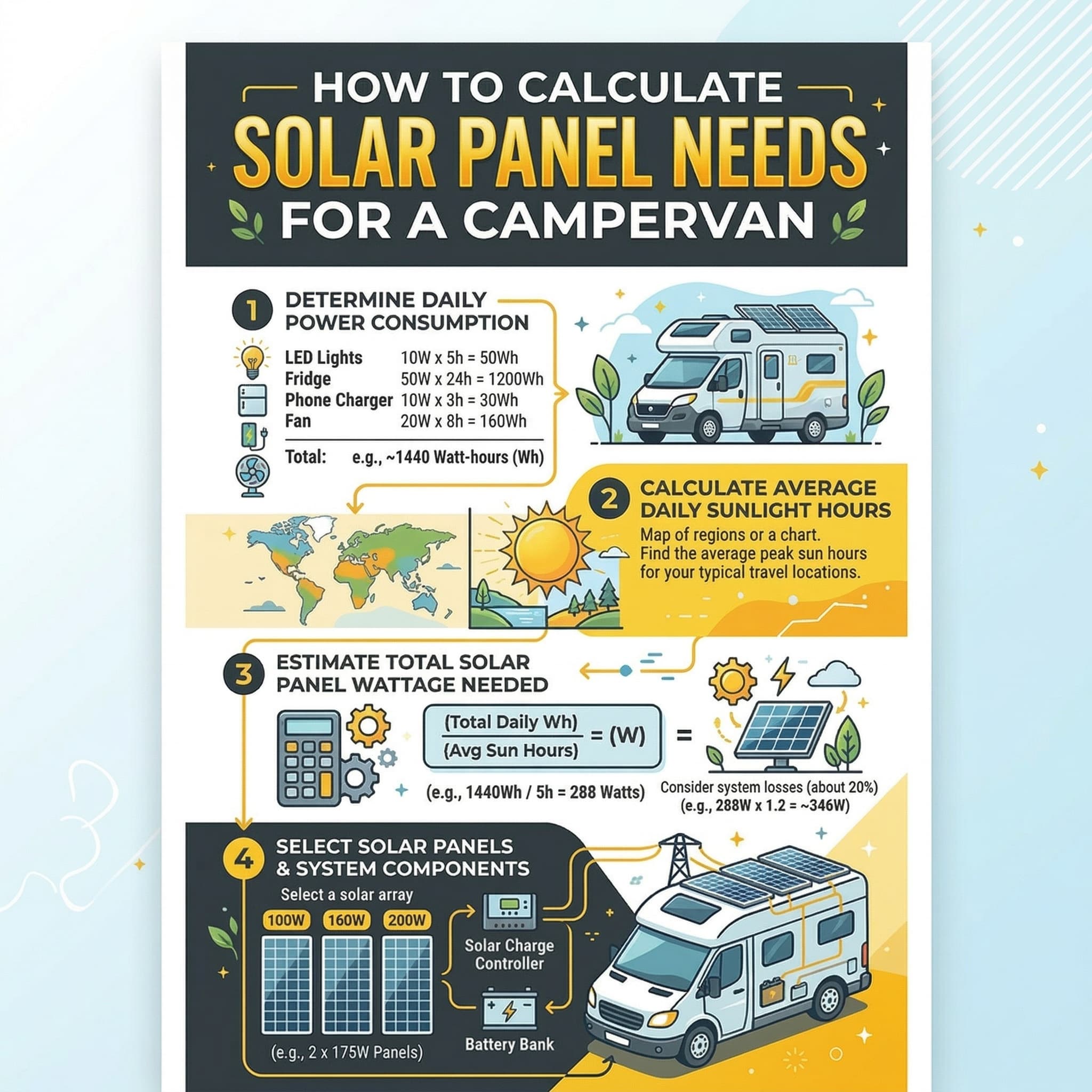
Truck camper roofs typically fit 200-400W of solar panels depending on the model. With limited roof real estate, prioritize high-efficiency monocrystalline panels and an MPPT controller to squeeze every watt out of partial shade conditions. A 200Ah LiFePO4 battery paired with 300W solar covers most weekend warriors comfortably from spring through fall.
Expert tip
Consider flexible solar panels (CIGS technology) for curved surfaces on pop-up campers. They produce 5-10% less power per nominal watt but enable installation on surfaces where rigid panels can't go — often yielding more total watts on irregular rooflines.
Example calculation for your setup
Results based on a typical use case
| Appliance | Power | Usage/day | Wh/day |
|---|---|---|---|
| Compression fridge | 45W | 24h | 1080 |
| LED lighting | 20W | 4h | 80 |
| Water pump | 30W | 0.5h | 15 |
| Phone charging | 15W | 2h | 30 |
| Daily consumption | 1205 Wh | ||
Recommended LiFePO4 battery
151 Ah
(80% depth of discharge)
Recommended AGM battery
241 Ah
(50% depth of discharge)
Adjust these values with the calculator below
Comparison table
| Profile | Usage/day | LiFePO4 size | Solar needed |
|---|---|---|---|
| Weekend truck camper | 500 Wh | 125Ah → 150Ah | 150-200W |
| Standard offgrid | 900 Wh | 225Ah → 250Ah | 250-350W |
| 4-season insulated | 1,200 Wh | 300Ah | 350-450W |
| Boondocking comfort | 1,600 Wh | 400Ah | 500-600W |
About this tool
Off-Grid Truck Camper Solar and Battery Sizing Guide#
Truck campers face unique challenges compared to van builds: limited roof space for solar, a smaller and taller profile, and often a need for more rugged self-sufficiency.
Roof Space Limitations by Truck Camper Type#
| Camper Type | Usable Roof Area | Max Solar Potential |
|---|---|---|
| Pop-up truck camper | 1.5-2.5 m² | 200-400W |
| Hard-side slide-in (short bed) | 2.5-3 m² | 400-600W |
| Hard-side slide-in (long bed) | 3-4 m² | 600-800W |
| Flatbed truck camper | 4-6 m² | 800-1,200W |
Sizing the Solar and Battery System#
For a truck camper couple living off-grid: daily consumption typically 800-1,200Wh/day (fridge + lighting + laptops + water pump + occasional inverter use). With 400W on a pop-up or short-bed: at 5h peak sun = 1,700Wh/day — sufficient for summer self-sufficiency. In winter with 2h peak sun: only 680Wh — supplement with engine charging.
Recommended configurations:
| Use Case | Solar | Battery | Engine Alt |
|---|---|---|---|
| Weekend adventures | 200-300W | 100-150Ah LiFePO4 | Not critical |
| Extended boondocking | 400-600W | 200-300Ah LiFePO4 | 30A DC-DC B2B |
| Full-time off-grid | 600-800W+ | 300-400Ah LiFePO4 | 40-60A DC-DC B2B |
Alternator Charging for Truck Campers#
Trucks often have powerful commercial-grade alternators (120-220A). A DC-DC (B2B) charger of 30-60A is ideal and provides a reliable, controlled charge from the truck battery. Avoid old-school split-charge relays — they can drain the starter battery.
One hour of driving with a 40A B2B = 40 × 12 × 1 = 480Wh — equivalent to 200W of solar for 3 hours. Daily driving makes a huge difference to battery levels.
Weight Considerations#
LiFePO4 saves critical weight on a truck camper where payload is a primary constraint:
- 200Ah AGM: ~60-70 kg
- 200Ah LiFePO4: ~22-28 kg
- Weight saved: 35-50 kg — significant for truck payload ratings
Expert tip: On a pop-up truck camper, flexible solar panels (CIGS or amorphous silicon) allow installation on curved surfaces that rigid panels can't reach. They produce 5-10% less per watt but give meaningfully more total surface area on curved camper tops.
Truck camper specific constraints for solar and battery sizing: the payload capacity of your truck is the primary constraint that changes everything. A full-size F-250 (1,700kg payload) can accommodate 400Ah LiFePO4 (approximately 50kg for four 100Ah units) + 600W solar on an aluminum roof rack without approaching payload limits. A compact Toyota Tacoma (700kg payload) must run a leaner system — 100-200Ah LiFePO4, 300W max solar — given that the camper body itself already uses 200-350kg of that payload budget.
Slide-in camper vs permanent truck bed conversion: slide-in campers have existing wiring harnesses (shore power inlet, 7-pin truck connector for battery trickle charge from truck while driving). These existing systems are usually 12V AGM. Upgrading to LiFePO4 requires verifying that all existing chargers (converter/charger) support LiFePO4 profile — most post-2018 units do, but verify in the manual. The Parallax 8345 converter common in North American RVs requires a charging profile update via dip switches.
Air conditioning for full-time truck campers: the Advocate one-piece 18V batteries for Zero-Breeze Mark 2 (€749) provide 2-8 hours of cooling in extreme heat. For all-night cooling: Dometic RTX 2000 12V rooftop (150W peak, 60W sustained) integrates with the truck camper roof and draws from the existing 12V house battery system — achievable with 300Ah LiFePO4 and 600W solar in the US Southwest.

Frequently asked questions
How much solar can I fit on a truck camper?▼
Roughly 200-400W on a pop-up or short-bed slide-in, 400-800W on a long-bed or flatbed camper. Flexible solar panels allow installation on curved surfaces — useful on pop-up camper tops and rounded hard-sides.
What battery size is best for a truck camper?▼
For weekend use: 100-150Ah LiFePO4. For extended boondocking: 200-300Ah. For full-time off-grid: 300Ah+. LiFePO4 is strongly preferred in truck campers — it weighs 60% less than AGM at the same usable capacity, preserving precious payload rating.
How do I charge my truck camper battery while driving?▼
Use a DC-DC (B2B) charger, not a split-charge relay. A 30-40A B2B provides controlled charging without risk of draining the truck's starter battery. One hour of driving with a 40A B2B = 480Wh — equivalent to 3 hours of 200W solar.
Can I run air conditioning in a truck camper off-grid?▼
12V compressor air conditioners (Zero Breeze, Dometic RTX 1000) draw 5-10A and can run on a 200Ah LiFePO4 for several hours. Full-size 230V RV ACs are generally not practical off-grid without a generator.
Advertising
Independent and free thanks to your clicks
Links marked with * are affiliate links. If a purchase is made through them, I receive a commission at no extra cost to you. The editorial selection and product evaluation are not influenced by commission rates. Your click helps fund this free tool.
Recommended gear
Check price
LiTime 12V 100Ah Bluetooth LiFePO4 (Group 31)Leo's Pick
LiFePO4 12V 100Ah Group 31, Bluetooth monitoring, 100A BMS, low-temp cutoff protection. Up to 15000 deep cycles at 60% DoD. Marine, RV, off-grid use. 222 Amazon reviews. LiTime is a leading mainstream LiFePO4 brand on Amazon US.“This is the battery I've been using in my van for 2 years. Reliable, lightweight, and the best value for money out there.”View on Amazon* →Check price
ECO-WORTHY 200W 12V/24V Solar Kit + 20A Bluetooth MPPTLeo's Pick
Complete 200W solar kit with Bluetooth-monitored MPPT controller. 12V/24V compatible, 20A charge controller with smartphone app. Ideal for vans, RVs, off-grid setups. Single-product solution covering both solar panel and charge controller.“The kit I recommend to every beginner. Plug it in, it works, and the included MPPT controller makes a real difference.”View on Amazon* →$107Amazon
Digital Multimeter
Measures voltage, current, resistance — essential for 12V wiring.“First tool to buy before you even start your install. You'll pull it out 100 times to check voltages and connections.”View on Amazon* →$41Amazon
12V Fuse Box
Protects each circuit independently, easy installation.“One fuse per circuit is the golden rule. This box keeps your install clean and every line independently protected.”View on Amazon* →