Loading...
Fact-checked on Jun 10, 2026
VANPOWERCALC.COMYOUR ENERGY PROFILE
YOUR ENERGY PROFILE.
This document contains the sizing of your future electrical installation, calculated based on your appliances.
Minimum Daily Consumption
0 WH / DAY
Inventory:
SYSTEM SIZINGPage 2
Battery
To guarantee 0WH without damaging your bank (80% max discharge):
0 AH
LiFePO4 12V
Solar
Minimum power required to recharge your consumption:
0 W
via MPPT
220V AC
Maximum power (with 25% safety margin).
0 W
No Need
Safety & CablingPage 3
12V Cable Sizing Guide
Use this professional reference table to select the correct gauge (mm²) for your cables. For 12V in a van, the maximum tolerated voltage drop is 3%. Always use multi-stranded flexible automotive wire.
| Current (A) | Round trip < 2m | Round trip 4m | Round trip 6m |
|---|---|---|---|
| 5A (LEDs, USB) | 1.5 mm² | 2.5 mm² | 4 mm² |
| 10A (Fridge, Pump) | 2.5 mm² | 4 mm² | 6 mm² |
| 20A (Heater) | 4 mm² | 10 mm² | 10 mm² |
| 50A (DC/DC Booster) | 10 mm² | 16 mm² | 25 mm² |
| 100A (Inverter) | 25 mm² | 35 mm² | 50 mm² |
Fuse Sizing
The fuse protects the wire, not the appliance. Always place it as close to the power source as possible (battery or busbar).
- Wire 1.5 mm² → Max fuse 10A
- Wire 2.5 mm² → Max fuse 20A
- Wire 4 mm² → Max fuse 30A
- Wire 6 mm² → Max fuse 40A
- Wire 10 mm² → Max fuse 60A
SCHÉMA ÉLECTRIQUE
PANNEAUX SOLAIRES
0W
RÉGULATEUR MPPT
BATTERIE AUXILIAIRE
0 Ah
Lithium LiFePO4
FUSIBLE
FUSIBLE
BOÎTE À FUSIBLES 12V
Pompe, Leds, Frigo...
CONVERTISSEUR 220V
NON REQUI
PRO GEARPage 4
SHOPPING LIST
Where to find this equipment? Here is the community-approved selection.
12V 6-way Fuse Box
Mandatory protection
Digital Multimeter
Test your connections
Heavy Duty Crimping Tool
For perfect lugs
Heat Shrink Tubing
Insulation and safety
GENERATED BY VANPOWERCALC.COM
Why Wire Size Matters More Than You Think#
Undersized solar wiring is the #1 invisible performance killer in DIY camper builds. If your wire is too thin, voltage drop between the panels and charge controller can steal 10-20% of your solar production — you'd never notice unless you measured. The National Electrical Code recommends keeping voltage drop below 3% for solar circuits. On a 12V system, that's a drop of less than 0.4V — surprisingly easy to exceed with long wire runs.
The Easy Method: 10 AWG for Most Setups#
For a typical van setup (2-3 panels, 200-600W total, wire run under 20 feet from panels to controller), 10 AWG (6mm²) solar wire handles up to 30A and keeps voltage drop under 3% for most configurations. This is the EXPLORIST.life-recommended shortcut that works for 90% of van builds. Use 10 AWG MC4-terminated solar cable for the roof-to-interior run and you're set.
The Technical Method: Calculate It Precisely#
For longer runs or higher-wattage arrays: (1) Determine your maximum short-circuit current (Isc) for the array. (2) Measure the total wire length (round trip, panel to controller and back). (3) Use Ohm's law: Voltage Drop = Current × Resistance × Length. For 10 AWG copper wire, resistance is 3.28 Ω per 1000 feet. Example: 30A × 0.00328 Ω/ft × 30 ft = 2.95V drop on a 40V circuit = 7.4% — too high! Size up to 8 AWG (1.64 Ω/1000ft): 30A × 0.00164 × 30 = 1.47V = 3.7% — borderline. Use 6 AWG for margin.
Series vs Parallel: Impact on Wire Size#
Wiring panels in series increases voltage but keeps current the same, which means you can use thinner wire with less voltage drop. Wiring in parallel keeps voltage the same but increases current, requiring thicker wire. For a van with 3 × 200W panels: In series (120V, 10A) → 10 AWG is plenty. In parallel (40V, 30A) → you may need 6-8 AWG depending on run length. This is why series wiring is preferred for van solar when your MPPT can handle the higher voltage.
Expert tip
Use MC4 connectors for all roof-level connections between panels — they're weather-rated, click-locked, and compatible across all solar panel brands. Never leave bare wire terminals on the roof exposed to rain and vibration. MC4 connectors in quality builds last 25+ years.
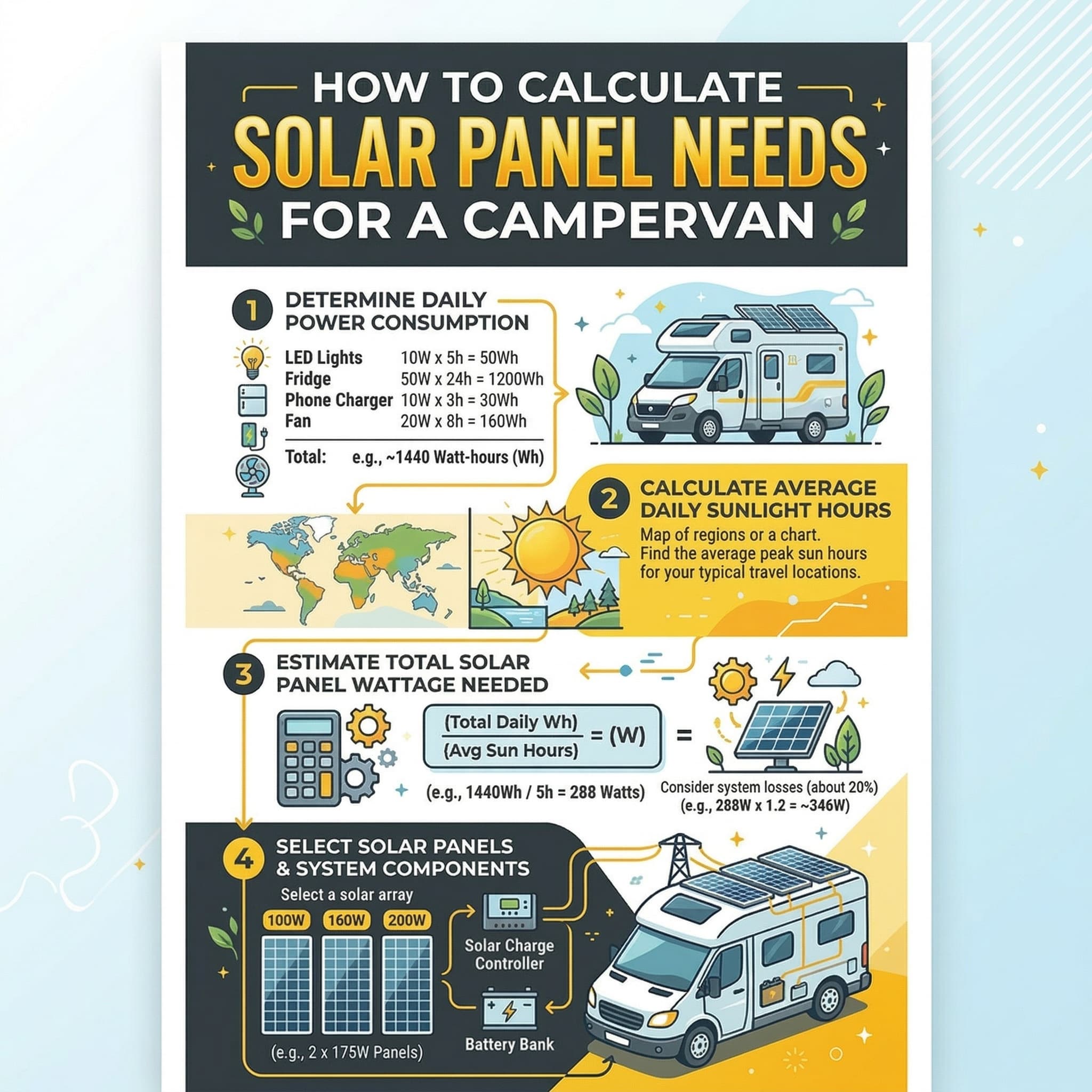
Example calculation for your setup
Results based on a typical use case
| Appliance | Power | Usage/day | Wh/day |
|---|---|---|---|
| Compression fridge | 45W | 24h | 1080 |
| LED lighting | 20W | 4h | 80 |
| Water pump | 30W | 0.5h | 15 |
| Phone charging | 15W | 2h | 30 |
| Daily consumption | 1205 Wh | ||
Recommended solar panels
402 Wc
4h average sun hours
Adjust these values with the calculator below
Comparison table
| Wire Gauge (AWG) | Max Current (A) | Resistance (Ω/1000ft) | Best For |
|---|---|---|---|
| 12 AWG | 20A | 5.21 | Single small panel (<150W) |
| 10 AWG | 30A | 3.28 | Most van setups (200-400W) |
| 8 AWG | 40A | 2.06 | Larger arrays in parallel |
| 6 AWG | 55A | 1.30 | High-power systems (800W+) |
About this tool
Solar Panel Wire Sizing for Campervan DIY Builds#
Getting solar panel wiring right is critical for both safety and efficiency. Under-sized cables cause resistive losses that reduce your solar production. Over-sized cables waste money. Here's exactly how to size solar wiring for every part of your campervan solar system.
Three Wire Runs to Size Correctly#
Run 1: Panel to Panel (string/parallel connections) Run 2: String/array output to MPPT (PV cable) Run 3: MPPT output to Battery (battery cable)
Each has different voltage and current characteristics.
Wire Gauge for Solar Panel Interconnects#
Panel interconnects carry the full short-circuit current (Isc). For a typical 200W panel, Isc ≈ 10-11A:
| Panel Configuration | Current | Recommended Wire | AWG Equivalent |
|---|---|---|---|
| 1× panel (to MPPT) | 10-11A | 4mm² | 12 AWG |
| 2× in parallel | 20-22A | 6mm² | 10 AWG |
| 3× in parallel | 30-33A | 10mm² | 8 AWG |
| 2× in series (to MPPT) | 10-11A | 4mm² | 12 AWG (same current, doubled voltage) |
Use UV-resistant PV (solar) cable for any outdoor roof runs. Standard automotive or household cable degrades quickly in UV exposure.
Wire Gauge from MPPT to Battery#
This is the highest-current run in your system. Size for MPPT rated output:
| MPPT Size | Output Current | Cable Size | Max Run Length (3% drop) |
|---|---|---|---|
| 20A MPPT | 20A | 4mm² | 4m |
| 30A MPPT | 30A | 6mm² | 3m |
| 40A MPPT | 40A | 6-10mm² | 2-3m |
| 50A MPPT | 50A | 10mm² | 2.5m |
| 60A MPPT | 60A | 16mm² | 2m |
Cable Routing: Roof Penetration Best Practices#
Never route solar cables through gland holes without sealing. Every roof penetration point is a potential water ingress point. Use:
- Dedicated cable entry glands (Renogy, Victron, and generic IP67 glands)
- 16mm marine glands for 2× 4-6mm² cables
- Self-amalgamating tape + silicone over the gland as secondary seal
Route inside the van: Run cables along interior wall edges hidden behind panels. Use split conduit or trunking for a clean build and to protect cables from chafing on metal edges.
Fusing the System#
PV-side fusing: Each parallel string needs a fuse or combiner box with per-string fusing. A single positive run from MPPT to battery also needs a fuse sized to the MPPT output × 125%.
- 30A MPPT → 40A inline fuse on battery positive cable
- 50A MPPT → 63A inline fuse on battery positive cable
Expert tip: Use MC4 connectors for all roof-level solar connections — they're weather-rated, click-lock, and universally compatible between panel brands. Never use bare wire terminals on the roof where they'll be exposed to moisture and vibration from driving.

Frequently asked questions
What wire size do I need for solar panels to MPPT in a campervan?▼
Use the panel's short-circuit current (Isc) to size the wire. For a single 200W panel (Isc ≈ 10A): 4mm² (12 AWG). For 2 panels in parallel (Isc ≈ 20A): 6mm² (10 AWG). Always use UV-resistant PV cable for outdoor runs.
What cable size goes from MPPT to battery?▼
Size for the MPPT's rated output current. 30A MPPT: 6mm² (10 AWG) for runs up to 3m. 50A MPPT: 10mm² (8 AWG) for runs up to 2.5m. Keep this run as short as possible — mount MPPT close to the battery.
Can I use normal electrical cable for solar panels on my van roof?▼
No. Standard PVC-insulated electrical cable degrades rapidly in UV exposure. Use UV-resistant, double-insulated PV cable (TÜV EN 50618 rated) for any outdoor panel connections. For interior runs, standard marine-grade flexible cable is fine.
How do I seal solar cable entries through my van roof?▼
Use dedicated cable entry glands (IP67 rated) designed for van roofs. Apply self-amalgamating tape over the gland and seal with silicone around the base. Never route bare cables through a drilled hole — water will find its way in.
Advertising
Independent and free thanks to your clicks
Links marked with * are affiliate links. If a purchase is made through them, I receive a commission at no extra cost to you. The editorial selection and product evaluation are not influenced by commission rates. Your click helps fund this free tool.
Recommended gear
$130Amazon
200W Rigid Solar Panel
Mono 200W, 22%+ efficiency, rigid aluminum frame for van roof.“I tested 4 panels before this one. Great efficiency even in overcast weather, and it sits well on a van roof.”View on Amazon* →Check price
ECO-WORTHY 200W 12V/24V Solar Kit + 20A Bluetooth MPPTLeo's Pick
Complete 200W solar kit with Bluetooth-monitored MPPT controller. 12V/24V compatible, 20A charge controller with smartphone app. Ideal for vans, RVs, off-grid setups. Single-product solution covering both solar panel and charge controller.“The kit I recommend to every beginner. Plug it in, it works, and the included MPPT controller makes a real difference.”View on Amazon* →$115Amazon
Victron MPPT Controller 100/30
Extracts 97% solar power, Li & AGM compatible.“The Victron is pricey, but you install it once and forget about it. The Bluetooth app is a real plus for tracking solar output.”View on Amazon* →$38Amazon
Solar Cable 6mm² MC4 10m
6mm² solar cable with pre-crimped MC4 connectors, 10m.“Don't cheap out on solar cables. 6mm² between panels and controller is the minimum to avoid power losses.”View on Amazon* →