Loading...
Fact-checked on Jun 20, 2026
VANPOWERCALC.COMYOUR ENERGY PROFILE
YOUR ENERGY PROFILE.
This document contains the sizing of your future electrical installation, calculated based on your appliances.
Minimum Daily Consumption
0 WH / DAY
Inventory:
SYSTEM SIZINGPage 2
Battery
To guarantee 0WH without damaging your bank (80% max discharge):
0 AH
LiFePO4 12V
Solar
Minimum power required to recharge your consumption:
0 W
via MPPT
220V AC
Maximum power (with 25% safety margin).
0 W
No Need
Safety & CablingPage 3
12V Cable Sizing Guide
Use this professional reference table to select the correct gauge (mm²) for your cables. For 12V in a van, the maximum tolerated voltage drop is 3%. Always use multi-stranded flexible automotive wire.
| Current (A) | Round trip < 2m | Round trip 4m | Round trip 6m |
|---|---|---|---|
| 5A (LEDs, USB) | 1.5 mm² | 2.5 mm² | 4 mm² |
| 10A (Fridge, Pump) | 2.5 mm² | 4 mm² | 6 mm² |
| 20A (Heater) | 4 mm² | 10 mm² | 10 mm² |
| 50A (DC/DC Booster) | 10 mm² | 16 mm² | 25 mm² |
| 100A (Inverter) | 25 mm² | 35 mm² | 50 mm² |
Fuse Sizing
The fuse protects the wire, not the appliance. Always place it as close to the power source as possible (battery or busbar).
- Wire 1.5 mm² → Max fuse 10A
- Wire 2.5 mm² → Max fuse 20A
- Wire 4 mm² → Max fuse 30A
- Wire 6 mm² → Max fuse 40A
- Wire 10 mm² → Max fuse 60A
SCHÉMA ÉLECTRIQUE
PANNEAUX SOLAIRES
0W
RÉGULATEUR MPPT
BATTERIE AUXILIAIRE
0 Ah
Lithium LiFePO4
FUSIBLE
FUSIBLE
BOÎTE À FUSIBLES 12V
Pompe, Leds, Frigo...
CONVERTISSEUR 220V
NON REQUI
PRO GEARPage 4
SHOPPING LIST
Where to find this equipment? Here is the community-approved selection.
12V 6-way Fuse Box
Mandatory protection
Digital Multimeter
Test your connections
Heavy Duty Crimping Tool
For perfect lugs
Heat Shrink Tubing
Insulation and safety
GENERATED BY VANPOWERCALC.COM
Why 12V Still Wins for Small Builds#
When you're building out a popup camper on an F150 or similar truck, every pound matters and simplicity is king. A 12V system is the default for good reason: every RV appliance — from your Dometic fridge to your diesel heater to your MaxxAir fan — runs natively on 12V. No converters needed, no voltage mismatch, no compatibility headaches.
The 48V Argument Falls Apart at Small Scale#
The typical 48V advantage — thinner cables for the same wattage — only matters when you're moving thousands of watts. On a popup camper with a 100-200Ah battery, a 1000W inverter, and maybe 400W of solar, your total current is already manageable on 12V. The 2/0 AWG cable from battery to inverter costs $5-8 per foot. Going to 48V might save you $30 in cable costs but adds $200+ for a 48V-to-12V DC-DC converter that runs 24/7 to power your basic loads.
When 48V Makes Sense#
If you're running an air conditioner, a large microwave, a welder, or Level 2 EV charging from your camper, then 48V is justified. These are 2000W+ loads where 12V current draw becomes impractical (200A+ at 12V = expensive cables and connectors). For a weekend overlander who runs a fridge, some lights, and charges devices? 12V with a quality LiFePO4 battery is the right answer.
24V: The Middle Ground Nobody Talks About#
For builds that need more than 12V simplicity but less than 48V complexity, 24V is worth considering. You get half the cable size of 12V, and many Victron products (MultiPlus, MPPT controllers) work natively at 24V. The downside: 24V appliances are rare, so you still need a DC-DC converter for 12V loads. But the converter is smaller and cheaper than a 48V-to-12V unit. For a serious overlander with 300Ah+ needs, 24V can be the sweet spot.
Expert tip
If you're torn between voltages for your popup camper, apply the 80/20 rule: if 80% of your loads are 12V and under 2000W total, use 12V. The money you'd spend on a 48V-to-12V converter buys you better 12V components instead.
Example calculation for your setup
Results based on a typical use case
| Appliance | Power | Usage/day | Wh/day |
|---|---|---|---|
| Compression fridge | 45W | 24h | 1080 |
| LED lighting | 20W | 4h | 80 |
| Water pump | 30W | 0.5h | 15 |
| Phone charging | 15W | 2h | 30 |
| Daily consumption | 1205 Wh | ||
Recommended LiFePO4 battery
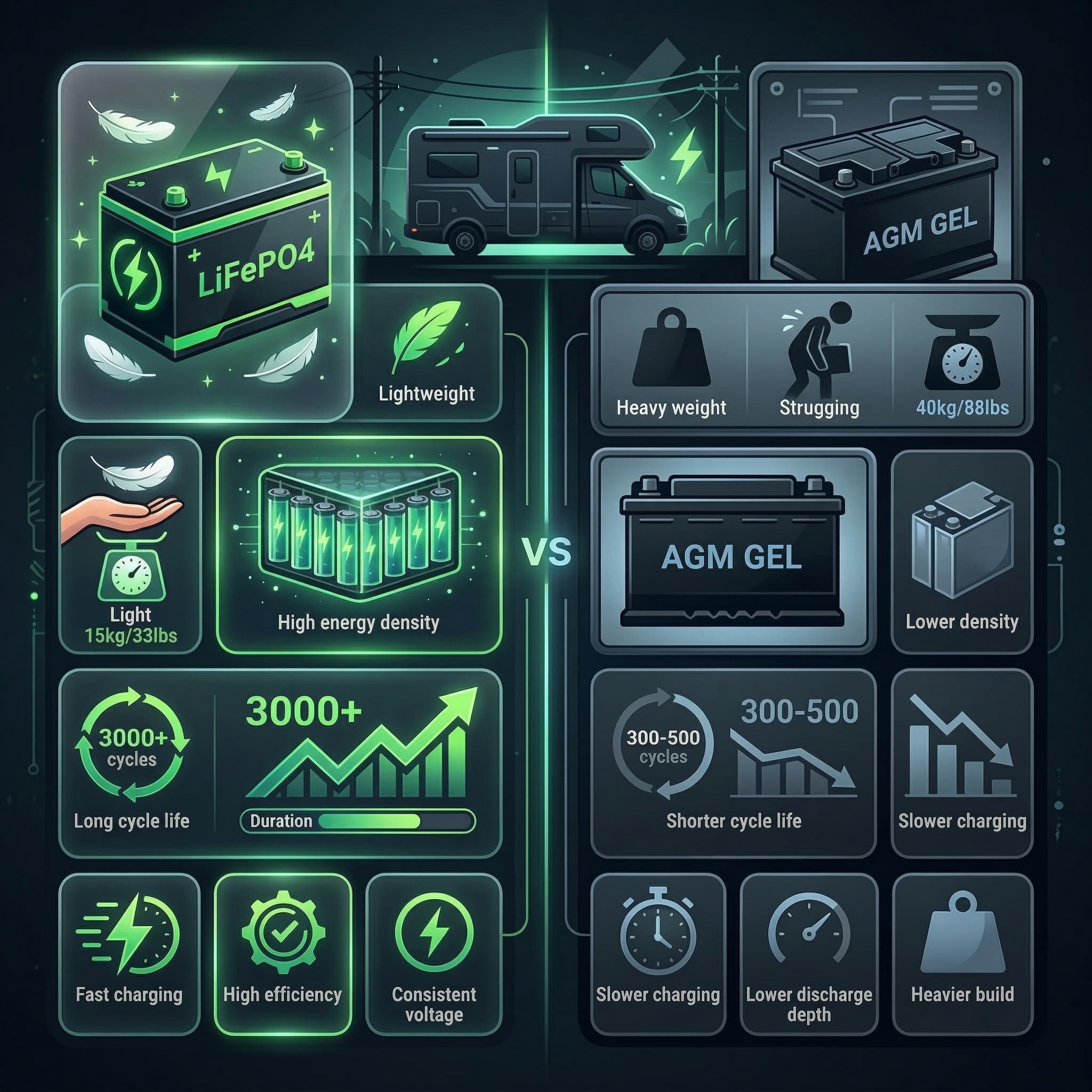
151 Ah
(80% depth of discharge)
Recommended AGM battery
241 Ah
(50% depth of discharge)
Recommended solar panels
402 Wc
4h average sun hours
Recommended inverter
No 220V appliances — no inverter needed
Adjust these values with the calculator below
Comparison table
| Factor | 12V | 24V | 48V |
|---|---|---|---|
| Cable size (3000W) | 2/0 AWG | 4 AWG | 8 AWG |
| Native appliances | All RV/van devices | Very few | Almost none |
| DC-DC converter needed? | No | Yes (24V→12V) | Yes (48V→12V) |
| Best for | <2000W systems | 2000-4000W | 4000W+ systems |
| Complexity | Low | Medium | High |
About this tool
Choosing between 12V and 48V for an overlanding popup camper is a less obvious decision than it sounds, because the voltage choice locks in your whole component ecosystem. For a popup camper specifically — lighter weight, simpler build, typically parked rather than driven continuously — the constraints differ from a full campervan build.
Where 12V wins for popup campers: an overlanding popup camper typically runs 100-400Ah of battery and 200-600W of solar. At this scale, 12V components are vastly more available in the field (every auto parts store, truck stop, and rural hardware store carries 12V fuses, relays, and wire). If something fails in Death Valley or the Outback, you're replacing a Renogy 12V MPPT from the nearest Amazon locator, not waiting for a 48V specialist component. For systems under 2,000Wh total capacity, 12V offers no real disadvantage.
Where 48V makes sense for pop-up campers: if your popup camper has an air conditioner (mini-split or rooftop RV unit), a serious coffee maker, or plans for electric cooking (induction), the power budget exceeds 3,000-5,000Wh and 48V becomes more compelling. Cable savings are real: running 200A at 12V from battery to inverter requires 4/0 cable ($8-12/foot). The same 2,000W at 48V requires only 40A and 6 AWG wire ($1-2/foot). On a 12-foot run, that's $120 vs $48 — meaningful on tighter budgets.
Popup camper-specific constraint — weight: 48V battery banks for meaningful capacity typically use prismatic LiFePO4 cells in large format (280Ah, 304Ah cells). A 48V 200Ah bank (4S configuration × 4 cells) weighs 70-90 lbs. A 12V 100Ah battery weighs 25-30 lbs. For a popup camper where tongue weight and axle loading matter, each 100Ah of 48V bank adds significantly more to the weight budget than 12V.
Hybrid approach increasingly used by experienced overlanders: 48V main system with 48V LiFePO4 batteries, 48V→12V DC-DC converter (Victron Orion-Tr 48/12-30A, 360W, $180) for 12V auxiliary circuits. All high-power equipment runs at 48V efficiency; all legacy 12V accessories (USB ports, 12V fridge outlets, lights) run from the Orion step-down. This gets the wiring savings of 48V while maintaining 12V versatility.
Practical 48V advantages demonstrated: for a cabin or overlanding setup with 3000W inverter loads (power tools, hair dryer, microwave), cable sizing from 12V requires 2× 50mm² cable for a 3m run (250A × 2 = enormous). At 48V for the same 3000W: 62.5A — 2× 16mm² cable handles it comfortably. Long-term installation savings: cheaper cables, smaller fuses, less heat, better efficiency.
The hybrid approach for overlanders: run DC loads (fridge, lights, fans, water pump, diesel heater controller) from 12V via a 48V→12V DC-DC converter (Victron Orion-Tr 48/12, 30A = 360W max 12V load). Run AC loads via a proper 48V inverter. Battery bank at 48V (e.g., four 100Ah LiFePO4 in series). Solar array wired for 48V input. The Victron SmartSolar 150/45 handles up to 2000W panels at 48V battery — excellent match for serious overlanders.
Why most van builders still choose 12V: the 12V appliance ecosystem is mature and affordable. A 12V compressor fridge (€250-400) offers the same cooling as its 24V equivalent but is more widely available and better supported. 12V→48V conversion adds complexity that most van lifers don't need. Only cross to 48V when your inverter loads regularly exceed 2000W continuous.

Frequently asked questions
Should I use 12V or 48V for my popup camper?▼
For most popup campers with standard loads (fridge, lights, fan), 12V is the right choice. It's simpler, lighter, and requires no DC-DC converters for your appliances.
Is 48V more efficient than 12V?▼
The inverter is slightly more efficient (~1-2%), but the gain is offset by the losses in the required DC-DC converter for 12V loads. At small scale, it's a wash.
Can I use 24V solar panels on a 12V system?▼
Yes, if you use an MPPT charge controller. The MPPT converts the higher panel voltage to your battery voltage without waste. PWM controllers cannot do this.
What voltage do overlanding vehicles typically use?▼
12V is standard for overlanding. Military vehicles (like the 24V LMTV) and large expedition trucks sometimes use 24V. 48V is extremely rare in mobile applications.
How much weight does a 48V system add?▼
The batteries themselves are similar weight-per-Wh regardless of voltage. But the added DC-DC converter (2-3 kg) and complexity of dual-voltage wiring adds 3-5 kg of overhead.
Advertising
Independent and free thanks to your clicks
Links marked with * are affiliate links. If a purchase is made through them, I receive a commission at no extra cost to you. The editorial selection and product evaluation are not influenced by commission rates. Your click helps fund this free tool.
Recommended gear
Check price
LiTime 12V 100Ah Bluetooth LiFePO4 (Group 31)Leo's Pick
LiFePO4 12V 100Ah Group 31, Bluetooth monitoring, 100A BMS, low-temp cutoff protection. Up to 15000 deep cycles at 60% DoD. Marine, RV, off-grid use. 222 Amazon reviews. LiTime is a leading mainstream LiFePO4 brand on Amazon US.“This is the battery I've been using in my van for 2 years. Reliable, lightweight, and the best value for money out there.”View on Amazon* →Check price
ECO-WORTHY 200W 12V/24V Solar Kit + 20A Bluetooth MPPTLeo's Pick
Complete 200W solar kit with Bluetooth-monitored MPPT controller. 12V/24V compatible, 20A charge controller with smartphone app. Ideal for vans, RVs, off-grid setups. Single-product solution covering both solar panel and charge controller.“The kit I recommend to every beginner. Plug it in, it works, and the included MPPT controller makes a real difference.”View on Amazon* →$107Amazon
Digital Multimeter
Measures voltage, current, resistance — essential for 12V wiring.“First tool to buy before you even start your install. You'll pull it out 100 times to check voltages and connections.”View on Amazon* →$41Amazon
12V Fuse Box
Protects each circuit independently, easy installation.“One fuse per circuit is the golden rule. This box keeps your install clean and every line independently protected.”View on Amazon* →