Loading...
Fact-checked on Jun 18, 2026
VANPOWERCALC.COMYOUR ENERGY PROFILE
YOUR ENERGY PROFILE.
This document contains the sizing of your future electrical installation, calculated based on your appliances.
Minimum Daily Consumption
0 WH / DAY
Inventory:
SYSTEM SIZINGPage 2
Battery
To guarantee 0WH without damaging your bank (80% max discharge):
0 AH
LiFePO4 12V
Solar
Minimum power required to recharge your consumption:
0 W
via MPPT
220V AC
Maximum power (with 25% safety margin).
0 W
No Need
Safety & CablingPage 3
12V Cable Sizing Guide
Use this professional reference table to select the correct gauge (mm²) for your cables. For 12V in a van, the maximum tolerated voltage drop is 3%. Always use multi-stranded flexible automotive wire.
| Current (A) | Round trip < 2m | Round trip 4m | Round trip 6m |
|---|---|---|---|
| 5A (LEDs, USB) | 1.5 mm² | 2.5 mm² | 4 mm² |
| 10A (Fridge, Pump) | 2.5 mm² | 4 mm² | 6 mm² |
| 20A (Heater) | 4 mm² | 10 mm² | 10 mm² |
| 50A (DC/DC Booster) | 10 mm² | 16 mm² | 25 mm² |
| 100A (Inverter) | 25 mm² | 35 mm² | 50 mm² |
Fuse Sizing
The fuse protects the wire, not the appliance. Always place it as close to the power source as possible (battery or busbar).
- Wire 1.5 mm² → Max fuse 10A
- Wire 2.5 mm² → Max fuse 20A
- Wire 4 mm² → Max fuse 30A
- Wire 6 mm² → Max fuse 40A
- Wire 10 mm² → Max fuse 60A
SCHÉMA ÉLECTRIQUE
PANNEAUX SOLAIRES
0W
RÉGULATEUR MPPT
BATTERIE AUXILIAIRE
0 Ah
Lithium LiFePO4
FUSIBLE
FUSIBLE
BOÎTE À FUSIBLES 12V
Pompe, Leds, Frigo...
CONVERTISSEUR 220V
NON REQUI
PRO GEARPage 4
SHOPPING LIST
Where to find this equipment? Here is the community-approved selection.
12V 6-way Fuse Box
Mandatory protection
Digital Multimeter
Test your connections
Heavy Duty Crimping Tool
For perfect lugs
Heat Shrink Tubing
Insulation and safety
GENERATED BY VANPOWERCALC.COM
What changed in 2026 for LiFePO4 van batteries#
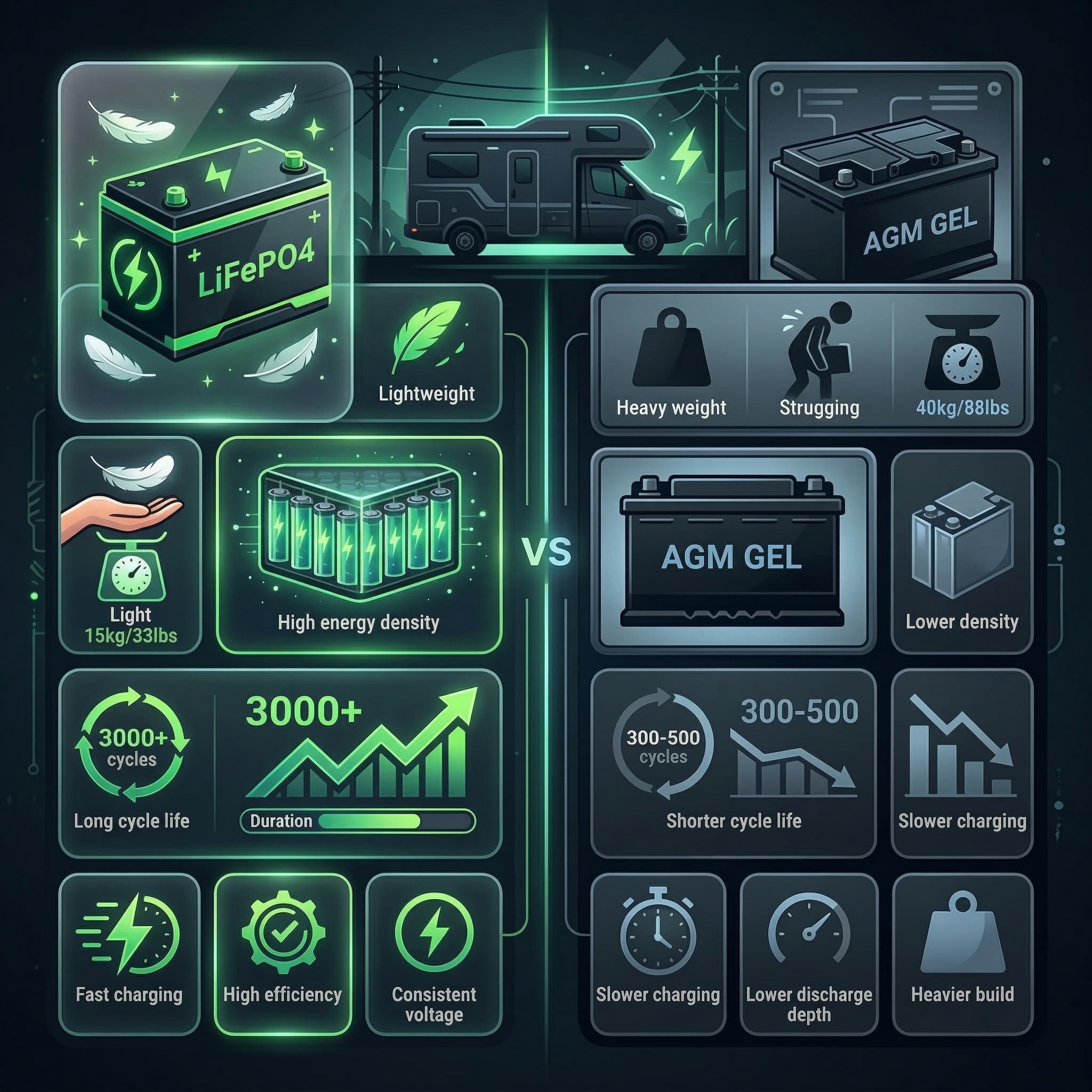
The LFP market shifted hard in 2025-2026. Mid-tier 100Ah batteries that sold for $400+ in 2024 now sit closer to $200, while premium options held their pricing because warranty depth and BMS spec gaps widened. The result: the "best value" pick changed brand, and the "best premium" pick stayed remarkably stable. If you bought a LiFePO4 before 2025, your replacement decision today looks different — that's what this guide covers.
How I rank LiFePO4 batteries for van use#
Marketing specs don't survive 100A+ continuous draws on a hot summer afternoon. Three things determine whether a battery actually lasts in a van build: BMS continuous amp rating (not the peak/surge number — that's a 3-30 second spec depending on brand), low-temp behavior (charging LFP below 0°C/32°F causes permanent lithium plating; either the BMS blocks it or the cells self-heat), and warranty backed by a company that will still answer the phone in year 7. Price-per-Ah matters too, but a $180 100Ah with a 60A BMS that trips when you run a 1,500W inverter ends up costing more than a $220 100Ah with a 100A BMS.
The 5 batteries compared#
The shortlist covers the value-to-premium spectrum: LiTime 100Ah (mid-tier value, 100A BMS, no heater on base model, 5-year warranty + 10-year projected service life), Renogy 100Ah (current 2026 lineup has 3 variants — base Core Mini without heating, Core Mini DuoHeat with self-heating, and Pro Smart with self-heating — all 100A BMS with Bluetooth on the Smart/Pro lines, 5-year warranty), Sok 100Ah (best teardown quality in the budget tier, current V8 BMS at 170A continuous / 200A peak, Bluetooth standard, 7-year warranty), Epoch Essential Series 105Ah (Bluetooth-enabled BMS + active heater standard, 105A continuous BMS, 11-year warranty — the feature/dollar leader), and Battle Born BB10012 (US-assembled in Reno NV, 10-year warranty, 100A BMS, heated variant available, deepest installer ecosystem). All five reflect verified 2026 specs from manufacturer datasheets. Higher capacity blocks (200Ah / 300Ah) follow the same brand rankings — single big block beats parallel small blocks for wiring complexity, but the BMS continuous rating must scale linearly with the load.
Expert tip
Match BMS continuous amps to your worst-case load AND account for inverter efficiency. A 1,500W AC inverter at 88% efficiency pulls ~142A at 12V (1,500W / 0.88 / 12V), not the naive 125A you'd get from P/V alone. So a 100A BMS battery won't sustain a 1,500W inverter under load — it'll trip. For 1,500W+ builds, run a 200A+ continuous BMS (single battery) or two 100A BMS batteries in parallel — BMS amps add up in parallel. Always check the "continuous discharge" spec — peak/surge ratings hold for 3-30 seconds only and don't size your build.
Example calculation for your setup
Results based on a typical use case
| Appliance | Power | Usage/day | Wh/day |
|---|---|---|---|
| Compression fridge | 45W | 24h | 1080 |
| LED lighting | 20W | 4h | 80 |
| Water pump | 30W | 0.5h | 15 |
| Phone charging | 15W | 2h | 30 |
| Daily consumption | 1205 Wh | ||
Recommended LiFePO4 battery
151 Ah
(80% depth of discharge)
Recommended AGM battery
241 Ah
(50% depth of discharge)
Adjust these values with the calculator below
Comparison table
| Battery | BMS continuous | Heater | Cycle life @80% DoD | Warranty | Price (USD, 2026) |
|---|---|---|---|---|---|
| LiTime 100Ah | 100A | Optional variant | 4,000+ | 5 years | $180-220 |
| Renogy 100Ah (Core/DuoHeat/Pro Smart) | 100A | DuoHeat + Pro Smart variants | 4,000+ | 5 years | $240-290 |
| Sok 100Ah | 170A (V8 BMS) | No (standard) | 4,000-8,000 | 7 years | $299 |
| Epoch Essential Series 105Ah | 105A | Standard (heated) | 4,000+ | 11 years | ~$499 |
| Battle Born BB10012 | 100A | Optional variant | 3,000-5,000 | 10 years | $899-1,099 |
About this tool
The 2026 winners by use case#
Best value, simple builds → LiTime 100Ah at around $180-$220 (verify current price on affiliate). 100A continuous BMS handles ~1,000W AC continuous through an 88% efficient inverter — perfect for 12V DC loads + light AC use (fridge, laptops, charging). 5-year warranty backed by a 10-year projected service life (LiTime's published cycle data: 4,000+ cycles at 100% DoD). IP65 case. The catch: no internal heater and no Bluetooth on the base model. If your van parks outdoors below freezing without a way to disable charging, step up to the heated variant or pick the Epoch Essential below.
Best feature-per-dollar, cold climate or full-time → Epoch Essential Series 105Ah at around $499. This is the surprise pick in 2026: at roughly half the Battle Born price, you get Bluetooth + active heater standard + 11-year warranty (longest in the consumer market) + 4,000+ cycles to 80% capacity + 105A continuous BMS. Note: it's 105Ah, not 100Ah — Epoch uses slightly higher-capacity cells in this pack, giving you ~5% more usable energy for the same footprint. Limitations: shorter market track record than Battle Born, US-only distribution.
Best premium support, commercial / ABYC builds → Battle Born BB10012 at around $899 ($1,099 for the heated variant). 4-5× the LiTime price for the same nameplate capacity. What you''re paying for: US assembly in Reno NV, real human warranty support, the largest installer ecosystem, and a 10-year warranty consistently honored for 8+ years (compare: many budget brands didn''t exist in 2018). 3,000-5,000 cycles at 80% DoD. The pick for ABYC E-11-aligned installations and commercial vehicles where downtime is an emergency.
Full comparison: 5 batteries#
(See comparison table below for specs at a glance.)
What I''d buy in 2026 by use case#
- Weekend / 3-season van → LiTime 100Ah base ($180-$220). 100A BMS handles ~1,000W AC continuous. Skip the heater unless you regularly camp below 0°C without sun.
- Full-time vanlife, mild climate → Sok 100Ah ($299) or LiTime 100Ah ($200). Sok wins on teardown quality and BMS spec: the current V8 BMS publishes 170A continuous / 200A peak, comfortably handling 1,500W+ builds without paralleling.
- Full-time vanlife, cold climate / mountain travel → Epoch Essential Series 105Ah ($499, heated standard) is the value play. Battle Born 100Ah heated ($1,099) is the premium play. Both have proven cold-weather behavior + active heaters.
- High-draw build (1,500W+ inverter, induction, AC) → Single LiTime 200Ah ($349-$399, 200A BMS) or two 100Ah/100A BMS batteries in parallel (200A combined BMS). 12V at 200A continuous is the practical ceiling — beyond that, move to 24V or 48V.
- Commercial / ABYC installation → Battle Born BB10012 + Victron Lynx busbar + Class T fuses. Documentation aligns with marine and RV standards. Higher BOM cost but auditable.
The 3 numbers that decide a LiFePO4 purchase#
BMS continuous amp rating. Not surge. For a 1,500W inverter at 12V you need ~142A continuous (P / 0.88 / 12V). For 2,000W: ~190A (range 185-196A across the 85-90% inverter efficiency band). A 100A BMS = max ~1,000W AC continuous through an 88%-efficient inverter. Peak/surge ratings (200-300A) hold for 3-30 seconds depending on manufacturer and don''t size your build.
Real capacity at C/5 discharge. Reputable brands deliver ≥92% of nameplate at moderate C/5 discharge (20A on a 100Ah). Cheap unbranded cells often deliver 75-80% — capacity claims on no-name Amazon listings are commonly 15-20% inflated. A 100Ah that delivers only 80Ah real is more expensive per usable amp-hour than a $200 LiTime.
Low-temp protection: cutoff vs heater. Charging LFP below 0°C causes lithium plating — permanent capacity loss. Two ways to handle it: (a) BMS low-temp cutoff that blocks charge current — your solar/DC-DC won''t damage the cells but you also won''t be charging when cold; or (b) self-heated cells with built-in 100-150W heater pads that warm the pack before accepting charge. A heated cycle typically draws 25-75Wh from the pack to warm up — small cost for the convenience.
Critical safety: paralleling batteries#
If you''re running two or more batteries in parallel, install one Class T or ANL fuse on each battery''s positive cable at the battery terminal, BEFORE the busbar. This is not optional. Without individual fusing, a BMS short-circuit failure on one battery can push full current through the other battery''s still-functional BMS, causing thermal runaway or arc-flash. ABYC E-11 has a 3-tier rule for overcurrent protection distance from the battery positive terminal: 7 inches for bare cable, 40 inches if the cable runs sheathed (conduit, split loom, junction box) to a non-battery source like a busbar or switch, and 72 inches if the cable is sheathed throughout and connects directly to the battery terminal. For a typical van build with the fuse mounted directly off the battery post in a sheathed run, you have up to 72 inches of cable before the fuse. The main inverter cable also needs its own fuse sized at 125% of continuous load (NEC 210.20(A) / ABYC E-11) — for a 2,000W 12V system that''s ~190A × 1.25 = 238A continuous, sized up to a 250A Class T or comparable ANL fuse, placed within the same 7/40/72 inch rule from the bank''s main positive busbar.
Common gotchas#
- Match SOC and brand when paralleling. Two 100Ah/100A in parallel = 200Ah / 200A BMS combined, but only if both batteries are at the same SOC at connection and from the same brand/model. Mismatched SOC causes high inrush current that can trip both BMS units simultaneously. Different brands often have different charge voltage targets and BMS behavior.
- Storage SOC depends on brand. Battle Born recommends storing at 100% SOC before disconnecting. Most other brands (Victron community guidance, LiTime) recommend 50-60% SOC for long-term storage. Read the manufacturer''s storage doc — there is no universal rule.
- "No float" needs nuance. LFP doesn''t need a traditional float stage, but most chargers force one. If your charger has a mandatory float, set it to ≤13.6V (the consensus longevity sweet spot across Battle Born, Victron community, and major brand guidance). For extended standby (storage), 13.2-13.4V is the Victron community-recommended range. Always check your specific battery manufacturer''s published float spec — never leave LFP held continuously at the top of any range for weeks, as calendar aging accelerates at sustained high SOC.
- Discharge at -20°C delivers 70-80% capacity at moderate discharge rates. Performance varies by cell quality and discharge rate. Don''t plan a winter trip assuming 100% of nameplate at extreme temperatures.
- The cheapest unbranded Amazon listing is rarely a bargain. Capacity claims on no-name 100Ah are commonly inflated 15-20%. Cost per real usable amp-hour is often higher than a LiTime or Renogy. Stick to brands with verifiable cycle test data.

Frequently asked questions
Which LiFePO4 battery is the 2026 winner for van builds?▼
Three winners by use case: LiTime 100Ah ($180-$220) for value and simple builds with a 5-year warranty + 10-year projected service life. Epoch Essential Series 105Ah (~$499) for cold-climate or full-time builds — heater + Bluetooth + 11-year warranty standard. Battle Born BB10012 ($899-$1,099) for commercial / ABYC-aligned installations with US-based warranty support.
What BMS continuous rating do I need for a 1,500W or 2,000W inverter?▼
Account for inverter efficiency (typical 85-90%). A 1,500W AC inverter at 88% efficiency pulls ~142A continuous at 12V (1,500W / 0.88 / 12V), not the naive 125A from P/V. A 2,000W inverter pulls ~190A at 88% (range 185-196A across the 85-90% efficiency band). So a 1,500W+ build needs a 200A+ BMS continuous (single battery) or two 100A BMS in parallel (combined 200A). Peak/surge ratings (200-300A) hold for only 3-30 seconds depending on brand and don't size your build.
Do I need a special charger for a LiFePO4 battery?▼
Yes — LFP requires a lithium-specific charge profile (14.2-14.6V absorption, preferably 14.4V; no traditional float). Most modern solar MPPT controllers (Victron, Renogy, Epever) and DC-DC chargers (Victron Orion-Tr, Sterling, Renogy) have a dedicated LiFePO4 preset. Older AC converters (PD9200 series) may need to be replaced or set to a lithium-compatible mode. If your charger forces a float stage, set it to ≤13.6V (consensus LFP longevity sweet spot) to avoid prolonged high-SOC stress.
Can I charge LiFePO4 batteries in winter?▼
You can discharge them well below freezing — they deliver 70-80% capacity at -20°C at moderate discharge rates. Charging is the problem: below 0°C, lithium plating starts and permanently damages cells. Two options: (a) buy a heated variant that warms cells with a 100-150W internal pad before charging (typical cycle draws 25-75Wh from the pack); or (b) rely on the BMS low-temp cutoff to block charge current until cells warm up naturally. Never bypass a cold-temp cutoff to 'force' a charge.
Is individual fusing required when paralleling LiFePO4 batteries?▼
Yes — install one Class T or ANL fuse on each battery's positive cable at the battery terminal, before the busbar. ABYC E-11 has a 3-tier distance rule: 7 inches for bare cable, 40 inches for cable sheathed (conduit/split loom) running to a non-battery source like a busbar, and 72 inches for cable sheathed throughout that connects directly to the battery terminal. Most van builds with a fuse mounted directly off the battery post in a sheathed run get the 72-inch allowance. Without individual fusing, a BMS short-circuit on one battery pushes full current through the other battery's BMS, risking thermal runaway. Also use matching brand/model batteries at the same SOC when paralleling — mismatched SOC causes inrush current that trips both BMS units.
Advertising
Independent and free thanks to your clicks
Links marked with * are affiliate links. If a purchase is made through them, I receive a commission at no extra cost to you. The editorial selection and product evaluation are not influenced by commission rates. Your click helps fund this free tool.
Recommended gear
Check price
LiTime 12V 100Ah Bluetooth LiFePO4 (Group 31)Leo's Pick
LiFePO4 12V 100Ah Group 31, Bluetooth monitoring, 100A BMS, low-temp cutoff protection. Up to 15000 deep cycles at 60% DoD. Marine, RV, off-grid use. 222 Amazon reviews. LiTime is a leading mainstream LiFePO4 brand on Amazon US.“This is the battery I've been using in my van for 2 years. Reliable, lightweight, and the best value for money out there.”View on Amazon* →Check price
LiFePO4 200Ah 12V Battery
200Ah true capacity, 200A built-in BMS, 5000+ cycles.“If you work remotely or run a fridge, go straight for 200Ah. You'll never regret having too much capacity.”View on Amazon* →$114Amazon
Victron BMV-712 Battery Monitor
Real-time SOC, history, Bluetooth alarms. Must-have.“Without a monitor, you're flying blind. This one gives you the exact battery % in real time — a total game-changer.”View on Amazon* →$56Amazon
Victron Orion DC-DC Charger 30A
Charges battery from alternator with correct Li profile.“Essential if you have a Euro 6+ vehicle. I've installed it on 3 different vans, zero issues. It charges your battery as soon as you drive.”View on Amazon* →