Loading...
Fact-checked on Mar 15, 2026
VANPOWERCALC.COMYOUR ENERGY PROFILE
YOUR ENERGY PROFILE.
This document contains the sizing of your future electrical installation, calculated based on your appliances.
Minimum Daily Consumption
0 WH / DAY
Inventory:
SYSTEM SIZINGPage 2
Battery
To guarantee 0WH without damaging your bank (80% max discharge):
0 AH
LiFePO4 12V
Solar
Minimum power required to recharge your consumption:
0 W
via MPPT
220V AC
Maximum power (with 25% safety margin).
0 W
No Need
Safety & CablingPage 3
12V Cable Sizing Guide
Use this professional reference table to select the correct gauge (mm²) for your cables. For 12V in a van, the maximum tolerated voltage drop is 3%. Always use multi-stranded flexible automotive wire.
| Current (A) | Round trip < 2m | Round trip 4m | Round trip 6m |
|---|---|---|---|
| 5A (LEDs, USB) | 1.5 mm² | 2.5 mm² | 4 mm² |
| 10A (Fridge, Pump) | 2.5 mm² | 4 mm² | 6 mm² |
| 20A (Heater) | 4 mm² | 10 mm² | 10 mm² |
| 50A (DC/DC Booster) | 10 mm² | 16 mm² | 25 mm² |
| 100A (Inverter) | 25 mm² | 35 mm² | 50 mm² |
Fuse Sizing
The fuse protects the wire, not the appliance. Always place it as close to the power source as possible (battery or busbar).
- Wire 1.5 mm² → Max fuse 10A
- Wire 2.5 mm² → Max fuse 20A
- Wire 4 mm² → Max fuse 30A
- Wire 6 mm² → Max fuse 40A
- Wire 10 mm² → Max fuse 60A
SCHÉMA ÉLECTRIQUE
PANNEAUX SOLAIRES
0W
RÉGULATEUR MPPT
BATTERIE AUXILIAIRE
0 Ah
Lithium LiFePO4
FUSIBLE
FUSIBLE
BOÎTE À FUSIBLES 12V
Pompe, Leds, Frigo...
CONVERTISSEUR 220V
NON REQUI
PRO GEARPage 4
SHOPPING LIST
Where to find this equipment? Here is the community-approved selection.
12V 6-way Fuse Box
Mandatory protection
Digital Multimeter
Test your connections
Heavy Duty Crimping Tool
For perfect lugs
Heat Shrink Tubing
Insulation and safety
GENERATED BY VANPOWERCALC.COM
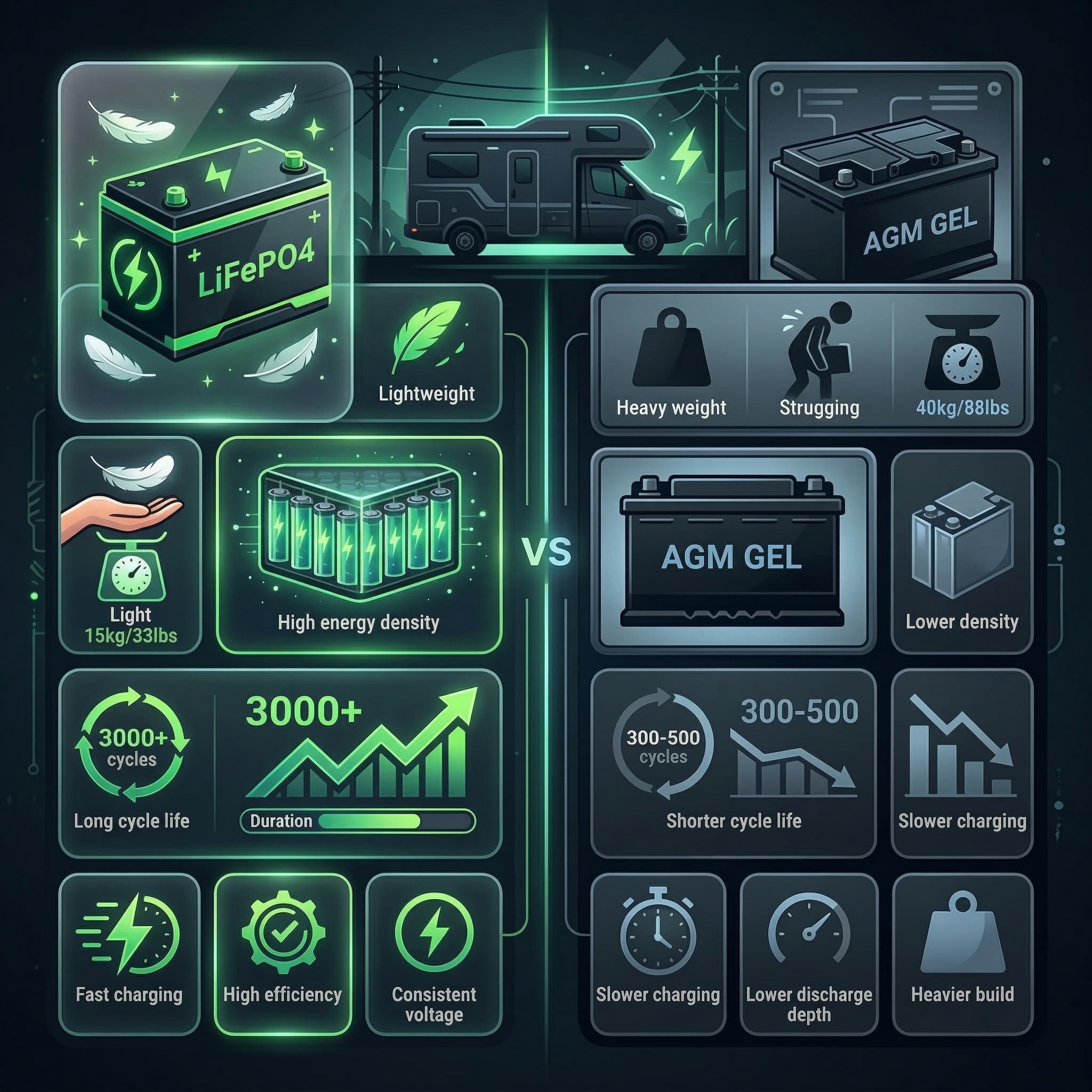
LiFePO4 lithium batteries have become the gold standard for van builds. Lighter, longer-lasting, and more usable than AGM — but sizing them correctly is key to getting your money's worth.
LiFePO4 batteries deliver their full rated capacity regardless of discharge rate, unlike AGM which loses 20-30% at high loads. A 200Ah LiFePO4 gives you a true 200Ah, while a 200Ah AGM realistically offers 100Ah usable. Factor in 3,000-5,000 cycle life versus 400-600 for AGM, and the cost per cycle makes lithium the cheaper option long-term.
Expert tip
When your LiFePO4 is new, do a full charge-discharge cycle and measure actual capacity with a battery monitor. Note the result. Re-measure yearly. When capacity drops below 80% of original, plan replacement within 18 months. This gives you early warning without being caught off-guard by sudden failure.
Example calculation for your setup
Results based on a typical use case
| Appliance | Power | Usage/day | Wh/day |
|---|---|---|---|
| Compression fridge | 45W | 24h | 1080 |
| LED lighting | 20W | 4h | 80 |
| Water pump | 30W | 0.5h | 15 |
| Phone charging | 15W | 2h | 30 |
| Daily consumption | 1205 Wh | ||
Recommended LiFePO4 battery
151 Ah
(80% depth of discharge)
Recommended AGM battery
241 Ah
(50% depth of discharge)
Adjust these values with the calculator below
Comparison table
| LiFePO4 model | Capacity | BMS | App | Price |
|---|---|---|---|---|
| Victron Smart 200Ah | 200Ah | ✓ | VictronConnect | $900-1,200 |
| Battle Born 100Ah | 100Ah | ✓ | — | $900-1,000 |
| Renogy 200Ah | 200Ah | ✓ | Renogy BT | $600-750 |
| Ampere Time 200Ah | 200Ah | ✓ | — | $450-550 |
About this tool
LiFePO4 Battery Guide for Campervans: Everything You Need to Know#
LiFePO4 (lithium iron phosphate) has become the dominant battery chemistry for campervan builds over the past 5 years. This guide covers everything you need to use LiFePO4 safely and effectively.
Why LiFePO4 is the Right Choice for Campervan Builds#
LiFePO4 is not just better than AGM — it is fundamentally different in ways that matter for van life:
| Factor | LiFePO4 | AGM | Practical Difference |
|---|---|---|---|
| Usable capacity | 80% DoD | 50% DoD | LiFePO4 doubles usable energy per Ah |
| Weight | 10-13 kg/100Ah | 27-33 kg/100Ah | LiFePO4 is 60% lighter |
| Cycle life | 3,000-5,000 | 300-500 | 10× longer lifespan |
| Charge voltage | 14.2-14.6V | 14.4-14.8V | Slightly lower, BMS regulated |
| Temperature: below 0°C | Cannot charge | Can charge (degraded) | BMS protects LiFePO4 automatically |
| Self-discharge | 2-3%/month | 3-10%/month | LiFePO4 stores better |
| Safety | Very stable (no thermal runaway) | Risk of H₂ gas | LiFePO4 is the safest lithium chemistry |
Understanding the BMS (Battery Management System)#
Every LiFePO4 battery needs a BMS. Quality branded batteries (Battle Born, Renogy, Victron) include it internally. BMS functions:
- Cell balancing: keeps individual cells at equal voltage
- Overcharge protection: disconnects if voltage exceeds 14.6V
- Over-discharge protection: disconnects when cells drop below 2.5V
- Overcurrent protection: disconnects or limits on shorts or excessive draw
- Temperature protection: prevents charging below 0°C
Charging Requirements for Campervan LiFePO4#
Your charging equipment MUST support a LiFePO4 charging profile:
- Solar MPPT: set to LiFePO4 mode (Bulk 14.4V, Absorption 14.4V, Float 13.5V)
- DC-DC charger: must support LiFePO4 profile (some older B2B chargers do not)
- Inverter-charger: configure for LiFePO4 (Victron MultiPlus: battery type = Lithium)
- No equalization charging — LiFePO4 does not need it and it will damage cells
Wiring Multiple LiFePO4 Batteries#
Connecting two or more LiFePO4 batteries in parallel works well if they are identical (same brand, same production batch):
- Use equal-length cables to each battery (within 5%) to ensure equal current sharing
- Use a busbar rather than daisy-chaining batteries
- Ensure each battery has its own fuse
Never mix old and new batteries or different capacities.
Lifespan and Replacement Timing#
At 1 cycle per day (common in regular van life use), 3,000 cycles = 8.2 years; 5,000 cycles = 13.7 years. In practice, most LiFePO4 batteries will outlast your campervan build.
Expert tip: When your LiFePO4 battery is new, do a full charge-discharge cycle and measure actual capacity with a battery monitor (Victron BMV-712 or BMV-700). Note the measured capacity. Re-measure every year. When it drops below 80% of original, plan for replacement within the next 12-18 months.

Frequently asked questions
Is LiFePO4 safe in a campervan?▼
Yes — LiFePO4 is the safest lithium chemistry. Unlike NMC and NCA (used in laptops and EVs), LiFePO4 is thermally stable and extremely unlikely to cause fires or thermal runaway. It does not produce toxic gases. The BMS provides additional overcurrent, overvoltage, and temperature protection.
Can LiFePO4 be charged while driving?▼
Yes. Use a DC-DC (B2B) battery-to-battery charger that supports LiFePO4 profile. The B2B charger takes current from the alternator/vehicle battery and charges your LiFePO4 at a controlled, temperature-monitored rate. Standard split-charge relays are not suitable for LiFePO4 charging.
Can I store a LiFePO4 battery over winter?▼
Yes easily. Store at 50-60% state of charge in a cool (5-20°C), dry location. LiFePO4 self-discharges only 2-3% per month. A battery stored at 50% in October will still be at 40-45% by March — no damage, no maintenance needed.
Do I need a battery monitor with LiFePO4?▼
Strongly recommended. Unlike AGM where voltage roughly indicates state of charge, LiFePO4 voltage stays very flat from 100% to 20% SoC. A shunt-based battery monitor (Victron BMV-700, Renogy RNG-BT-RVR30) is the only accurate way to know how much energy you have left.
Advertising
Independent and free thanks to your clicks
Links marked with * are affiliate links. If a purchase is made through them, I receive a commission at no extra cost to you. The editorial selection and product evaluation are not influenced by commission rates. Your click helps fund this free tool.
Recommended gear
Check price
LiTime 12V 100Ah Bluetooth LiFePO4 (Group 31)Leo's Pick
LiFePO4 12V 100Ah Group 31, Bluetooth monitoring, 100A BMS, low-temp cutoff protection. Up to 15000 deep cycles at 60% DoD. Marine, RV, off-grid use. 222 Amazon reviews. LiTime is a leading mainstream LiFePO4 brand on Amazon US.“This is the battery I've been using in my van for 2 years. Reliable, lightweight, and the best value for money out there.”View on Amazon* →Check price
LiFePO4 200Ah 12V Battery
200Ah true capacity, 200A built-in BMS, 5000+ cycles.“If you work remotely or run a fridge, go straight for 200Ah. You'll never regret having too much capacity.”View on Amazon* →$114Amazon
Victron BMV-712 Battery Monitor
Real-time SOC, history, Bluetooth alarms. Must-have.“Without a monitor, you're flying blind. This one gives you the exact battery % in real time — a total game-changer.”View on Amazon* →$56Amazon
Victron Orion DC-DC Charger 30A
Charges battery from alternator with correct Li profile.“Essential if you have a Euro 6+ vehicle. I've installed it on 3 different vans, zero issues. It charges your battery as soon as you drive.”View on Amazon* →