Loading...
Fact-checked on Jun 16, 2026
VANPOWERCALC.COMYOUR ENERGY PROFILE
YOUR ENERGY PROFILE.
This document contains the sizing of your future electrical installation, calculated based on your appliances.
Minimum Daily Consumption
0 WH / DAY
Inventory:
SYSTEM SIZINGPage 2
Battery
To guarantee 0WH without damaging your bank (80% max discharge):
0 AH
LiFePO4 12V
Solar
Minimum power required to recharge your consumption:
0 W
via MPPT
220V AC
Maximum power (with 25% safety margin).
0 W
No Need
Safety & CablingPage 3
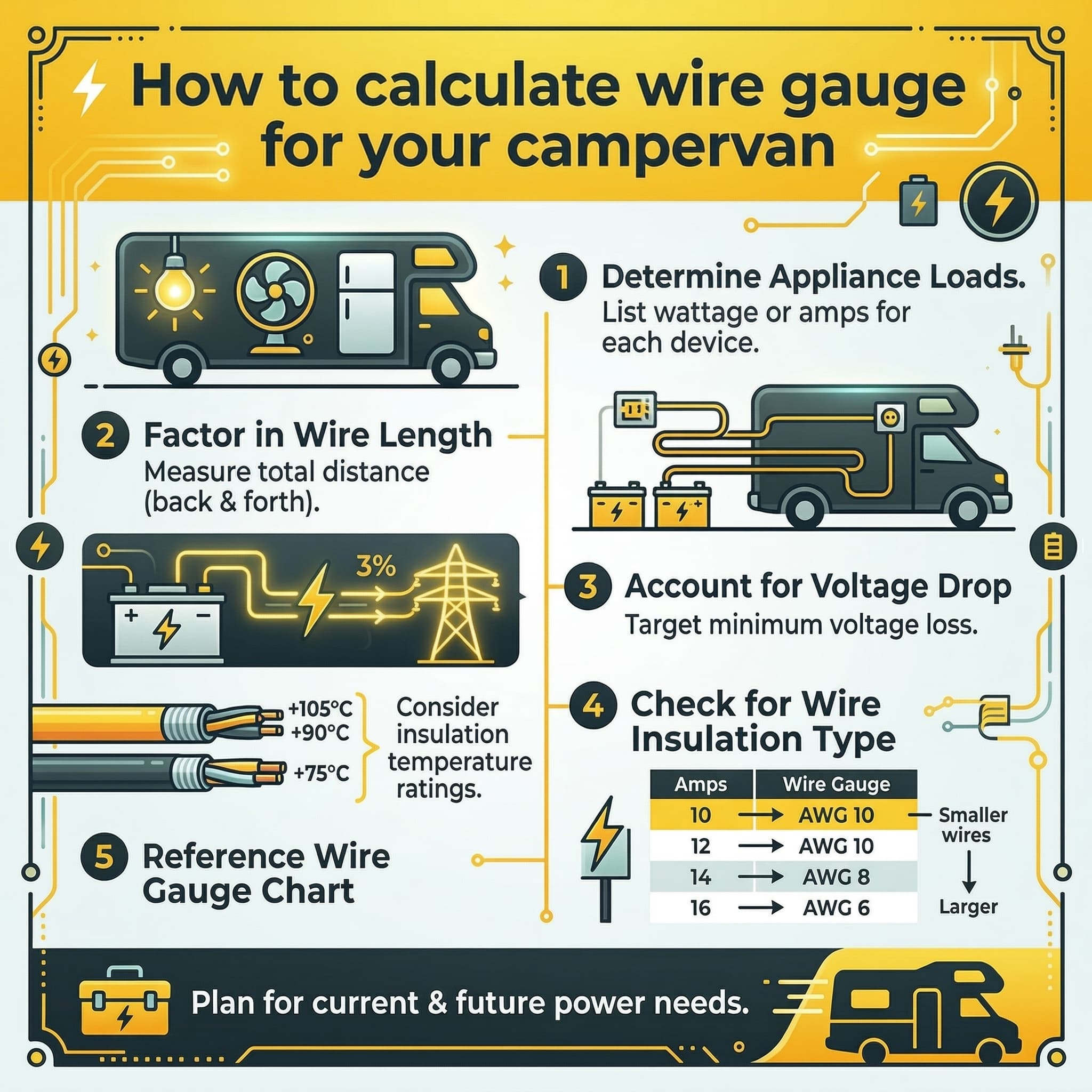
12V Cable Sizing Guide
Use this professional reference table to select the correct gauge (mm²) for your cables. For 12V in a van, the maximum tolerated voltage drop is 3%. Always use multi-stranded flexible automotive wire.
| Current (A) | Round trip < 2m | Round trip 4m | Round trip 6m |
|---|---|---|---|
| 5A (LEDs, USB) | 1.5 mm² | 2.5 mm² | 4 mm² |
| 10A (Fridge, Pump) | 2.5 mm² | 4 mm² | 6 mm² |
| 20A (Heater) | 4 mm² | 10 mm² | 10 mm² |
| 50A (DC/DC Booster) | 10 mm² | 16 mm² | 25 mm² |
| 100A (Inverter) | 25 mm² | 35 mm² | 50 mm² |
Fuse Sizing
The fuse protects the wire, not the appliance. Always place it as close to the power source as possible (battery or busbar).
- Wire 1.5 mm² → Max fuse 10A
- Wire 2.5 mm² → Max fuse 20A
- Wire 4 mm² → Max fuse 30A
- Wire 6 mm² → Max fuse 40A
- Wire 10 mm² → Max fuse 60A
SCHÉMA ÉLECTRIQUE
PANNEAUX SOLAIRES
0W
RÉGULATEUR MPPT
BATTERIE AUXILIAIRE
0 Ah
Lithium LiFePO4
FUSIBLE
FUSIBLE
BOÎTE À FUSIBLES 12V
Pompe, Leds, Frigo...
CONVERTISSEUR 220V
NON REQUI
PRO GEARPage 4
SHOPPING LIST
Where to find this equipment? Here is the community-approved selection.
12V 6-way Fuse Box
Mandatory protection
Digital Multimeter
Test your connections
Heavy Duty Crimping Tool
For perfect lugs
Heat Shrink Tubing
Insulation and safety
GENERATED BY VANPOWERCALC.COM
Why Parallel?#
Wiring batteries in parallel adds capacity while keeping voltage the same. Two 200Ah 12V batteries in parallel = 400Ah at 12V. Unlike series wiring (which doubles voltage), parallel wiring is the standard way to scale a 12V system's capacity without changing any other components — your MPPT, inverter, and loads all stay at 12V.
The Rules for Safe Parallel LiFePO4#
Rule 1: Same brand, same model, same production batch. Each battery has its own BMS with slightly different calibration. Different brands = different BMS cut-off voltages = one battery may shoulder more load than the other. Same production batch minimizes cell chemistry variations.
Rule 2: Equal cable lengths and gauge. This is the most common mistake. If Battery A has a 2-foot cable to the busbar and Battery B has a 4-foot cable, Battery A carries more current (lower resistance path). Over time, Battery A ages faster. Cut your cables to exactly the same length, down to the inch.
Rule 3: Diagonal wiring. Connect the positive from Battery A and the negative from Battery B to your busbar/loads (or vice versa). This ensures current flows through both batteries equally. If you connect both positive and negative from the same battery (same-side wiring), the nearest battery always carries more current.
Pre-Connection Procedure#
Before connecting LiFePO4 batteries in parallel, they must be at the same voltage. If Battery A is at 13.2V and Battery B is at 12.8V, connecting them creates a surge current between batteries as they equalize — potentially hundreds of amps for a fraction of a second. This can blow fuses, weld contacts, or damage the BMS.
Safe procedure:
- Charge both batteries fully (14.6V)
- Let them rest separately for 2 hours
- Measure voltage — they should be within 0.1V of each other
- If not within 0.1V, use a resistor (1 ohm, 50W) between them for 30 minutes to equalize slowly
- Connect with the main fuse/breaker in the OFF position
- Verify no abnormal heat at connections after 10 minutes
Expert tip
Here's the pro move: install a 250A class-T fuse on each battery's positive cable, between the battery and the positive busbar. If one battery's BMS fails open (rare but possible), the fuse isolates that battery from the bank. Without individual fuses, a failed battery can backfeed through the parallel connection and damage the other batteries.
Example calculation for your setup
Results based on a typical use case
| Appliance | Power | Usage/day | Wh/day |
|---|---|---|---|
| Compression fridge | 45W | 24h | 1080 |
| LED lighting | 20W | 4h | 80 |
| Water pump | 30W | 0.5h | 15 |
| Phone charging | 15W | 2h | 30 |
| Daily consumption | 1205 Wh | ||
Recommended LiFePO4 battery
151 Ah
(80% depth of discharge)
Recommended AGM battery
241 Ah
(50% depth of discharge)
Adjust these values with the calculator below
Comparison table
| Aspect | Correct | Incorrect | Risk |
|---|---|---|---|
| Cable length | Identical (both 60cm) | Different lengths | Unequal current → premature aging |
| Wiring | Diagonal (cross) | Same-side | Nearest battery carries more current |
| Pre-connect voltage | Within 0.1V | More than 0.5V diff | Surge current → BMS damage |
| Cable gauge | Same as main cables | Thinner than main | Bottleneck → heating |
| Battery match | Same model + batch | Different brands | Unequal BMS behavior |
About this tool
Wiring LiFePO4 batteries in parallel is one of the most misunderstood topics in the DIY campervan and RV community. Done correctly, it doubles your capacity safely. Done wrong, it can trigger BMS shutdowns, create unequal charging, or cause dangerous current spikes on connection.
The golden rule for parallel LiFePO4: always balance batteries to within 0.05V of each other before connecting. A 100Ah battery at 13.2V and another at 12.8V have a 0.4V difference — on connection, that difference drives 50-100A of equalizing current through both BMS units simultaneously. Most 12V 100Ah BMS boards are rated for 100A max. That equalizing spike can reset or damage the BMS. Measured on a Chargery BMS forum thread: a 0.5V difference between two 200Ah batteries produced a 180A inrush on connection. Solution: charge both batteries independently to the same voltage (within 0.05V) before paralleling.
Cable length symmetry matters more than most guides mention. If cable A runs 18 inches from battery 1 to the bus bar, and cable B runs 36 inches from battery 2/to the same bus bar, battery 1 will see lower resistance and will both charge and discharge more than battery 2 over time. After 6 months, battery 1 will have cycled 30-40% more than battery 2. Fix: use identical cable lengths and wire gauges for all parallel connections.
BMS communication between parallel batteries: lithium batteries in parallel each have their own BMS. These BMS units do not inherently communicate with each other. If battery 1's BMS trips on a low-cell condition, it disconnects — leaving battery 2 to supply the full load alone, which may cause its BMS to trip as well. This cascade failure is why many experienced installers prefer a single large-cell battery (300Ah, 400Ah) over paralleling two smaller units. If you do parallel, choose batteries from the same manufacturer, same Ah rating, and same production batch where possible.
Practical parallel wiring topology for campervans: use a common positive bus bar and a common negative bus bar. Connect each battery with its own fused positive cable (MIDI fuse 150-200A per battery) and run the loads from the center of the bus bars. This ensures equal current distribution regardless of small cable length differences.
Fusing parallel LiFePO4 banks safely: each battery must have its own fuse or circuit breaker between it and the busbars. Size each fuse at 125% of the maximum sustained discharge current that battery will deliver. For two 100Ah batteries in parallel, each rated 100A BMS discharge: 100A × 1.25 = 125A fuse per battery. Use Class T fuses (extremely fast-acting) for LiFePO4 parallel banks — ANL fuses work but Class T provides 10× faster disconnection on short circuits.
Temperature compensation in parallel LiFePO4: if one battery is significantly warmer than another (different mounting locations in the van — one in a warm engine-adjacent compartment, one in a cool underfloor space), internal resistance will differ significantly. Reduce charging current to the lower of the two BMS current ratings during high-temperature periods. The Victron Lynx Smart BMS observes individual battery temperatures when connected to Victron LiFePO4 units directly.
Future-proofing your parallel setup: design the busbar and cable architecture for 1.5× the current you need today. A 50mm² cable can carry 250A sustained. Investing €30 more in cable gauge now means you can add a third parallel battery in year 3 without re-running wiring. The busbar (€40-80 for a quality copper unit) should have spare terminals for future additions.

Frequently asked questions
Can I mix different brand LiFePO4 in parallel?▼
Technically possible but strongly discouraged. Different BMS calibrations mean unequal load sharing. Use the same brand, model, and ideally the same production batch.
What gauge cable for parallel connections?▼
Same gauge as your main battery cables — typically 2/0 AWG (70mm²) for systems with inverters up to 3000W. Undersized parallel cables defeat the purpose.
What is diagonal wiring?▼
Connect the positive from the first battery and the negative from the last battery to your loads. This ensures equal current flow through all parallel batteries.
Can I add a third battery later?▼
Yes, but it must be the same model and at the same voltage before connecting. Batteries of very different ages may have different internal resistance, causing unequal charging.
Do parallel LiFePO4 need a balancer?▼
Each battery's internal BMS handles cell balancing within the battery. Between parallel batteries, equal cables and diagonal wiring provide passive balancing. No external balancer needed.
Advertising
Independent and free thanks to your clicks
Links marked with * are affiliate links. If a purchase is made through them, I receive a commission at no extra cost to you. The editorial selection and product evaluation are not influenced by commission rates. Your click helps fund this free tool.
Recommended gear
Check price
LiTime 12V 100Ah Bluetooth LiFePO4 (Group 31)Leo's Pick
LiFePO4 12V 100Ah Group 31, Bluetooth monitoring, 100A BMS, low-temp cutoff protection. Up to 15000 deep cycles at 60% DoD. Marine, RV, off-grid use. 222 Amazon reviews. LiTime is a leading mainstream LiFePO4 brand on Amazon US.“This is the battery I've been using in my van for 2 years. Reliable, lightweight, and the best value for money out there.”View on Amazon* →Check price
LiFePO4 200Ah 12V Battery
200Ah true capacity, 200A built-in BMS, 5000+ cycles.“If you work remotely or run a fridge, go straight for 200Ah. You'll never regret having too much capacity.”View on Amazon* →$114Amazon
Victron BMV-712 Battery Monitor
Real-time SOC, history, Bluetooth alarms. Must-have.“Without a monitor, you're flying blind. This one gives you the exact battery % in real time — a total game-changer.”View on Amazon* →$56Amazon
Victron Orion DC-DC Charger 30A
Charges battery from alternator with correct Li profile.“Essential if you have a Euro 6+ vehicle. I've installed it on 3 different vans, zero issues. It charges your battery as soon as you drive.”View on Amazon* →