Loading...
Fact-checked on Jun 13, 2026
VANPOWERCALC.COMYOUR ENERGY PROFILE
YOUR ENERGY PROFILE.
This document contains the sizing of your future electrical installation, calculated based on your appliances.
Minimum Daily Consumption
0 WH / DAY
Inventory:
SYSTEM SIZINGPage 2
Battery
To guarantee 0WH without damaging your bank (80% max discharge):
0 AH
LiFePO4 12V
Solar
Minimum power required to recharge your consumption:
0 W
via MPPT
220V AC
Maximum power (with 25% safety margin).
0 W
No Need
Safety & CablingPage 3
12V Cable Sizing Guide
Use this professional reference table to select the correct gauge (mm²) for your cables. For 12V in a van, the maximum tolerated voltage drop is 3%. Always use multi-stranded flexible automotive wire.
| Current (A) | Round trip < 2m | Round trip 4m | Round trip 6m |
|---|---|---|---|
| 5A (LEDs, USB) | 1.5 mm² | 2.5 mm² | 4 mm² |
| 10A (Fridge, Pump) | 2.5 mm² | 4 mm² | 6 mm² |
| 20A (Heater) | 4 mm² | 10 mm² | 10 mm² |
| 50A (DC/DC Booster) | 10 mm² | 16 mm² | 25 mm² |
| 100A (Inverter) | 25 mm² | 35 mm² | 50 mm² |
Fuse Sizing
The fuse protects the wire, not the appliance. Always place it as close to the power source as possible (battery or busbar).
- Wire 1.5 mm² → Max fuse 10A
- Wire 2.5 mm² → Max fuse 20A
- Wire 4 mm² → Max fuse 30A
- Wire 6 mm² → Max fuse 40A
- Wire 10 mm² → Max fuse 60A
SCHÉMA ÉLECTRIQUE
PANNEAUX SOLAIRES
0W
RÉGULATEUR MPPT
BATTERIE AUXILIAIRE
0 Ah
Lithium LiFePO4
FUSIBLE
FUSIBLE
BOÎTE À FUSIBLES 12V
Pompe, Leds, Frigo...
CONVERTISSEUR 220V
NON REQUI
PRO GEARPage 4
SHOPPING LIST
Where to find this equipment? Here is the community-approved selection.
12V 6-way Fuse Box
Mandatory protection
Digital Multimeter
Test your connections
Heavy Duty Crimping Tool
For perfect lugs
Heat Shrink Tubing
Insulation and safety
GENERATED BY VANPOWERCALC.COM
Poor grounding is the leading cause of electrical fires in DIY van builds. A loose ground connection creates resistance, resistance creates heat, and heat on a wire surrounded by wood and insulation creates fire. Every year, van life forums document preventable fires caused by a single bad ground point at the battery negative terminal or chassis connection.
A common failure pattern: the builder grounds the battery negative to a convenient bolt under the van — maybe a seat belt mount or a cargo anchor — without cleaning the paint first. That bolt then has 0.5-1Ω of resistance at the connection. At 100A draw, that's 50-100W of heat generated right at the bolt. Enough to melt insulation after hours of use.
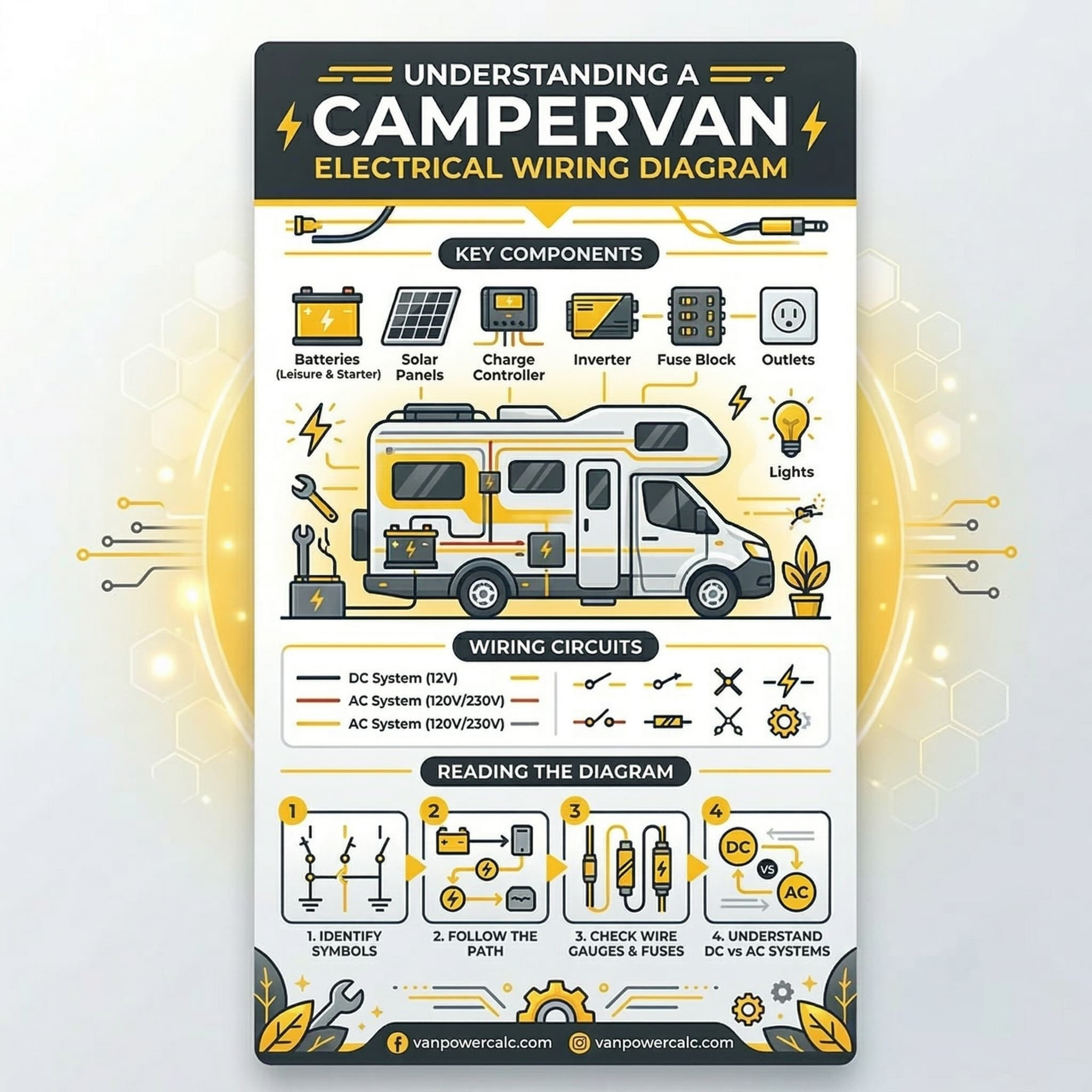
Expert tip
Every new connection in a van electrical system should be torqued to spec and then checked with a load test before installation. A connection that feels tight hand-tight can have 10× more resistance than a properly torqued lug.
Example calculation for your setup
Results based on a typical use case
| Appliance | Power | Usage/day | Wh/day |
|---|---|---|---|
| Compression fridge | 45W | 24h | 1080 |
| LED lighting | 20W | 4h | 80 |
| Water pump | 30W | 0.5h | 15 |
| Phone charging | 15W | 2h | 30 |
| Daily consumption | 1205 Wh | ||
Recommended LiFePO4 battery
151 Ah
(80% depth of discharge)
Recommended AGM battery
241 Ah
(50% depth of discharge)
Recommended solar panels
402 Wc
4h average sun hours
Recommended inverter
No 220V appliances — no inverter needed
Adjust these values with the calculator below
Comparison table
| Grounding method | Use case | Difficulty | Risk |
|---|---|---|---|
| Chassis ground (single-point) | 12V system standard | Easy | Low if done correctly |
| Star ground (battery negative) | Best practice | Medium | Very low |
| Series ground loops | Common mistake | — | High — avoid |
| Bonding + ground bar | Dual-battery setups | Medium | Very low |
About this tool
Two Types of Grounds in a Van Build
Chassis ground (negative from battery to van body metal) and system ground (negative distribution point for all 12V accessories) are often confused. Chassis ground connects your battery negative to the van's metal frame — this is required for engine electrical compatibility and for safety. System ground is your negative bus bar or distribution block where appliance negatives terminate. Both need clean metal-to-metal contact.
Where to Ground: The Right and Wrong Points
The right chassis ground point is always bare, unpainted metal with at least 8 AWG cable (4 AWG recommended for systems over 60A). Remove paint with a wire brush, use a star washer to bite into the metal, and apply dielectric grease after assembly. Wrong points: seat belt mounts (structural, don't modify), thin sheet metal panels (flex and corrode), pre-existing bolts without paint removal. The single best grounding point in a Mercedes Sprinter is the factory chassis ground bolt near the battery — it's already designed for high-current ground and is made of proper steel.
Ground Loops and Corrosion
Running 12V appliance grounds back to the battery negative directly (instead of to a central negative bus bar) creates multiple ground paths of different lengths — called a ground loop. Ground loops cause mysterious interference (radio noise, display flickering) and make finding faults a nightmare. The correct approach: one central negative bus bar near the battery, all appliance negatives go there, one thick cable connects the bus bar to the battery negative terminal.
Testing Your Ground System
Use a multimeter in DC voltage mode. With your system under load (fridge + lights running), measure from battery negative terminal to each appliance's negative terminal. Voltage drop should be under 0.3V. More than that and you have a resistance problem in that ground path. Repeat for chassis ground: battery negative to a chassis bolt should show less than 0.1V.
Dissimilar Metal Corrosion in Vans
Mixing aluminum and copper without protection causes galvanic corrosion — the junction turns into a battery that slowly dissolves one metal. Always use tinned copper wire (not bare copper) in vans, especially near rear doors where humidity enters. Use aluminum-rated connectors for aluminum bus bars. Apply Penetrox or No-Ox-Id paste at any copper-to-aluminum junction.

Frequently asked questions
Where should I ground my van battery negative?▼
To the van's existing factory ground point if accessible (bare metal bolt on chassis), or create a new point on solid chassis metal with paint fully removed. Use at least 4 AWG cable for the main ground run. Add a negative bus bar near the battery for all secondary grounds.
Do I need to ground my battery to the chassis in a van?▼
Yes if you want to use the factory 12V circuits (cigarette lighter, interior lights). No if you're running a completely isolated system (shore power + solar only, no engine integration). Most builds ground to chassis for compatibility.
Why does my fridge make my radio crackle?▼
Ground loop. Your fridge and radio have separate ground paths of different impedance, creating a shared noise path. Fix: run both to the same negative bus bar, and ensure the bus bar has one clean ground to the battery.
How do I test a bad ground connection?▼
Multimeter in DC voltage mode, black probe on battery negative, red probe on the appliance's chassis ground point under load. Reading over 0.3V = bad connection. Find the highest reading point and clean or replace that connection.
Can I use the van body sheet metal as a ground return path?▼
Technically yes, but it's bad practice. Thin sheet metal corrodes, flexes, and has inconsistent resistance. Always run a physical negative wire back to your bus bar — don't rely on body panels for ground return.
Advertising
Independent and free thanks to your clicks
Links marked with * are affiliate links. If a purchase is made through them, I receive a commission at no extra cost to you. The editorial selection and product evaluation are not influenced by commission rates. Your click helps fund this free tool.
Recommended gear
Check price
LiTime 12V 100Ah Bluetooth LiFePO4 (Group 31)Leo's Pick
LiFePO4 12V 100Ah Group 31, Bluetooth monitoring, 100A BMS, low-temp cutoff protection. Up to 15000 deep cycles at 60% DoD. Marine, RV, off-grid use. 222 Amazon reviews. LiTime is a leading mainstream LiFePO4 brand on Amazon US.“This is the battery I've been using in my van for 2 years. Reliable, lightweight, and the best value for money out there.”View on Amazon* →Check price
ECO-WORTHY 200W 12V/24V Solar Kit + 20A Bluetooth MPPTLeo's Pick
Complete 200W solar kit with Bluetooth-monitored MPPT controller. 12V/24V compatible, 20A charge controller with smartphone app. Ideal for vans, RVs, off-grid setups. Single-product solution covering both solar panel and charge controller.“The kit I recommend to every beginner. Plug it in, it works, and the included MPPT controller makes a real difference.”View on Amazon* →$107Amazon
Digital Multimeter
Measures voltage, current, resistance — essential for 12V wiring.“First tool to buy before you even start your install. You'll pull it out 100 times to check voltages and connections.”View on Amazon* →$41Amazon
12V Fuse Box
Protects each circuit independently, easy installation.“One fuse per circuit is the golden rule. This box keeps your install clean and every line independently protected.”View on Amazon* →