Loading...
Fact-checked on Jun 16, 2026
VANPOWERCALC.COMYOUR ENERGY PROFILE
YOUR ENERGY PROFILE.
This document contains the sizing of your future electrical installation, calculated based on your appliances.
Minimum Daily Consumption
0 WH / DAY
Inventory:
SYSTEM SIZINGPage 2
Battery
To guarantee 0WH without damaging your bank (80% max discharge):
0 AH
LiFePO4 12V
Solar
Minimum power required to recharge your consumption:
0 W
via MPPT
220V AC
Maximum power (with 25% safety margin).
0 W
No Need
Safety & CablingPage 3
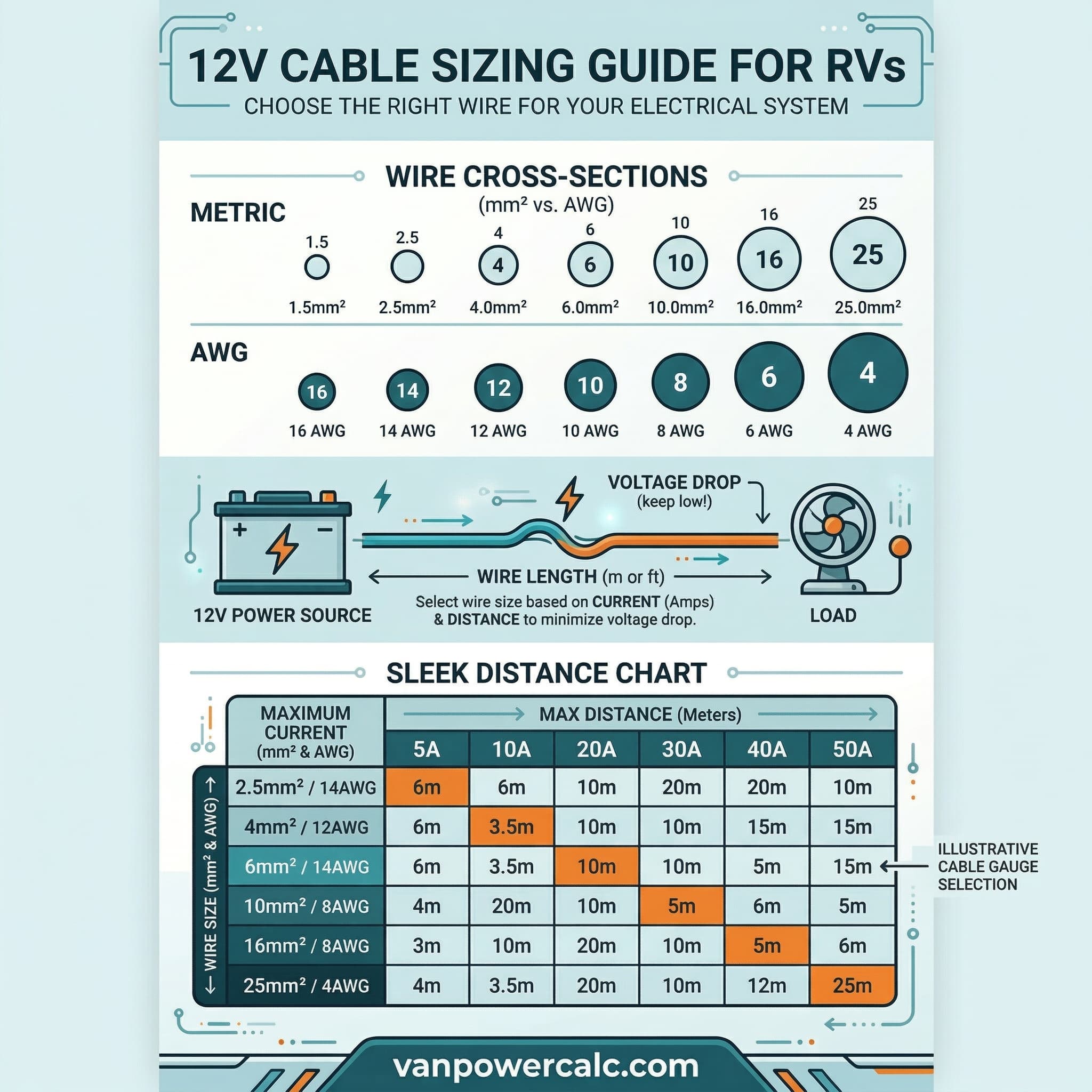
12V Cable Sizing Guide
Use this professional reference table to select the correct gauge (mm²) for your cables. For 12V in a van, the maximum tolerated voltage drop is 3%. Always use multi-stranded flexible automotive wire.
| Current (A) | Round trip < 2m | Round trip 4m | Round trip 6m |
|---|---|---|---|
| 5A (LEDs, USB) | 1.5 mm² | 2.5 mm² | 4 mm² |
| 10A (Fridge, Pump) | 2.5 mm² | 4 mm² | 6 mm² |
| 20A (Heater) | 4 mm² | 10 mm² | 10 mm² |
| 50A (DC/DC Booster) | 10 mm² | 16 mm² | 25 mm² |
| 100A (Inverter) | 25 mm² | 35 mm² | 50 mm² |
Fuse Sizing
The fuse protects the wire, not the appliance. Always place it as close to the power source as possible (battery or busbar).
- Wire 1.5 mm² → Max fuse 10A
- Wire 2.5 mm² → Max fuse 20A
- Wire 4 mm² → Max fuse 30A
- Wire 6 mm² → Max fuse 40A
- Wire 10 mm² → Max fuse 60A
SCHÉMA ÉLECTRIQUE
PANNEAUX SOLAIRES
0W
RÉGULATEUR MPPT
BATTERIE AUXILIAIRE
0 Ah
Lithium LiFePO4
FUSIBLE
FUSIBLE
BOÎTE À FUSIBLES 12V
Pompe, Leds, Frigo...
CONVERTISSEUR 220V
NON REQUI
PRO GEARPage 4
SHOPPING LIST
Where to find this equipment? Here is the community-approved selection.
12V 6-way Fuse Box
Mandatory protection
Digital Multimeter
Test your connections
Heavy Duty Crimping Tool
For perfect lugs
Heat Shrink Tubing
Insulation and safety
GENERATED BY VANPOWERCALC.COM
Why the EG4 12000XP for an RV?#
The EG4 12000XP is a beast: 12kW continuous output, split-phase 240V/120V, built-in dual MPPT inputs, and support for up to 48V battery banks. It's designed for whole-home backup but an increasing number of RV builders are choosing it for one key reason: it provides real 240V at 50A — enough to run a welder, a Level 2 EV charger, or a large air conditioner without a generator. No other single inverter in this price range offers that combination.
Grounding in an RV Context#
The EG4 12000XP is designed for residential installation where the neutral-ground bond is at the main panel. In an RV, this works differently. When connected to shore power, the campground pedestal provides the neutral-ground bond. In off-grid (inverter) mode, you need to configure the EG4 to create its own bond. This is typically done via a ground-neutral switching relay or by enabling the EG4's internal bond setting (check the latest firmware for this option). Failure to get this right means your GFCI outlets won't trip on a ground fault — a life-safety issue.
Panel and PV Setup#
The EG4 12000XP has two independent MPPT inputs, each accepting 150V at up to 6500W. For an RV roof, you're typically limited to 1000-2000W of panels. Wire them in two strings of 4 panels in series (per MPPT input): 4 × 40V Voc = 160V, which exceeds the 150V maximum. Solution: use 3 panels per string (120V Voc), and assign one string to each MPPT input for maximum tracking efficiency. The high idle consumption of the EG4 (~150W) means your solar needs to be substantial to maintain a net positive charge — 600W minimum, 1000W recommended for full-time RV use.
Expert tip
The EG4 12000XP's 150W idle draw is a hidden tax on your battery bank. If you sleep 8 hours without solar, that's 1.2 kWh gone just to keep the inverter alive. Consider powering overnight loads (fridge, fans) directly from a small 12V DC-DC converter and only starting the EG4 when AC is actively needed.
Example calculation for your setup
Results based on a typical use case
| Appliance | Power | Usage/day | Wh/day |
|---|---|---|---|
| Compression fridge | 45W | 24h | 1080 |
| LED lighting | 20W | 4h | 80 |
| Water pump | 30W | 0.5h | 15 |
| Phone charging | 15W | 2h | 30 |
| Daily consumption | 1205 Wh | ||
Recommended LiFePO4 battery
151 Ah
(80% depth of discharge)
Recommended AGM battery
241 Ah
(50% depth of discharge)
Recommended solar panels
402 Wc
4h average sun hours
Recommended inverter
No 220V appliances — no inverter needed
Adjust these values with the calculator below
Comparison table
| Spec | EG4 12000XP | Victron MultiPlus-II 5000 | RV Relevance |
|---|---|---|---|
| Output | 12kW / 240V split | 5kW / 120V single | EG4 for 240V needs |
| PV Input | 2× 150V/6500W MPPT | External MPPT needed | EG4 simpler setup |
| Weight | 52 kg | 30 kg | Victron easier to mount |
| Idle Draw | ~150W | ~20W | Victron better for small systems |
| Price | ~$3,500 | ~$2,800 | Comparable per kW |
About this tool
The EG4 12000XP is a 12kW split-phase inverter-charger (120/240V) increasingly used in RV and van conversions that need full residential power capability — running air conditioners, microwaves, and power tools simultaneously. Its installation has three critical areas where installers consistently make errors: grounding, solar panel string sizing, and the CAN communication setup between battery banks.
Grounding the EG4 12000XP correctly: the 12000XP requires separate bonding for the DC and AC sides. The DC negative (battery bank negative) should be bonded to chassis ground (vehicle frame or building structure) at a single point to prevent ground loops. The AC neutral output must also be bonded to ground at the inverter output (this is the "neutral-ground bond" required for a properly functioning GFCI downstream). Do NOT bond neutral to ground at both the inverter and at a sub-panel — this creates a path for 60Hz return current through the chassis, which causes electrical noise and can trip GFCI breakers erratically.
Solar input wiring for 12000XP: the EG4 12000XP has a built-in 80A MPPT rated for 500V VOC and up to 8,000W of PV input. For an RV installation targeting 4,000W of solar, a string of 10× 400W panels in series gives VOC of 40V × 10 = 400V (within the 500V limit) and an operating voltage of 32V × 10 = 320V (well within the MPPT sweet spot). Parallel strings can be used but require string fusing and are less efficient with the 12000XP's architecture. Maximum cable run from panels to inverter should not exceed 50 feet of 8 AWG wire without increasing to 6 AWG to maintain under 3% voltage drop.
CAN communication with LiFePO4 batteries: the EG4 12000XP communicates with EG4 LifePower4 batteries (and compatible third-party batteries) via a CAN bus port using the Pylontech protocol (also sometimes called EG4 CAN protocol). This allows the battery BMS to tell the inverter the exact allowable charge/discharge current and cell state, enabling "smart" charging. If using batteries without CAN communication: configure the inverter for "Use BatteryType — User Defined" and set the charge parameters manually (absorption 57.6V for 48V bank, float 54V).
Thermal management in RV context: the 12000XP generates significant heat at high loads — rated up to 60°C ambient operation, but the fan runs aggressively above 75% load. Install with at least 6 inches of clearance on all sides and route the fan exhaust outside the electrical compartment. In enclosed RV storage bays without ventilation, internal temperature can rise 20-30°C above ambient, which triggers thermal throttling and efficiency drops. A simple 4-inch bilge fan connected to the thermostat output can prevent this.

Frequently asked questions
Can I install an EG4 12000XP in an RV?▼
Yes, but it requires careful planning for grounding, space (it weighs 52 kg), and ventilation. It provides 240V split-phase, which is unique for mobile applications.
How much solar do I need with the EG4 12000XP?▼
Minimum 600W to offset the 150W idle consumption. 1000-1500W recommended for full-time use to keep the battery bank charged.
How do I handle grounding in an RV with the EG4?▼
Configure the neutral-ground bond to engage in off-grid mode and disengage on shore power. This can be done via a switching relay or the EG4's firmware settings.
What batteries work with the EG4 12000XP?▼
Any 48V LiFePO4 batteries with CAN bus communication. The EG4 LifePower4 or LL series batteries pair directly; third-party batteries may need protocol configuration.
Is the idle consumption too high for RV use?▼
At ~150W continuous idle, it consumes 3.6 kWh/day just being on. With a small battery bank, this is significant. Consider using a power-management relay to turn it on only when AC loads are needed.
Advertising
Independent and free thanks to your clicks
Links marked with * are affiliate links. If a purchase is made through them, I receive a commission at no extra cost to you. The editorial selection and product evaluation are not influenced by commission rates. Your click helps fund this free tool.
Recommended gear
Check price
LiTime 12V 100Ah Bluetooth LiFePO4 (Group 31)Leo's Pick
LiFePO4 12V 100Ah Group 31, Bluetooth monitoring, 100A BMS, low-temp cutoff protection. Up to 15000 deep cycles at 60% DoD. Marine, RV, off-grid use. 222 Amazon reviews. LiTime is a leading mainstream LiFePO4 brand on Amazon US.“This is the battery I've been using in my van for 2 years. Reliable, lightweight, and the best value for money out there.”View on Amazon* →Check price
ECO-WORTHY 200W 12V/24V Solar Kit + 20A Bluetooth MPPTLeo's Pick
Complete 200W solar kit with Bluetooth-monitored MPPT controller. 12V/24V compatible, 20A charge controller with smartphone app. Ideal for vans, RVs, off-grid setups. Single-product solution covering both solar panel and charge controller.“The kit I recommend to every beginner. Plug it in, it works, and the included MPPT controller makes a real difference.”View on Amazon* →$107Amazon
Digital Multimeter
Measures voltage, current, resistance — essential for 12V wiring.“First tool to buy before you even start your install. You'll pull it out 100 times to check voltages and connections.”View on Amazon* →$41Amazon
12V Fuse Box
Protects each circuit independently, easy installation.“One fuse per circuit is the golden rule. This box keeps your install clean and every line independently protected.”View on Amazon* →