Loading...
Fact-checked on Jun 18, 2026
VANPOWERCALC.COMYOUR ENERGY PROFILE
YOUR ENERGY PROFILE.
This document contains the sizing of your future electrical installation, calculated based on your appliances.
Minimum Daily Consumption
0 WH / DAY
Inventory:
SYSTEM SIZINGPage 2
Battery
To guarantee 0WH without damaging your bank (80% max discharge):
0 AH
LiFePO4 12V
Solar
Minimum power required to recharge your consumption:
0 W
via MPPT
220V AC
Maximum power (with 25% safety margin).
0 W
No Need
Safety & CablingPage 3
12V Cable Sizing Guide
Use this professional reference table to select the correct gauge (mm²) for your cables. For 12V in a van, the maximum tolerated voltage drop is 3%. Always use multi-stranded flexible automotive wire.
| Current (A) | Round trip < 2m | Round trip 4m | Round trip 6m |
|---|---|---|---|
| 5A (LEDs, USB) | 1.5 mm² | 2.5 mm² | 4 mm² |
| 10A (Fridge, Pump) | 2.5 mm² | 4 mm² | 6 mm² |
| 20A (Heater) | 4 mm² | 10 mm² | 10 mm² |
| 50A (DC/DC Booster) | 10 mm² | 16 mm² | 25 mm² |
| 100A (Inverter) | 25 mm² | 35 mm² | 50 mm² |
Fuse Sizing
The fuse protects the wire, not the appliance. Always place it as close to the power source as possible (battery or busbar).
- Wire 1.5 mm² → Max fuse 10A
- Wire 2.5 mm² → Max fuse 20A
- Wire 4 mm² → Max fuse 30A
- Wire 6 mm² → Max fuse 40A
- Wire 10 mm² → Max fuse 60A
SCHÉMA ÉLECTRIQUE
PANNEAUX SOLAIRES
0W
RÉGULATEUR MPPT
BATTERIE AUXILIAIRE
0 Ah
Lithium LiFePO4
FUSIBLE
FUSIBLE
BOÎTE À FUSIBLES 12V
Pompe, Leds, Frigo...
CONVERTISSEUR 220V
NON REQUI
PRO GEARPage 4
SHOPPING LIST
Where to find this equipment? Here is the community-approved selection.
12V 6-way Fuse Box
Mandatory protection
Digital Multimeter
Test your connections
Heavy Duty Crimping Tool
For perfect lugs
Heat Shrink Tubing
Insulation and safety
GENERATED BY VANPOWERCALC.COM
A LiFePO4 battery that shuts down at 50% or 60% state of charge is almost always a BMS protection issue, not a battery defect. Under heavy loads — a 2000W inverter, a compressor fridge, or a DC-DC charger — the instantaneous current draw creates a voltage sag that dips below the BMS cutoff threshold, typically 10.5V on a 12V system.
For a full-time van lifer running a Webasto diesel heater, a Nespresso machine, and a MacBook Pro simultaneously, peak draw can hit 180A for 2-3 seconds. Even a quality 100Ah Battle Born or Epoch battery will trigger low-voltage protection under that load if wiring isn't properly sized.
Expert tip
Cell imbalance causes 70% of premature LiFePO4 shutdowns in van builds. To check: charge to full (BMS LED shows full), then use a cell voltage monitor (€15 on Amazon) to check each cell. Healthy 4S pack: all cells between 3.38-3.42V when full. A cell at 3.55V while others are at 3.38V means the BMS balancer isn't working — the pack will shut down prematurely on every discharge cycle until balanced.
Example calculation for your setup
Results based on a typical use case
| Appliance | Power | Usage/day | Wh/day |
|---|---|---|---|
| Compression fridge | 45W | 24h | 1080 |
| LED lighting | 20W | 4h | 80 |
| Water pump | 30W | 0.5h | 15 |
| Phone charging | 15W | 2h | 30 |
| Daily consumption | 1205 Wh | ||
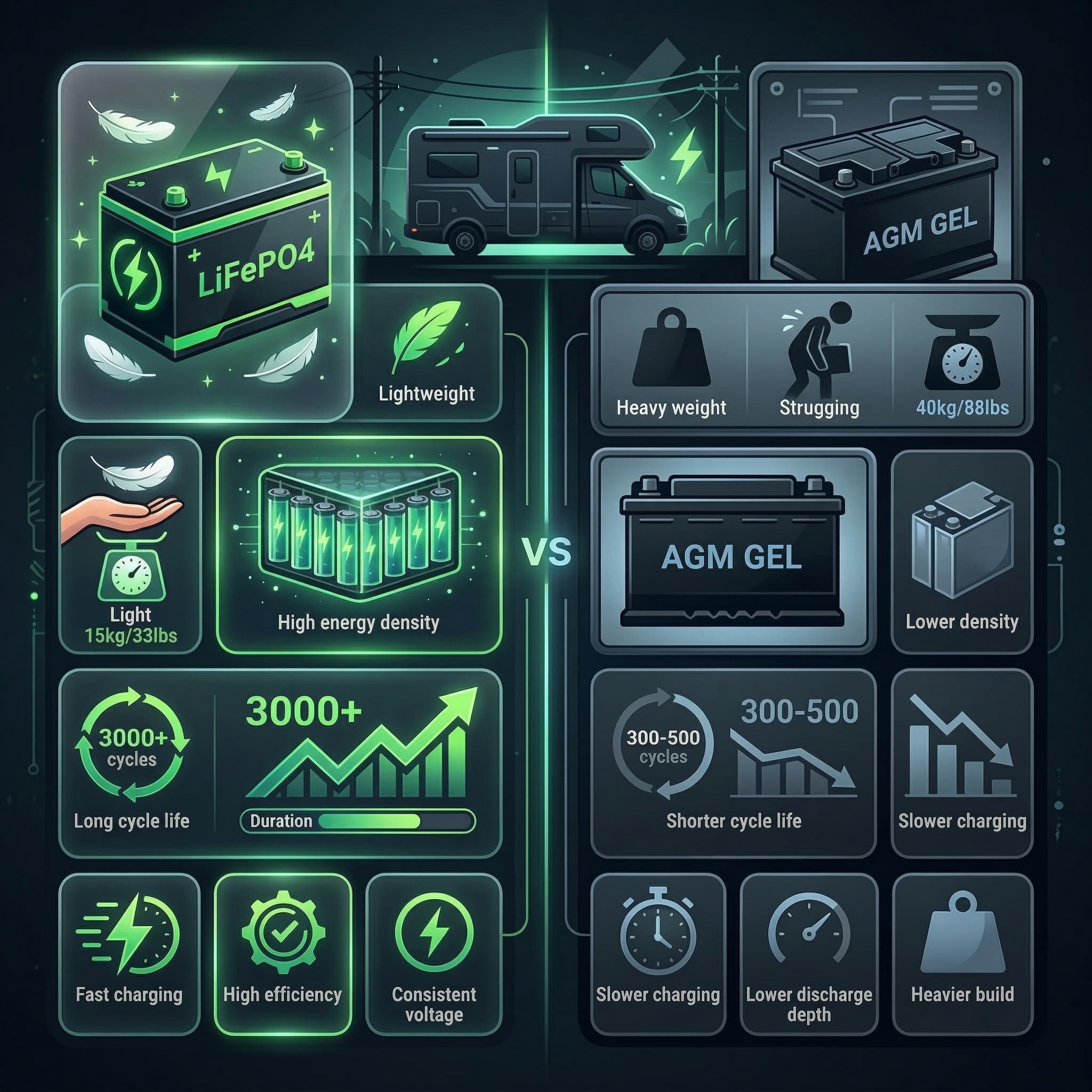
Recommended LiFePO4 battery
151 Ah
(80% depth of discharge)
Recommended AGM battery
241 Ah
(50% depth of discharge)
Adjust these values with the calculator below
Comparison table
| Issue | Symptom | Fix |
|---|---|---|
| Undersized wiring | Shuts off under load, wiring gets warm | Upgrade to 4/0 AWG, shorten runs |
| BMS cutoff too high | Cuts at 50-60% SoC | Adjust via app or contact manufacturer |
| Inverter surge | Shuts off when compressor starts | Add soft-start device, check inrush specs |
| Cold temps | Early shutdown in winter | Self-heating battery or battery blanket |
About this tool
A LiFePO4 battery shutting down early is one of the most frustrating van life experiences — your system was supposedly full charged at sunset, and by midnight the fridge alarms. Understanding why this happens, and how to fix it, starts with identifying which BMS protection triggered.
The main BMS protection mechanisms in a standard LiFePO4: low-voltage cutoff (any cell below 2.5V), over-current cutoff (discharge current exceeds BMS C-rate), over-temperature cutoff (cells above 60°C), under-temperature charge cutoff (temperature below 0°C), and cell imbalance protection (difference between cells exceeds threshold).
Diagnosis checklist: First, when does the shutdown happen? Under high load (inverter running) = overcurrent issue. At night with just the fridge = low voltage from undersized battery or high overnight consumption. In cold weather = temperature cutoff from cheap BMS. Second, what voltage does your Bluetooth battery app show at the moment of cutoff? Above 11.5V suggests overcurrent, not low voltage. Below 11.0V = genuinely depleted.
The most common real-world cause: cell imbalance in budget LiFePO4 packs. When one cell group is weaker than others, it hits the 2.5V minimum while the rest of the pack still has 30% capacity. The BMS correctly protects the weak cell by shutting the whole pack down — but the result is a pack that appears to have 70% remaining capacity while already being "empty." Fix: run the pack through 3-5 full charge-discharge cycles to allow the BMS balancer to equalize cells.
For legitimate capacity shortfall (not a fault, just undersized system): use VanPowerCalc battery calculator to verify. Input your actual overnight loads — fridge cycling at 40W average × 10 hours = 400Wh. LED lights 20W × 3h = 60Wh. Phone charging 15Wh. Diesel heater 8W × 8h = 64Wh. Total: 539Wh overnight. A 100Ah LiFePO4 (1200Wh usable) has comfortable 2.2× margin — but a 75Ah budget pack (900Wh usable) at 60% state when it gets cold in October is going to die at 3 AM every time.
Diagnosing the root cause systematically: First, verify with a multimeter that the battery BMS is actually the cutoff point. Measure voltage at the battery terminals during load — if it drops below 10.5V momentarily, the BMS is doing its job protecting over-discharged cells. Next, measure at the MPPT output terminals: if there is solar available, is the battery accepting charge? A non-accepting battery indicates temperature lockout (BMS blocking charge below 0-5°C) or cell imbalance.
Cell imbalance as the primary cause of premature shutdowns: In multi-cell LiFePO4 packs, one weaker cell hits low-voltage cutoff before the others. The BMS shuts down the entire pack to protect the weak cell, even though 3 of 4 cells (for a 4S pack) still have charge remaining. Fix: a passive or active balancer running during the float/maintenance phase will equalize the cells. Victron MPPT with absorption phase enabled (14.2-14.4V bulk, 30 minutes absorption) provides some passive balancing for most LiFePO4 packs.
Long-term fix for chronically imbalanced packs: manually top-balance cells. Disconnect the BMS, charge each cell individually to exactly 3.65V, reconnect. This is a once-every-2-year maintenance task that keeps packs performing at their rated capacity for the full cycle life.

Frequently asked questions
Why is my LiFePO4 battery shutting down early?▼
Early shutdown is almost always a BMS protection trigger — either low-voltage cutoff, over-current protection, or temperature protection. Check BMS voltage: if cutoff occurs at 11.8V under load, the cell grouping may be unbalanced (one cell hits 2.5V while others are at 3.1V). If cutoff occurs under high load (inverter), verify the BMS continuous discharge rating matches your peak current draw.
What voltage does a LiFePO4 battery shut down at?▼
A healthy 12V 4S LiFePO4 (four 3.2V cells in series) shuts down when any single cell drops below 2.5V under the BMS low-voltage cutoff, which typically occurs when the pack voltage reaches 10.0-11.0V under load. Most quality BMS units cut off at 10.0V pack voltage. If your BMS cuts off at 12.0V or higher, the BMS is set too conservatively for LiFePO4 (appropriate for AGM, not LiFePO4).
How do I prevent my LiFePO4 from shutting down at night?▼
Step 1: verify overnight consumption. Fridge cycling on/off at 5A average + MPPT controller quiescent (0.01A) + charge controller LED = 5-6A overnight = 60Ah from an 8am to 8pm off period. A 100Ah LiFePO4 at 100% charged before sunset has 100Ah available — sufficient for one night only. Solution: either add battery capacity or reduce overnight loads (fridge temperature setting, insulation).
Can high current loads cause early LiFePO4 shutdown?▼
Yes — a 2000W inverter at 12V draws 166A continuously. If your LiFePO4 BMS is rated for 100A continuous, the 166A draw triggers overcurrent protection immediately, not from low voltage but from current limit. Solution: either uprate the battery (use a 200A+ BMS rated pack like Victron Smart LiFePO4 200Ah) or reduce load (use a pure sine 1000W inverter for most tasks, only the 2000W for peak moments).
Why does my LiFePO4 shut down faster in cold weather?▼
LiFePO4 capacity decreases with temperature: at 0°C, a 100Ah cell delivers only 75-80Ah usable; at -10°C, 50-60Ah. Additionally, most BMS units disable charging (not discharging) below 0°C to prevent lithium plating — but some cheaper BMS units also restrict discharge below 5°C. In cold climates, insulate the battery compartment and consider a self-heating LiFePO4 (available from Lithium Battle Born, Renogy, and others at €50-100 premium).
Advertising
Independent and free thanks to your clicks
Links marked with * are affiliate links. If a purchase is made through them, I receive a commission at no extra cost to you. The editorial selection and product evaluation are not influenced by commission rates. Your click helps fund this free tool.
Recommended gear
Check price
LiTime 12V 100Ah Bluetooth LiFePO4 (Group 31)Leo's Pick
LiFePO4 12V 100Ah Group 31, Bluetooth monitoring, 100A BMS, low-temp cutoff protection. Up to 15000 deep cycles at 60% DoD. Marine, RV, off-grid use. 222 Amazon reviews. LiTime is a leading mainstream LiFePO4 brand on Amazon US.“This is the battery I've been using in my van for 2 years. Reliable, lightweight, and the best value for money out there.”View on Amazon* →Check price
LiFePO4 200Ah 12V Battery
200Ah true capacity, 200A built-in BMS, 5000+ cycles.“If you work remotely or run a fridge, go straight for 200Ah. You'll never regret having too much capacity.”View on Amazon* →$114Amazon
Victron BMV-712 Battery Monitor
Real-time SOC, history, Bluetooth alarms. Must-have.“Without a monitor, you're flying blind. This one gives you the exact battery % in real time — a total game-changer.”View on Amazon* →$56Amazon
Victron Orion DC-DC Charger 30A
Charges battery from alternator with correct Li profile.“Essential if you have a Euro 6+ vehicle. I've installed it on 3 different vans, zero issues. It charges your battery as soon as you drive.”View on Amazon* →