Loading...
Fact-checked on Jun 10, 2026
VANPOWERCALC.COMYOUR ENERGY PROFILE
YOUR ENERGY PROFILE.
This document contains the sizing of your future electrical installation, calculated based on your appliances.
Minimum Daily Consumption
0 WH / DAY
Inventory:
SYSTEM SIZINGPage 2
Battery
To guarantee 0WH without damaging your bank (80% max discharge):
0 AH
LiFePO4 12V
Solar
Minimum power required to recharge your consumption:
0 W
via MPPT
220V AC
Maximum power (with 25% safety margin).
0 W
No Need
Safety & CablingPage 3
12V Cable Sizing Guide
Use this professional reference table to select the correct gauge (mm²) for your cables. For 12V in a van, the maximum tolerated voltage drop is 3%. Always use multi-stranded flexible automotive wire.
| Current (A) | Round trip < 2m | Round trip 4m | Round trip 6m |
|---|---|---|---|
| 5A (LEDs, USB) | 1.5 mm² | 2.5 mm² | 4 mm² |
| 10A (Fridge, Pump) | 2.5 mm² | 4 mm² | 6 mm² |
| 20A (Heater) | 4 mm² | 10 mm² | 10 mm² |
| 50A (DC/DC Booster) | 10 mm² | 16 mm² | 25 mm² |
| 100A (Inverter) | 25 mm² | 35 mm² | 50 mm² |
Fuse Sizing
The fuse protects the wire, not the appliance. Always place it as close to the power source as possible (battery or busbar).
- Wire 1.5 mm² → Max fuse 10A
- Wire 2.5 mm² → Max fuse 20A
- Wire 4 mm² → Max fuse 30A
- Wire 6 mm² → Max fuse 40A
- Wire 10 mm² → Max fuse 60A
SCHÉMA ÉLECTRIQUE
PANNEAUX SOLAIRES
0W
RÉGULATEUR MPPT
BATTERIE AUXILIAIRE
0 Ah
Lithium LiFePO4
FUSIBLE
FUSIBLE
BOÎTE À FUSIBLES 12V
Pompe, Leds, Frigo...
CONVERTISSEUR 220V
NON REQUI
PRO GEARPage 4
SHOPPING LIST
Where to find this equipment? Here is the community-approved selection.
12V 6-way Fuse Box
Mandatory protection
Digital Multimeter
Test your connections
Heavy Duty Crimping Tool
For perfect lugs
Heat Shrink Tubing
Insulation and safety
GENERATED BY VANPOWERCALC.COM
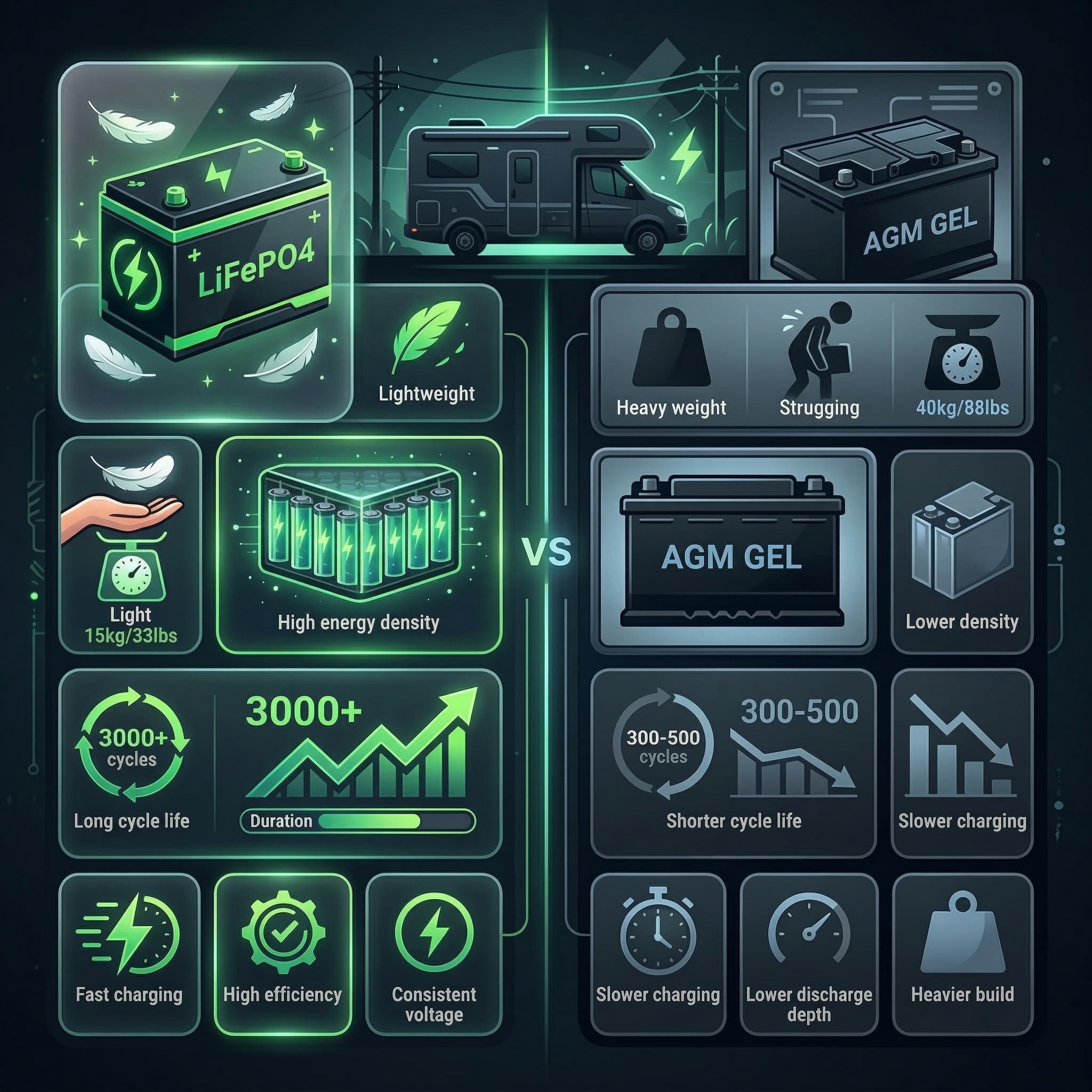
The most asked question in van build communities: "Is LiFePO4 worth it over AGM?" The short answer depends on how long you keep the van and how often you use the battery. Over a 5-year van life with daily use, LiFePO4 is almost always cheaper per kWh cycled — often 40-60% cheaper. For a van you use 2 weeks a year: AGM might make more financial sense.
Key numbers for the comparison: LiFePO4 200Ah (Battle Born, SOK): ~€500-800, weighs 25-28kg, usable capacity 190Ah (95%), 3000+ cycles to 80% capacity, compatible with any MPPT charger. AGM 200Ah (Victron, Renogy): ~€180-300, weighs 58-65kg, usable capacity 100Ah (50%), 400-600 cycles to 80% capacity. The "cheap" AGM becomes expensive when you factor in replacement frequency and the extra 30-40kg you carry for the same usable energy.
Expert tip
If upgrading from AGM to LiFePO4 mid-build: do not just swap the batteries. You must also update the charger profile on your MPPT, reconfigure any shore power charger, and add a DC-DC charger if you have a Euro 6 engine (VSR will no longer work). Running LiFePO4 with an AGM charger profile will work short-term but will slowly damage cells over 12-18 months.
Example calculation for your setup
Results based on a typical use case
| Appliance | Power | Usage/day | Wh/day |
|---|---|---|---|
| Compression fridge | 45W | 24h | 1080 |
| LED lighting | 20W | 4h | 80 |
| Water pump | 30W | 0.5h | 15 |
| Phone charging | 15W | 2h | 30 |
| Daily consumption | 1205 Wh | ||
Recommended LiFePO4 battery
151 Ah
(80% depth of discharge)
Recommended AGM battery
241 Ah
(50% depth of discharge)
Adjust these values with the calculator below
Comparison table
| Feature | LiFePO4 200Ah | AGM 200Ah | Winner |
|---|---|---|---|
| Price | €500-800 | €180-300 | AGM |
| Usable Capacity | 180Ah (90%) | 100Ah (50%) | LiFePO4 |
| Weight | 25-28kg | 58-65kg | LiFePO4 |
| Cycle Life | 3000+ cycles | 400-600 cycles | LiFePO4 |
| Cost/kWh cycled | ~€1.25 | ~€5.00 | LiFePO4 |
| Winter charging | 0°C min (BMS) | −20°C OK | AGM |
| Drop-in replace? | Check charger | Yes | AGM |
About this tool
The complete data-driven comparison between LiFePO4 and AGM for van builds — with the real numbers that matter.
Usable capacity: This is the most misunderstood difference. LiFePO4 should only be discharged to 10-20% SoC (80-90% usable DoD). AGM should only be discharged to 50% SoC max (50% usable DoD) to maintain cycle life. Real-world: a 200Ah AGM = 100Ah usable. A 200Ah LiFePO4 = 180Ah usable. To get 180Ah usable from AGM: you need a 360Ah AGM bank = 2× 180Ah batteries = 116-130kg and €360-600 — versus one 200Ah LiFePO4 at 25kg and €500-800.
Cycle life and real cost per kWh: LiFePO4 200Ah at €600, 3000 cycles at 80% DoD (160Ah per cycle): total energy delivered = 480,000 Wh = 480 kWh. Cost per kWh: €600 ÷ 480 = €1.25/kWh. AGM 200Ah at €250, 500 cycles at 50% DoD (100Ah per cycle): total energy = 50,000 Wh = 50 kWh. Cost per kWh: €250 ÷ 50 = €5.00/kWh. LiFePO4 is 4× cheaper per kWh cycled in the long run.
Weight: For a van build targeting a 200Ah usable bank — LiFePO4: 25-28kg. AGM equivalent (360Ah AGM): 117-130kg. Weight saving: 90-105kg. This matters for payload capacity, for off-road vehicles, for fuel economy (90kg extra = ~0.3-0.5L/100km extra diesel consumption), and for B-license weight limits.
Charging compatibility: LiFePO4 requires a charger with a LiFePO4 profile (absorption at 14.2-14.6V, no equalization, float at 13.6V or absorb-end). Most MPPT solar controllers sold after 2020 have LiFePO4 profiles. Shore power chargers (CTEK, Victron, Sterling): check the specifications — many older units only go to 14.4V absorption which is acceptable but not optimal. Smart alternator (Euro 6): LiFePO4 requires a DC-DC charger — a VSR/combiner relay does not work reliably.
Temperature behavior: LiFePO4 should not be charged below 0°C without a battery management system that has low-temperature cutoff. Most quality LiFePO4 batteries (Battle Born, SOK, EcoFlow) have internal BMS with low-temp charge protection. AGM can be charged at temperatures as low as -20°C (slowly). For winter van builds crossing below-zero nights without heating: verify your LiFePO4 BMS spec or add a self-heating battery (Renogy, Eco-Worthy).

Frequently asked questions
Is LiFePO4 really worth the extra cost over AGM for a van?▼
Yes, for daily/frequent use over 3+ years. The cost per usable kWh over the battery life is 3-5× cheaper for LiFePO4. Break-even typically occurs at 2-3 years of regular use. For seasonal-only use (2-4 weeks/year), AGM might still make sense due to lower upfront cost.
Can I use a regular AGM charger with a LiFePO4 battery?▼
Not recommended. AGM chargers run equalization cycles (typically 15.5-16V) which damage LiFePO4 cells permanently. Use a charger with a dedicated LiFePO4 profile (14.2-14.6V absorption, no equalization). Most modern MPPTs (Victron, Renogy) have LiFePO4 settings — just switch the profile.
What is the real weight difference between LiFePO4 and AGM?▼
For the same usable energy (100Ah usable): LiFePO4 100Ah = 13-14kg. AGM equivalent (200Ah bank for 100Ah usable) = 58-65kg. Weight saving per 100Ah usable energy: approximately 45-50kg. For a 200Ah usable build (common for van life): LiFePO4 200Ah = 25kg vs AGM 400Ah bank = 130kg.
Can LiFePO4 freeze in winter?▼
LiFePO4 cells should not be charged below 0°C — charging at sub-zero temperatures can cause lithium plating that permanently reduces capacity. Discharging is fine down to -20°C. Most quality LiFePO4 batteries have a BMS low-temperature cutoff that prevents charging below 0°C. In a heated van: not an issue. Unheated van in alpine winter: verify BMS specs.
Which LiFePO4 brands are reliable in 2024?▼
Top tier: Battle Born (US, ~€750/100Ah, excellent BMS, long track record), Victron SmartLithium (premium, excellent for Victron ecosystems). Good value: SOK Battery (~€400/100Ah), LiTime (formerly Ampere Time, ~€280/100Ah, good reviews). Budget: EcoWorthy, Enjoybot — acceptable quality at lower price, shorter warranty (2 years vs 10 years for Battle Born).
Advertising
Independent and free thanks to your clicks
Links marked with * are affiliate links. If a purchase is made through them, I receive a commission at no extra cost to you. The editorial selection and product evaluation are not influenced by commission rates. Your click helps fund this free tool.
Recommended gear
Check price
LiTime 12V 100Ah Bluetooth LiFePO4 (Group 31)Leo's Pick
LiFePO4 12V 100Ah Group 31, Bluetooth monitoring, 100A BMS, low-temp cutoff protection. Up to 15000 deep cycles at 60% DoD. Marine, RV, off-grid use. 222 Amazon reviews. LiTime is a leading mainstream LiFePO4 brand on Amazon US.“This is the battery I've been using in my van for 2 years. Reliable, lightweight, and the best value for money out there.”View on Amazon* →Check price
LiFePO4 200Ah 12V Battery
200Ah true capacity, 200A built-in BMS, 5000+ cycles.“If you work remotely or run a fridge, go straight for 200Ah. You'll never regret having too much capacity.”View on Amazon* →$114Amazon
Victron BMV-712 Battery Monitor
Real-time SOC, history, Bluetooth alarms. Must-have.“Without a monitor, you're flying blind. This one gives you the exact battery % in real time — a total game-changer.”View on Amazon* →$56Amazon
Victron Orion DC-DC Charger 30A
Charges battery from alternator with correct Li profile.“Essential if you have a Euro 6+ vehicle. I've installed it on 3 different vans, zero issues. It charges your battery as soon as you drive.”View on Amazon* →