Loading...
Fact-checked on Mar 15, 2026
VANPOWERCALC.COMYOUR ENERGY PROFILE
YOUR ENERGY PROFILE.
This document contains the sizing of your future electrical installation, calculated based on your appliances.
Minimum Daily Consumption
0 WH / DAY
Inventory:
SYSTEM SIZINGPage 2
Battery
To guarantee 0WH without damaging your bank (80% max discharge):
0 AH
LiFePO4 12V
Solar
Minimum power required to recharge your consumption:
0 W
via MPPT
220V AC
Maximum power (with 25% safety margin).
0 W
No Need
Safety & CablingPage 3
12V Cable Sizing Guide
Use this professional reference table to select the correct gauge (mm²) for your cables. For 12V in a van, the maximum tolerated voltage drop is 3%. Always use multi-stranded flexible automotive wire.
| Current (A) | Round trip < 2m | Round trip 4m | Round trip 6m |
|---|---|---|---|
| 5A (LEDs, USB) | 1.5 mm² | 2.5 mm² | 4 mm² |
| 10A (Fridge, Pump) | 2.5 mm² | 4 mm² | 6 mm² |
| 20A (Heater) | 4 mm² | 10 mm² | 10 mm² |
| 50A (DC/DC Booster) | 10 mm² | 16 mm² | 25 mm² |
| 100A (Inverter) | 25 mm² | 35 mm² | 50 mm² |
Fuse Sizing
The fuse protects the wire, not the appliance. Always place it as close to the power source as possible (battery or busbar).
- Wire 1.5 mm² → Max fuse 10A
- Wire 2.5 mm² → Max fuse 20A
- Wire 4 mm² → Max fuse 30A
- Wire 6 mm² → Max fuse 40A
- Wire 10 mm² → Max fuse 60A
SCHÉMA ÉLECTRIQUE
PANNEAUX SOLAIRES
0W
RÉGULATEUR MPPT
BATTERIE AUXILIAIRE
0 Ah
Lithium LiFePO4
FUSIBLE
FUSIBLE
BOÎTE À FUSIBLES 12V
Pompe, Leds, Frigo...
CONVERTISSEUR 220V
NON REQUI
PRO GEARPage 4
SHOPPING LIST
Where to find this equipment? Here is the community-approved selection.
12V 6-way Fuse Box
Mandatory protection
Digital Multimeter
Test your connections
Heavy Duty Crimping Tool
For perfect lugs
Heat Shrink Tubing
Insulation and safety
GENERATED BY VANPOWERCALC.COM
The Cold Weather Problem with LiFePO4#
LiFePO4 batteries have one critical weakness: they cannot be charged below 0°C (32°F). Attempting to charge below freezing causes lithium plating on the anode — permanent, irreversible damage that reduces capacity and can eventually cause internal shorts. Most quality BMS units block charging below 0°C automatically, but the result is the same: your solar panels produce power on a sunny winter morning, and your battery refuses to accept it.
Discharging Is Fine#
The good news: LiFePO4 batteries can be discharged normally down to -20°C (-4°F). You'll lose some capacity (about 10-15% at -10°C compared to 25°C), but the battery operates safely. The danger is exclusively in charging.
The Timing Problem#
In winter, your battery temperature is lowest in the morning — exactly when the sun rises and your solar panels start producing. The BMS blocks charging. By midday, as your heater has warmed the van interior, the battery warms above 0°C. But by then, you've missed 2-3 hours of the best solar production. In northern climates with only 4-6 hours of usable sun, losing half your charging window is devastating.
Solutions That Actually Work#
Solution 1: Self-Heated Batteries — Some LiFePO4 batteries (SOK heated models, Victron Smart with heating kit) have internal heating elements that engage below 5°C and warm the cells before allowing charge. This is the cleanest solution: the heater draws 20-30W from the battery itself, warms the cells to safe temperature, and then charging begins automatically. Cost: $50-100 more than non-heated models.
Solution 2: External Heating Mat — A 12V silicone heating mat ($20-30) wrapped around the battery, controlled by a thermostat set to activate at 5°C and deactivate at 15°C. Simple, effective, and works with any battery. Draw: 20-40W. Downside: requires a thermostat controller and wiring.
Solution 3: Keep the Battery Warm — Install the battery inside the heated living space (under the bed, in a cabinet) where your diesel heater keeps the ambient temperature above 10°C. This is the default solution for most van builds and works well as long as you run your heater overnight.
Expert tip
The cheapest winter battery protection is insulation, not heating. Wrap your battery compartment with 20mm XPS foam board on all sides. This doesn't prevent freezing during multi-day cold snaps, but it dramatically slows heat loss — your battery might stay above 5°C until noon instead of dawn, buying you 3-4 extra hours of solar charging.
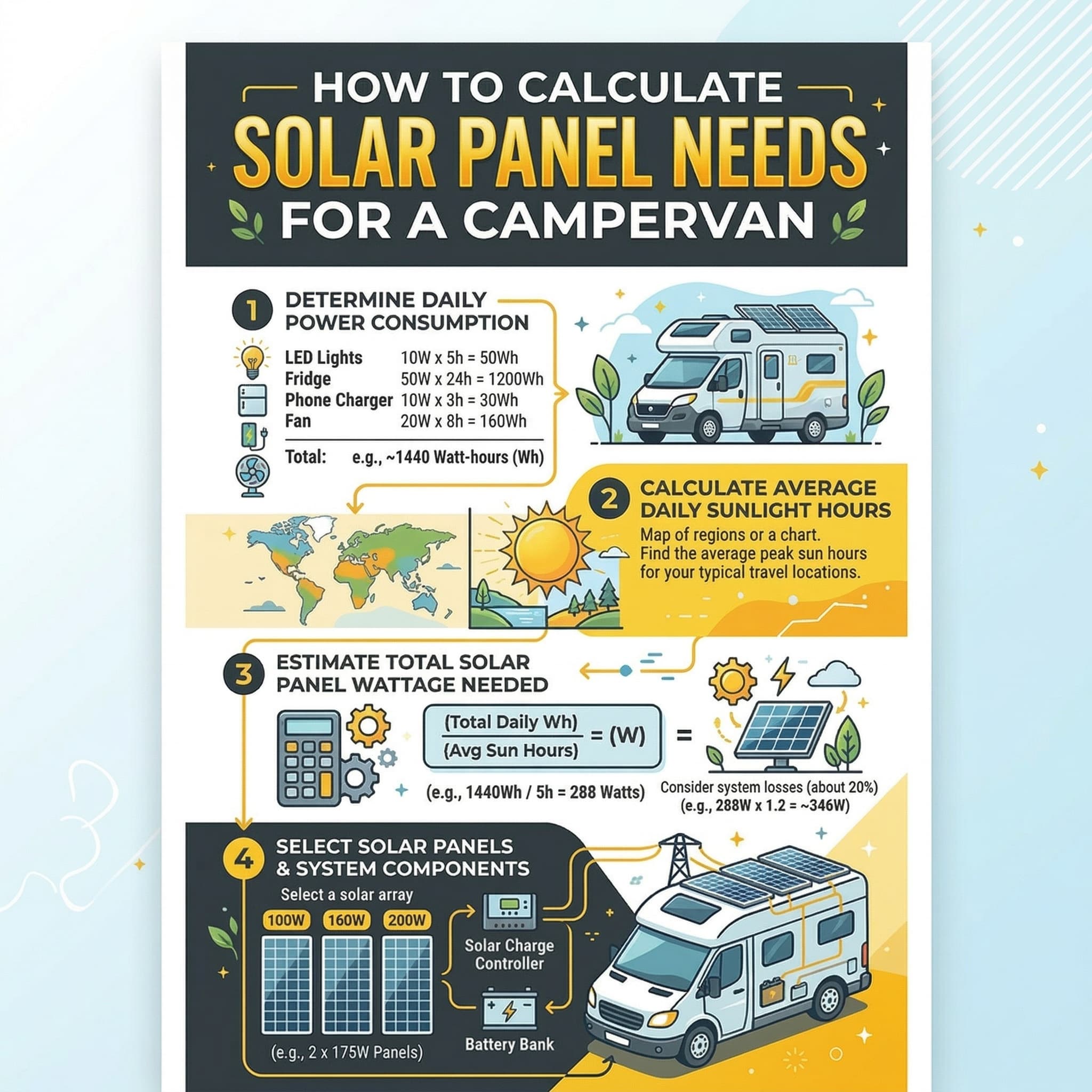
Example calculation for your setup
Results based on a typical use case
| Appliance | Power | Usage/day | Wh/day |
|---|---|---|---|
| Compression fridge | 45W | 24h | 1080 |
| LED lighting | 20W | 4h | 80 |
| Water pump | 30W | 0.5h | 15 |
| Phone charging | 15W | 2h | 30 |
| Daily consumption | 1205 Wh | ||
Recommended LiFePO4 battery
151 Ah
(80% depth of discharge)
Recommended AGM battery
241 Ah
(50% depth of discharge)
Adjust these values with the calculator below
Comparison table
| Temperature | Discharge OK? | Charge OK? | Capacity Loss |
|---|---|---|---|
| 25°C (77°F) | Yes | Yes | 0% (baseline) |
| 10°C (50°F) | Yes | Yes | ~5% |
| 0°C (32°F) | Yes | BMS blocks | ~10% |
| -10°C (14°F) | Yes | BMS blocks | ~15% |
| -20°C (-4°F) | Yes (limit) | BMS blocks | ~20-25% |
About this tool
LiFePO4 batteries in cold weather are a concern that every winter camper raises — and the concern is half-justified. The discharge performance of LiFePO4 at 0°C is 95-98% of its rated capacity (nearly no loss). The charge restriction below 0°C is very real and must be respected to avoid lithium plating, which permanently damages cells.
The chemistry: below 0°C (32°F), lithium ions cannot intercalate properly into the graphite anode during charging. Instead, metallic lithium plates onto the surface of the anode — permanently damaging the cell and reducing capacity. Most quality BMS boards (JK BMS, Daly, Chargery) have a low-temperature charge cutoff at 0°C to 5°C that prevents this automatically. The discharge cutoff is much lower: most LiFePO4 cells can discharge safely down to -20°C, though internal resistance rises by 40-60% at -20°C, reducing available power.
Solar performance in winter camping: the good news is that solar panels are actually slightly more efficient in cold weather (silicon efficiency increases by 0.4-0.5% per degree Celsius below 25°C). However, shorter days and lower sun angles reduce total energy yield dramatically — a 400W system in Scotland in January might only produce 150-300 Wh/day compared to 1,800-2,000 Wh in July. If you plan to charge from solar in below-freezing conditions, you need either a self-heating LiFePO4 battery or an insulated battery box with a small heating pad (10-20W thermostat-controlled).
Heating solutions compared: 1) Self-heating batteries (Renogy 100Ah Self-Heating, Ampere Time 100Ah with heat): draw 50-80W to heat the cells to 5°C before accepting a charge. In practice, this takes 15-30 minutes on a very cold morning. Cost premium vs standard: $80-150. 2) External battery heater pads (BougeRV, Renogy): thermostat-controlled, mount inside insulated battery box. Draw 30-50W continuously when temperature is below the set point. Effective to -20°C with good insulation. Cost: $40-80. 3) Heated van interior: parking in a slightly warm garage overnight, or leaving the diesel heater on low, keeps battery above 0°C without any dedicated heating.
Practical winter camper setup: pair a 200Ah LiFePO4 with self-heating (or a heated battery box), 400W solar, and a Victron SmartSolar MPPT 100/30 with battery temperature sensor (the MPPT automatically limits charge current when temperature drops, protecting the cells even without BMS level protection).

Frequently asked questions
Can I charge LiFePO4 below freezing?▼
No. Charging below 0°C causes permanent damage (lithium plating). Most BMS units automatically block charging below 0-5°C.
Can I use LiFePO4 in winter?▼
Yes, discharging works fine to -20°C. Only charging is restricted below 0°C. Use a heated battery or keep it in a warm space.
How much capacity do I lose in cold weather?▼
About 10-15% at -10°C. At -20°C, expect 20-25% less capacity. The battery is not damaged — capacity returns when it warms up.
Are self-heated LiFePO4 batteries worth it?▼
Yes, for winter campers. They add $50-100 to the cost but automatically solve the cold-charging problem without external components.
What happens if the BMS blocks charging?▼
Your solar panels produce power but the battery won't accept it. The MPPT controller sits idle until the battery warms above the BMS threshold. You lose all solar production during that time.
Advertising
Independent and free thanks to your clicks
Links marked with * are affiliate links. If a purchase is made through them, I receive a commission at no extra cost to you. The editorial selection and product evaluation are not influenced by commission rates. Your click helps fund this free tool.
Recommended gear
$130Amazon
200W Rigid Solar Panel
Mono 200W, 22%+ efficiency, rigid aluminum frame for van roof.“I tested 4 panels before this one. Great efficiency even in overcast weather, and it sits well on a van roof.”View on Amazon* →Check price
ECO-WORTHY 200W 12V/24V Solar Kit + 20A Bluetooth MPPTLeo's Pick
Complete 200W solar kit with Bluetooth-monitored MPPT controller. 12V/24V compatible, 20A charge controller with smartphone app. Ideal for vans, RVs, off-grid setups. Single-product solution covering both solar panel and charge controller.“The kit I recommend to every beginner. Plug it in, it works, and the included MPPT controller makes a real difference.”View on Amazon* →$115Amazon
Victron MPPT Controller 100/30
Extracts 97% solar power, Li & AGM compatible.“The Victron is pricey, but you install it once and forget about it. The Bluetooth app is a real plus for tracking solar output.”View on Amazon* →$38Amazon
Solar Cable 6mm² MC4 10m
6mm² solar cable with pre-crimped MC4 connectors, 10m.“Don't cheap out on solar cables. 6mm² between panels and controller is the minimum to avoid power losses.”View on Amazon* →