Loading...
Fact-checked on Apr 2, 2026
VANPOWERCALC.COMYOUR ENERGY PROFILE
YOUR ENERGY PROFILE.
This document contains the sizing of your future electrical installation, calculated based on your appliances.
Minimum Daily Consumption
0 WH / DAY
Inventory:
SYSTEM SIZINGPage 2
Battery
To guarantee 0WH without damaging your bank (80% max discharge):
0 AH
LiFePO4 12V
Solar
Minimum power required to recharge your consumption:
0 W
via MPPT
220V AC
Maximum power (with 25% safety margin).
0 W
No Need
Safety & CablingPage 3
12V Cable Sizing Guide
Use this professional reference table to select the correct gauge (mm²) for your cables. For 12V in a van, the maximum tolerated voltage drop is 3%. Always use multi-stranded flexible automotive wire.
| Current (A) | Round trip < 2m | Round trip 4m | Round trip 6m |
|---|---|---|---|
| 5A (LEDs, USB) | 1.5 mm² | 2.5 mm² | 4 mm² |
| 10A (Fridge, Pump) | 2.5 mm² | 4 mm² | 6 mm² |
| 20A (Heater) | 4 mm² | 10 mm² | 10 mm² |
| 50A (DC/DC Booster) | 10 mm² | 16 mm² | 25 mm² |
| 100A (Inverter) | 25 mm² | 35 mm² | 50 mm² |
Fuse Sizing
The fuse protects the wire, not the appliance. Always place it as close to the power source as possible (battery or busbar).
- Wire 1.5 mm² → Max fuse 10A
- Wire 2.5 mm² → Max fuse 20A
- Wire 4 mm² → Max fuse 30A
- Wire 6 mm² → Max fuse 40A
- Wire 10 mm² → Max fuse 60A
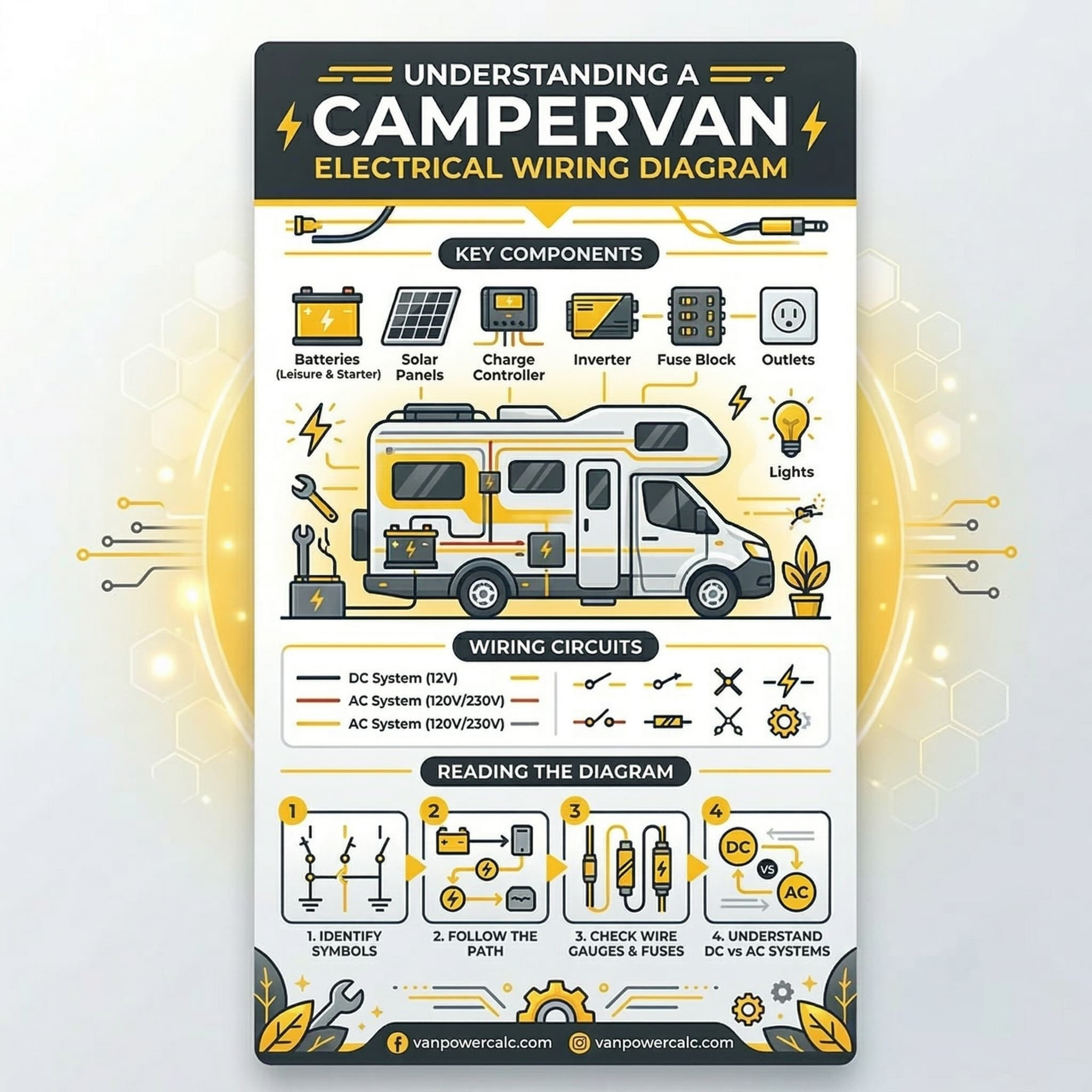
SCHÉMA ÉLECTRIQUE
PANNEAUX SOLAIRES
0W
RÉGULATEUR MPPT
BATTERIE AUXILIAIRE
0 Ah
Lithium LiFePO4
FUSIBLE
FUSIBLE
BOÎTE À FUSIBLES 12V
Pompe, Leds, Frigo...
CONVERTISSEUR 220V
NON REQUI
PRO GEARPage 4
SHOPPING LIST
Where to find this equipment? Here is the community-approved selection.
12V 6-way Fuse Box
Mandatory protection
Digital Multimeter
Test your connections
Heavy Duty Crimping Tool
For perfect lugs
Heat Shrink Tubing
Insulation and safety
GENERATED BY VANPOWERCALC.COM
The Trafic is a mid-size van that punches above its weight for weekend campers. But the compact dimensions mean every electrical component needs careful placement. The 120A alternator is smaller than larger vans, which limits DC-DC charger sizing.
The Trafic's starter battery is in the engine bay, passenger side. Cable routing to the rear uses the driver-side sill channel — remove the plastic trim and you'll find factory wiring with room to add 1-2 cables. Ground points: chassis bolt behind the rear bench mount is the cleanest spot. The Trafic's 2.0 dCi has a smart alternator on 2019+ models — you need a DC-DC charger, not a relay.
Expert tip
The Trafic has a factory-installed secondary battery bracket on some commercial models (check under the passenger seat). If yours has it, you can mount a leisure battery there without any custom fabrication — saves hours of work.
Example calculation for your setup
Results based on a typical use case
| Appliance | Power | Usage/day | Wh/day |
|---|---|---|---|
| Compression fridge | 45W | 24h | 1080 |
| LED lighting | 20W | 4h | 80 |
| Water pump | 30W | 0.5h | 15 |
| Phone charging | 15W | 2h | 30 |
| Daily consumption | 1205 Wh | ||
Recommended LiFePO4 battery
151 Ah
(80% depth of discharge)
Recommended AGM battery
241 Ah
(50% depth of discharge)
Recommended solar panels
402 Wc
4h average sun hours
Recommended inverter
No 220V appliances — no inverter needed
Adjust these values with the calculator below
About this tool
Space is the real constraint. The Trafic L1 (short wheelbase) has almost no room for a large battery box. Most builds put the battery under the rear bench or in a custom box behind the driver seat. A 100Ah LiFePO4 is the practical maximum without losing significant living space. Some builders mount a slim battery vertically against the rear panel using a custom L-bracket. For solar, the Trafic's curved roof works better with flexible panels, though rigid panels on low-profile brackets fit the L2 (long wheelbase) model. With a 120A alternator, keep your DC-DC charger at 20A — a 30A unit at full draw plus the van's own systems would push the alternator to 85%+ load, which isn't sustainable in hot weather.
Electrical System Sizing for the Trafic's Limitations#
The Trafic runs a standard 12V system with a factory battery in the 70-80Ah range. The alternator output varies by model year — pre-2019 models typically have a conventional alternator (easier for charging), while 2019+ EcoBlue engines come with a smart alternator that demands a DC-DC charger. For the leisure system, I recommend staying in the 100-200Ah LiFePO4 range. Going beyond 200Ah in a Trafic creates weight distribution problems — a 200Ah LiFePO4 weighs about 25kg, manageable under the bench. Two batteries would add 50kg to one side of an already compact van. Solar capacity on the L2 roof maxes out at about 400W with two rigid 200W panels, or 300W with three flexible 100W panels following the roof curve. The L1 fits 200-300W maximum.
Wiring Route Through the Trafic#
The Trafic has a convenient cable channel along the driver's side lower panel, running from the engine bay to the rear. I route the DC-DC charger input cable (6mm²) through the factory grommet near the driver's footwell — the one that the factory loom uses. Drill out the rubber grommet, pass the cable through, and re-seal with silicone. The solar cables come through the roof via a waterproof cable gland (ABS plastic, not metal — metal glands can crack from roof flex). Inside, I run all cables through split conduit clipped to the van's existing mounting points. The fuse box mounts on a plywood panel behind the driver seat — this spot is accessible, central, and keeps cable runs short. Battery positive cable from the rear bench to the fuse panel should be 10mm² minimum for runs over 2 meters.
Trafic-Specific Gotchas I've Learned#
Three things caught me off guard on Trafic builds. First: the rear doors have a surprisingly large gap at the top when closed — if you mount anything near the rear door frame, waterproof it aggressively or it will get wet in heavy rain. Second: the factory 12V outlet in the cargo area is on a circuit shared with the interior lights. Drawing more than 5A from it trips the factory fuse and kills your dash lights. Don't tap into it for leisure circuits. Third: the Trafic's fuel tank filler is on the right side, and many builders put the battery box on the right too. If you're running cable near the filler pipe, use heat-resistant conduit and maintain 50mm clearance. I also add a 12V Anderson plug on the outside rear panel — makes it easy to connect a portable solar panel when parked, or charge from an external source without opening the doors.

Frequently asked questions
Does the Renault Trafic have a smart alternator?▼
Models from 2019+ (facelift) with the 2.0 dCi engine have a smart alternator. Pre-2019 1.6 dCi models are conventional. Check with a multimeter at idle — fluctuating voltage (12.4-14.8V) means smart alternator.
What battery fits a Renault Trafic conversion?▼
100Ah LiFePO4 is the practical maximum for most Trafic builds. Standard dimensions (330×175×215mm) fit under the rear bench. 200Ah requires a custom mounting solution and sacrifices living space.
What size DC-DC charger for a Trafic?▼
20A maximum. The Trafic's 120A alternator is smaller than a Sprinter or Transit. A 30A DC-DC charger would overload it on hot days when the A/C compressor is also running.
Rigid or flexible solar panels on a Trafic?▼
The L1 (short) roof is too curved for most rigid panels without custom brackets. Flexible panels glue directly and add no height — important if you use car parks with height barriers. The L2 (long) roof has a flatter center section where rigid panels on low-profile rails work.
Is the Trafic big enough for full-time van life electrical needs?▼
For a minimalist or couple doing weekends: absolutely. For full-time digital nomad life: it's tight. The limited battery space (100Ah) and solar area (200W max) mean you'll need shore power or regular driving to supplement. Consider a Transit or Sprinter for heavy electrical needs.
Advertising
Independent and free thanks to your clicks
Links marked with * are affiliate links. If a purchase is made through them, I receive a commission at no extra cost to you. The editorial selection and product evaluation are not influenced by commission rates. Your click helps fund this free tool.
Recommended gear
Check price
LiTime 12V 100Ah Bluetooth LiFePO4 (Group 31)Leo's Pick
LiFePO4 12V 100Ah Group 31, Bluetooth monitoring, 100A BMS, low-temp cutoff protection. Up to 15000 deep cycles at 60% DoD. Marine, RV, off-grid use. 222 Amazon reviews. LiTime is a leading mainstream LiFePO4 brand on Amazon US.“This is the battery I've been using in my van for 2 years. Reliable, lightweight, and the best value for money out there.”View on Amazon* →Check price
ECO-WORTHY 200W 12V/24V Solar Kit + 20A Bluetooth MPPTLeo's Pick
Complete 200W solar kit with Bluetooth-monitored MPPT controller. 12V/24V compatible, 20A charge controller with smartphone app. Ideal for vans, RVs, off-grid setups. Single-product solution covering both solar panel and charge controller.“The kit I recommend to every beginner. Plug it in, it works, and the included MPPT controller makes a real difference.”View on Amazon* →$107Amazon
Digital Multimeter
Measures voltage, current, resistance — essential for 12V wiring.“First tool to buy before you even start your install. You'll pull it out 100 times to check voltages and connections.”View on Amazon* →$41Amazon
12V Fuse Box
Protects each circuit independently, easy installation.“One fuse per circuit is the golden rule. This box keeps your install clean and every line independently protected.”View on Amazon* →