Loading...
Fact-checked on Apr 21, 2026
VANPOWERCALC.COMYOUR ENERGY PROFILE
YOUR ENERGY PROFILE.
This document contains the sizing of your future electrical installation, calculated based on your appliances.
Minimum Daily Consumption
0 WH / DAY
Inventory:
SYSTEM SIZINGPage 2
Battery
To guarantee 0WH without damaging your bank (80% max discharge):
0 AH
LiFePO4 12V
Solar
Minimum power required to recharge your consumption:
0 W
via MPPT
220V AC
Maximum power (with 25% safety margin).
0 W
No Need
Safety & CablingPage 3
12V Cable Sizing Guide
Use this professional reference table to select the correct gauge (mm²) for your cables. For 12V in a van, the maximum tolerated voltage drop is 3%. Always use multi-stranded flexible automotive wire.
| Current (A) | Round trip < 2m | Round trip 4m | Round trip 6m |
|---|---|---|---|
| 5A (LEDs, USB) | 1.5 mm² | 2.5 mm² | 4 mm² |
| 10A (Fridge, Pump) | 2.5 mm² | 4 mm² | 6 mm² |
| 20A (Heater) | 4 mm² | 10 mm² | 10 mm² |
| 50A (DC/DC Booster) | 10 mm² | 16 mm² | 25 mm² |
| 100A (Inverter) | 25 mm² | 35 mm² | 50 mm² |
Fuse Sizing
The fuse protects the wire, not the appliance. Always place it as close to the power source as possible (battery or busbar).
- Wire 1.5 mm² → Max fuse 10A
- Wire 2.5 mm² → Max fuse 20A
- Wire 4 mm² → Max fuse 30A
- Wire 6 mm² → Max fuse 40A
- Wire 10 mm² → Max fuse 60A
SCHÉMA ÉLECTRIQUE
PANNEAUX SOLAIRES
0W
RÉGULATEUR MPPT
BATTERIE AUXILIAIRE
0 Ah
Lithium LiFePO4
FUSIBLE
FUSIBLE
BOÎTE À FUSIBLES 12V
Pompe, Leds, Frigo...
CONVERTISSEUR 220V
NON REQUI
PRO GEARPage 4
SHOPPING LIST
Where to find this equipment? Here is the community-approved selection.
12V 6-way Fuse Box
Mandatory protection
Digital Multimeter
Test your connections
Heavy Duty Crimping Tool
For perfect lugs
Heat Shrink Tubing
Insulation and safety
GENERATED BY VANPOWERCALC.COM
If your LiFePO4 cells are more than 0.05V apart at rest, your BMS is either struggling to balance or one cell is genuinely failing. Most built-in BMS units use passive balancing — tiny resistors that bleed energy from higher cells at 30-100mA. That's practically nothing when you've got 200Ah cells. A 50mV imbalance on a 200Ah cell can take 3-7 days of continuous full-charge hold to correct. People freak out after one charge cycle, but the BMS literally needs a week of sitting at absorption voltage to do its job.
To diagnose, you need to measure individual cell voltages with a multimeter while the battery is at rest (no load, no charge, wait 30 minutes). A healthy 4S LiFePO4 pack should show all cells within 0.02V of each other. If one cell reads 3.28V while the others are at 3.33V, that's a 0.05V drift that passive balancing can fix given time. But if one cell is at 3.10V while others are at 3.33V, that cell has significantly lower capacity — it's either damaged or was a bad cell from the factory. A capacity test on individual cells confirms whether it's a dud.
Expert tip
Before blaming the BMS, check your cell interconnect busbars. A loose or corroded busbar between cells adds series resistance that mimics cell imbalance on the BMS display. Torque all busbar bolts to 4-6 Nm and re-measure — I've seen 0.08V "imbalances" disappear after just tightening connections.
Example calculation for your setup
Results based on a typical use case
| Appliance | Power | Usage/day | Wh/day |
|---|---|---|---|
| Compression fridge | 45W | 24h | 1080 |
| LED lighting | 20W | 4h | 80 |
| Water pump | 30W | 0.5h | 15 |
| Phone charging | 15W | 2h | 30 |
| Daily consumption | 1205 Wh | ||
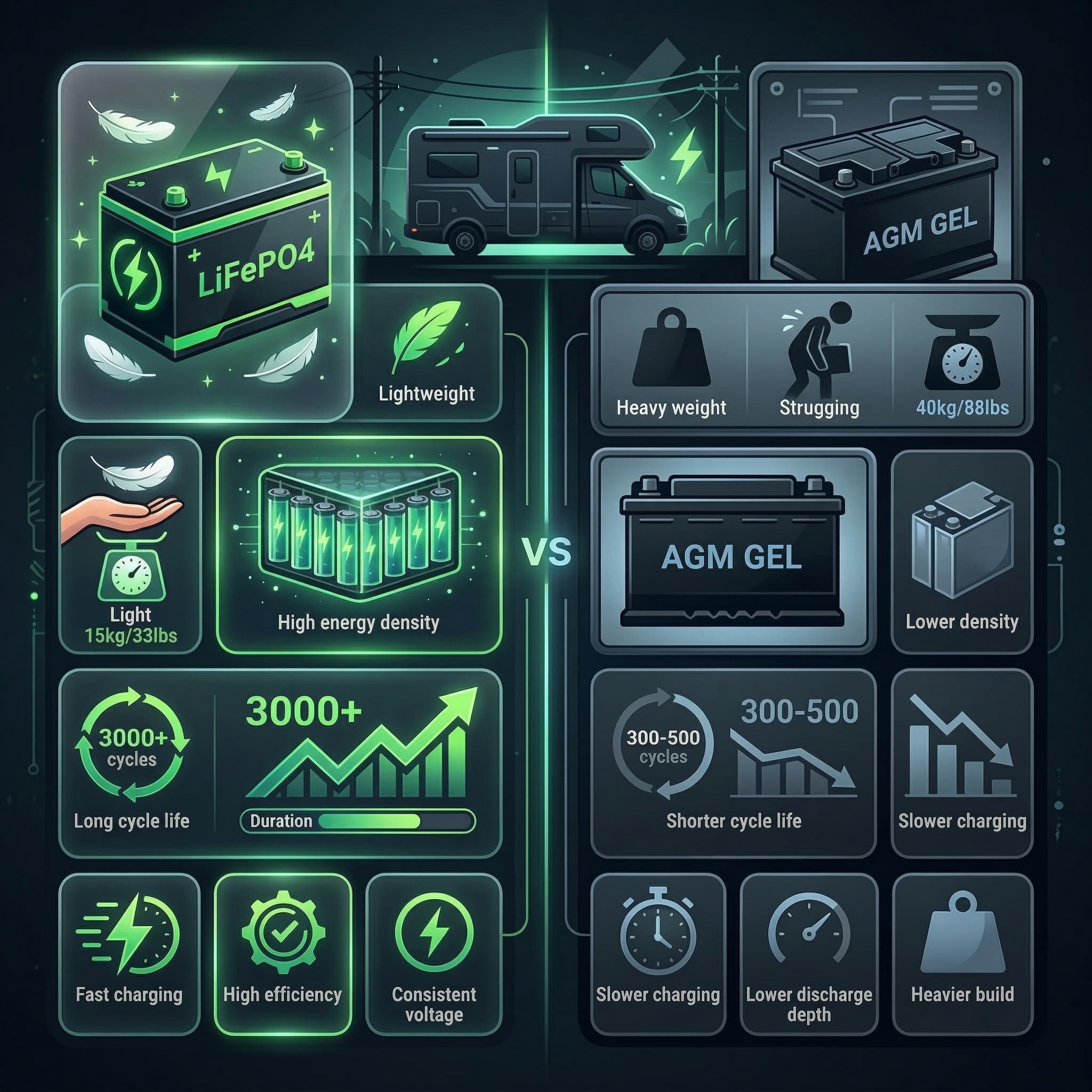
Recommended LiFePO4 battery
151 Ah
(80% depth of discharge)
Recommended AGM battery
241 Ah
(50% depth of discharge)
Adjust these values with the calculator below
About this tool
I've built 3 battery packs from individual cells and bought 2 pre-built drop-in LiFePO4 batteries. Cell balancing issues showed up in every single one eventually.
Passive balancing is deliberately slow. Your BMS has tiny resistors (usually 30-68mA balance current) that drain the highest cell to match the lowest. On a 100Ah cell, equalizing a 50mV difference can require bleeding several Ah — which at 50mA takes literal days. This isn't a defect, it's by design.
Top balancing is the real fix. If your pack is badly out of balance, charge each cell individually to exactly 3.65V using a bench power supply, then let them rest 24h. They'll settle to around 3.40V. Reconnect in series and your BMS starts from a level playing field. I do this once a year as preventive maintenance on my DIY pack.
Signs your BMS is actually balancing: if you have a Bluetooth BMS, watch the cell voltage display while holding at absorption (14.6V total). You should see the highest cell slowly dropping while the lowest stays put. If one cell consistently hits 3.65V first — triggering the BMS high-voltage cutoff — balancing isn't keeping up.
Dead cell vs drift: Normal drift is 0.01-0.05V after months of use. If one cell reads 0.1V+ lower at rest, or drops voltage dramatically under load while others stay stable, that cell's internal resistance has spiked. It's not going to recover. On a drop-in battery this usually means warranty claim. On a DIY build, swap the cell.
Temperature matters. Cells at different temperatures behave differently. If one cell sits against a hot van wall and the others don't, it'll show slightly different voltage characteristics. Try to keep all cells within 5 degrees of each other.

Frequently asked questions
How long does passive BMS balancing take on LiFePO4?▼
With typical passive balance currents of 30-100mA, correcting a 50mV imbalance on 100-200Ah cells takes 3-7 days of continuous full-charge hold. The battery needs to sit at 14.6V for the BMS to actively balance.
What's the difference between passive and active cell balancing?▼
Passive balancing burns excess energy from high cells as heat through small resistors — simple, cheap, but slow (30-100mA). Active balancing transfers energy from high cells to low cells using capacitors or inductors — faster (1-2A) but costs 3-5x more. For van use, passive is fine.
Should I manually top-balance new LiFePO4 cells before building a pack?▼
Yes, always. Charge each cell individually to 3.65V with a bench power supply, let them rest 24 hours, then verify they all settle to within 0.01V of each other. This gives your BMS the best starting point.
One cell reads 2.8V while the others are at 3.3V — can I save it?▼
A cell sitting at 2.8V has been deeply over-discharged and likely has permanent damage. You can try carefully charging it individually at low current (0.1C), but if its capacity tests below 80% of rated or it self-discharges more than 3% per month, replace it.
My Bluetooth BMS shows all cells balanced but the battery still cuts off early — why?▼
If cells appear balanced at rest but the BMS triggers low-voltage cutoff during heavy loads, one cell has higher internal resistance. Under load, a weak cell drops voltage faster than the others. You need to test cell voltages under load, not just at rest.
Advertising
Independent and free thanks to your clicks
Links marked with * are affiliate links. If a purchase is made through them, I receive a commission at no extra cost to you. The editorial selection and product evaluation are not influenced by commission rates. Your click helps fund this free tool.
Recommended gear
Check price
LiTime 12V 100Ah Bluetooth LiFePO4 (Group 31)Leo's Pick
LiFePO4 12V 100Ah Group 31, Bluetooth monitoring, 100A BMS, low-temp cutoff protection. Up to 15000 deep cycles at 60% DoD. Marine, RV, off-grid use. 222 Amazon reviews. LiTime is a leading mainstream LiFePO4 brand on Amazon US.“This is the battery I've been using in my van for 2 years. Reliable, lightweight, and the best value for money out there.”View on Amazon* →$107Amazon
Digital Multimeter
Measures voltage, current, resistance — essential for 12V wiring.“First tool to buy before you even start your install. You'll pull it out 100 times to check voltages and connections.”View on Amazon* →$25Amazon
Electrical Crimping Tool
Reliable crimp connections on 0.5mm²–16mm² cables, no soldering.“Forget soldering in a van — crimping is more reliable and vibration-proof. This one covers all the gauges you'll need.”View on Amazon* →