Loading...
Fact-checked on Jun 22, 2026
VANPOWERCALC.COMYOUR ENERGY PROFILE
YOUR ENERGY PROFILE.
This document contains the sizing of your future electrical installation, calculated based on your appliances.
Minimum Daily Consumption
0 WH / DAY
Inventory:
SYSTEM SIZINGPage 2
Battery
To guarantee 0WH without damaging your bank (80% max discharge):
0 AH
LiFePO4 12V
Solar
Minimum power required to recharge your consumption:
0 W
via MPPT
220V AC
Maximum power (with 25% safety margin).
0 W
No Need
Safety & CablingPage 3
12V Cable Sizing Guide
Use this professional reference table to select the correct gauge (mm²) for your cables. For 12V in a van, the maximum tolerated voltage drop is 3%. Always use multi-stranded flexible automotive wire.
| Current (A) | Round trip < 2m | Round trip 4m | Round trip 6m |
|---|---|---|---|
| 5A (LEDs, USB) | 1.5 mm² | 2.5 mm² | 4 mm² |
| 10A (Fridge, Pump) | 2.5 mm² | 4 mm² | 6 mm² |
| 20A (Heater) | 4 mm² | 10 mm² | 10 mm² |
| 50A (DC/DC Booster) | 10 mm² | 16 mm² | 25 mm² |
| 100A (Inverter) | 25 mm² | 35 mm² | 50 mm² |
Fuse Sizing
The fuse protects the wire, not the appliance. Always place it as close to the power source as possible (battery or busbar).
- Wire 1.5 mm² → Max fuse 10A
- Wire 2.5 mm² → Max fuse 20A
- Wire 4 mm² → Max fuse 30A
- Wire 6 mm² → Max fuse 40A
- Wire 10 mm² → Max fuse 60A
SCHÉMA ÉLECTRIQUE
PANNEAUX SOLAIRES
0W
RÉGULATEUR MPPT
BATTERIE AUXILIAIRE
0 Ah
Lithium LiFePO4
FUSIBLE
FUSIBLE
BOÎTE À FUSIBLES 12V
Pompe, Leds, Frigo...
CONVERTISSEUR 220V
NON REQUI
PRO GEARPage 4
SHOPPING LIST
Where to find this equipment? Here is the community-approved selection.
12V 6-way Fuse Box
Mandatory protection
Digital Multimeter
Test your connections
Heavy Duty Crimping Tool
For perfect lugs
Heat Shrink Tubing
Insulation and safety
GENERATED BY VANPOWERCALC.COM
Common Balancing Issues with SOK Batteries#
The SOK 12V 206Ah LiFePO4 battery is highly regarded for its robust build and repairability, but users occasionally run into cell balancing issues. When cells inside the battery are not balanced, one cell will hit the overvoltage protection limit (usually 3.65V) during charging, causing the BMS to cut off charge current before the overall battery reaches 100% capacity.
Passive Balancing Limitations#
The internal BMS of the SOK battery features passive balancing. Passive balancers typically bleed off a very small amount of current (around 30mA to 50mA) from the highest voltage cell to allow the lower cells to catch up. Because the 206Ah cells are so large, this tiny bleed current can take days or even weeks to correct a severe imbalance. If the battery is deeply discharged and rapidly charged daily, the passive balancer simply doesn't have enough time to do its job.
Steps to Fix SOK Balance Issues#
If you suspect an imbalance (which can be checked via Bluetooth if you have the smart version, or by opening the case and manually checking cell voltages), here are the steps to resolve it:
- Extended Absorption Charging: Set your charge controller to hold an absorption voltage of 14.4V to 14.6V for an extended period (several hours). This gives the passive balancer more time to bleed off high cells while the low cells continue to trickle charge.
- Lower the Charge Current: When the battery is nearly full, lower the charge current to 5A or less. A slower charge rate allows the BMS to better manage the voltage spread, preventing the highest cell from spiking and triggering a disconnect.
- Manual Top Balancing: Since SOK batteries are user-serviceable, you can remove the lid, access the cells, and use a dedicated active balancer or a bench power supply to manually bring the low cells up to match the high cells.
By keeping charging parameters optimized and allowing adequate balancing time at the top of the charge cycle, you can restore full capacity and extend the life of your SOK battery.
Expert tip
If your cells are severely drifting, consider adding an external 5A active balancer connected directly to the cell terminals to permanently solve imbalance issues.
Example calculation for your setup
Results based on a typical use case
| Appliance | Power | Usage/day | Wh/day |
|---|---|---|---|
| Compression fridge | 45W | 24h | 1080 |
| LED lighting | 20W | 4h | 80 |
| Water pump | 30W | 0.5h | 15 |
| Phone charging | 15W | 2h | 30 |
| Daily consumption | 1205 Wh | ||
Recommended LiFePO4 battery
151 Ah
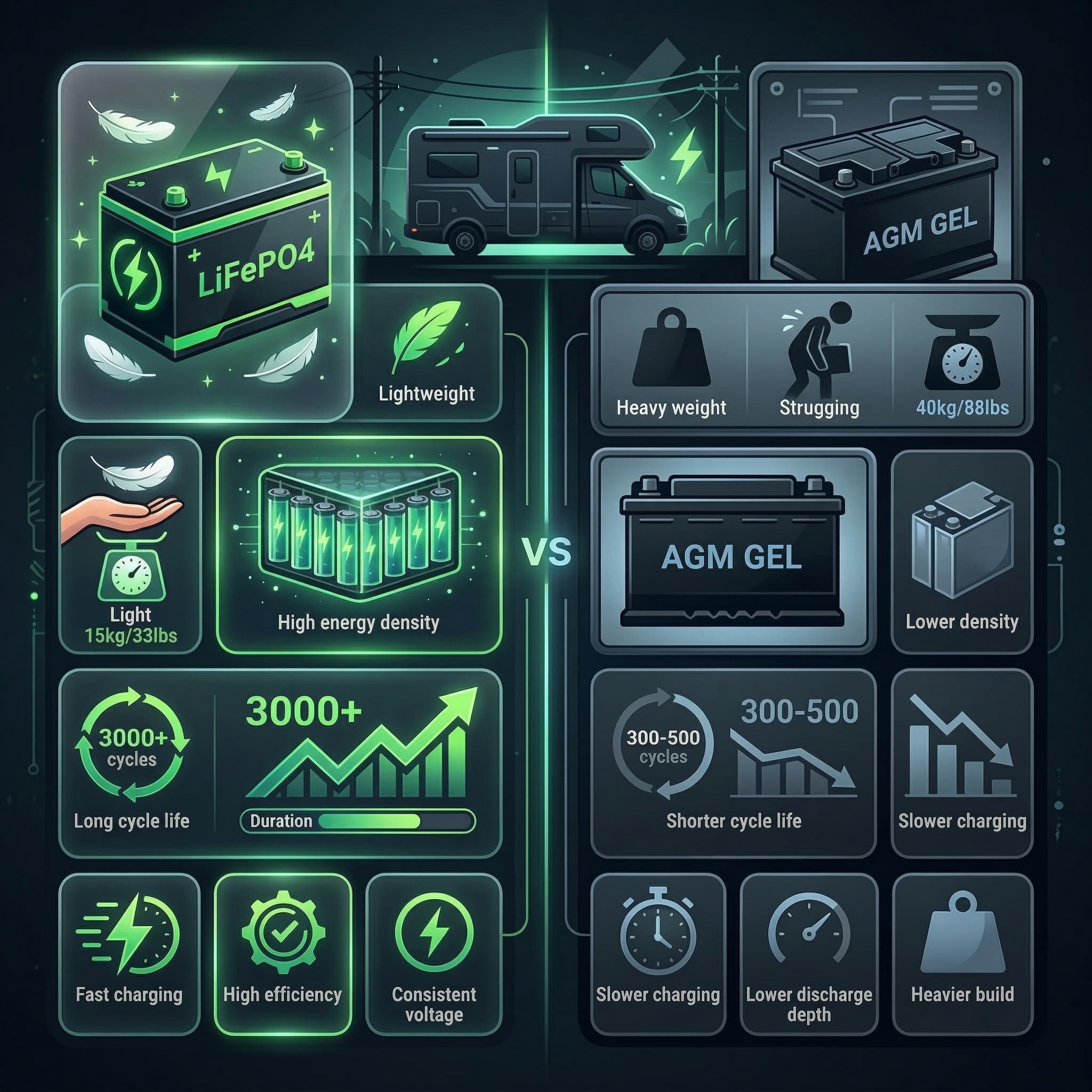
(80% depth of discharge)
Recommended AGM battery
241 Ah
(50% depth of discharge)
Adjust these values with the calculator below
Comparison table
| Balancing Method | Pros | Cons |
|---|---|---|
| Passive BMS (Built-in) | Automatic, requires no extra hardware | Extremely slow for 206Ah cells |
| Extended Float/Absorption | Easy to configure on solar controller | Requires consistent sunlight/time |
| Active Balancer (Add-on) | Very fast, transfers energy between cells | Requires opening case and extra wiring |
About this tool
SOK 12V 206Ah batteries (now marketed as SOK 12V 206Ah LiFePO4 with integrated Bluetooth BMS) have a documented balancing behavior that confuses many users: during the first 5-10 cycles, the cells can show up to 100-150mV spread, which the on-board BMS reports as "not balancing" or "cell imbalance" in the SOK app. This is normal top-balancing behavior for new cells — here's what's actually happening and when to be concerned.
How SOK's BMS balances: the SOK 206Ah uses passive top-balancing — a small resistive bypass current (50-100mA) dissipates energy from the highest cell to allow lower cells to catch up at the top of charge. This only activates when cells reach 3.4V+, meaning the battery must be nearly full for balancing to work. If you never charge above 95% (e.g., MPPT set to 14.0V float), the BMS never enters the balancing window. Result: cells diverge over months of cycling.
Diagnosis: connect via Bluetooth to the SOK app and charge the battery to 100% (14.6V absorption, held for 30-60 minutes). Watch the individual cell voltages. Healthy spread at 100% SoC: under 20mV between lowest and highest cell. Concerning spread: 50-100mV after 3-5 charge cycles at 14.6V. If cells don't converge after 10 full charge cycles at 14.6V, one cell has higher internal resistance or lower capacity — contact SOK for warranty replacement.
Fixed-charge profile for SOK 206Ah: the officially recommended profile is 14.4-14.6V bulk/absorption, held for 30 minutes after voltage is reached, then 13.5V float. A MPPT or converter set to 13.8V "lithium" profile won't trigger top-balancing — set it to 14.4V or higher. The BMS protects against overcharge up to 14.9V (overvoltage cutoff per cell: 3.65V × 4 = 14.6V), so charging to 14.6V is safe.
Parallel balancing with two SOK 206Ah: if you run two SOK batteries in parallel and see balancing issues, the interplay of two independent BMS boards adds complexity. Run each battery to 100% SOC independently before paralleling. Once paralleled, the BMS boards can't communicate, so accept that cell-level data through the app will only show the battery you're connected to. Monitor both periodically throughout the season.
SOK battery balancing timeline: In a completely new 206Ah LiFePO4, cells may be slightly mismatched from the factory (within 10mV is acceptable; 10-50mV indicates initial imbalance). Over the first 5-10 charge/discharge cycles, the BMS passive balancing circuit (typically 50-100mA balancing current) slowly matches cell voltages. During each absorption phase (14.2V held for 30-60 minutes), the balancer shunts tiny amounts of current from the high cell to equalize. Track cell voltages via the SOK Bluetooth app during this break-in period.
When balancing fails to resolve: if after 20 full cycles one cell consistently hits its high-voltage cutoff (3.65V) while others are at 3.40V, that cell has significantly lower capacity than the others. This is a defective cell situation — contact SOK support. Their warranty covers cells deviating more than 5% from rated capacity within the first year.
Optimizing SOK charging profile for maximum longevity: set your MPPT to absorption voltage of 14.2V (not 14.6V — that's for AGM), absorption timeout 30 minutes, float 13.5V or disabled. The conservative 14.6V absorption reduces cell stress at full charge and extends overall cycle life by 20-30% compared to aggressive 14.6V charging.

Frequently asked questions
How long does it take for a BMS to balance a battery?▼
Depending on the imbalance severity and battery size, passive BMS balancing can take anywhere from a few hours to several weeks, as they only bleed 30-50mA of current.
Can I open my SOK battery to fix it?▼
Yes, one of the main features of SOK batteries is their serviceable metal casing, allowing users to open them and replace parts or manually balance cells.
How do I force a SOK battery to rebalance?▼
Charge to 100% (14.6V) and hold at float for 2-4 hours. The BMS balances cells during this top-charge phase. Repeat 3-4 times if cells are significantly out of balance. Some SOK models have a manual balance trigger in the Bluetooth app.
Is cell imbalance dangerous?▼
Not immediately dangerous — the BMS prevents overcharge and over-discharge of individual cells. But long-term imbalance reduces usable capacity because the weakest cell triggers cutoff early. Fix it sooner rather than later.
Can I return a SOK battery that won't balance?▼
SOK has a 5-year warranty. If cells remain more than 0.1V apart after multiple rebalancing cycles, contact SOK support with screenshots from the BMS app. They typically replace the unit if it is a genuine manufacturing defect.
Advertising
Independent and free thanks to your clicks
Links marked with * are affiliate links. If a purchase is made through them, I receive a commission at no extra cost to you. The editorial selection and product evaluation are not influenced by commission rates. Your click helps fund this free tool.
Recommended gear
Check price
LiTime 12V 100Ah Bluetooth LiFePO4 (Group 31)Leo's Pick
LiFePO4 12V 100Ah Group 31, Bluetooth monitoring, 100A BMS, low-temp cutoff protection. Up to 15000 deep cycles at 60% DoD. Marine, RV, off-grid use. 222 Amazon reviews. LiTime is a leading mainstream LiFePO4 brand on Amazon US.“This is the battery I've been using in my van for 2 years. Reliable, lightweight, and the best value for money out there.”View on Amazon* →Check price
LiFePO4 200Ah 12V Battery
200Ah true capacity, 200A built-in BMS, 5000+ cycles.“If you work remotely or run a fridge, go straight for 200Ah. You'll never regret having too much capacity.”View on Amazon* →$114Amazon
Victron BMV-712 Battery Monitor
Real-time SOC, history, Bluetooth alarms. Must-have.“Without a monitor, you're flying blind. This one gives you the exact battery % in real time — a total game-changer.”View on Amazon* →$56Amazon
Victron Orion DC-DC Charger 30A
Charges battery from alternator with correct Li profile.“Essential if you have a Euro 6+ vehicle. I've installed it on 3 different vans, zero issues. It charges your battery as soon as you drive.”View on Amazon* →