Loading...
Fact-checked on Jun 9, 2026
VANPOWERCALC.COMYOUR ENERGY PROFILE
YOUR ENERGY PROFILE.
This document contains the sizing of your future electrical installation, calculated based on your appliances.
Minimum Daily Consumption
0 WH / DAY
Inventory:
SYSTEM SIZINGPage 2
Battery
To guarantee 0WH without damaging your bank (80% max discharge):
0 AH
LiFePO4 12V
Solar
Minimum power required to recharge your consumption:
0 W
via MPPT
220V AC
Maximum power (with 25% safety margin).
0 W
No Need
Safety & CablingPage 3
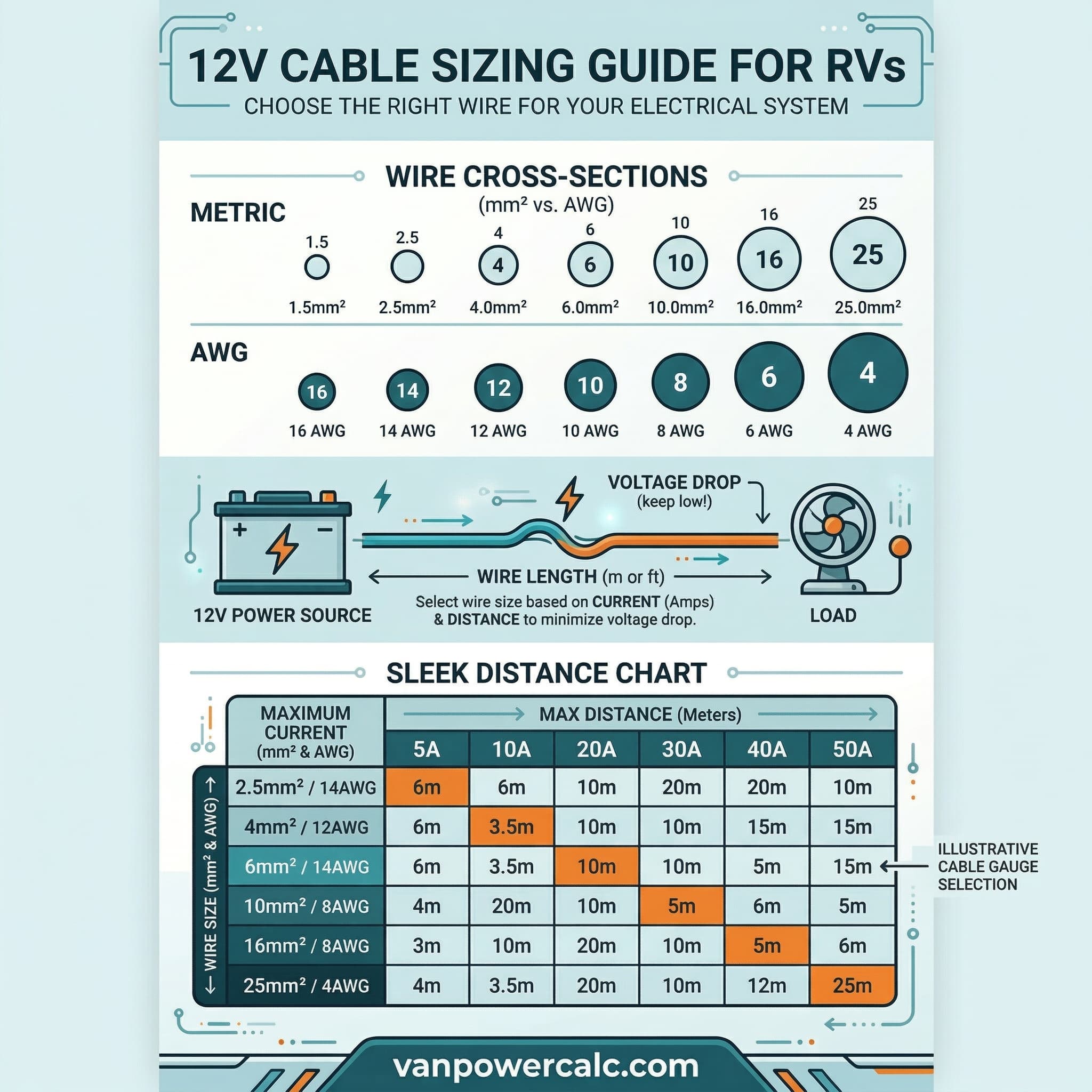
12V Cable Sizing Guide
Use this professional reference table to select the correct gauge (mm²) for your cables. For 12V in a van, the maximum tolerated voltage drop is 3%. Always use multi-stranded flexible automotive wire.
| Current (A) | Round trip < 2m | Round trip 4m | Round trip 6m |
|---|---|---|---|
| 5A (LEDs, USB) | 1.5 mm² | 2.5 mm² | 4 mm² |
| 10A (Fridge, Pump) | 2.5 mm² | 4 mm² | 6 mm² |
| 20A (Heater) | 4 mm² | 10 mm² | 10 mm² |
| 50A (DC/DC Booster) | 10 mm² | 16 mm² | 25 mm² |
| 100A (Inverter) | 25 mm² | 35 mm² | 50 mm² |
Fuse Sizing
The fuse protects the wire, not the appliance. Always place it as close to the power source as possible (battery or busbar).
- Wire 1.5 mm² → Max fuse 10A
- Wire 2.5 mm² → Max fuse 20A
- Wire 4 mm² → Max fuse 30A
- Wire 6 mm² → Max fuse 40A
- Wire 10 mm² → Max fuse 60A
SCHÉMA ÉLECTRIQUE
PANNEAUX SOLAIRES
0W
RÉGULATEUR MPPT
BATTERIE AUXILIAIRE
0 Ah
Lithium LiFePO4
FUSIBLE
FUSIBLE
BOÎTE À FUSIBLES 12V
Pompe, Leds, Frigo...
CONVERTISSEUR 220V
NON REQUI
PRO GEARPage 4
SHOPPING LIST
Where to find this equipment? Here is the community-approved selection.
12V 6-way Fuse Box
Mandatory protection
Digital Multimeter
Test your connections
Heavy Duty Crimping Tool
For perfect lugs
Heat Shrink Tubing
Insulation and safety
GENERATED BY VANPOWERCALC.COM
I installed a 5kW Chinese diesel heater in my 12m³ well-insulated Sprinter and it was overkill. On low, it cycled on and off every few minutes. On high, it turned the van into a sauna in under 5 minutes. Most van builders buy too much heater because "what if it's really cold?" — but an oversized heater that constantly cycles is louder, burns more fuel, and carbon-fouls faster than a properly sized one running at a steady medium output. Let me walk you through the actual math so you get this right.
The core formula is simple: you need to calculate your heat loss in BTUs per hour, then match it to a heater's output. A 2kW heater produces about 6,800 BTU/h, a 5kW produces 17,000 BTU/h, and an 8kW produces 27,300 BTU/h. Your van's heat loss depends on three things: volume, insulation R-value, and the temperature difference between inside and outside (delta-T). A standard cargo van (Sprinter 144" or Transit L2) has roughly 10-14m³ of interior volume. With decent insulation (25mm polyiso on walls, 50mm on ceiling, insulated floor), your effective R-value averages around R-7 to R-10. Without insulation — bare metal walls — you're looking at R-1 to R-2, and you'll need dramatically more heat. For a well-insulated 12m³ van with R-8 walls aiming for a 30°C delta-T (keeping 20°C inside when it's -10°C outside), heat loss runs about 4,000-5,500 BTU/h. A 2kW heater at full blast covers that. A 5kW heater would run at 30-40% output, which is fine as long as it doesn't cycle.
Expert tip
Buy the smallest heater that covers your worst-case scenario. An oversized heater running on low will carbon up the glow plug and heat exchanger within one season. I'd rather run a 2kW heater at 80% than a 5kW at 20%. If you're between sizes, the smaller one running harder will last longer and burn cleaner.
Example calculation for your setup
Results based on a typical use case
| Appliance | Power | Usage/day | Wh/day |
|---|---|---|---|
| Compression fridge | 45W | 24h | 1080 |
| LED lighting | 20W | 4h | 80 |
| Water pump | 30W | 0.5h | 15 |
| Phone charging | 15W | 2h | 30 |
| Daily consumption | 1205 Wh | ||
Recommended LiFePO4 battery
151 Ah
(80% depth of discharge)
Recommended AGM battery
241 Ah
(50% depth of discharge)
Recommended solar panels
402 Wc
4h average sun hours
Recommended inverter
No 220V appliances — no inverter needed
Adjust these values with the calculator below
About this tool
Let me give you real sizing recommendations based on hundreds of van builds I've seen.
For a small van (VW Transporter, Ford Transit Custom, ~6-8m³ insulated): a 2kW heater is perfect. It'll hold 20°C down to about -15°C outside. At full output, fuel consumption is roughly 0.10-0.12 L/hour. On low, it sips about 0.04 L/hour. That means a 10L fuel tank lasts 4-10 days depending on conditions.
For a medium van (Sprinter 144", Transit L3, ~10-14m³ insulated): a 2kW heater still works down to about -5°C outside. If you camp in serious winter conditions regularly, a 5kW gives you headroom — just make sure you run it at medium, not low, to avoid the cycling problem. Fuel consumption on a 5kW at medium is about 0.16-0.20 L/hour.
For a large van or bus conversion (Sprinter 170", school bus, ~15-25m³): a 5kW is the minimum. For poorly insulated or very large builds over 20m³, the 8kW makes sense. An 8kW heater at full output burns about 0.30-0.38 L/hour.
Altitude derating matters and almost nobody accounts for it. Diesel combustion efficiency drops about 1% per 100m of elevation above sea level. At 2,000m (6,500 ft), your heater loses roughly 20% of its rated output. A 5kW heater effectively becomes a 4kW heater. If you ski camp or boondock at altitude regularly, size up.
One more factor: windows. Glass is a thermal disaster — R-value of about R-1. A van with a large rear window and two side windows loses significantly more heat than one with solid insulated panels. Each square meter of single-pane glass adds roughly 800-1,000 BTU/h of heat loss at a 30°C delta-T.
The Chinese diesel heaters (Vevor, Hcalory, generic "all-in-one" units) work surprisingly well for the price. The 2kW units run $80-150, the 5kW units $100-200. They're noisy on high (the combustion fan is the main culprit) but at medium to low output, cabin noise is typically 40-50 dB. The Webasto Air Top 2000 STC and Eberspacher Airtronic D2 are the premium alternatives at $800-1,200 — quieter, better built, and easier to get serviced, but the heating output is comparable to a Chinese 2kW unit.

Frequently asked questions
Is a 2kW diesel heater enough for a van in winter?▼
For a well-insulated van under 14m³ (Sprinter 144", Transit L3), a 2kW heater holds 20°C down to about -5°C to -15°C outside, depending on insulation quality. It produces about 6,800 BTU/h at full output, which covers most winter camping scenarios.
How much fuel does a diesel air heater use?▼
A 2kW heater uses 0.04-0.12 L/hour (low to high). A 5kW uses 0.12-0.24 L/hour. An 8kW uses 0.18-0.38 L/hour. A 10L tank on a 2kW unit running at medium lasts roughly 5-8 days of overnight heating.
Why does my Chinese diesel heater keep cycling on and off?▼
It is oversized for your space. When the heater reaches target temperature too fast, it shuts down, the van cools, and it restarts. This cycling fouls the glow plug and wastes fuel. Solution: use a smaller heater, or run the thermostat at a lower setting with the fan on medium.
Does altitude affect diesel heater performance?▼
Yes. Combustion efficiency drops about 1% per 100m above sea level. At 2,000m elevation, expect roughly 20% less heat output. Size up if you regularly camp at altitude — a 2kW heater effectively becomes a 1.6kW unit at 2,000m.
Chinese diesel heater vs Webasto — is the premium worth it?▼
The Chinese 2kW units ($80-150) produce the same heat as a Webasto Air Top 2000 ($800-1,200). The Webasto is quieter, better built, has proper service networks, and lasts longer with less maintenance. For occasional use, Chinese is fine. For full-time living, the Webasto pays for itself in reliability.
Advertising
Independent and free thanks to your clicks
Links marked with * are affiliate links. If a purchase is made through them, I receive a commission at no extra cost to you. The editorial selection and product evaluation are not influenced by commission rates. Your click helps fund this free tool.
Recommended gear
$90Amazon
Diesel Heater 5kW 12VLeo's Pick
For larger vehicles or cold climates. 0.2L/h cruise consumption. 30% off with code SQ3U5UKC.“The 5kW version for large vans or real winters. Heats the entire vehicle in 15 minutes, even at -10°C.”View on Amazon* →Check price
LiTime 12V 100Ah Bluetooth LiFePO4 (Group 31)Leo's Pick
LiFePO4 12V 100Ah Group 31, Bluetooth monitoring, 100A BMS, low-temp cutoff protection. Up to 15000 deep cycles at 60% DoD. Marine, RV, off-grid use. 222 Amazon reviews. LiTime is a leading mainstream LiFePO4 brand on Amazon US.“This is the battery I've been using in my van for 2 years. Reliable, lightweight, and the best value for money out there.”View on Amazon* →$41Amazon
12V Fuse Box
Protects each circuit independently, easy installation.“One fuse per circuit is the golden rule. This box keeps your install clean and every line independently protected.”View on Amazon* →