Loading...
Fact-checked on Mar 30, 2026
VANPOWERCALC.COMYOUR ENERGY PROFILE
YOUR ENERGY PROFILE.
This document contains the sizing of your future electrical installation, calculated based on your appliances.
Minimum Daily Consumption
0 WH / DAY
Inventory:
SYSTEM SIZINGPage 2
Battery
To guarantee 0WH without damaging your bank (80% max discharge):
0 AH
LiFePO4 12V
Solar
Minimum power required to recharge your consumption:
0 W
via MPPT
220V AC
Maximum power (with 25% safety margin).
0 W
No Need
Safety & CablingPage 3
12V Cable Sizing Guide
Use this professional reference table to select the correct gauge (mm²) for your cables. For 12V in a van, the maximum tolerated voltage drop is 3%. Always use multi-stranded flexible automotive wire.
| Current (A) | Round trip < 2m | Round trip 4m | Round trip 6m |
|---|---|---|---|
| 5A (LEDs, USB) | 1.5 mm² | 2.5 mm² | 4 mm² |
| 10A (Fridge, Pump) | 2.5 mm² | 4 mm² | 6 mm² |
| 20A (Heater) | 4 mm² | 10 mm² | 10 mm² |
| 50A (DC/DC Booster) | 10 mm² | 16 mm² | 25 mm² |
| 100A (Inverter) | 25 mm² | 35 mm² | 50 mm² |
Fuse Sizing
The fuse protects the wire, not the appliance. Always place it as close to the power source as possible (battery or busbar).
- Wire 1.5 mm² → Max fuse 10A
- Wire 2.5 mm² → Max fuse 20A
- Wire 4 mm² → Max fuse 30A
- Wire 6 mm² → Max fuse 40A
- Wire 10 mm² → Max fuse 60A
SCHÉMA ÉLECTRIQUE
PANNEAUX SOLAIRES
0W
RÉGULATEUR MPPT
BATTERIE AUXILIAIRE
0 Ah
Lithium LiFePO4
FUSIBLE
FUSIBLE
BOÎTE À FUSIBLES 12V
Pompe, Leds, Frigo...
CONVERTISSEUR 220V
NON REQUI
PRO GEARPage 4
SHOPPING LIST
Where to find this equipment? Here is the community-approved selection.
12V 6-way Fuse Box
Mandatory protection
Digital Multimeter
Test your connections
Heavy Duty Crimping Tool
For perfect lugs
Heat Shrink Tubing
Insulation and safety
GENERATED BY VANPOWERCALC.COM
Working remotely from a van demands a reliable, powerful electrical system. No dropping offline mid-Zoom call. This build is designed to run a laptop continuously, a Starlink connection, dual monitors if needed, and all the comforts of a mobile office.
The heart of this setup: 300Ah LiFePO4 for 3,600Wh capacity, 400W solar panels for fast recharging even in overcast conditions, and a 2000W pure sine inverter to power your professional gear. Add a 30A DC-DC charger and you're self-sufficient anywhere in Europe.
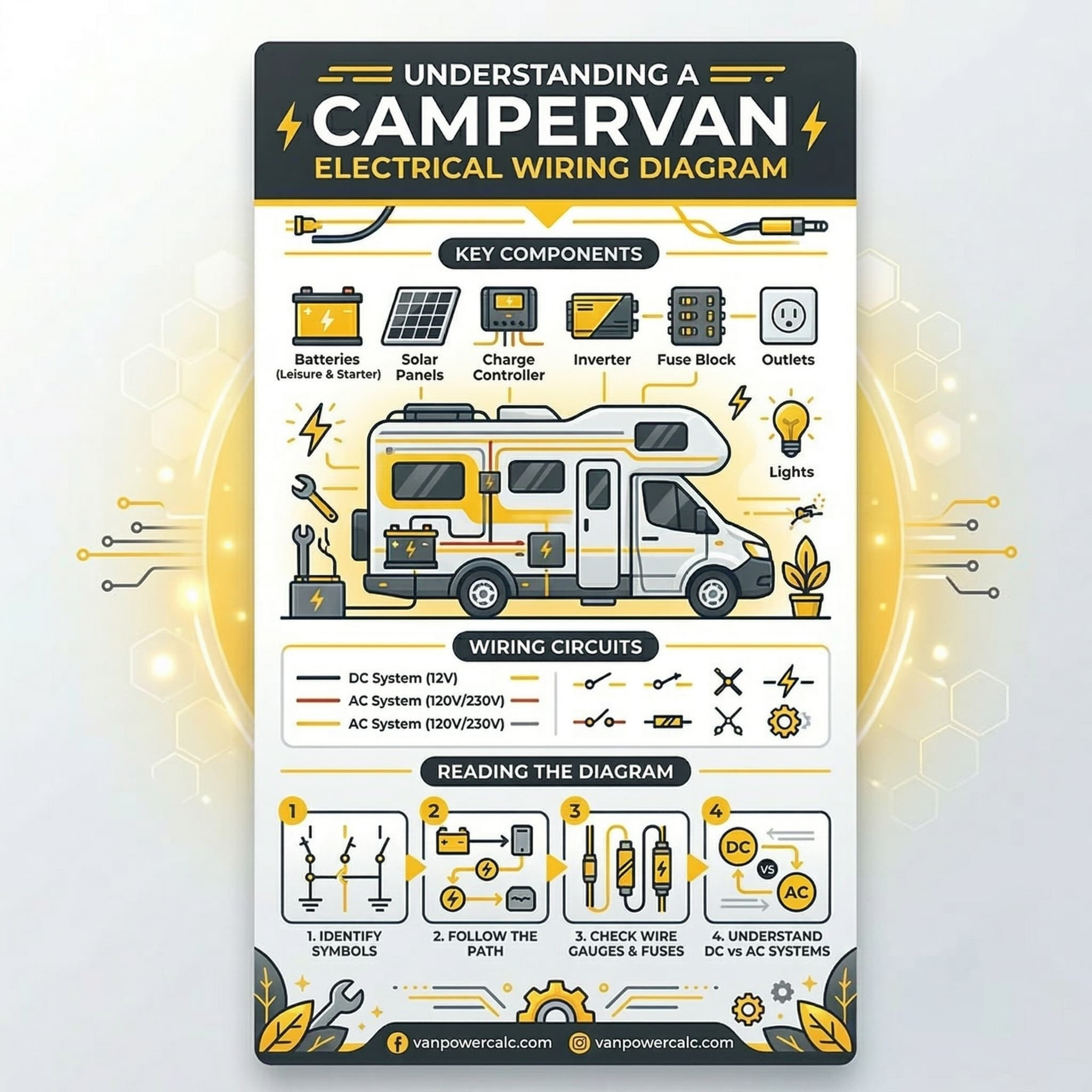
Expert tip
Pro tip: invest in a USB-C PD 65W outlet that runs directly from 12V (brands like Alpicool or KWMobile, ~€25). It converts 12V battery power to USB-C Power Delivery to charge your laptop WITHOUT going through the inverter. You save 15-20% in conversion losses. Reserve the inverter for the coffee machine and Starlink.
Example calculation for your setup
Results based on a typical use case
| Appliance | Power | Usage/day | Wh/day |
|---|---|---|---|
| Compression fridge | 45W | 24h | 1080 |
| LED lighting | 20W | 4h | 80 |
| Water pump | 30W | 0.5h | 15 |
| Phone charging | 15W | 2h | 30 |
| Daily consumption | 1205 Wh | ||
Recommended LiFePO4 battery
151 Ah
(80% depth of discharge)
Recommended AGM battery
241 Ah
(50% depth of discharge)
Recommended solar panels
402 Wc
4h average sun hours
Recommended inverter
No 220V appliances — no inverter needed
Adjust these values with the calculator below
Comparison table
| Component | Model | Specs | Price |
|---|---|---|---|
| LiFePO4 Battery | Redodo 300Ah | 300Ah, 12.8V, 200A BMS | ~€550 |
| Solar Panels | Renogy 4x100W Mono | 400W total, roof mount | ~€330 |
| MPPT Controller | Victron SmartSolar 100/30 | 30A, Bluetooth, 100V max | ~€150 |
| DC-DC Charger | Victron Orion-Tr Smart 12/12-30 | 30A, Bluetooth | ~€160 |
| Pure Sine Inverter | EDECOA 2000W | 2000W continuous, 4000W peak | ~€200 |
| Fuse Box | Blue Sea ST Blade 12 | 12 circuits | ~€45 |
| Battery Cables | 50mm² + lugs | Heavy-duty complete set | ~€45 |
| Solar Cables | MC4 + 6mm² | 15m, Y-connectors | ~€35 |
| Outlets + USB | USB-C PD 65W + 12V x4 | Direct laptop charging | ~€50 |
| LED Lighting | Dimmable spots + strip | Complete 10-point kit | ~€50 |
| Battery Monitor | Victron SmartShunt | 500A, Bluetooth, app | ~€75 |
| Miscellaneous | Lugs, ANL fuses, conduit, mounts | Pro wiring kit | ~€60 |
| **TOTAL** | **~€1,750** |
About this tool
The Digital Nomad Build: Zero Compromise on Productivity#
Being a digital nomad in a van is the ultimate freedom. But that freedom has an energy price. A laptop draws 60-80Wh per hour of work, Starlink pulls 40-75W continuously, and you need full comfort (coffee, lighting, fridge) while working.
Power Consumption Breakdown#
- Laptop (MacBook Pro or equivalent): 8h x 70W = 560Wh/day
- Starlink Mini: 12h x 50W = 600Wh/day
- External monitor (USB-C portable): 6h x 15W = 90Wh
- 50L fridge: 35Ah = 420Wh/day
- LED lighting: 60Wh
- Charging (phones, tablet, headset): 50Wh
- Ventilation (MaxxFan): 80Wh
- Nespresso machine: 2 coffees x 1200W x 2min = 80Wh
- Total: ~1,940Wh/day
Why 300Ah and Not 200Ah#
With 1,940Wh daily consumption:
- 200Ah LiFePO4 = 2,400Wh → only 1.2 days autonomy without sun
- 300Ah LiFePO4 = 3,600Wh → 1.8 days autonomy without sun
The margin is crucial on rainy days. With 400W solar and a 30A MPPT, you produce 1,600-2,000Wh on sunny days in Southern Europe.
The 2000W Inverter#
A 2000W pure sine inverter lets you run:
- Nespresso machine (1200W for 2 min)
- Hair dryer on cool (800W)
- Laptop + monitor + Starlink simultaneously
- Small vacuum occasionally

Frequently asked questions
How much does a digital nomad van electrical setup cost?▼
The complete build (300Ah LiFePO4 + 400W solar + 2000W inverter + DC-DC + Starlink power setup) runs about €2,200-2,500. It's an investment, but it pays off fast: no rent, no electricity bill, no coworking subscription. Within 6 months of vanlife, you're well ahead.
Does Starlink work well in a van?▼
Yes, Starlink Mini or Standard works across Europe with a clear sky view. Speed: 50-200 Mbps depending on area. Power draw: 40-75W. Latency: 25-50ms — fine for Zoom calls. The Roam plan costs €50-75/month. It's the most reliable internet solution for vanlifers.
Is 400W solar enough for a digital nomad?▼
In Southern Europe (Spain, Portugal, Greece) April-October: yes, 400W produces 1,600-2,200Wh/day, covering your ~1,900Wh consumption. In winter or Scandinavia: no, supplement with DC-DC by driving 1-2h/day or hook up at campsites. The solar + 30A DC-DC combo covers 95% of situations.
What inverter for a laptop and Starlink?▼
A 2000W pure sine is ideal. It powers laptop + Starlink + coffee without breaking a sweat. Avoid modified sine wave inverters — they make laptop power supplies buzz and can damage Starlink. Victron Phoenix 12/2000 is the gold standard, but EDECOA and Giandel 2000W are half-price alternatives.
Advertising
Independent and free thanks to your clicks
Links marked with * are affiliate links. If a purchase is made through them, I receive a commission at no extra cost to you. The editorial selection and product evaluation are not influenced by commission rates. Your click helps fund this free tool.
Recommended gear
Check price
LiTime 12V 100Ah Bluetooth LiFePO4 (Group 31)Leo's Pick
LiFePO4 12V 100Ah Group 31, Bluetooth monitoring, 100A BMS, low-temp cutoff protection. Up to 15000 deep cycles at 60% DoD. Marine, RV, off-grid use. 222 Amazon reviews. LiTime is a leading mainstream LiFePO4 brand on Amazon US.“This is the battery I've been using in my van for 2 years. Reliable, lightweight, and the best value for money out there.”View on Amazon* →Check price
ECO-WORTHY 200W 12V/24V Solar Kit + 20A Bluetooth MPPTLeo's Pick
Complete 200W solar kit with Bluetooth-monitored MPPT controller. 12V/24V compatible, 20A charge controller with smartphone app. Ideal for vans, RVs, off-grid setups. Single-product solution covering both solar panel and charge controller.“The kit I recommend to every beginner. Plug it in, it works, and the included MPPT controller makes a real difference.”View on Amazon* →$107Amazon
Digital Multimeter
Measures voltage, current, resistance — essential for 12V wiring.“First tool to buy before you even start your install. You'll pull it out 100 times to check voltages and connections.”View on Amazon* →$41Amazon
12V Fuse Box
Protects each circuit independently, easy installation.“One fuse per circuit is the golden rule. This box keeps your install clean and every line independently protected.”View on Amazon* →