Loading...
Fact-checked on Mar 18, 2026
VANPOWERCALC.COMYOUR ENERGY PROFILE
YOUR ENERGY PROFILE.
This document contains the sizing of your future electrical installation, calculated based on your appliances.
Minimum Daily Consumption
0 WH / DAY
Inventory:
SYSTEM SIZINGPage 2
Battery
To guarantee 0WH without damaging your bank (80% max discharge):
0 AH
LiFePO4 12V
Solar
Minimum power required to recharge your consumption:
0 W
via MPPT
220V AC
Maximum power (with 25% safety margin).
0 W
No Need
Safety & CablingPage 3
12V Cable Sizing Guide
Use this professional reference table to select the correct gauge (mm²) for your cables. For 12V in a van, the maximum tolerated voltage drop is 3%. Always use multi-stranded flexible automotive wire.
| Current (A) | Round trip < 2m | Round trip 4m | Round trip 6m |
|---|---|---|---|
| 5A (LEDs, USB) | 1.5 mm² | 2.5 mm² | 4 mm² |
| 10A (Fridge, Pump) | 2.5 mm² | 4 mm² | 6 mm² |
| 20A (Heater) | 4 mm² | 10 mm² | 10 mm² |
| 50A (DC/DC Booster) | 10 mm² | 16 mm² | 25 mm² |
| 100A (Inverter) | 25 mm² | 35 mm² | 50 mm² |
Fuse Sizing
The fuse protects the wire, not the appliance. Always place it as close to the power source as possible (battery or busbar).
- Wire 1.5 mm² → Max fuse 10A
- Wire 2.5 mm² → Max fuse 20A
- Wire 4 mm² → Max fuse 30A
- Wire 6 mm² → Max fuse 40A
- Wire 10 mm² → Max fuse 60A
SCHÉMA ÉLECTRIQUE
PANNEAUX SOLAIRES
0W
RÉGULATEUR MPPT
BATTERIE AUXILIAIRE
0 Ah
Lithium LiFePO4
FUSIBLE
FUSIBLE
BOÎTE À FUSIBLES 12V
Pompe, Leds, Frigo...
CONVERTISSEUR 220V
NON REQUI
PRO GEARPage 4
SHOPPING LIST
Where to find this equipment? Here is the community-approved selection.
12V 6-way Fuse Box
Mandatory protection
Digital Multimeter
Test your connections
Heavy Duty Crimping Tool
For perfect lugs
Heat Shrink Tubing
Insulation and safety
GENERATED BY VANPOWERCALC.COM
Why Your 300Ah Battery Might Only Deliver 200Ah#
You just bought an Rvpozwer 12V 300Ah LiFePO4 battery, set it up with your Victron shunt, charged it to 100%, and ran a basic discharge test. After draining about 70Ah, the battery disconnected — the shunt still showed 85% remaining. Something clearly doesn't add up. This is a widely reported phenomenon on DIY solar forums, particularly with budget LiFePO4 brands selling on Amazon.
What Causes False Capacity Readings?#
There are two primary suspects: (1) the battery genuinely contains fewer or smaller cells than advertised, or (2) your monitoring setup is miscalibrated. Budget LiFePO4 batteries from lesser-known brands may use cells with lower actual capacity than stated — a 300Ah battery using four 280Ah CATL cells actually only delivers 280Ah at best, and often less depending on temperature and discharge rate. Some reports suggest certain brands use recycled or B-grade cells that only deliver 60-70% of their rating.
The Weight Test: A Quick Reality Check#
A genuine 300Ah 12V LiFePO4 battery should weigh approximately 28-32 kg (62-70 lbs). If your battery weighs only 25 kg, it's physically impossible for it to contain enough cell material for 300Ah. Weigh your battery and compare it against reputable brands like EG4, SOK, or Battle Born at similar capacities. A significant weight discrepancy is the clearest indicator of inflated capacity claims.
How to Perform a Proper Capacity Test#
To accurately test your battery's real capacity: (1) Charge to 100% and let it rest for 2 hours. (2) Synchronize your shunt monitor at exactly 14.6V resting voltage. (3) Discharge at a steady 0.2C rate (60A for a supposed 300Ah) through a known resistive load. (4) Record the total Ah consumed when the BMS cuts off. If the battery delivers less than 270Ah (90% of rated), you have grounds for a return claim. Document everything with timestamped photos and shunt screenshots for your Amazon dispute.
Expert tip
Before buying any budget battery, search for "[brand name] teardown" on YouTube. Reputable reviewers like Will Prowse open them up and test cells individually — saving you from wasting money on inflated specs.
Example calculation for your setup
Results based on a typical use case
| Appliance | Power | Usage/day | Wh/day |
|---|---|---|---|
| Compression fridge | 45W | 24h | 1080 |
| LED lighting | 20W | 4h | 80 |
| Water pump | 30W | 0.5h | 15 |
| Phone charging | 15W | 2h | 30 |
| Daily consumption | 1205 Wh | ||
Recommended LiFePO4 battery
151 Ah
(80% depth of discharge)
Recommended AGM battery
241 Ah
(50% depth of discharge)
Adjust these values with the calculator below
Comparison table
| Brand | Claimed Capacity | Typical Real Capacity | Weight |
|---|---|---|---|
| Rvpozwer | 300Ah | ~200-230Ah (reported) | 25 kg |
| SOK Battery | 206Ah | 200-206Ah (verified) | 27 kg |
| EG4 | 280Ah (server rack) | 275-280Ah (verified) | 30 kg |
| LiTime | 300Ah | 285-300Ah (verified) | 29 kg |
About this tool
The 300Ah "real capacity" question for 12V LiFePO4 batteries from brands like RVPower, Ampere Time, and similar is one of the most frequently tested topics in the van life community — and the answer reveals important nuances about how battery capacity works under real-world conditions.
Nominal vs actual capacity: Battery manufacturers rate capacity at C/10 (discharge rate of 1/10 the capacity over 10 hours). A 300Ah battery tested at C/10 means 30A draw over 10 hours. Most van loads draw far more than 30A: an inverter powering a laptop + coffee maker can pull 100A+ instantaneously. At higher discharge rates, effective capacity decreases.
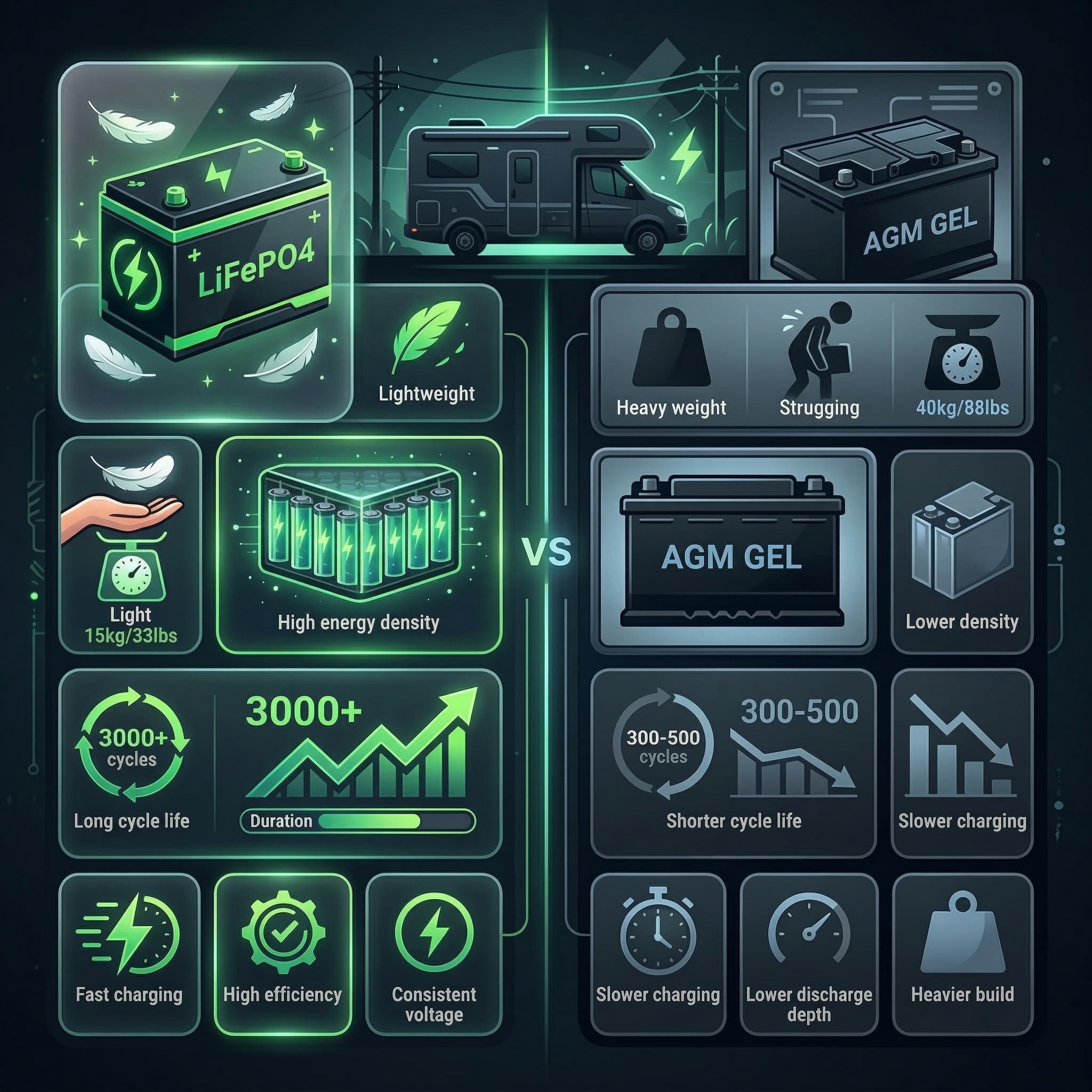
C-rate impact on LiFePO4 capacity: LiFePO4 chemistry handles high discharge rates extremely well compared to AGM. A quality 300Ah LiFePO4 retains approximately: C/10 (30A): 300Ah. C/5 (60A): 295Ah (98%). C/2 (150A): 285Ah (95%). 1C (300A): 270Ah (90%). Compare this to AGM which retains only 50-60% of rated capacity at 1C discharge — LiFePO4 is dramatically more stable under high loads.
Temperature effects on real capacity: LiFePO4 capacity is temperature-sensitive on the charging side, but the discharge side is fairly robust. At 0°C: ~90% of rated capacity available during discharge. At -10°C: ~75-80%. At -20°C: ~60-65%, and some BMS units will disconnect to protect cells. This means your 300Ah battery effectively becomes a 180-200Ah battery in severe cold weather overnight. Plan accordingly for alpine winter camping.
How to test actual battery capacity: connect a constant-current DC load (€80 bench load tester from Amazon), set it to C/10 (30A for a 300Ah battery), and measure Ah delivered from 100% SOC (14.4V fully charged) to BMS cutoff (typically 10.5-11.0V). Record the Ah from a battery monitor (Victron BMV-712 or equivalent). If the test delivers less than 285Ah (95% of nominal), contact the manufacturer — quality units from reputable suppliers consistently deliver 98-102% of nominal.
Red flags indicating B-grade cells in budget LiFePO4: capacity testing below 90% of nominal on first cycle, significant cell voltage imbalance (>50mV) after charging (indicates one weak cell), premature BMS cutoff at moderate loads (30% of BMS max current), and operating temperature outside the 15-45°C optimal range causing performance anomalies.

Frequently asked questions
Do LiFePO4 batteries really deliver the rated capacity?▼
Quality batteries (cells from CATL, Eve, Winston) consistently deliver 98-102% of rated capacity at C/10 discharge rate. Budget 'B-grade' cell batteries may deliver 85-92%. Always test with a DC load tester. Any battery delivering less than 90% rated capacity on the first test should be returned.
What affects how much capacity I get from a 300Ah battery?▼
Main factors: discharge rate (higher C-rate = less capacity, but LiFePO4 is very stable), temperature (-20°C reduces capacity by 35-40%), and cell age (gradual capacity fade starting after 1000 cycles, retaining 80% at rated cycle life end).
How do I test my LiFePO4 battery capacity?▼
Method 1: Battery monitor (Victron BMV-712) tracks Ah in and out. Charge to 100%, discharge at C/10, note Ah when BMS cuts off. Method 2: DC load tester (set to constant current mode). Method 3: Use the van - measure Wh from full to BMS cutoff via BMV. Accurate BMV shunt calibration is critical.
Is RVPower / Ampere Time LiFePO4 quality reliable?▼
These mid-tier brands use reliable cell brands (typically CATL or purchased from Chinese Tier 1 cell manufacturers). The BMS quality is the more variable element — check if BMS specifications are published. Brands with published BMS specs (max continuous charge/discharge current) tend to be more accountable.
How long will a 300Ah LiFePO4 battery last?▼
Quality LiFePO4 batteries are rated 3000-4000 cycles to 80% capacity retention. At 1 cycle/day (full-time van life): 8-11 years. At 1 cycle/week (weekend use): 57-77 years — effectively lifetime. The LiFePO4 chemistry is significantly longer-lived than other lithium chemistries.
Advertising
Independent and free thanks to your clicks
Links marked with * are affiliate links. If a purchase is made through them, I receive a commission at no extra cost to you. The editorial selection and product evaluation are not influenced by commission rates. Your click helps fund this free tool.
Recommended gear
Check price
LiTime 12V 100Ah Bluetooth LiFePO4 (Group 31)Leo's Pick
LiFePO4 12V 100Ah Group 31, Bluetooth monitoring, 100A BMS, low-temp cutoff protection. Up to 15000 deep cycles at 60% DoD. Marine, RV, off-grid use. 222 Amazon reviews. LiTime is a leading mainstream LiFePO4 brand on Amazon US.“This is the battery I've been using in my van for 2 years. Reliable, lightweight, and the best value for money out there.”View on Amazon* →Check price
LiFePO4 200Ah 12V Battery
200Ah true capacity, 200A built-in BMS, 5000+ cycles.“If you work remotely or run a fridge, go straight for 200Ah. You'll never regret having too much capacity.”View on Amazon* →$114Amazon
Victron BMV-712 Battery Monitor
Real-time SOC, history, Bluetooth alarms. Must-have.“Without a monitor, you're flying blind. This one gives you the exact battery % in real time — a total game-changer.”View on Amazon* →$56Amazon
Victron Orion DC-DC Charger 30A
Charges battery from alternator with correct Li profile.“Essential if you have a Euro 6+ vehicle. I've installed it on 3 different vans, zero issues. It charges your battery as soon as you drive.”View on Amazon* →