Loading...
Fact-checked on Apr 5, 2026
VANPOWERCALC.COMYOUR ENERGY PROFILE
YOUR ENERGY PROFILE.
This document contains the sizing of your future electrical installation, calculated based on your appliances.
Minimum Daily Consumption
0 WH / DAY
Inventory:
SYSTEM SIZINGPage 2
Battery
To guarantee 0WH without damaging your bank (80% max discharge):
0 AH
LiFePO4 12V
Solar
Minimum power required to recharge your consumption:
0 W
via MPPT
220V AC
Maximum power (with 25% safety margin).
0 W
No Need
Safety & CablingPage 3
12V Cable Sizing Guide
Use this professional reference table to select the correct gauge (mm²) for your cables. For 12V in a van, the maximum tolerated voltage drop is 3%. Always use multi-stranded flexible automotive wire.
| Current (A) | Round trip < 2m | Round trip 4m | Round trip 6m |
|---|---|---|---|
| 5A (LEDs, USB) | 1.5 mm² | 2.5 mm² | 4 mm² |
| 10A (Fridge, Pump) | 2.5 mm² | 4 mm² | 6 mm² |
| 20A (Heater) | 4 mm² | 10 mm² | 10 mm² |
| 50A (DC/DC Booster) | 10 mm² | 16 mm² | 25 mm² |
| 100A (Inverter) | 25 mm² | 35 mm² | 50 mm² |
Fuse Sizing
The fuse protects the wire, not the appliance. Always place it as close to the power source as possible (battery or busbar).
- Wire 1.5 mm² → Max fuse 10A
- Wire 2.5 mm² → Max fuse 20A
- Wire 4 mm² → Max fuse 30A
- Wire 6 mm² → Max fuse 40A
- Wire 10 mm² → Max fuse 60A
SCHÉMA ÉLECTRIQUE
PANNEAUX SOLAIRES
0W
RÉGULATEUR MPPT
BATTERIE AUXILIAIRE
0 Ah
Lithium LiFePO4
FUSIBLE
FUSIBLE
BOÎTE À FUSIBLES 12V
Pompe, Leds, Frigo...
CONVERTISSEUR 220V
NON REQUI
PRO GEARPage 4
SHOPPING LIST
Where to find this equipment? Here is the community-approved selection.
12V 6-way Fuse Box
Mandatory protection
Digital Multimeter
Test your connections
Heavy Duty Crimping Tool
For perfect lugs
Heat Shrink Tubing
Insulation and safety
GENERATED BY VANPOWERCALC.COM
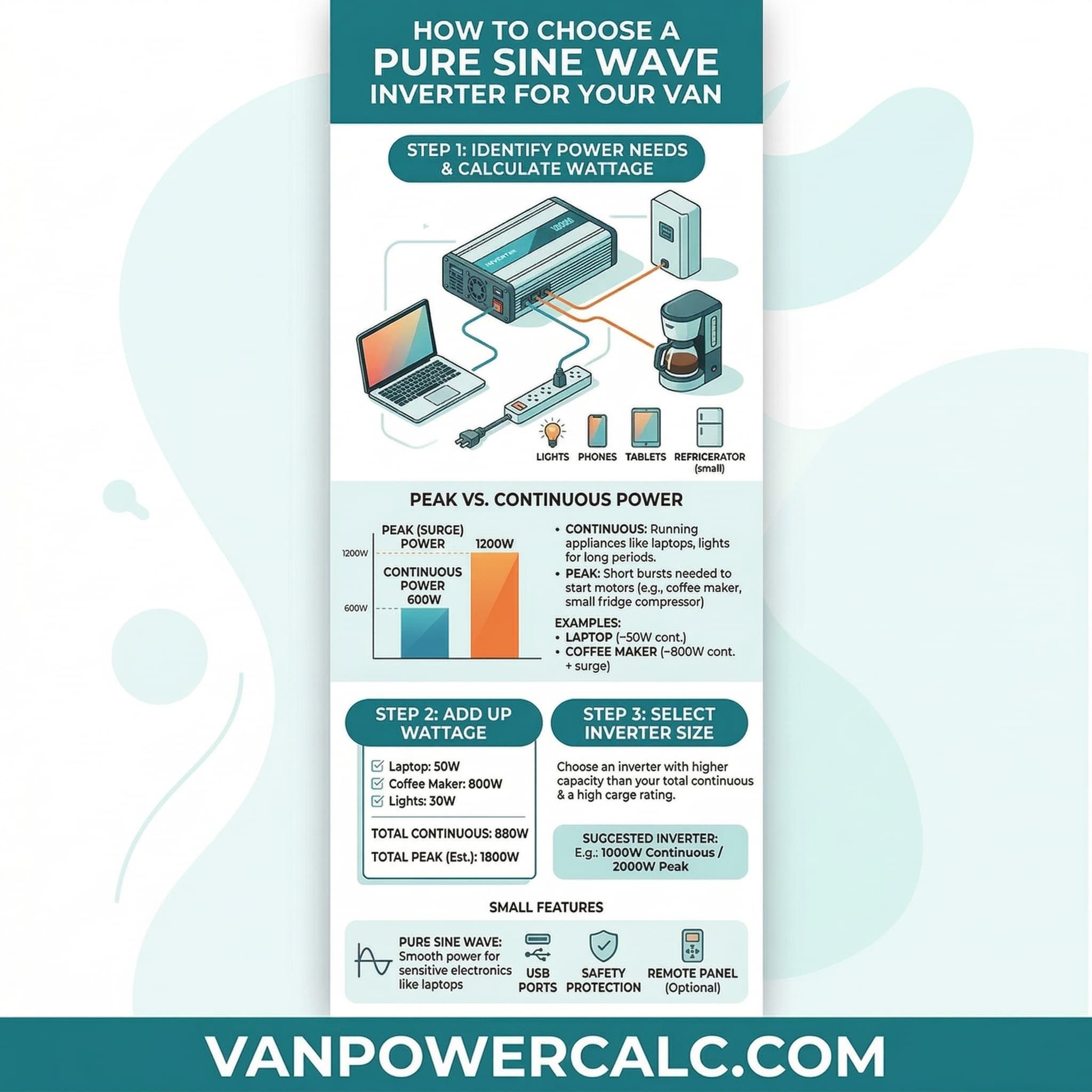
I'll save you the suspense: buy a pure sine wave inverter. In 2026, the price gap has shrunk to $40-60 for a 1000W unit and the risk of running sensitive gear on modified sine isn't worth the savings. But here's the full picture.
A pure sine wave outputs a smooth AC waveform identical to grid power. Everything works: laptops, CPAP machines, induction cooktops, battery chargers, LED dimmers, power tools. A modified sine wave outputs a stepped square wave that approximates AC. Simple resistive loads work fine — kettles, incandescent lights, basic chargers. But it makes motors run 10-20% hotter, causes buzzing in audio gear, and can damage sensitive electronics over time.
Expert tip
If you already own a modified sine inverter and only run a kettle and phone charger, keep it. But the moment you plug in a laptop, power tool, or any device with a switching power supply — switch to pure sine. The $50-100 upgrade prevents $200+ in damaged gear.
Example calculation for your setup
Results based on a typical use case
| Appliance | Power | Usage/day | Wh/day |
|---|---|---|---|
| Compression fridge | 45W | 24h | 1080 |
| LED lighting | 20W | 4h | 80 |
| Water pump | 30W | 0.5h | 15 |
| Phone charging | 15W | 2h | 30 |
| Daily consumption | 1205 Wh | ||
Recommended inverter
No 220V appliances — no inverter needed
Adjust these values with the calculator below
About this tool
The devices that absolutely won't tolerate modified sine: CPAP/BiPAP machines (medical alert — some models shut down or deliver incorrect pressure), induction cooktops (won't even turn on), many laptop chargers (reduced lifespan, may not charge), laser printers, and some LED dimmers (flicker or buzz). I've personally killed a $200 Makita charger on modified sine — it ran hot for a week then the internal capacitor blew. Modified sine has exactly one advantage: efficiency. A cheap modified sine inverter converts 93-95% of DC to AC. A good pure sine manages 88-92%. That 3-5% difference means a modified sine wastes less power on the conversion itself. For a 100W continuous load, that's 3-5W saved — not enough to matter.
What Pure Sine and Modified Sine Actually Look Like#
A pure sine wave inverter outputs a smooth, continuous wave that matches grid power exactly — 60Hz in the US, 50Hz in Europe, with a clean sinusoidal shape. This is what every electronic device is designed to receive. A modified sine wave is a stepped approximation — it jumps between positive voltage, zero, and negative voltage in sharp rectangular steps. The fundamental frequency is correct (50 or 60Hz), but the waveform is full of harmonics. Those harmonics cause audible buzzing in audio equipment, interfere with the timing circuits in CPAP machines, confuse the power factor correction in laptop chargers, and generate excess heat in motor windings. I can hear the difference: plug a speaker into modified sine and you get a faint 60Hz hum underneath the audio. Pure sine is silent.
Sizing Your Pure Sine Inverter#
The biggest mistake: buying the biggest inverter available "just in case." A 3000W inverter draws 15-25W of power just being turned on, even at zero load. Over 24 hours, that's 360-600Wh of parasitic draw — 25-40Ah from your battery doing absolutely nothing. I size the inverter for actual maximum simultaneous load plus 20% headroom. My typical loads: laptop charger (65W) + phone charger (15W) + LED TV (40W) = 120W simultaneous. A 300W inverter handles this perfectly. For occasional heavy loads — blender (600W), hair dryer (1200W on low), power tools (800W) — I run a 1500W pure sine. The only reason to go 2000W+ is regular induction cooking or running multiple heavy loads simultaneously. Common brands I trust: Victron Phoenix (premium, $300-500), Giandel (good mid-range, $150-250), AIMS (solid budget option, $120-200).
Installation Details That Affect Performance#
The cable between battery and inverter is the most critical wire in your entire system. A 2000W inverter at 12V pulls up to 180A at full load. That requires 35mm² cable for runs under 1.5 meters, or 50mm² for runs up to 3 meters. Use cable that's too thin and you'll see voltage drop, reduced inverter output, and heat buildup that can melt insulation. I keep the inverter as close to the battery as physically possible — ideally under 1 meter of cable. Fuse the positive cable with an ANL or MEGA fuse rated at 200-250A (for a 2000W/12V inverter). Mount the fuse within 30cm of the battery terminal. Ground the inverter chassis to the vehicle chassis with a short 6mm² bonding cable — this provides a safety ground for the AC outlets. And always install a remote on/off switch so you can kill the inverter from your living area without crawling to the battery box. The parasitic draw alone justifies never leaving it on when you don't need AC power.

Frequently asked questions
Will a modified sine inverter damage my laptop?▼
It probably won't kill it immediately, but it stresses the power supply. The stepped waveform causes the laptop charger to run hotter and can reduce its lifespan from 5 years to 1-2 years. Some chargers will refuse to charge at all. Not worth the risk.
What devices need pure sine wave?▼
CPAP/medical devices, induction cooktops, laptop chargers, LED dimmers, audio equipment, power tools with brushless motors, battery chargers for lithium devices. Basically anything with a microprocessor or switching power supply.
What works fine on modified sine?▼
Resistive loads: kettles, toasters, incandescent lights, basic phone chargers (the cheap wall-wart type), hair dryers, and simple fans without speed controllers.
How much more does pure sine cost?▼
At 1000W: $120-180 (pure) vs $70-120 (modified). At 2000W: $200-350 vs $130-200. The gap has narrowed significantly in the last 2-3 years. Chinese manufacturers like Giandel and AIMS offer quality pure sine at near-modified prices.
Can I tell the difference between pure and modified sine?▼
Yes. Listen to a fan or motor on each — modified sine causes a distinct buzzing or humming sound. Look at an LED bulb — modified sine causes visible flicker. Measure with a multimeter that reads True RMS — modified sine shows 10-15% lower voltage than stated.
Advertising
Independent and free thanks to your clicks
Links marked with * are affiliate links. If a purchase is made through them, I receive a commission at no extra cost to you. The editorial selection and product evaluation are not influenced by commission rates. Your click helps fund this free tool.
Recommended gear
$104Amazon
Pure Sine Inverter 2000W 12V
Runs induction cooktop, hair dryer, coffee machine.“The 2000W version for those who want to plug in everything: induction plate, hair dryer, pro coffee machine. Make sure your cables are properly sized.”View on Amazon* →$33Amazon
Battery Cable 50mm² Red+Black
50mm² cable for 2000W+ inverter. Red and black, 1m each.“Between battery and inverter, you need heavy-duty cable. 50mm² handles big current draws without overheating.”View on Amazon* →$13Amazon
ANL Fuse 250A + Fuse Holder
Mandatory inverter protection. 250A with integrated fuse holder.“The ANL fuse protects your battery-to-inverter cable. It's a few bucks that can prevent a fire. Non-negotiable.”View on Amazon* →Check price
LiFePO4 200Ah 12V Battery
200Ah true capacity, 200A built-in BMS, 5000+ cycles.“If you work remotely or run a fridge, go straight for 200Ah. You'll never regret having too much capacity.”View on Amazon* →