Loading...
Fact-checked on Mar 15, 2026
VANPOWERCALC.COMYOUR ENERGY PROFILE
YOUR ENERGY PROFILE.
This document contains the sizing of your future electrical installation, calculated based on your appliances.
Minimum Daily Consumption
0 WH / DAY
Inventory:
SYSTEM SIZINGPage 2
Battery
To guarantee 0WH without damaging your bank (80% max discharge):
0 AH
LiFePO4 12V
Solar
Minimum power required to recharge your consumption:
0 W
via MPPT
220V AC
Maximum power (with 25% safety margin).
0 W
No Need
Safety & CablingPage 3
12V Cable Sizing Guide
Use this professional reference table to select the correct gauge (mm²) for your cables. For 12V in a van, the maximum tolerated voltage drop is 3%. Always use multi-stranded flexible automotive wire.
| Current (A) | Round trip < 2m | Round trip 4m | Round trip 6m |
|---|---|---|---|
| 5A (LEDs, USB) | 1.5 mm² | 2.5 mm² | 4 mm² |
| 10A (Fridge, Pump) | 2.5 mm² | 4 mm² | 6 mm² |
| 20A (Heater) | 4 mm² | 10 mm² | 10 mm² |
| 50A (DC/DC Booster) | 10 mm² | 16 mm² | 25 mm² |
| 100A (Inverter) | 25 mm² | 35 mm² | 50 mm² |
Fuse Sizing
The fuse protects the wire, not the appliance. Always place it as close to the power source as possible (battery or busbar).
- Wire 1.5 mm² → Max fuse 10A
- Wire 2.5 mm² → Max fuse 20A
- Wire 4 mm² → Max fuse 30A
- Wire 6 mm² → Max fuse 40A
- Wire 10 mm² → Max fuse 60A
SCHÉMA ÉLECTRIQUE
PANNEAUX SOLAIRES
0W
RÉGULATEUR MPPT
BATTERIE AUXILIAIRE
0 Ah
Lithium LiFePO4
FUSIBLE
FUSIBLE
BOÎTE À FUSIBLES 12V
Pompe, Leds, Frigo...
CONVERTISSEUR 220V
NON REQUI
PRO GEARPage 4
SHOPPING LIST
Where to find this equipment? Here is the community-approved selection.
12V 6-way Fuse Box
Mandatory protection
Digital Multimeter
Test your connections
Heavy Duty Crimping Tool
For perfect lugs
Heat Shrink Tubing
Insulation and safety
GENERATED BY VANPOWERCALC.COM
Connecting a lithium battery directly to your van alternator is a recipe for a very expensive repair. A DC-DC charger (also called a B2B or booster) is non-negotiable for lithium van builds.
A DC-DC charger regulates the voltage and current flowing from the alternator to your house battery, protecting both components. For Euro 6 vehicles with smart alternators, this is not optional — it is mandatory. Most popular units (Victron Orion, Renogy DCC50S) also accept solar input, combining two charging sources in one device.
Expert tip
Most van builders install a single 30A DC-DC charger and wonder why their 200Ah LiFePO4 never reaches 100% SOC on driving days under 4 hours. Simple solution: install two Victron Orion 12-12|30 units in parallel (60A combined = 720W). The incremental cost is €120, and it doubles charging speed — critical for urban van lifers with short daily drives.
Example calculation for your setup
Results based on a typical use case
| Appliance | Power | Usage/day | Wh/day |
|---|---|---|---|
| Compression fridge | 45W | 24h | 1080 |
| LED lighting | 20W | 4h | 80 |
| Water pump | 30W | 0.5h | 15 |
| Phone charging | 15W | 2h | 30 |
| Daily consumption | 1205 Wh | ||
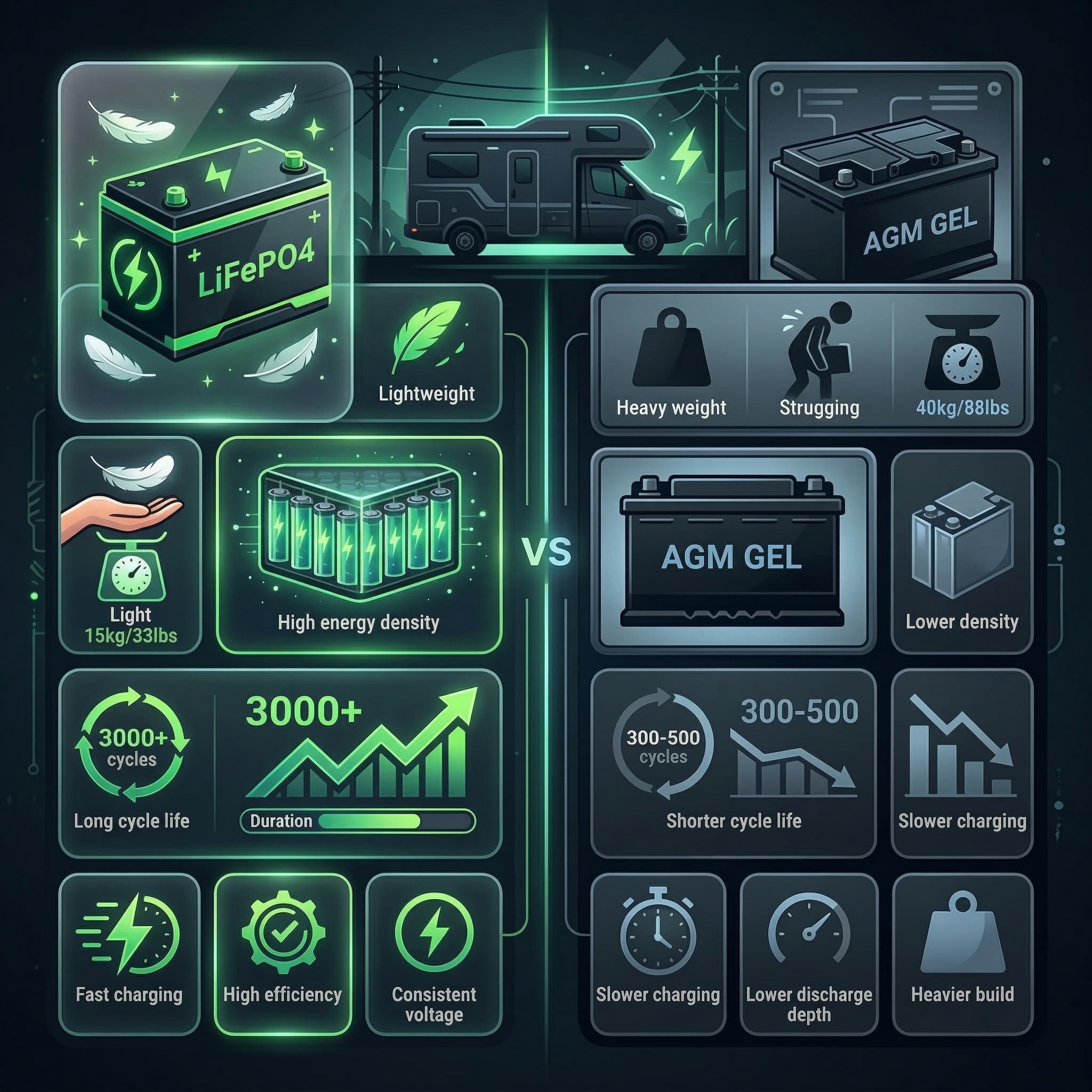
Recommended LiFePO4 battery
151 Ah
(80% depth of discharge)
Recommended AGM battery
241 Ah
(50% depth of discharge)
Adjust these values with the calculator below
Comparison table
| Charger | Output | Efficiency | App | Price |
|---|---|---|---|---|
| Victron Orion-Tr Smart 12/12-30 | 30A / 360W | 95% | VictronConnect | $160-200 |
| Victron Orion-Tr Smart 12/12-18 | 18A / 216W | 95% | VictronConnect | $120-150 |
| Renogy 40A DC-DC | 40A / 480W | 92% | Renogy BT | $120-160 |
| Sterling B2B 30A | 30A / 360W | 90% | — | $100-150 |
About this tool
The DC-DC charger (also called B2B charger or battery-to-battery charger) is the most misunderstood component in van electrical builds — and getting it wrong either destroys your lithium battery or leaves it perpetually undercharged.
The problem it solves: modern Euro 5/6 vans have "smart" alternators that actively vary output voltage to reduce engine load at highway speed (fuel economy mandate). A Transit Custom alternator can cycle between 11.8V and 14.6V during normal driving based on ECU load management. LiFePO4 batteries need a stable 14.6V absorption phase to fully charge — an unpredictable alternator can never provide this.
A DC-DC charger acts as an isolated DC-DC converter: it draws variable voltage from the starter battery (which the alternator does charge correctly, as it's the primary load the ECU manages), and outputs a clean, programmable multi-stage charge profile to the leisure battery. It's galvanically isolated, meaning ground faults on one side don't affect the other — important for steel van body integrity.
The Victron Orion-Tr Smart 12-12|30 is the van conversion standard for good reason: Bluetooth monitoring via VictronConnect app, adjustable absorption voltage (critical for matching your specific LiFePO4 BMS settings), separate inputs and outputs for proper isolation, and a 5-year track record of reliability in van builds.
Installation tips: always fuse within 50cm of the source battery (80A ANL fuse on input side, 40A blade fuse on output). Use 16mm² cable for runs up to 2 meters. Connect the ignition sense wire to a switched 12V source (cigarette lighter socket via relay) to ensure charging only occurs when engine is running — this prevents drain-down when parked with ignition off.
For maximum charging speed on long driving days: two Orion 12-12|30 units in parallel deliver 60A (720W) output, charging a 200Ah LiFePO4 from 20% to full in about 3.5 hours of driving. At €280 total for two units, it's the most cost-effective upgrade for urban van lifers with daily drives under 4 hours.
Sizing the DC-DC charger correctly: Rule of thumb is 30-40% of battery bank capacity in amps. A 100Ah LiFePO4: 30-40A DC-DC charger (Victron Orion Smart 30A = 360W @ 12V output). A 200Ah LiFePO4: 40-60A charger. Over-sizing the charger above 50% battery capacity rarely provides benefit since LiFePO4 bulk charge acceptance tapers off at higher SOC anyway. Under-sizing below 20% means very slow replenishment on driving days.
Vehicle alternator compatibility — the critical detail: Modern vehicles with smart alternators (variable voltage 13.2-14.7V, ECU-controlled) and start-stop systems require an isolated DC-DC charger, not a simple B2B connection. The non-isolated input of some budget chargers can cause ground loops between the starter battery and house battery — causing confusing charging behavior and potential ECU interference. The Victron Orion-Tr Smart (galvanically isolated) resolves this at €140-200.
Engine runtime for meaningful charging: A 40A DC-DC charger at 12V adds 480W to the battery. Driving 1 hour = 480Wh recovered. For a van depleted to 20% SOC (80% battery to recover = 160Ah for a 200Ah pack = 1920Wh): requires 4 hours of driving to fully charge. Practical for most travel days; insufficient for stationary days without solar.

Frequently asked questions
Do I need a DC-DC charger to charge lithium from my van alternator?▼
Yes — a DC-DC charger (also called B2B charger) is mandatory for properly charging LiFePO4 from a modern alternator. Modern smart alternators with Euro 6 engine management vary output voltage unpredictably (11.8-14.8V) and activate ECO charging modes that prevent full battery charge. A Victron Orion-Tr Smart 12-12|30 provides stable 14.6V absorption charging regardless of alternator behavior.
How long does a DC-DC charger take to charge a van battery?▼
A Victron Orion-Tr Smart 12-12|30 outputs 30A continuously = 360W. Charging a 100Ah LiFePO4 from 20% to 100% SOC (80Ah needed) takes 80Ah ÷ 30A = 2.67 hours of driving. A 200Ah LiFePO4 from 20% takes 5.3 hours. Real-world: most van lifers fully recharge a 100Ah bank during any driving day over 3 hours.
Will a DC-DC charger drain my starter battery?▼
No — quality DC-DC chargers like the Victron Orion-Tr Smart have a built-in starter battery protection voltage threshold (default 12.5V). When starter battery voltage drops below this threshold, the DC-DC charger automatically disconnects. Some units also have an ignition sense wire input that only allows charging when the engine is running.
What is the difference between a DC-DC charger and a split charge relay?▼
A split charge relay simply connects starter and leisure batteries in parallel when the alternator charges — simple but problematic for LiFePO4. It can backfeed the leisure battery into the starter battery when engine is off, and cannot deliver the absorption phase needed for full LiFePO4 charge. DC-DC chargers are isolated, provide proper charge profiles, and protect both batteries. Relay costs €20 but ruins LiFePO4; DC-DC costs €120-200 and treats it correctly.
Can I install a DC-DC charger myself?▼
Yes — the Victron Orion-Tr Smart 12-12|30 installation requires: fused connection to starter battery (ANL fuse 80A within 50cm of battery), fused output to leisure battery (40A fuse), optional ignition sense wire to engine harness. Full install takes 2-3 hours with basic electrical knowledge. Wire gauge: 16mm² for power cables up to 2m run length.
Advertising
Independent and free thanks to your clicks
Links marked with * are affiliate links. If a purchase is made through them, I receive a commission at no extra cost to you. The editorial selection and product evaluation are not influenced by commission rates. Your click helps fund this free tool.
Recommended gear
$56Amazon
Victron Orion DC-DC Charger 30A
Charges battery from alternator with correct Li profile.“Essential if you have a Euro 6+ vehicle. I've installed it on 3 different vans, zero issues. It charges your battery as soon as you drive.”View on Amazon* →$33Amazon
Battery Cable 50mm² Red+Black
50mm² cable for 2000W+ inverter. Red and black, 1m each.“Between battery and inverter, you need heavy-duty cable. 50mm² handles big current draws without overheating.”View on Amazon* →Check price
LiTime 12V 100Ah Bluetooth LiFePO4 (Group 31)Leo's Pick
LiFePO4 12V 100Ah Group 31, Bluetooth monitoring, 100A BMS, low-temp cutoff protection. Up to 15000 deep cycles at 60% DoD. Marine, RV, off-grid use. 222 Amazon reviews. LiTime is a leading mainstream LiFePO4 brand on Amazon US.“This is the battery I've been using in my van for 2 years. Reliable, lightweight, and the best value for money out there.”View on Amazon* →$107Amazon
Digital Multimeter
Measures voltage, current, resistance — essential for 12V wiring.“First tool to buy before you even start your install. You'll pull it out 100 times to check voltages and connections.”View on Amazon* →