Loading...
Fact-checked on Apr 3, 2026
VANPOWERCALC.COMYOUR ENERGY PROFILE
YOUR ENERGY PROFILE.
This document contains the sizing of your future electrical installation, calculated based on your appliances.
Minimum Daily Consumption
0 WH / DAY
Inventory:
SYSTEM SIZINGPage 2
Battery
To guarantee 0WH without damaging your bank (80% max discharge):
0 AH
LiFePO4 12V
Solar
Minimum power required to recharge your consumption:
0 W
via MPPT
220V AC
Maximum power (with 25% safety margin).
0 W
No Need
Safety & CablingPage 3
12V Cable Sizing Guide
Use this professional reference table to select the correct gauge (mm²) for your cables. For 12V in a van, the maximum tolerated voltage drop is 3%. Always use multi-stranded flexible automotive wire.
| Current (A) | Round trip < 2m | Round trip 4m | Round trip 6m |
|---|---|---|---|
| 5A (LEDs, USB) | 1.5 mm² | 2.5 mm² | 4 mm² |
| 10A (Fridge, Pump) | 2.5 mm² | 4 mm² | 6 mm² |
| 20A (Heater) | 4 mm² | 10 mm² | 10 mm² |
| 50A (DC/DC Booster) | 10 mm² | 16 mm² | 25 mm² |
| 100A (Inverter) | 25 mm² | 35 mm² | 50 mm² |
Fuse Sizing
The fuse protects the wire, not the appliance. Always place it as close to the power source as possible (battery or busbar).
- Wire 1.5 mm² → Max fuse 10A
- Wire 2.5 mm² → Max fuse 20A
- Wire 4 mm² → Max fuse 30A
- Wire 6 mm² → Max fuse 40A
- Wire 10 mm² → Max fuse 60A
SCHÉMA ÉLECTRIQUE
PANNEAUX SOLAIRES
0W
RÉGULATEUR MPPT
BATTERIE AUXILIAIRE
0 Ah
Lithium LiFePO4
FUSIBLE
FUSIBLE
BOÎTE À FUSIBLES 12V
Pompe, Leds, Frigo...
CONVERTISSEUR 220V
NON REQUI
PRO GEARPage 4
SHOPPING LIST
Where to find this equipment? Here is the community-approved selection.
12V 6-way Fuse Box
Mandatory protection
Digital Multimeter
Test your connections
Heavy Duty Crimping Tool
For perfect lugs
Heat Shrink Tubing
Insulation and safety
GENERATED BY VANPOWERCALC.COM
Not everyone lives in their van full-time. If you're doing Friday-to-Sunday trips, you can get away with a surprisingly small electrical system: 100Ah LiFePO4, 100W solar, and basic wiring. Total cost under $700. Total install time: one weekend.
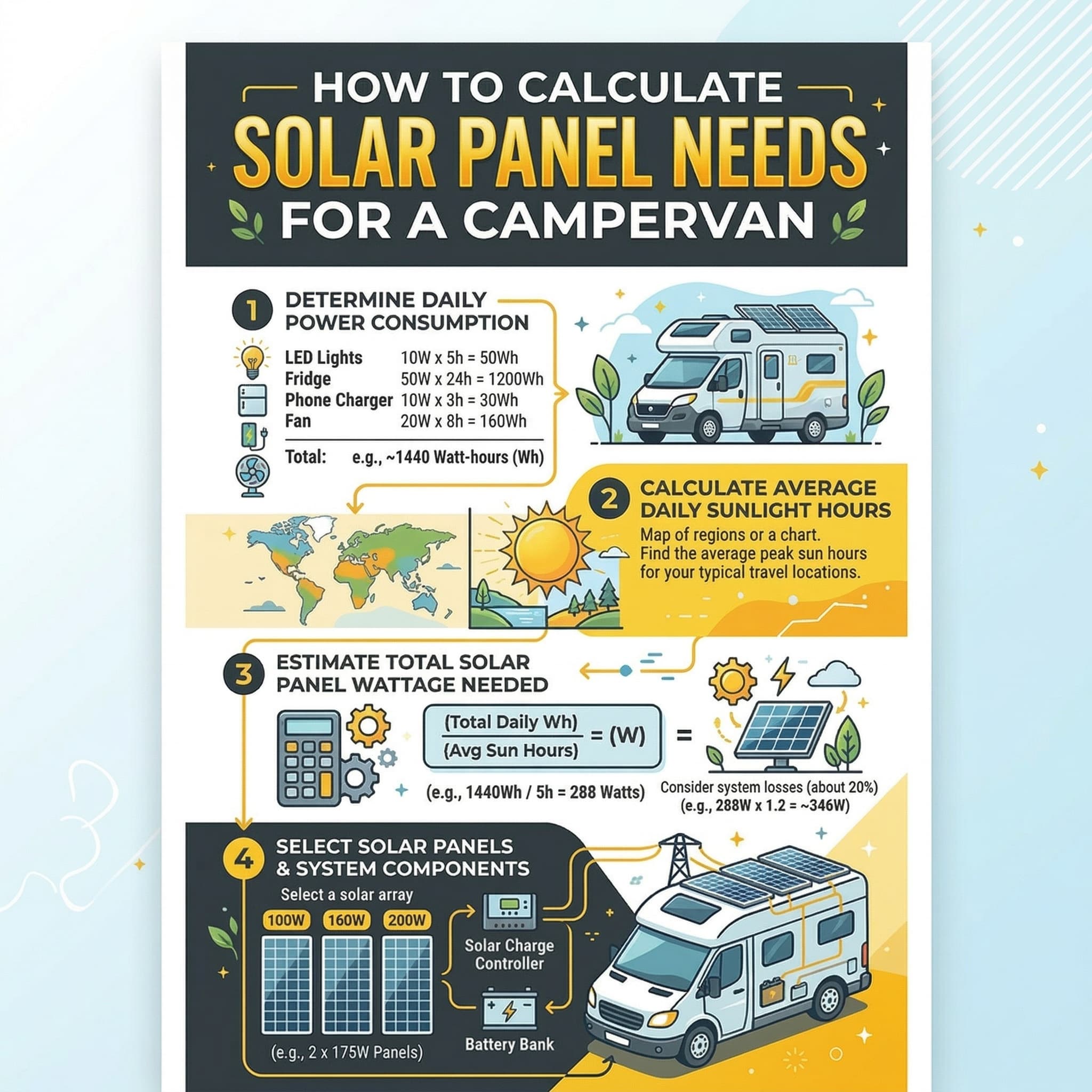
The math: weekend consumption = fridge (35Ah/day × 2.5 days = 88Ah) + lights and phones (10Ah/day × 2.5 = 25Ah) = 113Ah total. A 100Ah LiFePO4 gives 80Ah usable — that's short. But 100W of solar produces ~40Ah/day in summer, adding 100Ah over the weekend. Total available: 180Ah. Total needed: 113Ah. Plenty of margin.
Expert tip
Charge your battery to 100% before every trip using a home charger. Starting a weekend at 100% instead of 80% gives you 25% more usable capacity — that's an extra half-day of autonomy for zero cost.
Example calculation for your setup
Results based on a typical use case
| Appliance | Power | Usage/day | Wh/day |
|---|---|---|---|
| Compression fridge | 45W | 24h | 1080 |
| LED lighting | 20W | 4h | 80 |
| Water pump | 30W | 0.5h | 15 |
| Phone charging | 15W | 2h | 30 |
| Daily consumption | 1205 Wh | ||
Recommended LiFePO4 battery
151 Ah
(80% depth of discharge)
Recommended AGM battery
241 Ah
(50% depth of discharge)
Adjust these values with the calculator below
About this tool
The key insight for weekenders: you charge at home before each trip (shore power or a simple charger) and the solar just has to maintain the battery during the trip — not fully recharge it. This means you can go smaller on both battery and solar than a full-timer. My recommended weekend setup: 100Ah LiFePO4 ($350), 100W rigid solar panel ($70), 20A MPPT controller ($80), basic fuse box ($30), 12V wiring kit ($50), and a 12V-to-USB outlet for phones ($15). Skip the inverter unless you need AC power — most weekend needs are 12V. Skip the DC-DC charger if you always charge from home before trips. Add them later if your usage grows. This minimal approach gets you camping with a cold fridge, lights, and charged phones for under $600 in parts. If you're handy, the install is a Saturday project.

Frequently asked questions
What's the cheapest functional van electrical setup?▼
$500-700: 100Ah LiFePO4 ($350), 100W solar + 20A MPPT ($150), fuse box + wiring ($80), 12V outlets ($20). No inverter, no DC-DC charger. Covers fridge, lights, and USB charging for 3-day weekends.
Do I need solar for weekend trips?▼
Not strictly — a fully charged 100Ah battery lasts 2-3 days for basic loads. But 100W of solar ($70) extends that to indefinite summer use and costs less than the anxiety of watching your battery percentage drop. Worth it.
Can I upgrade a weekend setup to full-time later?▼
Easily. The 100Ah battery stays. Add a second 100Ah in parallel ($350). Upgrade to 200-400W solar ($150-300). Add a DC-DC charger ($150-250) and inverter ($150-300). Each upgrade is independent — you don't redo previous work.
Do I need a DC-DC charger for weekend use?▼
Not if you always charge at home. The DC-DC charger charges while driving — useful for multi-day road trips but overkill for Friday-to-Sunday getaways where you start at 100%.
100Ah or 200Ah for weekends?▼
100Ah is enough for 2-3 day trips with basic loads (fridge + lights + USB). Go 200Ah if you want to stretch to 4-5 days, run a laptop, or camp in winter when solar output drops. The 200Ah bank costs $300-400 more but doubles your buffer.
Advertising
Independent and free thanks to your clicks
Links marked with * are affiliate links. If a purchase is made through them, I receive a commission at no extra cost to you. The editorial selection and product evaluation are not influenced by commission rates. Your click helps fund this free tool.
Recommended gear
Check price
LiTime 12V 100Ah Bluetooth LiFePO4 (Group 31)Leo's Pick
LiFePO4 12V 100Ah Group 31, Bluetooth monitoring, 100A BMS, low-temp cutoff protection. Up to 15000 deep cycles at 60% DoD. Marine, RV, off-grid use. 222 Amazon reviews. LiTime is a leading mainstream LiFePO4 brand on Amazon US.“This is the battery I've been using in my van for 2 years. Reliable, lightweight, and the best value for money out there.”View on Amazon* →Check price
ECO-WORTHY 200W 12V/24V Solar Kit + 20A Bluetooth MPPTLeo's Pick
Complete 200W solar kit with Bluetooth-monitored MPPT controller. 12V/24V compatible, 20A charge controller with smartphone app. Ideal for vans, RVs, off-grid setups. Single-product solution covering both solar panel and charge controller.“The kit I recommend to every beginner. Plug it in, it works, and the included MPPT controller makes a real difference.”View on Amazon* →$107Amazon
Digital Multimeter
Measures voltage, current, resistance — essential for 12V wiring.“First tool to buy before you even start your install. You'll pull it out 100 times to check voltages and connections.”View on Amazon* →$41Amazon
12V Fuse Box
Protects each circuit independently, easy installation.“One fuse per circuit is the golden rule. This box keeps your install clean and every line independently protected.”View on Amazon* →