Loading...
Fact-checked on Apr 1, 2026
VANPOWERCALC.COMYOUR ENERGY PROFILE
YOUR ENERGY PROFILE.
This document contains the sizing of your future electrical installation, calculated based on your appliances.
Minimum Daily Consumption
0 WH / DAY
Inventory:
SYSTEM SIZINGPage 2
Battery
To guarantee 0WH without damaging your bank (80% max discharge):
0 AH
LiFePO4 12V
Solar
Minimum power required to recharge your consumption:
0 W
via MPPT
220V AC
Maximum power (with 25% safety margin).
0 W
No Need
Safety & CablingPage 3
12V Cable Sizing Guide
Use this professional reference table to select the correct gauge (mm²) for your cables. For 12V in a van, the maximum tolerated voltage drop is 3%. Always use multi-stranded flexible automotive wire.
| Current (A) | Round trip < 2m | Round trip 4m | Round trip 6m |
|---|---|---|---|
| 5A (LEDs, USB) | 1.5 mm² | 2.5 mm² | 4 mm² |
| 10A (Fridge, Pump) | 2.5 mm² | 4 mm² | 6 mm² |
| 20A (Heater) | 4 mm² | 10 mm² | 10 mm² |
| 50A (DC/DC Booster) | 10 mm² | 16 mm² | 25 mm² |
| 100A (Inverter) | 25 mm² | 35 mm² | 50 mm² |
Fuse Sizing
The fuse protects the wire, not the appliance. Always place it as close to the power source as possible (battery or busbar).
- Wire 1.5 mm² → Max fuse 10A
- Wire 2.5 mm² → Max fuse 20A
- Wire 4 mm² → Max fuse 30A
- Wire 6 mm² → Max fuse 40A
- Wire 10 mm² → Max fuse 60A
SCHÉMA ÉLECTRIQUE
PANNEAUX SOLAIRES
0W
RÉGULATEUR MPPT
BATTERIE AUXILIAIRE
0 Ah
Lithium LiFePO4
FUSIBLE
FUSIBLE
BOÎTE À FUSIBLES 12V
Pompe, Leds, Frigo...
CONVERTISSEUR 220V
NON REQUI
PRO GEARPage 4
SHOPPING LIST
Where to find this equipment? Here is the community-approved selection.
12V 6-way Fuse Box
Mandatory protection
Digital Multimeter
Test your connections
Heavy Duty Crimping Tool
For perfect lugs
Heat Shrink Tubing
Insulation and safety
GENERATED BY VANPOWERCALC.COM
A tiny house off-grid needs 3-10x more battery than a van. Where a van gets away with 200Ah, a tiny house with a fridge, washing machine, water heater, and lighting easily needs 600-1,200Ah of LiFePO4 to cover 3 days without sun.
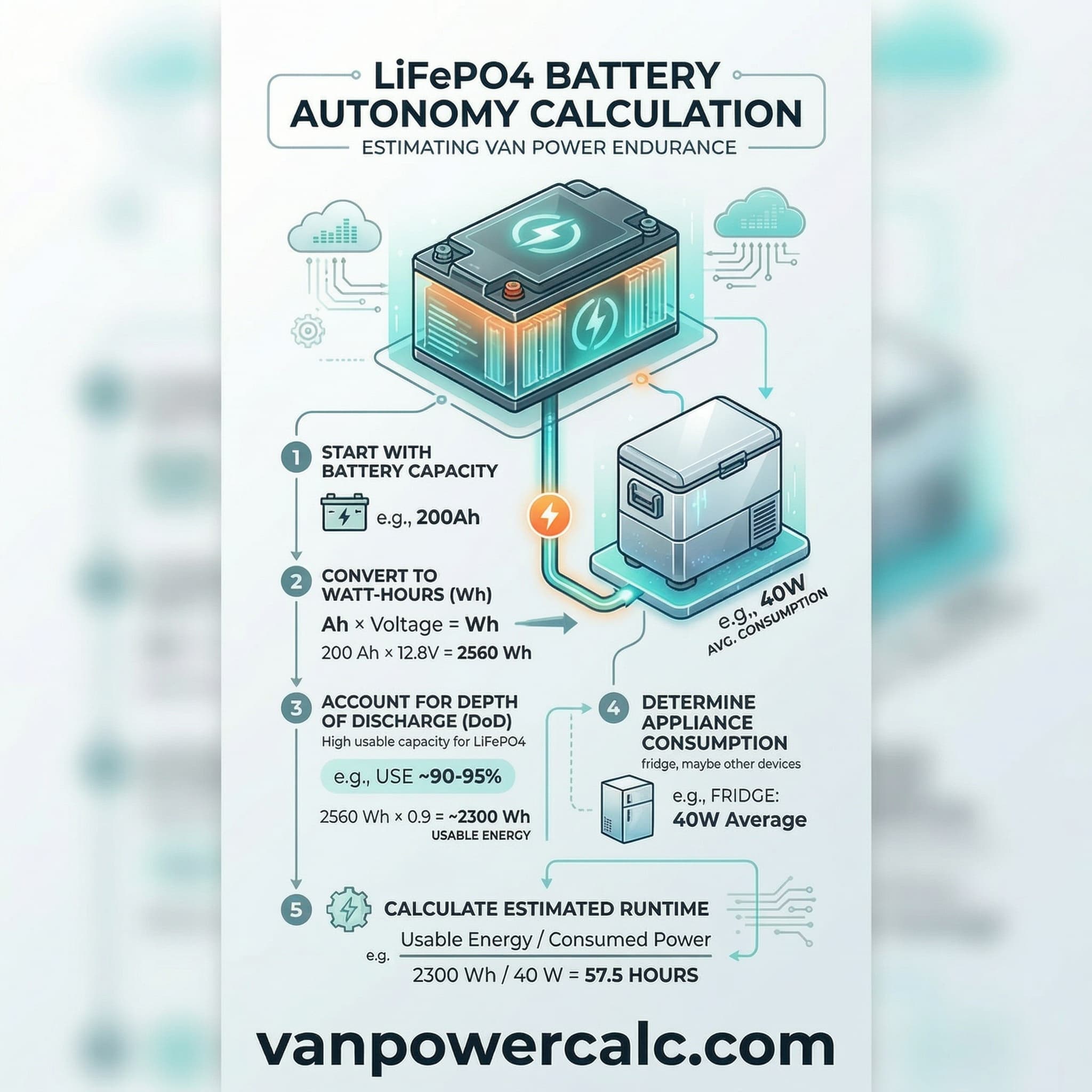
Start with your daily consumption. A typical off-grid tiny house: fridge (1,200Wh), lighting (200Wh), laptop and wifi (300Wh), water pump (100Wh), phone charging (50Wh) = 1,850Wh/day baseline. Add a washing machine once a week (+500Wh averaged) and occasional power tools (+200Wh) = ~2,500Wh/day. For 3 days of autonomy: 2,500 × 3 / 0.8 DoD / 12V = 781Ah minimum.
Expert tip
For a tiny house, consider a hybrid inverter (Victron MultiPlus II, EG4 6000XP) that combines inverter, charger, and transfer switch with generator input. When your battery runs low during a winter week, a small generator running for 3-4 hours tops off the bank. This backup costs $400-600 and eliminates the need to oversize your battery for worst-case scenarios.
Example calculation for your setup
Results based on a typical use case
| Appliance | Power | Usage/day | Wh/day |
|---|---|---|---|
| Compression fridge | 45W | 24h | 1080 |
| LED lighting | 20W | 4h | 80 |
| Water pump | 30W | 0.5h | 15 |
| Phone charging | 15W | 2h | 30 |
| Daily consumption | 1205 Wh | ||
Recommended LiFePO4 battery
151 Ah
(80% depth of discharge)
Recommended AGM battery
241 Ah
(50% depth of discharge)
Adjust these values with the calculator below
About this tool
The jump from van to tiny house electrical is mostly about scale, not complexity. The same principles apply — LiFePO4 over AGM, MPPT over PWM, proper fusing and cable sizing. But the numbers get bigger. Solar arrays of 1-3kW are common (vs 200-400W for vans). Battery banks of 600-1,200Ah (vs 100-300Ah). Inverters of 3-5kW (vs 1-2kW). And the wiring needs to handle it. Some tiny houses run 24V or 48V systems instead of 12V to keep cable sizes manageable — at 2,500W load on 12V you're pulling 208A, but at 48V it's only 52A. Much thinner cables, smaller fuses, less heat. If you're building from scratch, 48V is worth considering for any system over 3kW continuous load. The downside: fewer 48V-native appliances and higher component costs.

Frequently asked questions
How big a battery bank for an off-grid tiny house?▼
600-1,200Ah LiFePO4 for most builds. Calculate: daily Wh × days of autonomy / 0.8 DoD / system voltage. At 2,500Wh/day with 3 days autonomy on 12V: 781Ah. On 48V: 195Ah. Size depends heavily on your appliances and how many cloudy days you plan for.
Should a tiny house use 12V, 24V, or 48V?▼
48V for systems over 3kW continuous. 24V for 1.5-3kW. 12V only for small setups under 1.5kW. Higher voltage = thinner cables, less heat, more efficient. The trade-off is fewer native 12V appliances work directly — you'll need DC-DC converters for 12V devices.
How much solar for an off-grid tiny house?▼
1-3kW depending on location and consumption. For 2,500Wh/day in a sunny climate (5 PSH): 2,500 / 5 / 0.85 (losses) = 588W minimum. Double that for winter buffer and cloudy days: 1,200W is a solid starting point.
Can I run a washing machine off-grid?▼
Yes — a modern front-loader uses 200-500Wh per cycle. Run it during peak solar hours so the panels directly power the load. Avoid top-loaders with electric water heating — they can spike to 2,000W+. Cold wash with a heat-pump dryer is the most efficient combo.
Do I need a generator backup?▼
Highly recommended. A 2-3kW inverter generator ($400-600) running 3-4 hours can put 3-4kWh into your battery bank — enough to ride out a week of clouds. Without a generator, you'd need to double your solar and battery investment to cover worst-case winter scenarios.
Advertising
Independent and free thanks to your clicks
Links marked with * are affiliate links. If a purchase is made through them, I receive a commission at no extra cost to you. The editorial selection and product evaluation are not influenced by commission rates. Your click helps fund this free tool.
Recommended gear
Check price
LiTime 12V 100Ah Bluetooth LiFePO4 (Group 31)Leo's Pick
LiFePO4 12V 100Ah Group 31, Bluetooth monitoring, 100A BMS, low-temp cutoff protection. Up to 15000 deep cycles at 60% DoD. Marine, RV, off-grid use. 222 Amazon reviews. LiTime is a leading mainstream LiFePO4 brand on Amazon US.“This is the battery I've been using in my van for 2 years. Reliable, lightweight, and the best value for money out there.”View on Amazon* →Check price
LiFePO4 200Ah 12V Battery
200Ah true capacity, 200A built-in BMS, 5000+ cycles.“If you work remotely or run a fridge, go straight for 200Ah. You'll never regret having too much capacity.”View on Amazon* →$114Amazon
Victron BMV-712 Battery Monitor
Real-time SOC, history, Bluetooth alarms. Must-have.“Without a monitor, you're flying blind. This one gives you the exact battery % in real time — a total game-changer.”View on Amazon* →$56Amazon
Victron Orion DC-DC Charger 30A
Charges battery from alternator with correct Li profile.“Essential if you have a Euro 6+ vehicle. I've installed it on 3 different vans, zero issues. It charges your battery as soon as you drive.”View on Amazon* →