Loading...
Fact-checked on Apr 5, 2026
VANPOWERCALC.COMYOUR ENERGY PROFILE
YOUR ENERGY PROFILE.
This document contains the sizing of your future electrical installation, calculated based on your appliances.
Minimum Daily Consumption
0 WH / DAY
Inventory:
SYSTEM SIZINGPage 2
Battery
To guarantee 0WH without damaging your bank (80% max discharge):
0 AH
LiFePO4 12V
Solar
Minimum power required to recharge your consumption:
0 W
via MPPT
220V AC
Maximum power (with 25% safety margin).
0 W
No Need
Safety & CablingPage 3
12V Cable Sizing Guide
Use this professional reference table to select the correct gauge (mm²) for your cables. For 12V in a van, the maximum tolerated voltage drop is 3%. Always use multi-stranded flexible automotive wire.
| Current (A) | Round trip < 2m | Round trip 4m | Round trip 6m |
|---|---|---|---|
| 5A (LEDs, USB) | 1.5 mm² | 2.5 mm² | 4 mm² |
| 10A (Fridge, Pump) | 2.5 mm² | 4 mm² | 6 mm² |
| 20A (Heater) | 4 mm² | 10 mm² | 10 mm² |
| 50A (DC/DC Booster) | 10 mm² | 16 mm² | 25 mm² |
| 100A (Inverter) | 25 mm² | 35 mm² | 50 mm² |
Fuse Sizing
The fuse protects the wire, not the appliance. Always place it as close to the power source as possible (battery or busbar).
- Wire 1.5 mm² → Max fuse 10A
- Wire 2.5 mm² → Max fuse 20A
- Wire 4 mm² → Max fuse 30A
- Wire 6 mm² → Max fuse 40A
- Wire 10 mm² → Max fuse 60A
SCHÉMA ÉLECTRIQUE
PANNEAUX SOLAIRES
0W
RÉGULATEUR MPPT
BATTERIE AUXILIAIRE
0 Ah
Lithium LiFePO4
FUSIBLE
FUSIBLE
BOÎTE À FUSIBLES 12V
Pompe, Leds, Frigo...
CONVERTISSEUR 220V
NON REQUI
PRO GEARPage 4
SHOPPING LIST
Where to find this equipment? Here is the community-approved selection.
12V 6-way Fuse Box
Mandatory protection
Digital Multimeter
Test your connections
Heavy Duty Crimping Tool
For perfect lugs
Heat Shrink Tubing
Insulation and safety
GENERATED BY VANPOWERCALC.COM
With 400W of solar and a 200Ah LiFePO4, I get 3-4 days of full autonomy in summer. In winter up north, that drops to 1-2 days. Shore power (typically 10A/2300W at European campsites, 30A in the US) is still the only realistic option for high-draw appliances like space heaters or air conditioning.
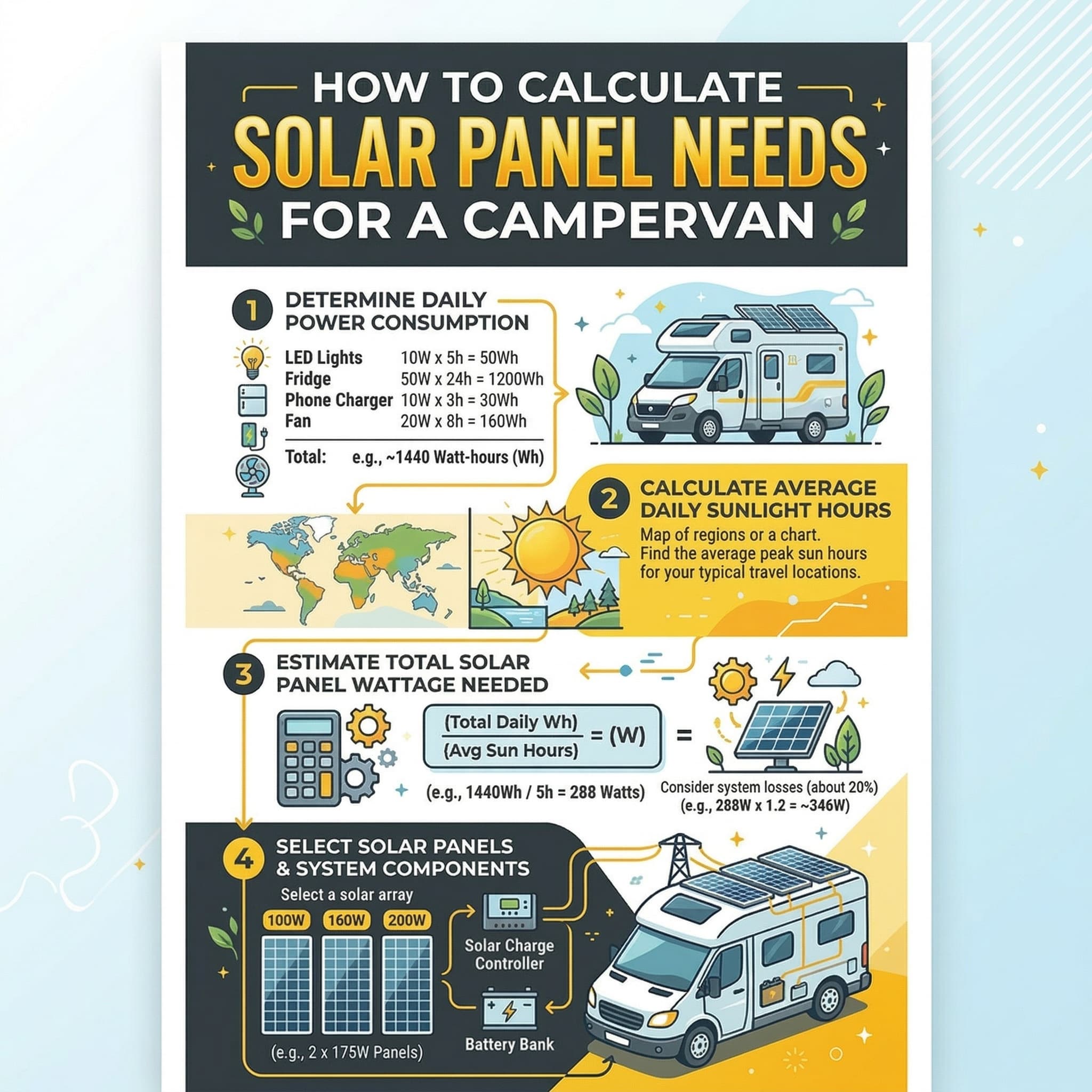
Here's my daily breakdown. Compressor fridge: 350Wh. LED lights: 50Wh. Phone/laptop charging: 150Wh. Starlink Mini: 120Wh. Total: about 670Wh/day. My 400W array produces 1600-2000Wh on a good summer day (4-5 peak sun hours). That's nearly 3x what I need. In December? Maybe 400-600Wh. Barely covers the fridge and lights.
Expert tip
Track your actual consumption for two weeks with a shunt monitor before buying solar. Most people overestimate by 30-40%. I budgeted for 900Wh/day and actually used 670Wh. Those extra panels would have been wasted money and roof space.
Example calculation for your setup
Results based on a typical use case
| Appliance | Power | Usage/day | Wh/day |
|---|---|---|---|
| Compression fridge | 45W | 24h | 1080 |
| LED lighting | 20W | 4h | 80 |
| Water pump | 30W | 0.5h | 15 |
| Phone charging | 15W | 2h | 30 |
| Daily consumption | 1205 Wh | ||
Recommended LiFePO4 battery
151 Ah
(80% depth of discharge)
Recommended AGM battery
241 Ah
(50% depth of discharge)
Adjust these values with the calculator below
About this tool
I ran both setups for a year and tracked everything with a Victron SmartShunt. The data tells a clear story.
Solar works brilliantly from April through September. I was fully off-grid for weeks at a time, parking wherever I wanted. No campsite fees -- that alone saved me $30-50/week in the US, or 5-8 EUR/night in Europe.
But winter changed everything. In December in Oregon, I got 1.2 peak sun hours average. My 400W panels produced maybe 350-480Wh/day. My daily consumption didn't drop -- the fridge still runs, I still need lights, and I actually use MORE power in winter (longer nights, more screen time).
The alternator charger was the real savior. My Victron Orion-Tr Smart 12/12-30 pushes 30A while driving. Two hours of driving gives me 720Wh -- more than a full winter day of solar. If you're moving regularly, this matters more than adding extra panels.
Cost breakdown for my setup: 400W rigid panels ($350), Victron MPPT 100/30 ($180), 200Ah LiFePO4 ($650), DC-DC charger ($230), wiring and fuses ($120). Total: about $1,530. At $40/week saved on campsite fees, it paid for itself in 38 weeks.
Shore power is still king for some things. Running a 1500W space heater overnight? That's 12,000Wh -- you'd need 1,000Ah of batteries and 2kW of solar to even attempt that off-grid. An induction cooktop at 1800W for 30 minutes? 900Wh per meal. Doable from solar in summer, not in winter.
My recommendation: build for solar first, keep shore power as backup. Size your solar for 1.5x your summer daily consumption. Accept that winter means either driving more or plugging in occasionally.

Frequently asked questions
How many watts of solar do I need to be off-grid in a campervan?▼
200W covers a minimal setup (fridge, lights, phone charging) in summer. 400W handles a comfortable setup including Starlink and laptop. Beyond 600W you're usually limited by roof space, not energy needs.
Can I run air conditioning on solar in a van?▼
Not really. A rooftop AC draws 1200-1800W continuously. Even with 800W of solar and 400Ah of batteries, you'd get 2-3 hours max. AC requires shore power or a generator.
How much does shore power cost at campsites?▼
In the US: $30-60/night at RV parks with full hookups. In Europe: 4-10 EUR/night for electricity at most campsites. Some aires in France offer free or cheap 4-hour electricity tokens for 2-4 EUR.
Is a DC-DC charger worth it alongside solar?▼
Absolutely. A 30A DC-DC charger gives you 360Wh per hour of driving. Two hours of travel produces more energy than a full winter day of 400W solar. It's the most underrated charging source for vanlife.
Do I need shore power if I have enough solar?▼
For 3-season vanlife in sunny climates, you can get away without it. But having a shore power inlet (with a quality charger like the Victron IP22) costs about $200 to install and gives you peace of mind. I'd always include it.
Advertising
Independent and free thanks to your clicks
Links marked with * are affiliate links. If a purchase is made through them, I receive a commission at no extra cost to you. The editorial selection and product evaluation are not influenced by commission rates. Your click helps fund this free tool.
Recommended gear
$130Amazon
200W Rigid Solar Panel
Mono 200W, 22%+ efficiency, rigid aluminum frame for van roof.“I tested 4 panels before this one. Great efficiency even in overcast weather, and it sits well on a van roof.”View on Amazon* →Check price
ECO-WORTHY 200W 12V/24V Solar Kit + 20A Bluetooth MPPTLeo's Pick
Complete 200W solar kit with Bluetooth-monitored MPPT controller. 12V/24V compatible, 20A charge controller with smartphone app. Ideal for vans, RVs, off-grid setups. Single-product solution covering both solar panel and charge controller.“The kit I recommend to every beginner. Plug it in, it works, and the included MPPT controller makes a real difference.”View on Amazon* →$115Amazon
Victron MPPT Controller 100/30
Extracts 97% solar power, Li & AGM compatible.“The Victron is pricey, but you install it once and forget about it. The Bluetooth app is a real plus for tracking solar output.”View on Amazon* →$38Amazon
Solar Cable 6mm² MC4 10m
6mm² solar cable with pre-crimped MC4 connectors, 10m.“Don't cheap out on solar cables. 6mm² between panels and controller is the minimum to avoid power losses.”View on Amazon* →