Loading...
Fact-checked on Apr 1, 2026
VANPOWERCALC.COMYOUR ENERGY PROFILE
YOUR ENERGY PROFILE.
This document contains the sizing of your future electrical installation, calculated based on your appliances.
Minimum Daily Consumption
0 WH / DAY
Inventory:
SYSTEM SIZINGPage 2
Battery
To guarantee 0WH without damaging your bank (80% max discharge):
0 AH
LiFePO4 12V
Solar
Minimum power required to recharge your consumption:
0 W
via MPPT
220V AC
Maximum power (with 25% safety margin).
0 W
No Need
Safety & CablingPage 3
12V Cable Sizing Guide
Use this professional reference table to select the correct gauge (mm²) for your cables. For 12V in a van, the maximum tolerated voltage drop is 3%. Always use multi-stranded flexible automotive wire.
| Current (A) | Round trip < 2m | Round trip 4m | Round trip 6m |
|---|---|---|---|
| 5A (LEDs, USB) | 1.5 mm² | 2.5 mm² | 4 mm² |
| 10A (Fridge, Pump) | 2.5 mm² | 4 mm² | 6 mm² |
| 20A (Heater) | 4 mm² | 10 mm² | 10 mm² |
| 50A (DC/DC Booster) | 10 mm² | 16 mm² | 25 mm² |
| 100A (Inverter) | 25 mm² | 35 mm² | 50 mm² |
Fuse Sizing
The fuse protects the wire, not the appliance. Always place it as close to the power source as possible (battery or busbar).
- Wire 1.5 mm² → Max fuse 10A
- Wire 2.5 mm² → Max fuse 20A
- Wire 4 mm² → Max fuse 30A
- Wire 6 mm² → Max fuse 40A
- Wire 10 mm² → Max fuse 60A
SCHÉMA ÉLECTRIQUE
PANNEAUX SOLAIRES
0W
RÉGULATEUR MPPT
BATTERIE AUXILIAIRE
0 Ah
Lithium LiFePO4
FUSIBLE
FUSIBLE
BOÎTE À FUSIBLES 12V
Pompe, Leds, Frigo...
CONVERTISSEUR 220V
NON REQUI
PRO GEARPage 4
SHOPPING LIST
Where to find this equipment? Here is the community-approved selection.
12V 6-way Fuse Box
Mandatory protection
Digital Multimeter
Test your connections
Heavy Duty Crimping Tool
For perfect lugs
Heat Shrink Tubing
Insulation and safety
GENERATED BY VANPOWERCALC.COM
If you sized your solar for summer and assumed it'd carry you through winter — bad news. In northern states or northern Europe, December solar output is roughly 30-40% of what you get in June. A 200W panel that happily pumps out 850Wh on a July day will struggle to produce 300Wh in January.
The key variable is peak sun hours (PSH). Southern California gets 5-6 PSH even in December. Portland or London? Maybe 1.5-2 PSH. With real-world losses factored in (~15% for wiring, angle, and dirt), your 200W panel in a northern winter delivers: 200W × 1.5 PSH × 0.85 = 255Wh/day. That barely covers a fridge.
Expert tip
Tilt your panels toward the winter sun if your mounting allows it. Even 15-20° of tilt toward the south makes a massive difference in winter — I measured 30-40% more production on tilted vs flat panels in December. Some rail mounts have adjustable legs for exactly this.
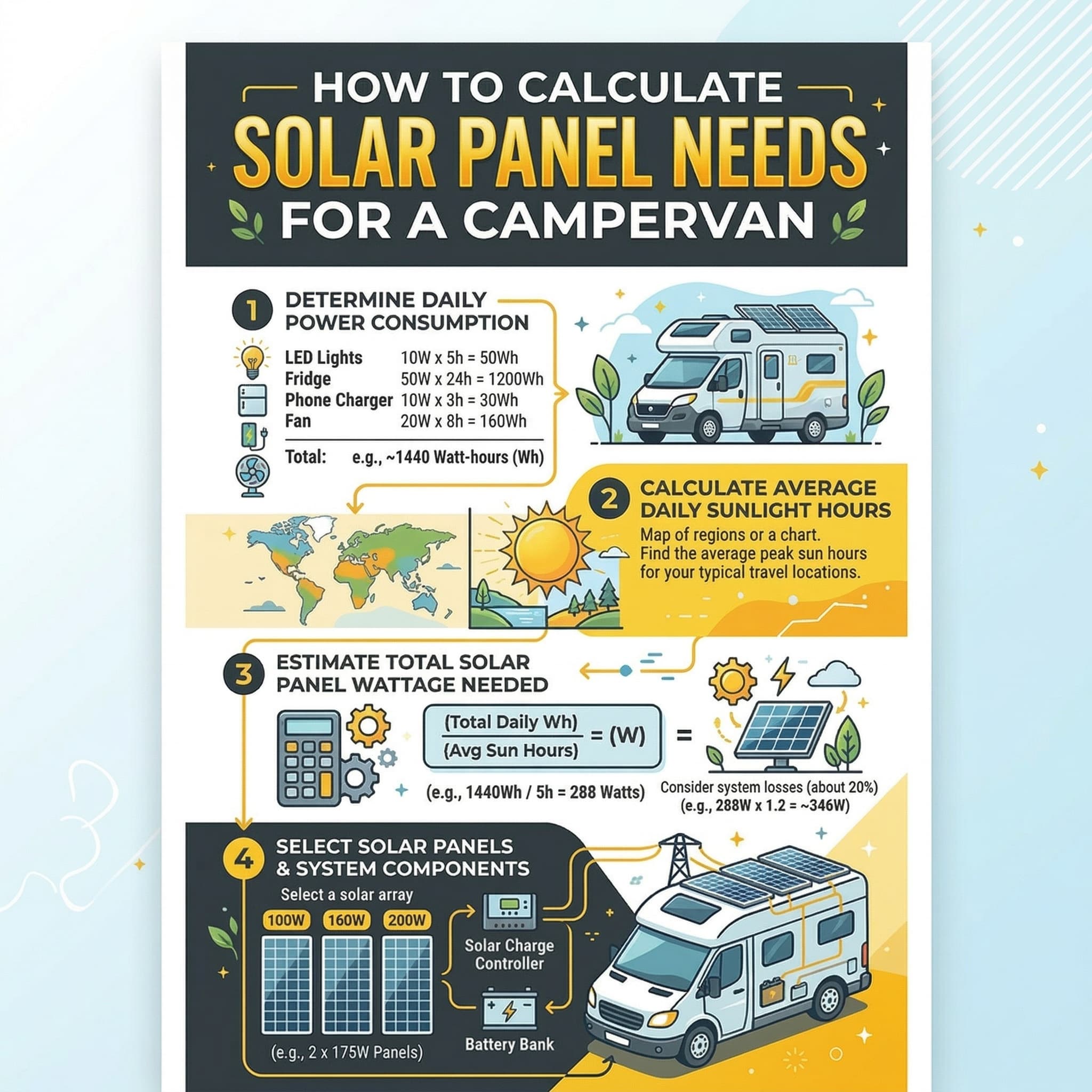
Example calculation for your setup
Results based on a typical use case
| Appliance | Power | Usage/day | Wh/day |
|---|---|---|---|
| Compression fridge | 45W | 24h | 1080 |
| LED lighting | 20W | 4h | 80 |
| Water pump | 30W | 0.5h | 15 |
| Phone charging | 15W | 2h | 30 |
| Daily consumption | 1205 Wh | ||
Recommended solar panels
402 Wc
4h average sun hours
Adjust these values with the calculator below
About this tool
I spent last December parked in the French Alps at 1,200m altitude. Clear skies, but the sun barely climbed above the mountains until 10 AM and disappeared by 3 PM — giving me maybe 4 hours of useful light. My 400W array (two 200W rigid panels) peaked at 280W around noon and averaged maybe 150W over those 4 hours. Total daily harvest: 600Wh. My consumption was about 700Wh/day. Every single day I ran a deficit. The DC-DC charger while driving to town for groceries twice a week was what kept me alive electrically. Here's the counterintuitive part: cold temperatures actually boost panel efficiency. Solar cells produce more voltage in cold air. A panel rated at 200W at 25°C might hit 215W at -5°C. But the shorter days and lower sun angle far outweigh this small gain.

Frequently asked questions
How much solar do van panels produce in winter?▼
Roughly 30-50% of summer output, depending on latitude. In the northern US or northern Europe: 200W of panels produces 250-400Wh/day in December vs 800-1,000Wh in July. In the southern US or Mediterranean: 400-600Wh/day year-round.
Is 200W of solar enough for winter van life?▼
Not on its own in northern latitudes. 200W in winter gives you 250-350Wh/day — enough for LED lights and phone charging, not enough for a fridge full-time. You'll need to supplement with driving (DC-DC charger) or shore power. In the southern US or Spain, 200W can cover basic needs year-round.
Does cold weather damage solar panels?▼
No — cold actually helps. Solar cells are more efficient in cold temperatures, producing slightly higher voltage. Snow cover is the real enemy: even a thin layer blocks all production. Panels at an angle shed snow faster than flat-mounted ones.
Should I add more panels for winter?▼
More panels help but aren't always the answer. The constraint in winter is often daylight hours, not panel capacity. Going from 200W to 400W doubles your winter output, but you're still limited to 4-5 hours of usable sun. A DC-DC charger ($150-300) is often a better winter investment than doubling your solar array.
How do I manage power in winter van life?▼
Three strategies: reduce consumption (LED everything, turn off the inverter when not in use, run fridge on eco mode), add charging sources (DC-DC charger while driving, occasional shore power hookup), and oversize your battery to handle multi-day deficits. A 300Ah bank gives you 3-4 days of buffer vs 200Ah's 2-3 days.
Advertising
Independent and free thanks to your clicks
Links marked with * are affiliate links. If a purchase is made through them, I receive a commission at no extra cost to you. The editorial selection and product evaluation are not influenced by commission rates. Your click helps fund this free tool.
Recommended gear
$130Amazon
200W Rigid Solar Panel
Mono 200W, 22%+ efficiency, rigid aluminum frame for van roof.“I tested 4 panels before this one. Great efficiency even in overcast weather, and it sits well on a van roof.”View on Amazon* →Check price
ECO-WORTHY 200W 12V/24V Solar Kit + 20A Bluetooth MPPTLeo's Pick
Complete 200W solar kit with Bluetooth-monitored MPPT controller. 12V/24V compatible, 20A charge controller with smartphone app. Ideal for vans, RVs, off-grid setups. Single-product solution covering both solar panel and charge controller.“The kit I recommend to every beginner. Plug it in, it works, and the included MPPT controller makes a real difference.”View on Amazon* →$115Amazon
Victron MPPT Controller 100/30
Extracts 97% solar power, Li & AGM compatible.“The Victron is pricey, but you install it once and forget about it. The Bluetooth app is a real plus for tracking solar output.”View on Amazon* →$38Amazon
Solar Cable 6mm² MC4 10m
6mm² solar cable with pre-crimped MC4 connectors, 10m.“Don't cheap out on solar cables. 6mm² between panels and controller is the minimum to avoid power losses.”View on Amazon* →