Loading...
Fact-checked on Jun 12, 2026
VANPOWERCALC.COMYOUR ENERGY PROFILE
YOUR ENERGY PROFILE.
This document contains the sizing of your future electrical installation, calculated based on your appliances.
Minimum Daily Consumption
0 WH / DAY
Inventory:
SYSTEM SIZINGPage 2
Battery
To guarantee 0WH without damaging your bank (80% max discharge):
0 AH
LiFePO4 12V
Solar
Minimum power required to recharge your consumption:
0 W
via MPPT
220V AC
Maximum power (with 25% safety margin).
0 W
No Need
Safety & CablingPage 3
12V Cable Sizing Guide
Use this professional reference table to select the correct gauge (mm²) for your cables. For 12V in a van, the maximum tolerated voltage drop is 3%. Always use multi-stranded flexible automotive wire.
| Current (A) | Round trip < 2m | Round trip 4m | Round trip 6m |
|---|---|---|---|
| 5A (LEDs, USB) | 1.5 mm² | 2.5 mm² | 4 mm² |
| 10A (Fridge, Pump) | 2.5 mm² | 4 mm² | 6 mm² |
| 20A (Heater) | 4 mm² | 10 mm² | 10 mm² |
| 50A (DC/DC Booster) | 10 mm² | 16 mm² | 25 mm² |
| 100A (Inverter) | 25 mm² | 35 mm² | 50 mm² |
Fuse Sizing
The fuse protects the wire, not the appliance. Always place it as close to the power source as possible (battery or busbar).
- Wire 1.5 mm² → Max fuse 10A
- Wire 2.5 mm² → Max fuse 20A
- Wire 4 mm² → Max fuse 30A
- Wire 6 mm² → Max fuse 40A
- Wire 10 mm² → Max fuse 60A
SCHÉMA ÉLECTRIQUE
PANNEAUX SOLAIRES
0W
RÉGULATEUR MPPT
BATTERIE AUXILIAIRE
0 Ah
Lithium LiFePO4
FUSIBLE
FUSIBLE
BOÎTE À FUSIBLES 12V
Pompe, Leds, Frigo...
CONVERTISSEUR 220V
NON REQUI
PRO GEARPage 4
SHOPPING LIST
Where to find this equipment? Here is the community-approved selection.
12V 6-way Fuse Box
Mandatory protection
Digital Multimeter
Test your connections
Heavy Duty Crimping Tool
For perfect lugs
Heat Shrink Tubing
Insulation and safety
GENERATED BY VANPOWERCALC.COM
I get this question at least once a week: "I found a great deal on a 24V 1500W inverter but my battery bank is 48V — can I just wire it up?" The short answer is no. The long answer is also no, but with an explanation. A 24V inverter expects input between roughly 20-30V DC. A 48V LiFePO4 bank sits at 51.2V nominal and charges up to 58.4V. Connecting 48V to a 24V inverter will either trigger its overvoltage protection (best case) or destroy the input stage MOSFETs (worst case). I've seen both happen. The magic smoke does not go back in.
So why do people end up in this situation? Usually it's one of three scenarios: they upgraded their battery bank from 24V to 48V but already own a 24V inverter, they found a killer deal on a 24V unit, or they're working with a vehicle that has a 48V hybrid system and want to add a 24V inverter for appliances. In all three cases, there's a real voltage mismatch that needs solving. The physics don't care about your budget. A 48V LiFePO4 bank ranges from about 44V (empty, 2.75V/cell) to 58.4V (full charge at 3.65V/cell). A 24V inverter's input MOSFETs are typically rated for 60V max with zero margin, and many cheaper units use 40V-rated FETs. Either way, you're asking for trouble.
Expert tip
If you're building a new system and debating between 24V and 48V, commit to one voltage and buy all components to match. Mixing voltages through DC-DC converters always costs more in money, efficiency, and complexity than just buying the right voltage equipment from the start. The "deal" on that mismatched inverter is never actually a deal once you add the converter cost.
Example calculation for your setup
Results based on a typical use case
| Appliance | Power | Usage/day | Wh/day |
|---|---|---|---|
| Compression fridge | 45W | 24h | 1080 |
| LED lighting | 20W | 4h | 80 |
| Water pump | 30W | 0.5h | 15 |
| Phone charging | 15W | 2h | 30 |
| Daily consumption | 1205 Wh | ||
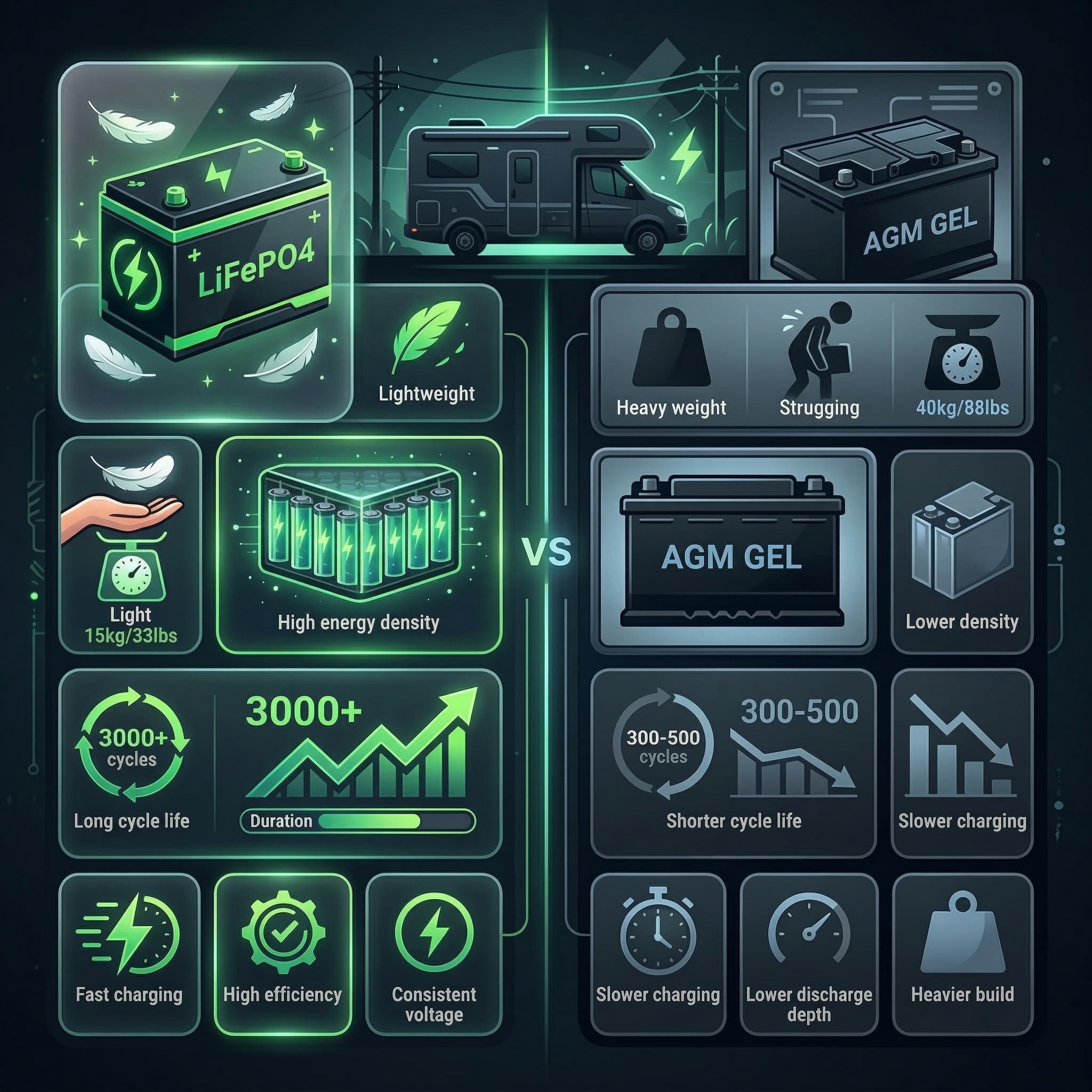
Recommended LiFePO4 battery
151 Ah
(80% depth of discharge)
Recommended AGM battery
241 Ah
(50% depth of discharge)
Adjust these values with the calculator below
About this tool
There are really only two paths forward, and one of them is the obvious right answer.
Option 1: DC-DC Converter (48V to 24V)
You can install a 48V-to-24V step-down converter between your battery and the inverter. For a 1500W inverter, you need a converter rated for at least 1500W continuous — that means 62.5A output at 24V. These exist, but they're not cheap. A quality 1500W 48V-to-24V DC-DC converter runs $150-300. And here's the kicker: every conversion step has losses. A good DC-DC converter runs at 92-95% efficiency. So your 1500W inverter now has two conversion stages: 48V DC to 24V DC (losing 5-8%), then 24V DC to 120V/230V AC (losing another 10-15%). Total system efficiency drops to around 78-85%, versus 85-90% for a single-stage 48V inverter. On a 200Ah 48V bank (9.6kWh), that efficiency difference means you lose roughly 500-1,150Wh of usable energy — about 1-2 hours of running a 500W load.
The wiring also gets complicated. The DC-DC converter output at 62.5A needs 16mm² (6 AWG) cable minimum between the converter and inverter. The input side at 48V pulls about 33A, so 6mm² (10 AWG) works. You need fusing on both sides. And the converter generates heat — a 1500W unit at 95% efficiency dumps 75W as heat, which needs ventilation.
Option 2: Buy a 48V Inverter (The Right Answer)
A new 48V 1500W pure sine wave inverter costs $200-400. That's comparable to or less than a quality DC-DC converter alone — and you get better efficiency, simpler wiring, fewer failure points, and less heat. A 1500W inverter at 48V draws only 31.25A, so you can run 6mm² (10 AWG) cable on short runs. No second conversion stage, no extra fusing, no heat management for the converter.
The math is clear: a $250 48V inverter replaces a $200 DC-DC converter plus gives you better efficiency and reliability. The only scenario where the DC-DC route makes sense is if you already own a very expensive 24V inverter (like a Victron MultiPlus 24/3000, which runs $1,500+) and the cost of replacing it exceeds the converter cost significantly.
What about wiring 48V as two 24V banks in parallel? Don't. If you have four 12V batteries in series making 48V, you cannot tap the midpoint for 24V without creating a severely imbalanced system. The two halves would discharge unevenly, the BMS (if it's a single 16S unit) would see cell imbalances, and you'd shorten battery life dramatically. This is not a real solution.

Frequently asked questions
Will a 24V inverter work on a 48V battery?▼
No. A 48V LiFePO4 bank outputs 44-58.4V, which exceeds a 24V inverter input range (typically 20-30V). Connecting directly will trigger overvoltage protection or destroy the inverter input stage. You need a DC-DC converter or a properly rated 48V inverter.
How much does a 48V to 24V DC-DC converter cost?▼
For a 1500W-rated unit, expect $150-300. Combined with efficiency losses (5-8% per conversion stage), the total cost often exceeds simply buying a 48V inverter ($200-400), which is the better solution in most cases.
Can I tap the midpoint of a 48V bank for 24V?▼
Do not do this. Tapping the midpoint creates an imbalanced system where the two halves discharge unevenly. Your BMS will see cell imbalances, and battery life will suffer dramatically. Use a proper DC-DC converter or buy a 48V inverter.
What is the efficiency loss of using a DC-DC converter with an inverter?▼
A DC-DC converter adds 5-8% losses on top of the inverter 10-15% losses. Total system efficiency drops to 78-85% versus 85-90% for a direct 48V inverter. On a 200Ah 48V bank, that means losing 500-1,150Wh of usable energy.
When does a DC-DC converter make sense instead of buying a new inverter?▼
Only when you already own an expensive inverter (like a Victron MultiPlus 24/3000 at $1,500+) where replacement cost far exceeds the $150-300 DC-DC converter. For standard inverters under $500, buying the correct voltage unit is always cheaper and more efficient.
Advertising
Independent and free thanks to your clicks
Links marked with * are affiliate links. If a purchase is made through them, I receive a commission at no extra cost to you. The editorial selection and product evaluation are not influenced by commission rates. Your click helps fund this free tool.
Recommended gear
$104Amazon
Pure Sine Inverter 2000W 12V
Runs induction cooktop, hair dryer, coffee machine.“The 2000W version for those who want to plug in everything: induction plate, hair dryer, pro coffee machine. Make sure your cables are properly sized.”View on Amazon* →$33Amazon
Battery Cable 50mm² Red+Black
50mm² cable for 2000W+ inverter. Red and black, 1m each.“Between battery and inverter, you need heavy-duty cable. 50mm² handles big current draws without overheating.”View on Amazon* →$13Amazon
ANL Fuse 250A + Fuse Holder
Mandatory inverter protection. 250A with integrated fuse holder.“The ANL fuse protects your battery-to-inverter cable. It's a few bucks that can prevent a fire. Non-negotiable.”View on Amazon* →Check price
LiFePO4 200Ah 12V Battery
200Ah true capacity, 200A built-in BMS, 5000+ cycles.“If you work remotely or run a fridge, go straight for 200Ah. You'll never regret having too much capacity.”View on Amazon* →