Loading...
Fact-checked on Apr 8, 2026
VANPOWERCALC.COMYOUR ENERGY PROFILE
YOUR ENERGY PROFILE.
This document contains the sizing of your future electrical installation, calculated based on your appliances.
Minimum Daily Consumption
0 WH / DAY
Inventory:
SYSTEM SIZINGPage 2
Battery
To guarantee 0WH without damaging your bank (80% max discharge):
0 AH
LiFePO4 12V
Solar
Minimum power required to recharge your consumption:
0 W
via MPPT
220V AC
Maximum power (with 25% safety margin).
0 W
No Need
Safety & CablingPage 3
12V Cable Sizing Guide
Use this professional reference table to select the correct gauge (mm²) for your cables. For 12V in a van, the maximum tolerated voltage drop is 3%. Always use multi-stranded flexible automotive wire.
| Current (A) | Round trip < 2m | Round trip 4m | Round trip 6m |
|---|---|---|---|
| 5A (LEDs, USB) | 1.5 mm² | 2.5 mm² | 4 mm² |
| 10A (Fridge, Pump) | 2.5 mm² | 4 mm² | 6 mm² |
| 20A (Heater) | 4 mm² | 10 mm² | 10 mm² |
| 50A (DC/DC Booster) | 10 mm² | 16 mm² | 25 mm² |
| 100A (Inverter) | 25 mm² | 35 mm² | 50 mm² |
Fuse Sizing
The fuse protects the wire, not the appliance. Always place it as close to the power source as possible (battery or busbar).
- Wire 1.5 mm² → Max fuse 10A
- Wire 2.5 mm² → Max fuse 20A
- Wire 4 mm² → Max fuse 30A
- Wire 6 mm² → Max fuse 40A
- Wire 10 mm² → Max fuse 60A
SCHÉMA ÉLECTRIQUE
PANNEAUX SOLAIRES
0W
RÉGULATEUR MPPT
BATTERIE AUXILIAIRE
0 Ah
Lithium LiFePO4
FUSIBLE
FUSIBLE
BOÎTE À FUSIBLES 12V
Pompe, Leds, Frigo...
CONVERTISSEUR 220V
NON REQUI
PRO GEARPage 4
SHOPPING LIST
Where to find this equipment? Here is the community-approved selection.
12V 6-way Fuse Box
Mandatory protection
Digital Multimeter
Test your connections
Heavy Duty Crimping Tool
For perfect lugs
Heat Shrink Tubing
Insulation and safety
GENERATED BY VANPOWERCALC.COM
Since early 2026, energy grids across Europe have been under serious strain. Fuel shortages, spiking electricity prices, rolling blackouts in some regions. Me? I couldn't care less. Not because I'm heartless — I just built my van's electrical system to depend on nobody. And I'll show you exactly how to do the same.
My current setup: 400W of solar panels and a 200Ah LiFePO4 battery. In summer across southern Europe, that generates 1,600–1,900Wh per day. Plenty for the fridge, laptop, lights, phone charging, and even a small inverter for morning coffee. Total investment: $1,500–3,000 — roughly what a US household spends on electricity in a single year at 2026 rates.
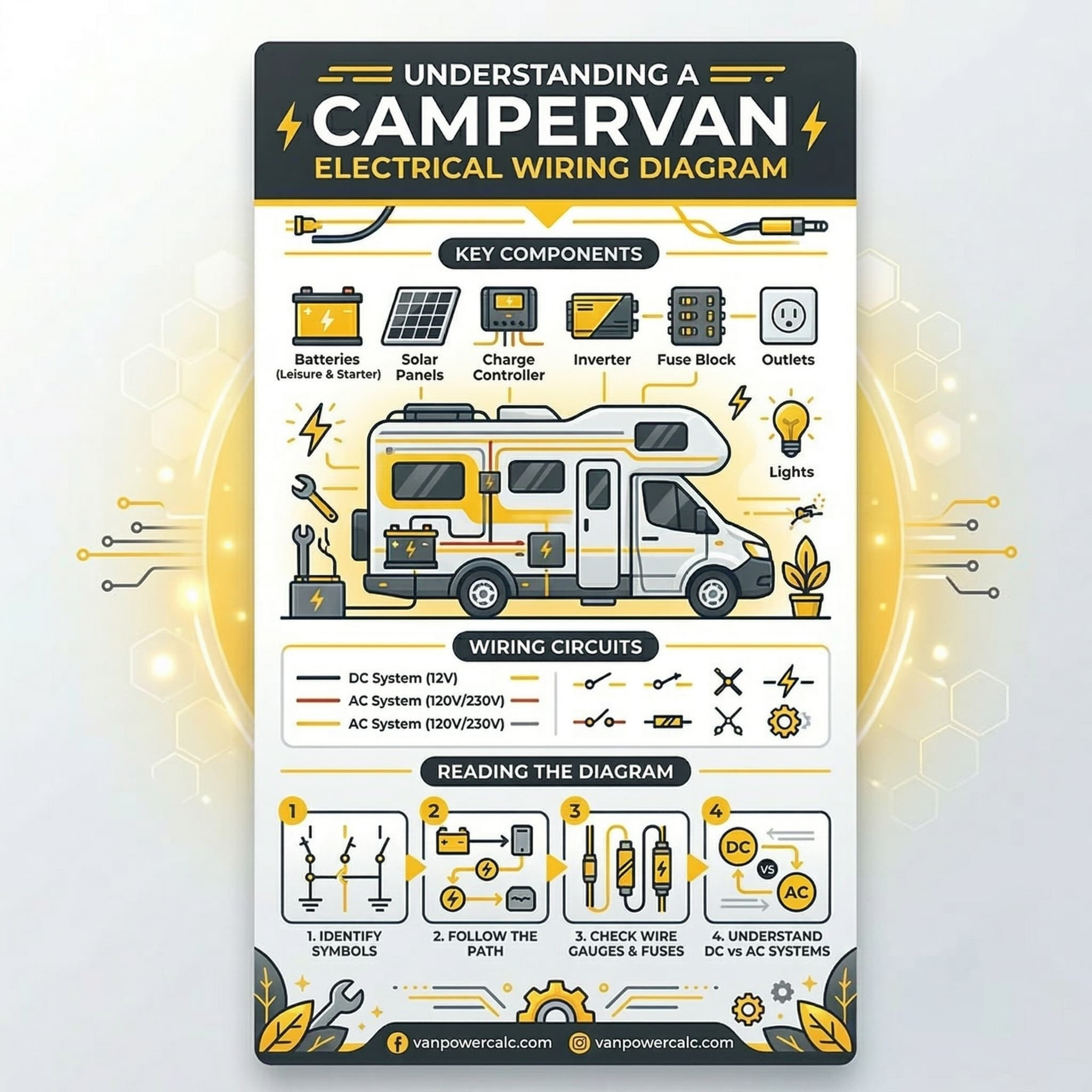
Expert tip
Measure your actual consumption for 3 days before sizing anything. Most people overestimate their needs by 30%. A $15 watt meter on each appliance will save you from oversizing — and overpaying for — your entire system.
Example calculation for your setup
Results based on a typical use case
| Appliance | Power | Usage/day | Wh/day |
|---|---|---|---|
| Compression fridge | 45W | 24h | 1080 |
| LED lighting | 20W | 4h | 80 |
| Water pump | 30W | 0.5h | 15 |
| Phone charging | 15W | 2h | 30 |
| Daily consumption | 1205 Wh | ||
Recommended LiFePO4 battery
151 Ah
(80% depth of discharge)
Recommended AGM battery
241 Ah
(50% depth of discharge)
Adjust these values with the calculator below
About this tool
The comparison is brutal. An average US household pays around $2,000/year on electricity in 2026 with crisis pricing. A vanlifer with 400W solar and a 200Ah LiFePO4 pays... $0. The upfront cost sits between $1,000 and $5,000 depending on the setup, but solar has no monthly bill, no rate hikes, no surprise fees.
I ran the numbers over 5 years. With a $2,500 setup, amortized cost comes to about $500/year, then it's free. The LiFePO4 battery lasts 3,000 cycles minimum — that's 8 to 10 years of daily use. Meanwhile the grid keeps raising prices. Energy independence in a van isn't some hippie dream — it's basic math.
What Real Off-Grid Autonomy Looks Like Day to Day#
I spend about 80% of my time fully off-grid. A typical day: wake up, battery at 70% after running the fridge overnight (a 12V Dometic CFX drawing about 1.5A average). By 10 AM, the 400W panels are pushing 25-30A into the battery through my Victron MPPT 100/30. By 1 PM, the battery hits 100% and the controller switches to float. From there, every watt I produce goes directly to whatever I'm running — laptop (65W), phone charging (15W), LED lights (20W total), water pump (60W intermittent). On a sunny day I produce 1,800-2,000Wh and consume 800-1,200Wh. The surplus just sits there as a buffer for cloudy days.
Building a System That Handles 3 Cloudy Days#
The golden rule I follow: size your battery bank for 3 days of autonomy without any solar input. My daily consumption averages about 80Ah at 12V. Three days means I need 240Ah of usable capacity. With LiFePO4's 80-90% usable depth of discharge, a 300Ah bank covers this perfectly. A 200Ah bank — which is what most budget builds run — gives you about 1.5 days of autonomy. That works in summer in the southwest US, but it'll leave you plugging into campground power in the Pacific Northwest in November. The difference between a $600 200Ah battery and a $1,000 300Ah battery is the difference between energy stress and actual independence.
The Backup Charging Strategy#
Solar alone isn't a complete autonomy plan. I always carry two backup charging methods. A DC-DC charger (Victron Orion-Tr Smart 30A, about $200) recovers 30Ah per hour of driving — a 3-hour drive puts 90Ah back in the bank. And a shore power charger (Victron IP22 30A, about $150) lets me top off at any campground with hookups when I find one cheap enough. Between solar, alternator charging, and occasional shore power, I haven't been below 30% battery in over a year. The key is redundancy — no single charging source needs to be perfect if you have three options.
Cost of Autonomy vs. Grid Dependence Over 10 Years#
Here are the real numbers. Grid-dependent apartment: $2,000/year electricity, rising at 8-12% annually with 2026 crisis pricing. Over 10 years, that's $25,000-$30,000 in electricity alone. My van setup cost $3,200 total — panels, battery, MPPT, inverter, DC-DC charger, wiring, fuses. One battery replacement at year 8 adds another $800. Total 10-year energy cost: $4,000. That's an 85% reduction. Even if you factor in fuel for driving to chase sun, you're still at a fraction of grid costs. The van doesn't just reduce your energy bill — it eliminates the entire concept of an energy bill.

Frequently asked questions
How much does a fully autonomous van electrical system cost?▼
Between $1,000 for a basic setup (200W solar + 100Ah LiFePO4) and $5,000 for a complete system (400W+ solar, 200Ah+ LiFePO4, 2000W inverter, DC-DC charger). Most people land around $2,500 for comfortable autonomy.
Can a van be 100% electrically self-sufficient?▼
In summer, absolutely — 400W of solar handles it easily. Winter in northern latitudes is tougher, expect 50–70% autonomy. A DC-DC charger via the alternator fills the gap when you drive.
How many days of autonomy with a 200Ah LiFePO4 battery?▼
About 1,920Wh usable (200Ah x 12V x 80% DoD). That covers 2–3 days of normal use — fridge, lights, device charging — with zero solar input.
Does solar work in winter for a van?▼
Yes, but output drops 50–70% compared to summer. A 400W array produces around 500–700Wh/day in winter in southern Europe. You either adapt consumption or top up with the DC-DC charger while driving.
Do I need an inverter to be off-grid in a van?▼
Not mandatory, but very useful. A 12V-to-120V (or 230V) inverter lets you run standard appliances — laptop charger, coffee maker, hair dryer. A 1,000–2,000W model covers 90% of needs. Budget $150–400 depending on wattage.
Advertising
Independent and free thanks to your clicks
Links marked with * are affiliate links. If a purchase is made through them, I receive a commission at no extra cost to you. The editorial selection and product evaluation are not influenced by commission rates. Your click helps fund this free tool.
Recommended gear
Check price
LiTime 12V 100Ah Bluetooth LiFePO4 (Group 31)Leo's Pick
LiFePO4 12V 100Ah Group 31, Bluetooth monitoring, 100A BMS, low-temp cutoff protection. Up to 15000 deep cycles at 60% DoD. Marine, RV, off-grid use. 222 Amazon reviews. LiTime is a leading mainstream LiFePO4 brand on Amazon US.“This is the battery I've been using in my van for 2 years. Reliable, lightweight, and the best value for money out there.”View on Amazon* →Check price
ECO-WORTHY 200W 12V/24V Solar Kit + 20A Bluetooth MPPTLeo's Pick
Complete 200W solar kit with Bluetooth-monitored MPPT controller. 12V/24V compatible, 20A charge controller with smartphone app. Ideal for vans, RVs, off-grid setups. Single-product solution covering both solar panel and charge controller.“The kit I recommend to every beginner. Plug it in, it works, and the included MPPT controller makes a real difference.”View on Amazon* →$107Amazon
Digital Multimeter
Measures voltage, current, resistance — essential for 12V wiring.“First tool to buy before you even start your install. You'll pull it out 100 times to check voltages and connections.”View on Amazon* →$41Amazon
12V Fuse Box
Protects each circuit independently, easy installation.“One fuse per circuit is the golden rule. This box keeps your install clean and every line independently protected.”View on Amazon* →