Loading...
Fact-checked on Apr 5, 2026
VANPOWERCALC.COMYOUR ENERGY PROFILE
YOUR ENERGY PROFILE.
This document contains the sizing of your future electrical installation, calculated based on your appliances.
Minimum Daily Consumption
0 WH / DAY
Inventory:
SYSTEM SIZINGPage 2
Battery
To guarantee 0WH without damaging your bank (80% max discharge):
0 AH
LiFePO4 12V
Solar
Minimum power required to recharge your consumption:
0 W
via MPPT
220V AC
Maximum power (with 25% safety margin).
0 W
No Need
Safety & CablingPage 3
12V Cable Sizing Guide
Use this professional reference table to select the correct gauge (mm²) for your cables. For 12V in a van, the maximum tolerated voltage drop is 3%. Always use multi-stranded flexible automotive wire.
| Current (A) | Round trip < 2m | Round trip 4m | Round trip 6m |
|---|---|---|---|
| 5A (LEDs, USB) | 1.5 mm² | 2.5 mm² | 4 mm² |
| 10A (Fridge, Pump) | 2.5 mm² | 4 mm² | 6 mm² |
| 20A (Heater) | 4 mm² | 10 mm² | 10 mm² |
| 50A (DC/DC Booster) | 10 mm² | 16 mm² | 25 mm² |
| 100A (Inverter) | 25 mm² | 35 mm² | 50 mm² |
Fuse Sizing
The fuse protects the wire, not the appliance. Always place it as close to the power source as possible (battery or busbar).
- Wire 1.5 mm² → Max fuse 10A
- Wire 2.5 mm² → Max fuse 20A
- Wire 4 mm² → Max fuse 30A
- Wire 6 mm² → Max fuse 40A
- Wire 10 mm² → Max fuse 60A
SCHÉMA ÉLECTRIQUE
PANNEAUX SOLAIRES
0W
RÉGULATEUR MPPT
BATTERIE AUXILIAIRE
0 Ah
Lithium LiFePO4
FUSIBLE
FUSIBLE
BOÎTE À FUSIBLES 12V
Pompe, Leds, Frigo...
CONVERTISSEUR 220V
NON REQUI
PRO GEARPage 4
SHOPPING LIST
Where to find this equipment? Here is the community-approved selection.
12V 6-way Fuse Box
Mandatory protection
Digital Multimeter
Test your connections
Heavy Duty Crimping Tool
For perfect lugs
Heat Shrink Tubing
Insulation and safety
GENERATED BY VANPOWERCALC.COM
A shadow covering just 10% of your panel can slash output by 50% or more. That's not a typo. If you've got a MaxxFan, roof rack, or antenna casting a shadow across your panels, you might be losing half your solar production without realizing it.
The physics are brutal: solar cells are wired in series inside each panel. One shaded cell becomes a bottleneck that chokes current through the entire string — like stepping on a garden hose. Most panels have 3 bypass diodes that isolate shaded cell groups, but that still means losing a third of your panel's output when any section catches a shadow.
Expert tip
Before permanently mounting your panels, set them on the roof temporarily and log a full day of production with VictronConnect or your MPPT's app. Move them a few inches, test again. The difference between "good enough" and "optimal" placement can be 15-20% of daily production — that compounds to hundreds of kWh over a year.
Example calculation for your setup
Results based on a typical use case
| Appliance | Power | Usage/day | Wh/day |
|---|---|---|---|
| Compression fridge | 45W | 24h | 1080 |
| LED lighting | 20W | 4h | 80 |
| Water pump | 30W | 0.5h | 15 |
| Phone charging | 15W | 2h | 30 |
| Daily consumption | 1205 Wh | ||
Recommended solar panels
402 Wc
4h average sun hours
Adjust these values with the calculator below
About this tool
I measured this on my own rig last August. Two 200W panels in series on a Sprinter roof, MaxxFan dead center casting a morning shadow on the left panel. Before 10 AM, my MPPT showed 85W total from 400W of panels — barely 20% efficiency. Once the sun cleared the fan around 11 AM, output jumped to 340W. That's 3+ hours of garbage production every morning. The fix was simple but took me embarrassingly long to figure out: I rewired the panels in parallel instead of series. Now the shaded panel only affects itself. Morning output jumped to 220W. Still not perfect, but a massive improvement for zero dollars — just rewiring.
Why Series Wiring Fails With Partial Shade#
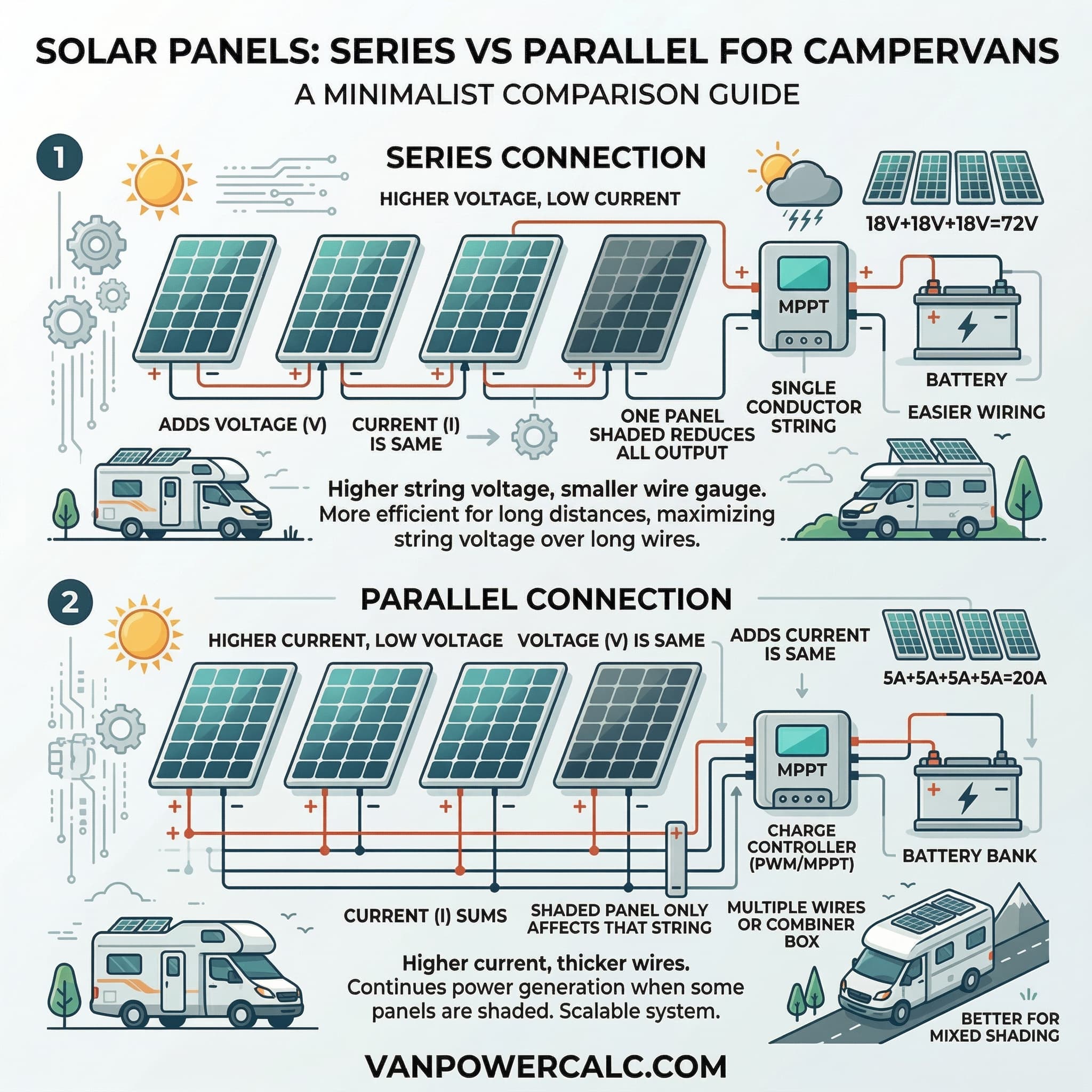
In a series configuration, current is limited by the weakest cell. When shade hits even 10% of one panel, the entire string drops to match that panel's reduced output. With two 200W panels in series producing about 10A each at Vmp, a shadow cutting one panel to 3A drags the whole string down to 3A. You lose 70% of your total capacity because of one shadow. In parallel, each panel operates independently — the shaded panel drops to 3A while the unshaded panel keeps pumping 10A. Total output: 13A instead of 6A. That's more than double the power from the same hardware.
Practical Fixes I've Tested on My Sprinter#
Beyond rewiring to parallel, I tried three other approaches. First, I added bypass diodes — most modern panels already have them built in, but cheaper panels from Amazon sometimes don't. Check your junction box. Bypass diodes let current flow around shaded cells within a single panel, limiting losses to about 33% per shaded section instead of 100%. Second, I repositioned my MaxxFan cover by replacing the stock one with a lower-profile Maxxair cover. This reduced the shadow footprint by roughly 40%. Third, I tilted my rear panel 5° using adjustable Z-brackets — this changed the shadow geometry enough to clear the fan shadow 45 minutes earlier each morning.
When to Consider Micro-Inverters or Optimizers#
If your roof has multiple obstructions — AC unit, fan, antenna, roof rack crossbars — individual panel optimizers like the Victron SmartSolar MPPT 75/15 (one per panel) can recover 15-25% more energy compared to a single MPPT with panels in parallel. At about $80 per optimizer, the payback is fast if you're losing more than 1 hour of peak production daily to shade. I've seen builds with four 100W panels and four individual MPPTs outperform two 200W panels on a single controller by 30% on a roof cluttered with accessories. The wiring is more involved — each MPPT needs its own positive and negative run to the bus bar — but the gains are real and measurable.
Measuring Your Actual Shade Losses#
Before spending money on fixes, quantify the problem. Connect a Bluetooth-enabled MPPT like the Victron SmartSolar and log production data for a week using the VictronConnect app. Note your peak hours and compare them against theoretical maximum (panel wattage × 0.85 for real-world efficiency). If your morning or afternoon output dips below 40% of theoretical for more than 2 hours daily, the ROI on fixing shading is strong. I track my production in a spreadsheet — before and after each modification — so I know exactly what worked. The parallel rewiring alone recovered about 1.2 kWh per day on my setup, which translates to roughly 35Ah back into my 200Ah LiFePO4 bank every morning.

Frequently asked questions
Why does a small shadow cause such a big drop in solar output?▼
Solar cells in a panel are wired in series. Current through the whole string is limited by the weakest cell. One shaded cell producing near-zero current drags down every cell in that group. Bypass diodes help by shorting out the affected third of the panel, but you still lose that entire section.
Does MPPT help with partial shading?▼
Significantly. A quality MPPT controller (Victron SmartSolar, EPEver Tracer) continuously scans for the maximum power point. Under partial shade, the power curve gets messy with multiple peaks — a good MPPT finds the best one. Compared to PWM, MPPT recovers 20-40% more power in shaded conditions.
Should I wire my van panels in series or parallel?▼
Parallel, almost always for a van. In parallel, each panel operates independently — shade on one doesn't affect the others. In series, the shaded panel bottlenecks the whole array. The only downside of parallel is thicker cables and lower voltage, but for 2-3 panels on a van roof it's a no-brainer.
Are half-cut cell panels better for shading?▼
Yes. Half-cut panels have 6 bypass diode groups instead of 3, so a shadow only kills 1/6 of output instead of 1/3. They're becoming standard in residential solar and starting to appear in 12V van-sized panels. Worth the small premium if you have roof obstacles.
Can I eliminate shading on my van roof?▼
Rarely 100%, but you can minimize it. Mount panels as far from the MaxxFan and antennas as possible. Use low-profile rail mounts. If you have two panels, position the one with the best clear sky exposure for morning hours when the sun is low and shadows are longest.
Advertising
Independent and free thanks to your clicks
Links marked with * are affiliate links. If a purchase is made through them, I receive a commission at no extra cost to you. The editorial selection and product evaluation are not influenced by commission rates. Your click helps fund this free tool.
Recommended gear
$130Amazon
200W Rigid Solar Panel
Mono 200W, 22%+ efficiency, rigid aluminum frame for van roof.“I tested 4 panels before this one. Great efficiency even in overcast weather, and it sits well on a van roof.”View on Amazon* →Check price
ECO-WORTHY 200W 12V/24V Solar Kit + 20A Bluetooth MPPTLeo's Pick
Complete 200W solar kit with Bluetooth-monitored MPPT controller. 12V/24V compatible, 20A charge controller with smartphone app. Ideal for vans, RVs, off-grid setups. Single-product solution covering both solar panel and charge controller.“The kit I recommend to every beginner. Plug it in, it works, and the included MPPT controller makes a real difference.”View on Amazon* →$115Amazon
Victron MPPT Controller 100/30
Extracts 97% solar power, Li & AGM compatible.“The Victron is pricey, but you install it once and forget about it. The Bluetooth app is a real plus for tracking solar output.”View on Amazon* →$38Amazon
Solar Cable 6mm² MC4 10m
6mm² solar cable with pre-crimped MC4 connectors, 10m.“Don't cheap out on solar cables. 6mm² between panels and controller is the minimum to avoid power losses.”View on Amazon* →