Loading...
Fact-checked on Jun 23, 2026
VANPOWERCALC.COMYOUR ENERGY PROFILE
YOUR ENERGY PROFILE.
This document contains the sizing of your future electrical installation, calculated based on your appliances.
Minimum Daily Consumption
0 WH / DAY
Inventory:
SYSTEM SIZINGPage 2
Battery
To guarantee 0WH without damaging your bank (80% max discharge):
0 AH
LiFePO4 12V
Solar
Minimum power required to recharge your consumption:
0 W
via MPPT
220V AC
Maximum power (with 25% safety margin).
0 W
No Need
Safety & CablingPage 3
12V Cable Sizing Guide
Use this professional reference table to select the correct gauge (mm²) for your cables. For 12V in a van, the maximum tolerated voltage drop is 3%. Always use multi-stranded flexible automotive wire.
| Current (A) | Round trip < 2m | Round trip 4m | Round trip 6m |
|---|---|---|---|
| 5A (LEDs, USB) | 1.5 mm² | 2.5 mm² | 4 mm² |
| 10A (Fridge, Pump) | 2.5 mm² | 4 mm² | 6 mm² |
| 20A (Heater) | 4 mm² | 10 mm² | 10 mm² |
| 50A (DC/DC Booster) | 10 mm² | 16 mm² | 25 mm² |
| 100A (Inverter) | 25 mm² | 35 mm² | 50 mm² |
Fuse Sizing
The fuse protects the wire, not the appliance. Always place it as close to the power source as possible (battery or busbar).
- Wire 1.5 mm² → Max fuse 10A
- Wire 2.5 mm² → Max fuse 20A
- Wire 4 mm² → Max fuse 30A
- Wire 6 mm² → Max fuse 40A
- Wire 10 mm² → Max fuse 60A
SCHÉMA ÉLECTRIQUE
PANNEAUX SOLAIRES
0W
RÉGULATEUR MPPT
BATTERIE AUXILIAIRE
0 Ah
Lithium LiFePO4
FUSIBLE
FUSIBLE
BOÎTE À FUSIBLES 12V
Pompe, Leds, Frigo...
CONVERTISSEUR 220V
NON REQUI
PRO GEARPage 4
SHOPPING LIST
Where to find this equipment? Here is the community-approved selection.
12V 6-way Fuse Box
Mandatory protection
Digital Multimeter
Test your connections
Heavy Duty Crimping Tool
For perfect lugs
Heat Shrink Tubing
Insulation and safety
GENERATED BY VANPOWERCALC.COM
Choosing between an MPPT and PWM solar charge controller is one of the first electrical decisions in a van build. The difference in efficiency is real — and matters most in low-light conditions.
An MPPT controller harvests 20-30% more energy than a PWM in real-world van conditions, especially in partial shade or when panel voltage is high relative to battery voltage. The Victron SmartSolar 100/30 covers most 12V van setups up to 400W of solar. For budget builds under 200W with a 12V panel wired at battery voltage, a PWM controller is an acceptable trade-off.
Expert tip
One MPPT setting most van builders overlook: the absorption voltage on LiFePO4. The factory default on most controllers is AGM-optimized (14.7V absorption). For LiFePO4, set absorption to 14.2-14.4V, float to 13.5V (or disable float entirely). Over-absorbing LiFePO4 doesn't cause immediate damage — the BMS will stop accepting current — but it adds unnecessary stress to cells over hundreds of cycles.
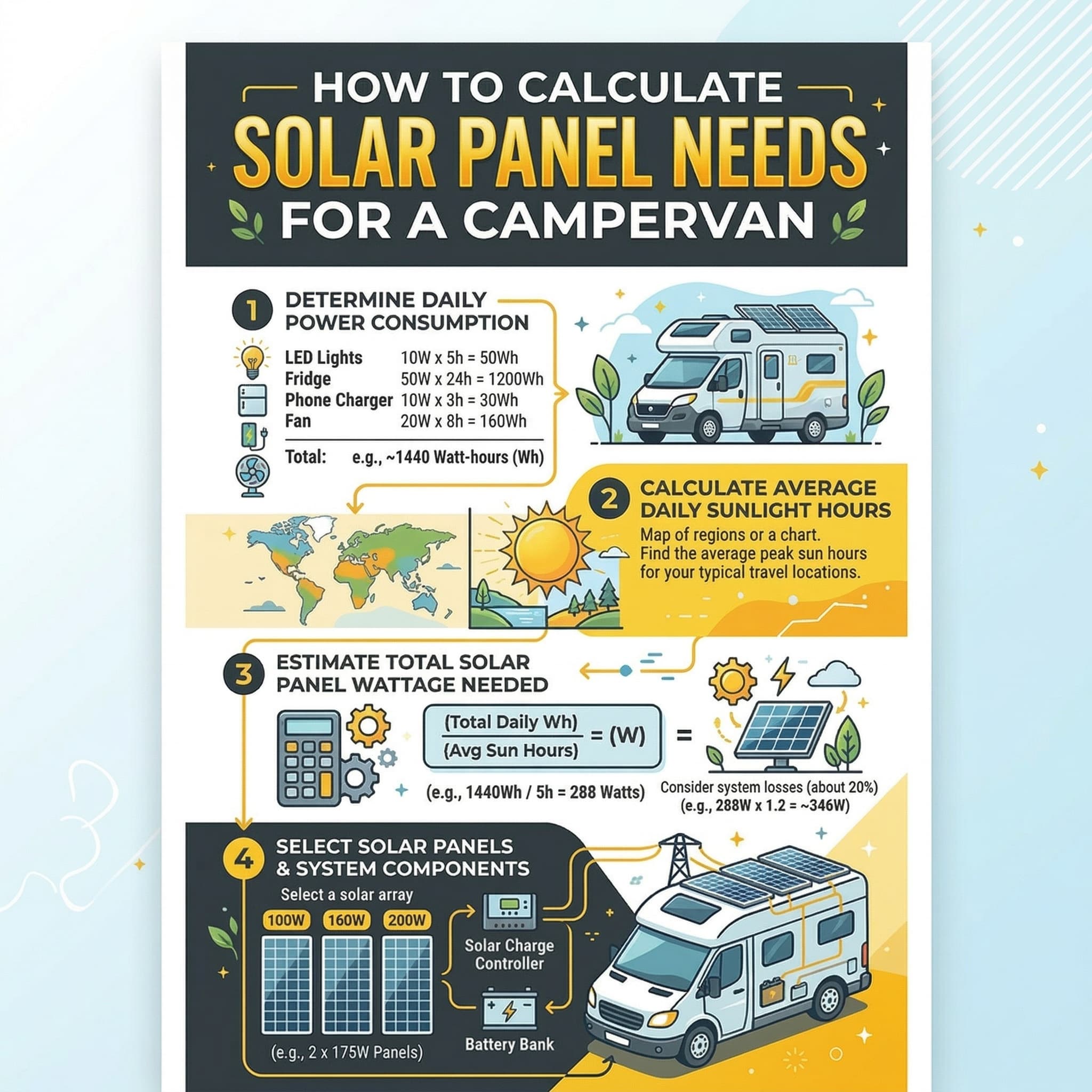
Example calculation for your setup
Results based on a typical use case
| Appliance | Power | Usage/day | Wh/day |
|---|---|---|---|
| Compression fridge | 45W | 24h | 1080 |
| LED lighting | 20W | 4h | 80 |
| Water pump | 30W | 0.5h | 15 |
| Phone charging | 15W | 2h | 30 |
| Daily consumption | 1205 Wh | ||
Recommended solar panels
402 Wc
4h average sun hours
Adjust these values with the calculator below
Comparison table
| Feature | MPPT | PWM |
|---|---|---|
| Efficiency | 93-99% | 70-80% |
| Oversize panels OK | Yes | No |
| High-voltage panels | Yes | No (12-18V only) |
| Price (20A) | $50-120 | $15-40 |
| Best for | LiFePO4 + large arrays | Small AGM weekend |
| Battery compatibility | All types | 12V only |
About this tool
The MPPT vs PWM solar charge controller debate comes down to efficiency mathematics, and in almost every real-world van scenario, MPPT wins. The question is by how much — and whether the cost difference is justified for your specific system.
Understanding the fundamental difference: A PWM (Pulse Width Modulation) controller is effectively a switch that connects panels directly to the battery when charging is needed. The panel output voltage is forced down to battery voltage (13.5-14.5V), and all energy associated with the voltage difference is lost as heat. A 100W panel rated at 18V Vmp connected to a 12V battery through a PWM controller delivers: P = 18V × (12V/18V) × Isc = 67W — 33% of the panel's rated capacity wasted.
MPPT (Maximum Power Point Tracking) uses a DC-DC converter topology to operate the panel at its optimal power point (18-40V depending on panel series wiring), then step-down convert the power to battery charging voltage. A quality MPPT extracts 95-97% of available panel power. Same 100W panel in the same conditions delivers 97W through MPPT vs 67W through PWM.
When does this matter most? On cold, bright days. Cold temperatures increase panel Voc (open circuit voltage) and Vmp, making the gap between panel operating voltage and battery voltage even larger. At -5°C, a nominally 20V Vmp panel operates at 23V+ — a PWM controller wastes 40% of that potential. An MPPT extracts 97%+ regardless.
When does PWM still make sense? Small panels under 100W on 12V batteries with closely matched voltages (panel Vmp within 2V of charge voltage), short cable runs, and warm climates. A €25 PWM controller for a 60W panel on a weekend van that never goes northern Europe saves €40 vs a proper MPPT — and the performance difference is under 15% in warm summer conditions.
Victron SmartSolar MPPT lineup: 75/10 (€45, 150W max panel, 10A), 75/15 (€55, 220W max, 15A), 100/20 (€75, 290W max, 20A), 100/30 (€120, 430W max, 30A), 100/50 (€165, 700W max, 50A). The 75/15 covers two standard 100W panels in series; step up to 100/30 or 100/50 for 300W+ arrays. VE.Direct port enables Bluetooth app monitoring with all units.
Practical installation note: when wiring panels in series for MPPT compatibility, the combined Voc must stay below the controller's maximum input voltage rating. Two 100W panels in series (Voc = 24V × 2 = 48V) are safe on a 75V controller. Add temperature derating: at -20°C, Voc increases approximately 0.5V/°C below STC, so 48V at 25°C could reach 58V at -20°C — still safely within 75V limit.

Frequently asked questions
Is MPPT worth it over PWM for a van?▼
Yes, in almost every case. MPPT delivers 20-35% more energy from the same panels. A €120 Victron MPPT 100/30 vs a €25 PWM controller for a 300W panel array: the MPPT recovers its €95 cost difference in 3-6 months of additional energy — especially in autumn and winter conditions where panel Vmp vs battery voltage gap widens.
What size MPPT controller do I need for 400W of solar?▼
MPPT output amps = Solar watts ÷ Battery voltage × 1.1 = 400 ÷ 12 × 1.1 = 36.7A. Use the Victron MPPT 100/50 (50A, 100V input limit). Wire panels in 2S2P (two pairs of 2 in series, then parallel) to stay within 100V input: 2× Voc per series string.
Can I use a PWM controller for LiFePO4?▼
Technically yes, but not recommended. LiFePO4 charges at 14.2-14.4V — close to the PWM bulk charge voltage, so panel voltage mismatch wastes less energy than with AGM. However, PWM controllers cannot absorb energy from high-voltage arrays (24V, 36V panels). MPPT allows higher panel voltage → lower current → thinner, cheaper cables.
What input voltage range does a Victron MPPT handle?▼
Victron SmartSolar series: 75V models accept 0-75V input, 100V models accept 0-100V, 150V models up to 150V. Most commonly used: 100V controllers with 2-panel series arrays (Voc typically 44-50V per pair — safely within 100V). Always verify Voc with 25% cold-weather margin.
Does MPPT work better in winter?▼
Yes — MPPT advantage is largest in cold weather. Cold panels have higher Voc and Vmp, increasing the voltage difference vs battery charging voltage. An MPPT extracts 30-40% more energy than PWM on a cold December day with the same panels, compared to 20-25% difference in July.
Advertising
Independent and free thanks to your clicks
Links marked with * are affiliate links. If a purchase is made through them, I receive a commission at no extra cost to you. The editorial selection and product evaluation are not influenced by commission rates. Your click helps fund this free tool.
Recommended gear
$130Amazon
200W Rigid Solar Panel
Mono 200W, 22%+ efficiency, rigid aluminum frame for van roof.“I tested 4 panels before this one. Great efficiency even in overcast weather, and it sits well on a van roof.”View on Amazon* →Check price
ECO-WORTHY 200W 12V/24V Solar Kit + 20A Bluetooth MPPTLeo's Pick
Complete 200W solar kit with Bluetooth-monitored MPPT controller. 12V/24V compatible, 20A charge controller with smartphone app. Ideal for vans, RVs, off-grid setups. Single-product solution covering both solar panel and charge controller.“The kit I recommend to every beginner. Plug it in, it works, and the included MPPT controller makes a real difference.”View on Amazon* →$115Amazon
Victron MPPT Controller 100/30
Extracts 97% solar power, Li & AGM compatible.“The Victron is pricey, but you install it once and forget about it. The Bluetooth app is a real plus for tracking solar output.”View on Amazon* →$38Amazon
Solar Cable 6mm² MC4 10m
6mm² solar cable with pre-crimped MC4 connectors, 10m.“Don't cheap out on solar cables. 6mm² between panels and controller is the minimum to avoid power losses.”View on Amazon* →