Loading...
Fact-checked on Apr 23, 2026
VANPOWERCALC.COMYOUR ENERGY PROFILE
YOUR ENERGY PROFILE.
This document contains the sizing of your future electrical installation, calculated based on your appliances.
Minimum Daily Consumption
0 WH / DAY
Inventory:
SYSTEM SIZINGPage 2
Battery
To guarantee 0WH without damaging your bank (80% max discharge):
0 AH
LiFePO4 12V
Solar
Minimum power required to recharge your consumption:
0 W
via MPPT
220V AC
Maximum power (with 25% safety margin).
0 W
No Need
Safety & CablingPage 3
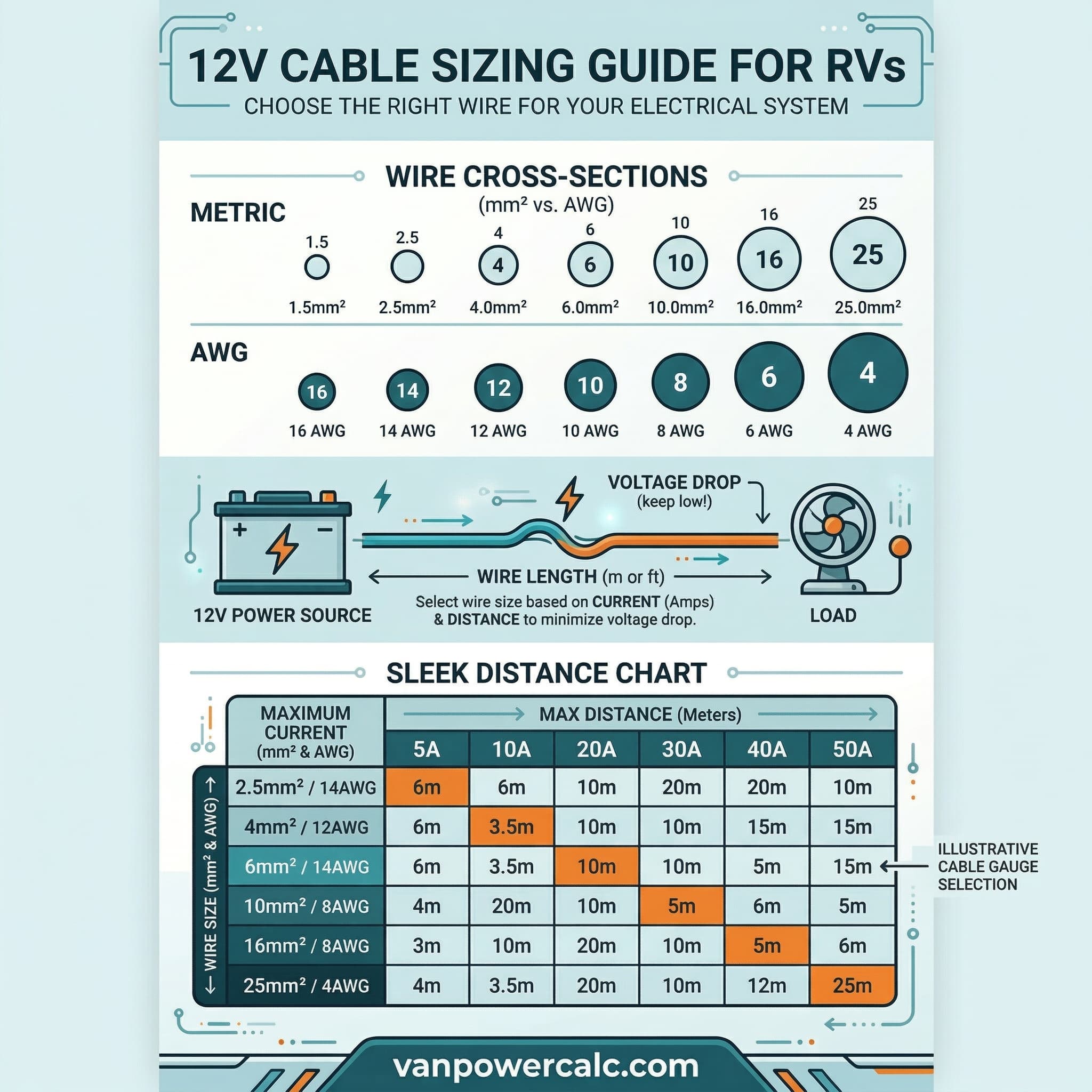
12V Cable Sizing Guide
Use this professional reference table to select the correct gauge (mm²) for your cables. For 12V in a van, the maximum tolerated voltage drop is 3%. Always use multi-stranded flexible automotive wire.
| Current (A) | Round trip < 2m | Round trip 4m | Round trip 6m |
|---|---|---|---|
| 5A (LEDs, USB) | 1.5 mm² | 2.5 mm² | 4 mm² |
| 10A (Fridge, Pump) | 2.5 mm² | 4 mm² | 6 mm² |
| 20A (Heater) | 4 mm² | 10 mm² | 10 mm² |
| 50A (DC/DC Booster) | 10 mm² | 16 mm² | 25 mm² |
| 100A (Inverter) | 25 mm² | 35 mm² | 50 mm² |
Fuse Sizing
The fuse protects the wire, not the appliance. Always place it as close to the power source as possible (battery or busbar).
- Wire 1.5 mm² → Max fuse 10A
- Wire 2.5 mm² → Max fuse 20A
- Wire 4 mm² → Max fuse 30A
- Wire 6 mm² → Max fuse 40A
- Wire 10 mm² → Max fuse 60A
SCHÉMA ÉLECTRIQUE
PANNEAUX SOLAIRES
0W
RÉGULATEUR MPPT
BATTERIE AUXILIAIRE
0 Ah
Lithium LiFePO4
FUSIBLE
FUSIBLE
BOÎTE À FUSIBLES 12V
Pompe, Leds, Frigo...
CONVERTISSEUR 220V
NON REQUI
PRO GEARPage 4
SHOPPING LIST
Where to find this equipment? Here is the community-approved selection.
12V 6-way Fuse Box
Mandatory protection
Digital Multimeter
Test your connections
Heavy Duty Crimping Tool
For perfect lugs
Heat Shrink Tubing
Insulation and safety
GENERATED BY VANPOWERCALC.COM
Winterizing a van isn't just slapping on 19mm of Armaflex and hoping. It's three things working together: dew point (12°C at 20°C/60% RH), thermal bridges (steel conducts 1515× more than closed-cell foam), and total R-value. My first van had drips on the ceiling every single morning. Here's what actually works.
A Sprinter L2H2 has about 27 m² of insulated surface (walls + roof, floor excluded). At -5°C outside and 18°C inside, ΔT = 23K. With R ≈ 0.58 (bare Armaflex 19mm), heat loss is Q = 23 × 27 / 0.6 = 1035 W continuous — you'll need a 2kW Webasto cycling at 60%. Double layer (Armaflex 19mm + Thinsulate 42mm loft compressed to 20mm) hits R≈1.1, dropping losses to ~517W. A 1kW heater handles it. That's half the diesel, half the battery drain from glow plug startups.
Expert tip
Stick a cheap wireless hygrometer in the low corner behind your bed. If humidity stays above 65% for more than 2 hours, you're condensing somewhere. A Maxxfan running at 20% draws ~6Ah/day and saves you six months of panel repairs and mold remediation.
Example calculation for your setup
Results based on a typical use case
| Appliance | Power | Usage/day | Wh/day |
|---|---|---|---|
| Compression fridge | 45W | 24h | 1080 |
| LED lighting | 20W | 4h | 80 |
| Water pump | 30W | 0.5h | 15 |
| Phone charging | 15W | 2h | 30 |
| Daily consumption | 1205 Wh | ||
Recommended LiFePO4 battery
151 Ah
(80% depth of discharge)
Recommended AGM battery
241 Ah
(50% depth of discharge)
Recommended solar panels
402 Wc
4h average sun hours
Recommended inverter
No 220V appliances — no inverter needed
Adjust these values with the calculator below
About this tool
Dew point is the rule everyone skips. At 20°C interior with 60% relative humidity (two people breathing on a normal night), air condenses the moment it hits a surface at 12°C or below. In winter, the outer steel panel sits at -5°C and its interior face creeps up to only ~5°C with thin insulation. You're sleeping under a waterfall. Bare Armaflex 19mm gives you R = 0.019 / 0.033 = 0.576, which I round to R ≈ 0.58 m²K/W. Barely acceptable for mild winter (target R≥0.6 walls, R≥0.8 roof). For Scandinavia at -15°C, go R≥1.2 walls and R≥1.5 roof.
Thermal bridges are where 80% of builds fail. Steel has λ = 50 W/(m·K), Armaflex λ = 0.033 — that's 1515× worse. An untreated roof rib becomes a 2°C strip while everything around it sits at 18°C. Result: black mold along every rib within three months. Door frames, hinges, wheel arches, seat rail mounts — all bridges. Fix it by wrapping Armaflex past the edges, using recycled PET fiber batts around ribs, and taping every rivet with aluminum foil tape. Single-glazed windows hit U ≈ 5.8 W/m²K vs 0.5 for an insulated wall — they typically account for 15-30% of heat loss in a standard van conversion (up to 30-50% in poorly insulated builds with large window areas). DIY Reflectix panels with neodymium magnets beat any €200 commercial kit.
Material choices: sheep's wool looks great on Instagram but absorbs 30% of its weight in water and molds within two winters. Spray foam in a van? Never — it off-gasses and cracks from panel vibration. Reflective bubble foil glued flat (Reflectix alone)? Useless thermally. It only works with a 2cm air gap as a radiant barrier, mainly for summer roof heat. The winner: Armaflex AF 19mm (closed-cell, acts as its own vapor barrier) plus Thinsulate or recycled PET stuffing the cavities. Never put a separate vapor barrier behind Armaflex — you'll trap moisture. Floor insulation: skip for weekend use, mandatory for full-timers (cold feet = misery). None of this matters without ventilation (Maxxfan + CO2 monitor). Two people breathe out ~1L of water per night — it has to go somewhere.

Frequently asked questions
How do I stop condensation in a van in winter?▼
Three things working together. First, minimum R ≈ 0.58 on walls so interior surfaces stay above the 12°C dew point (at 20°C/60% RH). Second, kill thermal bridges (metal ribs, door frames) with Armaflex wraps and aluminum tape. Third, continuous ventilation — a Maxxfan at 20% pulls 6Ah/day and exhausts respiratory moisture (~1L/person/night). Skip any of these and you get black mold in three months.
What's the minimum insulation thickness for winter vanlife?▼
For mild winter (0 to -5°C), bare Armaflex 19mm gives R ≈ 0.58 — the acceptable floor. For Alps or Scandinavia (-10 to -20°C), you need a double layer: Armaflex 19mm + Thinsulate 42mm loft compressed, R total ≈ 1.1. On the roof target 25mm of Armaflex plus a thin fiber layer above, R≥1.5.
Do I really need to insulate van windows?▼
Yes, top priority. Single-glazed windows have U≈5.8 W/m²K vs 0.5 for an insulated wall — they typically represent 15-30% of heat loss in a standard van conversion (up to 30-50% in poorly insulated builds with large window areas). DIY fix: Reflectix cut to the window shape plus neodymium magnets, costs around $30 total and performs at 80% of any $200 commercial kit. Deploy them every time you park for the night.
What R-value do I need to camp at -15°C?▼
R≥1.2 walls, R≥1.5 roof, R≥0.8 floor. Practical build: Armaflex 19mm (R ≈ 0.58) + Thinsulate 42mm loft compressed to 20mm (R≈0.55) = R total 1.13. Without this, at -15°C outside and 18°C inside (ΔT=33K) across 27m², losses blow past 1800W — no 2kW diesel heater keeps up.
Insulation or heater — what's the priority?▼
Insulation, always first. A van at R ≈ 0.58 at -5°C burns approximately 800ml diesel per night with a 2kW Webasto (depending on runtime and ambient temperature). Same van at R=1.2 drops to roughly 400ml/night under the same conditions. Across a 90-night winter that's potentially 36L of diesel saved plus halved battery drain (fewer glow plug cycles, each pulling 5-6A for 2-3 min). Insulation is a one-shot investment; heating is a running cost.
Advertising
Independent and free thanks to your clicks
Links marked with * are affiliate links. If a purchase is made through them, I receive a commission at no extra cost to you. The editorial selection and product evaluation are not influenced by commission rates. Your click helps fund this free tool.
Recommended gear
$55Amazon
Armaflex AF 19mm
The vanlife insulation standard. 19mm closed-cell elastomeric foam, R≈3.3, vapor-tight.View on Amazon* →$65Amazon
3M Thinsulate SM600L
Premium lightweight insulation. Breathable, hydrophobic, non-settling. R≈4.3 for 1 inch.View on Amazon* →$40Amazon
Reflectix reflective insulation
Radiant barrier with bubble foil. Supplements insulation on windows and roof.View on Amazon* →$15Amazon
Aluminum foil tape 2"
Seal insulation seams and create a continuous vapor barrier. Essential.View on Amazon* →