Loading...
Fact-checked on Jun 14, 2026
VANPOWERCALC.COMYOUR ENERGY PROFILE
YOUR ENERGY PROFILE.
This document contains the sizing of your future electrical installation, calculated based on your appliances.
Minimum Daily Consumption
0 WH / DAY
Inventory:
SYSTEM SIZINGPage 2
Battery
To guarantee 0WH without damaging your bank (80% max discharge):
0 AH
LiFePO4 12V
Solar
Minimum power required to recharge your consumption:
0 W
via MPPT
220V AC
Maximum power (with 25% safety margin).
0 W
No Need
Safety & CablingPage 3
12V Cable Sizing Guide
Use this professional reference table to select the correct gauge (mm²) for your cables. For 12V in a van, the maximum tolerated voltage drop is 3%. Always use multi-stranded flexible automotive wire.
| Current (A) | Round trip < 2m | Round trip 4m | Round trip 6m |
|---|---|---|---|
| 5A (LEDs, USB) | 1.5 mm² | 2.5 mm² | 4 mm² |
| 10A (Fridge, Pump) | 2.5 mm² | 4 mm² | 6 mm² |
| 20A (Heater) | 4 mm² | 10 mm² | 10 mm² |
| 50A (DC/DC Booster) | 10 mm² | 16 mm² | 25 mm² |
| 100A (Inverter) | 25 mm² | 35 mm² | 50 mm² |
Fuse Sizing
The fuse protects the wire, not the appliance. Always place it as close to the power source as possible (battery or busbar).
- Wire 1.5 mm² → Max fuse 10A
- Wire 2.5 mm² → Max fuse 20A
- Wire 4 mm² → Max fuse 30A
- Wire 6 mm² → Max fuse 40A
- Wire 10 mm² → Max fuse 60A
SCHÉMA ÉLECTRIQUE
PANNEAUX SOLAIRES
0W
RÉGULATEUR MPPT
BATTERIE AUXILIAIRE
0 Ah
Lithium LiFePO4
FUSIBLE
FUSIBLE
BOÎTE À FUSIBLES 12V
Pompe, Leds, Frigo...
CONVERTISSEUR 220V
NON REQUI
PRO GEARPage 4
SHOPPING LIST
Where to find this equipment? Here is the community-approved selection.
12V 6-way Fuse Box
Mandatory protection
Digital Multimeter
Test your connections
Heavy Duty Crimping Tool
For perfect lugs
Heat Shrink Tubing
Insulation and safety
GENERATED BY VANPOWERCALC.COM
Food Trucks Are NOT Vans#
A food truck's electrical demands dwarf a typical van conversion. Where a van might need 1000-2000W, a food truck with a coffee machine, griddle, and exhaust fan can easily hit 5000-8000W continuous. This changes everything: the inverter, the battery bank, and the entire electrical architecture must be fundamentally different from a vanlife setup.
Common Food Truck Loads#
- Commercial coffee machine: 1500-2500W continuous
- Electric griddle/flat top: 1500-3000W
- Exhaust hood fan: 200-500W
- Refrigerator (commercial): 200-400W (800W+ startup)
- Cash register / POS: 50-100W
- LED lighting: 100-200W
- Phone charger / music: 50W
Total typical: 3600-6750W continuous, with startup surges up to 10,000W when multiple compressors kick in simultaneously.
Inverter Options#
For 48V systems (recommended):
- EG4 6000XP: 6000W continuous / 12000W surge. 48V input. Split-phase 120/240V output. About $850. The most popular choice for food trucks on a budget.
- Victron MultiPlus-II 5000VA: 5000W continuous with 9000W surge. Integrates AC charging for when you plug into shore power at commissaries. About $1800. Premium choice with generator support built in.
- Sigineer 6000W: Budget-friendly at $600, 48V, pure sine wave. Works but limited support and configurability.
Critical consideration — generator hybrid: Most food trucks use a generator + inverter/battery hybrid. The generator runs during peak service (lunch rush), the batteries handle prep time and quiet periods. A Victron MultiPlus or EG4 with AC input can automatically switch between generator and battery — seamless for the operator.
Expert tip
Size your inverter for the coffee machine. Seriously. A commercial espresso machine is the single hardest load in a food truck — it draws 2000-2500W continuously and has a heating element surge. If your inverter handles the coffee machine plus the exhaust fan simultaneously, it handles everything else.
Example calculation for your setup
Results based on a typical use case
| Appliance | Power | Usage/day | Wh/day |
|---|---|---|---|
| Compression fridge | 45W | 24h | 1080 |
| LED lighting | 20W | 4h | 80 |
| Water pump | 30W | 0.5h | 15 |
| Phone charging | 15W | 2h | 30 |
| Daily consumption | 1205 Wh | ||
Recommended inverter
No 220V appliances — no inverter needed
Adjust these values with the calculator below
Comparison table
| Inverter | Watts | Surge | Voltage | Price (~) |
|---|---|---|---|---|
| EG4 6000XP | 6000W | 12000W | 48V | $850 |
| Victron MultiPlus-II 5000 | 5000W | 9000W | 48V | $1800 |
| Sigineer 6000W | 6000W | 12000W | 48V | $600 |
| EG4 12000XP | 12000W | 24000W | 48V | $1500 |
About this tool
Food truck and mobile kitchen power requirements are significantly more demanding than typical campervan needs. You're running commercial kitchen equipment — immersion blenders, commercial coffee machines, heat lamps, POS systems — not just a laptop and a fridge. Choosing the right inverter is therefore not a simple Ah calculation exercise.
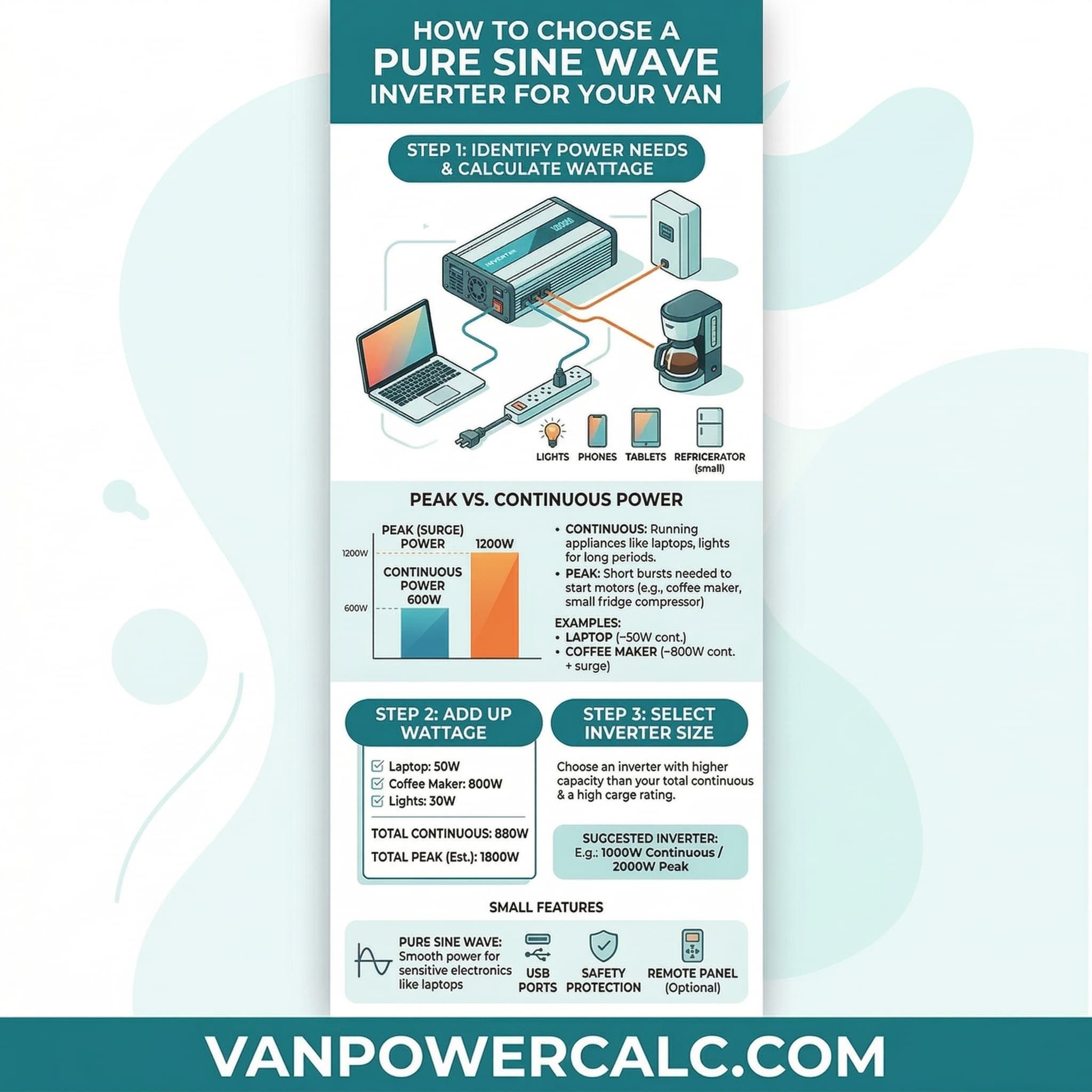
Identify your peak vs. continuous loads first. An espresso machine rated at 1,300W draws 1,300W continuously while heating. A commercial blender rated at 2HP (1,500W) draws 1,500W during operation but has a startup surge of 3,000-4,500W for 200-400ms. Your inverter must handle both: the continuous rating covers steady loads, and the surge (peak) rating must exceed startup spikes. Most quality inverters handle 2× their continuous rating for 5-10 seconds. So a 2,000W continuous inverter handles 4,000W startup — suitable for most commercial blenders.
Key inverter specifications for food truck use: (1) Continuous wattage: sum your largest simultaneous loads. Coffee machine (1,300W) + POS + phone chargers (100W) = 1,400W minimum. A 2,000W continuous inverter has adequate headroom. (2) Surge/peak rating: should be ≥2× your largest single motor load. (3) Efficiency at partial load: most inverters are most efficient at 75-90% of rated load. Running a 3,000W inverter at 200W is wasteful — it may only be 75% efficient at that load vs. 94% at full load. (4) Transfer time for grid switching: if you plug into shore power at events, the inverter's transfer time from battery to grid should be under 20ms to avoid resetting digital equipment.
Best inverter options for food trucks in 2025: Victron MultiPlus 12/3000/120-50 ($550): true sine wave, 3,000W continuous, 6,000W peak, 50A AC charger built-in for shore power integration. Installers' top pick for quality and reliability. Growatt SPF 3000TL ($310): good value, 3,000W continuous, MPPT solar input if you have panels on the truck roof. EGS 3000W ($220): budget option, 3,000W, acceptable for occasional use but failure rate higher on commercial duty cycles.
Battery sizing for a mobile kitchen: calculate total Wh consumed per service (lunch service = 3 hours typical). Sum all loads × time: espresso machine 1,300W × 0.5h effective run = 650Wh; blender 1,500W × 0.1h = 150Wh; lighting + POS 200W × 3h = 600Wh; refrigerated display 80W × 3h = 240Wh. Total: 1,640Wh per service. For 2 services between charging: 3,280Wh minimum battery needed — so 280Ah at 12V, or 140Ah at 24V (recommended for equipment of this scale).

Frequently asked questions
How big an inverter do I need for a food truck?▼
5000-8000W continuous for most food trucks. Size based on your maximum simultaneous load plus 25% headroom for startup surges.
Should a food truck use 12V or 48V?▼
48V, always. Food truck loads are too high for 12V — the current would require impractically thick cables. 48V cuts current by 4x.
Can I run a food truck on batteries alone?▼
For a few hours, yes. But a full service day typically requires a generator supplement. A 10kWh battery bank runs a 5000W load for about 2 hours.
What batteries for a food truck?▼
48V LiFePO4, minimum 5kWh (150Ah at 48V). For a full day without a generator, you'd need 15-20kWh — expensive ($3000-5000 in batteries alone).
Do I need a generator with my inverter?▼
For peak service hours, almost certainly yes. A generator + inverter hybrid gives you grid-like reliability with battery backup for quiet periods.
Advertising
Independent and free thanks to your clicks
Links marked with * are affiliate links. If a purchase is made through them, I receive a commission at no extra cost to you. The editorial selection and product evaluation are not influenced by commission rates. Your click helps fund this free tool.
Recommended gear
$133Amazon
Portable Induction Cooktop 2000W
Fast cooking without gas, 2000W. Requires pure sine inverter.“With a 2000W inverter, you can cook with induction in your van. Faster, cleaner, and no gas to manage.”View on Amazon* →$104Amazon
Pure Sine Inverter 2000W 12V
Runs induction cooktop, hair dryer, coffee machine.“The 2000W version for those who want to plug in everything: induction plate, hair dryer, pro coffee machine. Make sure your cables are properly sized.”View on Amazon* →Check price
LiFePO4 200Ah 12V Battery
200Ah true capacity, 200A built-in BMS, 5000+ cycles.“If you work remotely or run a fridge, go straight for 200Ah. You'll never regret having too much capacity.”View on Amazon* →$33Amazon
Battery Cable 50mm² Red+Black
50mm² cable for 2000W+ inverter. Red and black, 1m each.“Between battery and inverter, you need heavy-duty cable. 50mm² handles big current draws without overheating.”View on Amazon* →