Loading...
Fact-checked on Mar 15, 2026
VANPOWERCALC.COMYOUR ENERGY PROFILE
YOUR ENERGY PROFILE.
This document contains the sizing of your future electrical installation, calculated based on your appliances.
Minimum Daily Consumption
0 WH / DAY
Inventory:
SYSTEM SIZINGPage 2
Battery
To guarantee 0WH without damaging your bank (80% max discharge):
0 AH
LiFePO4 12V
Solar
Minimum power required to recharge your consumption:
0 W
via MPPT
220V AC
Maximum power (with 25% safety margin).
0 W
No Need
Safety & CablingPage 3
12V Cable Sizing Guide
Use this professional reference table to select the correct gauge (mm²) for your cables. For 12V in a van, the maximum tolerated voltage drop is 3%. Always use multi-stranded flexible automotive wire.
| Current (A) | Round trip < 2m | Round trip 4m | Round trip 6m |
|---|---|---|---|
| 5A (LEDs, USB) | 1.5 mm² | 2.5 mm² | 4 mm² |
| 10A (Fridge, Pump) | 2.5 mm² | 4 mm² | 6 mm² |
| 20A (Heater) | 4 mm² | 10 mm² | 10 mm² |
| 50A (DC/DC Booster) | 10 mm² | 16 mm² | 25 mm² |
| 100A (Inverter) | 25 mm² | 35 mm² | 50 mm² |
Fuse Sizing
The fuse protects the wire, not the appliance. Always place it as close to the power source as possible (battery or busbar).
- Wire 1.5 mm² → Max fuse 10A
- Wire 2.5 mm² → Max fuse 20A
- Wire 4 mm² → Max fuse 30A
- Wire 6 mm² → Max fuse 40A
- Wire 10 mm² → Max fuse 60A
SCHÉMA ÉLECTRIQUE
PANNEAUX SOLAIRES
0W
RÉGULATEUR MPPT
BATTERIE AUXILIAIRE
0 Ah
Lithium LiFePO4
FUSIBLE
FUSIBLE
BOÎTE À FUSIBLES 12V
Pompe, Leds, Frigo...
CONVERTISSEUR 220V
NON REQUI
PRO GEARPage 4
SHOPPING LIST
Where to find this equipment? Here is the community-approved selection.
12V 6-way Fuse Box
Mandatory protection
Digital Multimeter
Test your connections
Heavy Duty Crimping Tool
For perfect lugs
Heat Shrink Tubing
Insulation and safety
GENERATED BY VANPOWERCALC.COM
Why 48V in an RV?#
Moving from 12V to 48V in an RV isn't just a voltage change — it's a complete system architecture shift. At 48V, you pull 1/4 the current for the same wattage, which means thinner cables, smaller fuses, and less heat. A 3000W inverter draws only 65A at 48V versus 250A at 12V. The trade-off: you need a 48V-to-12V DC-DC converter for all your existing 12V loads (fridge, fans, lights), and 48V LiFePO4 batteries cost more upfront. But for systems above 3000W — especially with shore power integration, alternator charging, and Level 2 EV charging — 48V is the only sensible choice.
Critical Pre-Install Checks#
1. Ground Fault Protection: At 48V nominal (56V charging), touch voltage becomes a real safety concern. Install GFCI breakers on all AC circuits, not just bathrooms. For the DC side, use a ground fault detector module and bond the chassis at exactly one point.
2. PV Array Voltage: A 48V MPPT (like the Victron 150/70 or EG4 equivalent) needs PV input above 60V to begin tracking. Four panels at 40V Voc in series = 160V — well within range but check the maximum at cold temperatures too.
3. AC Distribution: Your existing RV breaker panel (typically a Progressive Dynamics PD5000 or similar) may not be rated for the inrush current from a large inverter. A 5000W inverter can deliver 50A of 120VAC — verify your panel's bus bars can handle this.
Shore Power Integration#
The most complex part of a 48V RV system is the transfer switch between shore power and inverter power. Hybrid inverters like the Victron MultiPlus-II handle this internally with a built-in transfer switch. But you must configure the input current limit correctly: set it to match your shore power cord rating (30A or 50A), not the inverter's maximum. If you set the input limit too high, you'll trip the campground breaker every time the AC kicks on while the inverter is pass-through charging.
Expert tip
Before connecting anything, bench-test your entire system on the ground first — inverter, batteries, MPPT, and DC-DC converter. It's infinitely easier to troubleshoot loose connections on a workbench than inside a cramped RV electrical cabinet.
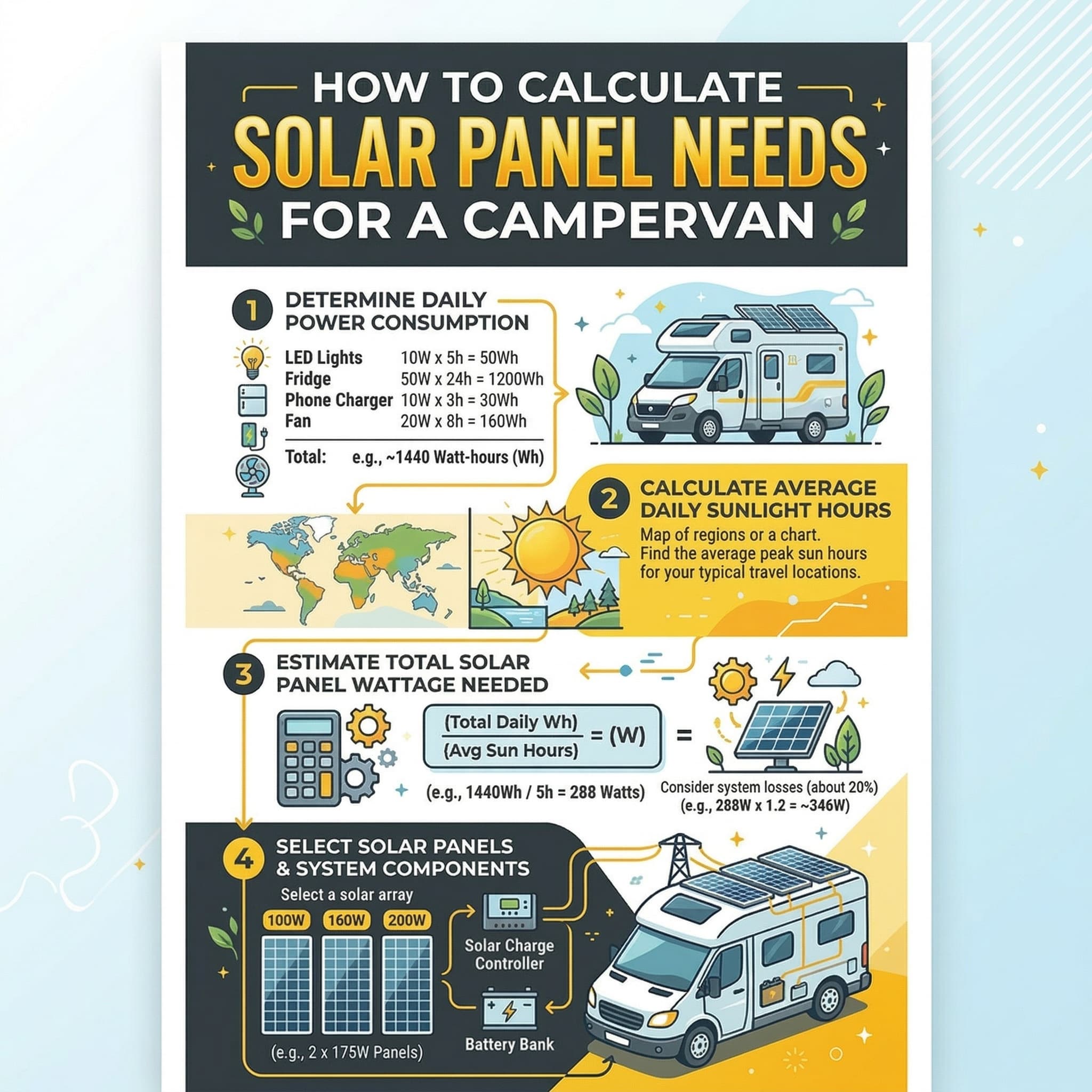
Example calculation for your setup
Results based on a typical use case
| Appliance | Power | Usage/day | Wh/day |
|---|---|---|---|
| Compression fridge | 45W | 24h | 1080 |
| LED lighting | 20W | 4h | 80 |
| Water pump | 30W | 0.5h | 15 |
| Phone charging | 15W | 2h | 30 |
| Daily consumption | 1205 Wh | ||
Recommended solar panels
402 Wc
4h average sun hours
Adjust these values with the calculator below
Comparison table
| System Voltage | Cable for 3000W | Fuse Size (3000W) | Best For |
|---|---|---|---|
| 12V | 2/0 AWG (250A) | 300A ANL | Small vans, <2000W |
| 24V | 4 AWG (125A) | 150A ANL | Medium RVs, 2000-3000W |
| 48V | 8 AWG (65A) | 80A ANL | Large RVs, 3000W+ |
| Note | Cables sized for 3ft run | Fuses sized at 125% of max current |
About this tool
A 48V RV solar and shore power system is one of the more complex DIY electrical architectures — it offers excellent efficiency and is the right choice for large battery banks (10+ kWh), but it introduces new failure modes compared to 12V systems. Running through a structured pre-install sanity check takes 2-3 hours but can prevent weeks of troubleshooting.
System architecture validation: confirm your component voltage ratings form coherent tiers. In a 48V system, typical components are: 48V LiFePO4 battery bank (51.2V nominal), 48V→120/240V inverter-charger (e.g., EG4 6000XP or Victron Quattro 48/5000), 48V MPPT charge controller (Victron SmartSolar MPPT 150/100 or Renogy 60A), solar string in high-voltage configuration (280-400V open circuit for most 48V MPPT inputs). Battery bank size: most 48V battery banks are 16-cell LiFePO4 (16 × 3.2V = 51.2V nominal). Charging voltage: 56-58.4V bulk/absorption, 54-55V float. Verify your inverter-charger and MPPT are configured for these voltages before energizing.
Wiring cross-section checklist for 48V: the advantage of 48V is that current is 4× lower than 12V for the same power. A 5,000W load at 48V draws only 104A vs 417A at 12V. This means: battery cables can be 2/0 AWG (67mm²) instead of 4/0 AWG (107mm²). MPPT output cables can be 4 AWG instead of 2/0 AWG. Verify every cable in your run against its ampacity at the operating temperature of your installation.
Shore power integration specific checks: if your inverter-charger has an AC pass-through (most do: EG4 6000XP, Victron Quattro), wiring must comply with NFPA 70 (NEC) or your local equivalent. Transfer relay: verify that the transfer from inverter to shore power happens in under 20ms. Some cheap inverters take 40-80ms, which causes brief dropouts on sensitive electronics (NAS drives, CPAP machines). EG4 and Victron both test at 5-10ms transfer time.
Pre-energization checklist (48V specific): (1) Battery at partial charge, not full — 46-48V. Full charge risk: if you accidentally create a short to ground while connecting, the higher voltage (58V fully charged) creates a more energetic arc. (2) All AC loads disconnected and inverter AC output breaker open. (3) MPPT disconnected from battery (open the battery-side breaker). Connect battery → verify inverter shows correct battery voltage and no alarm. Connect MPPT → verify it sees solar string voltage and enters float/absorption correctly. Connect AC loads last.

Frequently asked questions
Is 48V worth it for an RV?▼
Yes, for systems above 3000W. You get 1/4 the cable size, less heat, and more efficient inverter operation. Below 2000W, stick with 12V for simplicity.
Do I need a 12V converter with a 48V system?▼
Yes. All standard RV appliances (fridge, lights, fans, water pump) run on 12V. You need a 48V-to-12V DC-DC converter, typically rated at 30-50A.
Can I use my existing RV breaker panel with 48V?▼
The AC panel stays the same (it handles 120VAC regardless of battery voltage). But verify its bus bars can handle the inverter's maximum AC output current.
What grounding is needed for 48V?▼
Single-point chassis bonding for DC negative, GFCI breakers on all AC circuits, and a ground fault detector on the DC side. At 48V, touch voltage is a real safety hazard.
How do I size the PV array for a 48V MPPT?▼
Minimum PV voltage must exceed the MPPT activation threshold (typically 60V for 48V systems). Wire panels in series to reach 100-200V PV input for optimal MPPT tracking.
Advertising
Independent and free thanks to your clicks
Links marked with * are affiliate links. If a purchase is made through them, I receive a commission at no extra cost to you. The editorial selection and product evaluation are not influenced by commission rates. Your click helps fund this free tool.