Loading...
Fact-checked on Apr 5, 2026
VANPOWERCALC.COMYOUR ENERGY PROFILE
YOUR ENERGY PROFILE.
This document contains the sizing of your future electrical installation, calculated based on your appliances.
Minimum Daily Consumption
0 WH / DAY
Inventory:
SYSTEM SIZINGPage 2
Battery
To guarantee 0WH without damaging your bank (80% max discharge):
0 AH
LiFePO4 12V
Solar
Minimum power required to recharge your consumption:
0 W
via MPPT
220V AC
Maximum power (with 25% safety margin).
0 W
No Need
Safety & CablingPage 3
12V Cable Sizing Guide
Use this professional reference table to select the correct gauge (mm²) for your cables. For 12V in a van, the maximum tolerated voltage drop is 3%. Always use multi-stranded flexible automotive wire.
| Current (A) | Round trip < 2m | Round trip 4m | Round trip 6m |
|---|---|---|---|
| 5A (LEDs, USB) | 1.5 mm² | 2.5 mm² | 4 mm² |
| 10A (Fridge, Pump) | 2.5 mm² | 4 mm² | 6 mm² |
| 20A (Heater) | 4 mm² | 10 mm² | 10 mm² |
| 50A (DC/DC Booster) | 10 mm² | 16 mm² | 25 mm² |
| 100A (Inverter) | 25 mm² | 35 mm² | 50 mm² |
Fuse Sizing
The fuse protects the wire, not the appliance. Always place it as close to the power source as possible (battery or busbar).
- Wire 1.5 mm² → Max fuse 10A
- Wire 2.5 mm² → Max fuse 20A
- Wire 4 mm² → Max fuse 30A
- Wire 6 mm² → Max fuse 40A
- Wire 10 mm² → Max fuse 60A
SCHÉMA ÉLECTRIQUE
PANNEAUX SOLAIRES
0W
RÉGULATEUR MPPT
BATTERIE AUXILIAIRE
0 Ah
Lithium LiFePO4
FUSIBLE
FUSIBLE
BOÎTE À FUSIBLES 12V
Pompe, Leds, Frigo...
CONVERTISSEUR 220V
NON REQUI
PRO GEARPage 4
SHOPPING LIST
Where to find this equipment? Here is the community-approved selection.
12V 6-way Fuse Box
Mandatory protection
Digital Multimeter
Test your connections
Heavy Duty Crimping Tool
For perfect lugs
Heat Shrink Tubing
Insulation and safety
GENERATED BY VANPOWERCALC.COM
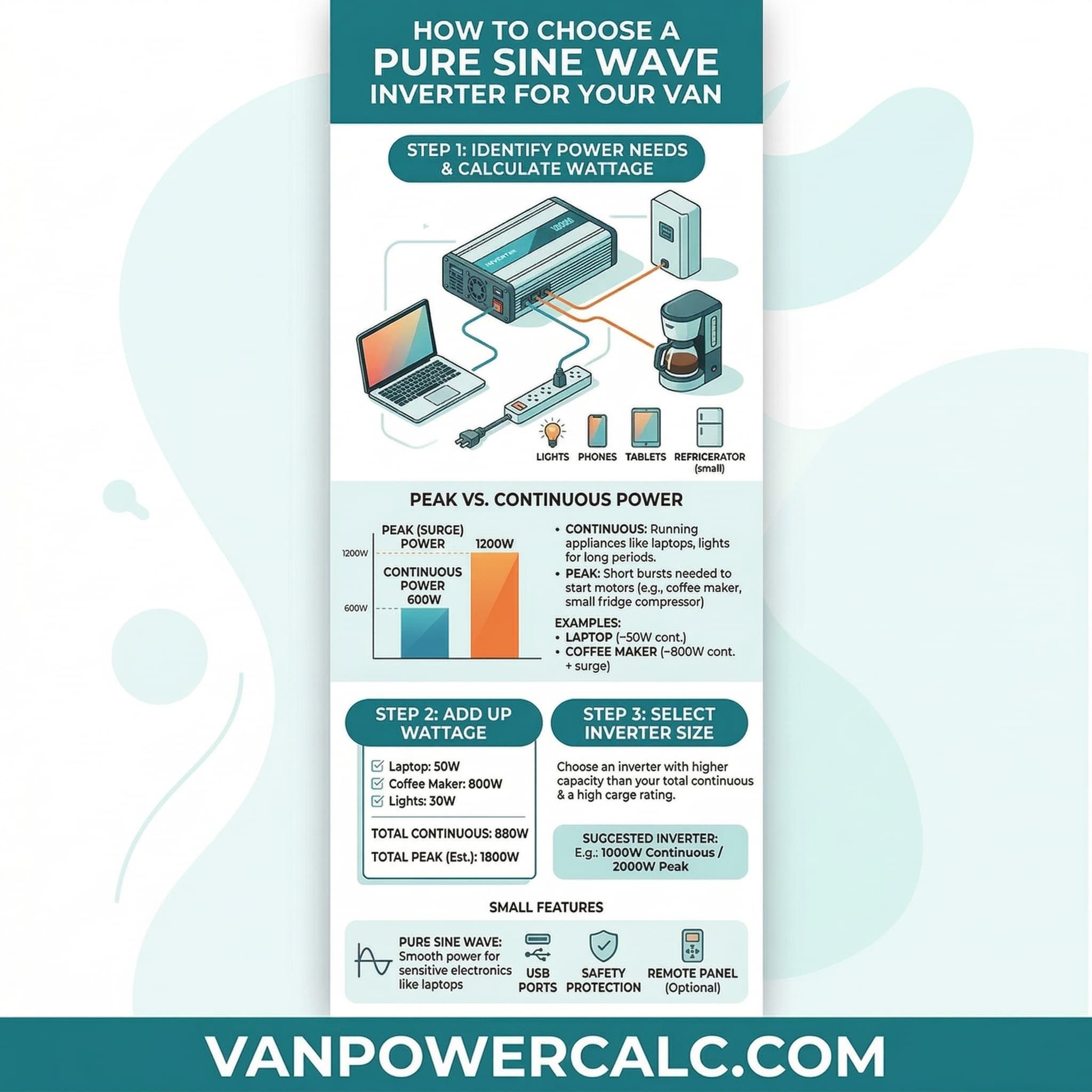
Adding 120V/230V outlets to your van means wiring from your inverter to standard wall outlets. It sounds simple — and the wiring is — but the safety requirements are where most DIY builds cut corners. An improperly grounded AC circuit in a metal van is genuinely dangerous.
The setup: inverter output → RCD/GFCI → AC distribution panel (2-4 breakers) → outlets. Use 2.5mm² (14 AWG) cable minimum for 20A circuits and proper AC-rated cable (not automotive 12V wire). Each outlet must be properly grounded — the ground wire connects to the van chassis via a dedicated ground bus bar, not daisy-chained through outlets.
Expert tip
Install an AC main switch near your bed — a simple rocker switch that cuts the inverter's AC output. If you hear a spark, smell burning, or anything feels wrong at 3 AM, you want to kill AC power without getting out of bed.
Example calculation for your setup
Results based on a typical use case
| Appliance | Power | Usage/day | Wh/day |
|---|---|---|---|
| Compression fridge | 45W | 24h | 1080 |
| LED lighting | 20W | 4h | 80 |
| Water pump | 30W | 0.5h | 15 |
| Phone charging | 15W | 2h | 30 |
| Daily consumption | 1205 Wh | ||
Recommended inverter
No 220V appliances — no inverter needed
Adjust these values with the calculator below
Comparison table
| Component | Spec | Notes |
|---|---|---|
| Shore Power Inlet | Marinco 30A or 16A CEE | IP66 rated, mount on outside wall |
| Battery Charger | 30-50A multi-stage | Victron, Sterling, or CTEK |
| AC Cable (inlet to charger) | 2.5mm² H07RN-F | Flexible rubber-sheathed |
| RCD/GFCI | 30mA trip, Type A | Mandatory for safety |
| MCB Breaker | 16A or 20A | Match inlet rating |
| Grounding | 6mm² to chassis | Required by regulation |
| Extension Cord | 16A, 25m max | Outdoor-rated, 2.5mm² |
| Charge Time (200Ah) | 4-7 hours | Depends on charger amperage |
About this tool
Mount outlets where you'll actually use them: one near the kitchen (coffee maker, blender), one near the bed/desk (laptop charger), and one near the entrance (for plugging in tools or charging outside). Use IP44-rated outlets if there's any splash risk — standard indoor outlets corrode fast in a van's humid environment. The wiring route for AC should be physically separated from 12V DC wiring — run them on opposite sides of the van or in separate conduit. If AC and DC wires run together and the AC insulation fails, it can energize your 12V system at 230V. Not likely, but easy to prevent. One important detail: your inverter's neutral may or may not be bonded to ground. Check the manual. If it's not bonded (floating neutral), you need to add a neutral-ground bond at the inverter output for the RCD to function. Without this bond, the RCD has no reference path and won't trip on a ground fault.

Frequently asked questions
What wire size for AC outlets in a van?▼
2.5mm² (14 AWG) for 20A circuits, 1.5mm² (16 AWG) for 15A circuits. Use proper AC-rated cable (H07V-K or equivalent) — not automotive 12V wire, which has different insulation ratings.
Do I need an RCD for van AC outlets?▼
Yes, absolutely. A 30mA RCD between the inverter output and your AC outlets is mandatory for safety and required by electrical standards in most countries. Type A minimum, Type B recommended with inverters.
How do I ground AC outlets in a van?▼
Connect the ground wire from each outlet to a dedicated AC ground bus bar. Bond that bus bar to the van chassis with 6mm² (10 AWG) green/yellow cable. This gives fault current a path to trip the RCD.
How many AC outlets should I install?▼
2-4 is typical. Kitchen area, desk/bed area, and optionally the entrance and bathroom. Don't overdo it — each outlet is another potential point of failure. Most van AC use is intermittent (coffee maker, charger) not continuous.
Can I use standard house outlets in a van?▼
Indoor outlets work but corrode faster in a van's humid environment. IP44-rated outlets (splash-proof) last longer. Alternatively, standard outlets inside a sealed junction box with a hinged cover work well.
Advertising
Independent and free thanks to your clicks
Links marked with * are affiliate links. If a purchase is made through them, I receive a commission at no extra cost to you. The editorial selection and product evaluation are not influenced by commission rates. Your click helps fund this free tool.
Recommended gear
$104Amazon
Pure Sine Inverter 2000W 12V
Runs induction cooktop, hair dryer, coffee machine.“The 2000W version for those who want to plug in everything: induction plate, hair dryer, pro coffee machine. Make sure your cables are properly sized.”View on Amazon* →$33Amazon
Battery Cable 50mm² Red+Black
50mm² cable for 2000W+ inverter. Red and black, 1m each.“Between battery and inverter, you need heavy-duty cable. 50mm² handles big current draws without overheating.”View on Amazon* →$13Amazon
ANL Fuse 250A + Fuse Holder
Mandatory inverter protection. 250A with integrated fuse holder.“The ANL fuse protects your battery-to-inverter cable. It's a few bucks that can prevent a fire. Non-negotiable.”View on Amazon* →Check price
LiFePO4 200Ah 12V Battery
200Ah true capacity, 200A built-in BMS, 5000+ cycles.“If you work remotely or run a fridge, go straight for 200Ah. You'll never regret having too much capacity.”View on Amazon* →