Loading...
Fact-checked on Jun 14, 2026
VANPOWERCALC.COMYOUR ENERGY PROFILE
YOUR ENERGY PROFILE.
This document contains the sizing of your future electrical installation, calculated based on your appliances.
Minimum Daily Consumption
0 WH / DAY
Inventory:
SYSTEM SIZINGPage 2
Battery
To guarantee 0WH without damaging your bank (80% max discharge):
0 AH
LiFePO4 12V
Solar
Minimum power required to recharge your consumption:
0 W
via MPPT
220V AC
Maximum power (with 25% safety margin).
0 W
No Need
Safety & CablingPage 3
12V Cable Sizing Guide
Use this professional reference table to select the correct gauge (mm²) for your cables. For 12V in a van, the maximum tolerated voltage drop is 3%. Always use multi-stranded flexible automotive wire.
| Current (A) | Round trip < 2m | Round trip 4m | Round trip 6m |
|---|---|---|---|
| 5A (LEDs, USB) | 1.5 mm² | 2.5 mm² | 4 mm² |
| 10A (Fridge, Pump) | 2.5 mm² | 4 mm² | 6 mm² |
| 20A (Heater) | 4 mm² | 10 mm² | 10 mm² |
| 50A (DC/DC Booster) | 10 mm² | 16 mm² | 25 mm² |
| 100A (Inverter) | 25 mm² | 35 mm² | 50 mm² |
Fuse Sizing
The fuse protects the wire, not the appliance. Always place it as close to the power source as possible (battery or busbar).
- Wire 1.5 mm² → Max fuse 10A
- Wire 2.5 mm² → Max fuse 20A
- Wire 4 mm² → Max fuse 30A
- Wire 6 mm² → Max fuse 40A
- Wire 10 mm² → Max fuse 60A
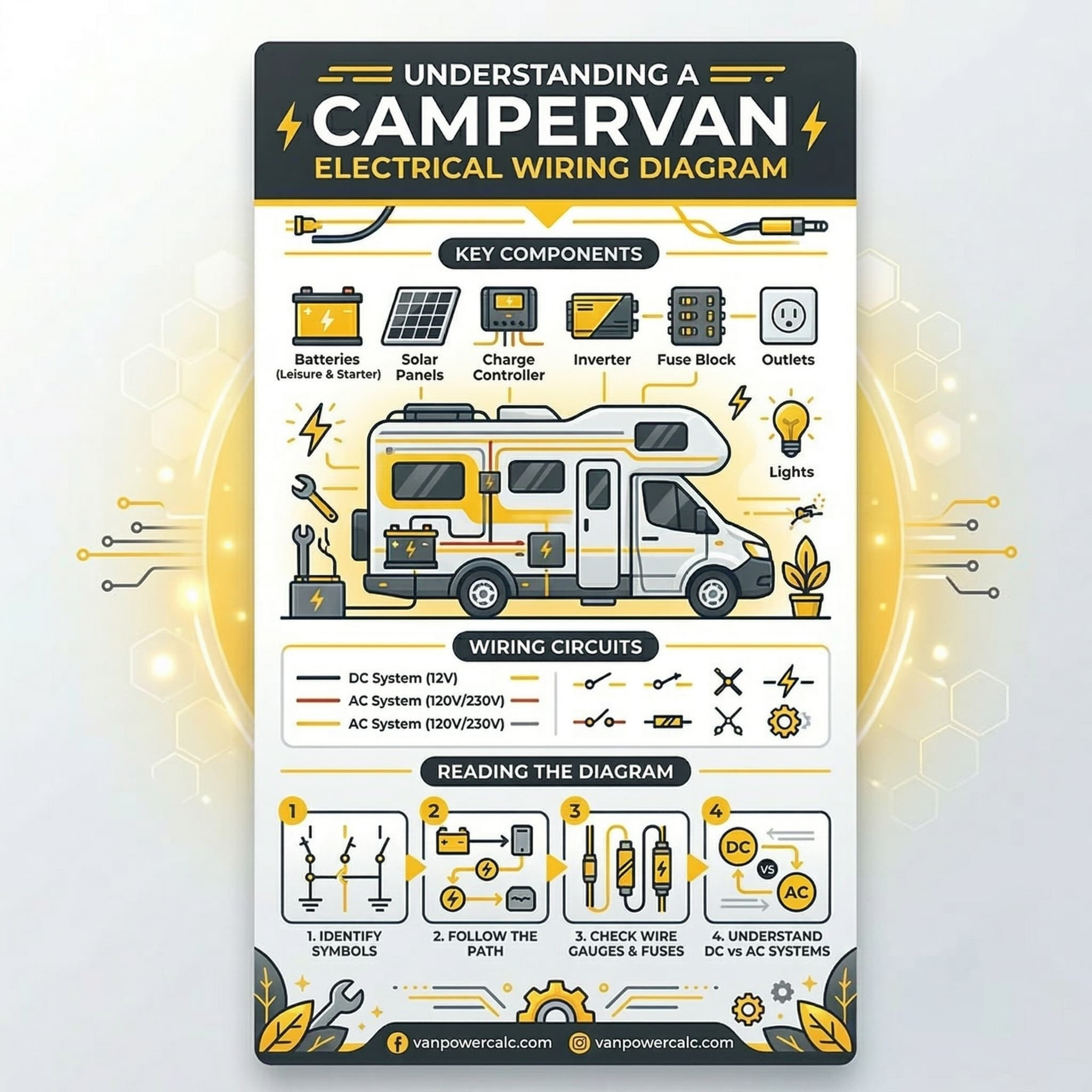
SCHÉMA ÉLECTRIQUE
PANNEAUX SOLAIRES
0W
RÉGULATEUR MPPT
BATTERIE AUXILIAIRE
0 Ah
Lithium LiFePO4
FUSIBLE
FUSIBLE
BOÎTE À FUSIBLES 12V
Pompe, Leds, Frigo...
CONVERTISSEUR 220V
NON REQUI
PRO GEARPage 4
SHOPPING LIST
Where to find this equipment? Here is the community-approved selection.
12V 6-way Fuse Box
Mandatory protection
Digital Multimeter
Test your connections
Heavy Duty Crimping Tool
For perfect lugs
Heat Shrink Tubing
Insulation and safety
GENERATED BY VANPOWERCALC.COM
I spent 3 years in a van before meeting plenty of tiny house folks. The question always comes up: "Which is better for electrical independence?" The answer isn't as obvious as you'd think. The van has advantages the tiny doesn't, and vice versa. Here's my honest comparison after 5 years of off-grid living.
On the battery side, a van typically runs 200–400Ah of LiFePO4 (2.4–4.8 kWh). A tiny house needs 400–800Ah (4.8–9.6 kWh) because it consumes more: bigger fridge, washing machine, sometimes electric heating. For solar, a van fits 400–600W on its roof, while a tiny house easily accommodates 1,000–2,000W with a larger roof or ground-mounted panels.
Expert tip
If you're torn between van and tiny, start by listing your must-have appliances and calculate your daily consumption. Above 3,000Wh/day, the van will be too limiting — go tiny house.
Example calculation for your setup
Results based on a typical use case
| Appliance | Power | Usage/day | Wh/day |
|---|---|---|---|
| Compression fridge | 45W | 24h | 1080 |
| LED lighting | 20W | 4h | 80 |
| Water pump | 30W | 0.5h | 15 |
| Phone charging | 15W | 2h | 30 |
| Daily consumption | 1205 Wh | ||
Recommended LiFePO4 battery
151 Ah
(80% depth of discharge)
Recommended AGM battery
241 Ah
(50% depth of discharge)
Adjust these values with the calculator below
About this tool
The electrical installation cost differs sharply. For a van, budget $1,000-5,000 for a complete autonomous setup. For a tiny house, it's more like $3,000-12,000 because needs are bigger and components larger (hybrid inverter, 48V batteries, full distribution panel).
But the tiny house has one massive advantage: roof area. With 1,500W of panels, it produces 6,000-7,000Wh/day in summer — enough for a nearly normal lifestyle. The van with its 400W is capped at 1,600-1,900Wh/day — you have to make compromises.
The van wins on mobility. Not enough sun in the Pacific Northwest? I drive south in 8 hours. The tiny house stays wherever it sits. In 2026, that energy mobility is worth its weight in gold.
System Architecture: 12V Simplicity vs 48V Power#
A van runs on 12V (sometimes 24V for larger builds). Everything is automotive-grade: blade fuses, Anderson connectors, MPPT controllers sized for 200-600W of panels. Total system complexity is low — I can wire a complete van electrical system in a weekend. A tiny house typically runs a 48V battery bank with a hybrid inverter that handles solar charging, battery management, and AC output in one unit. Think Victron MultiPlus or Sol-Ark. The hybrid inverter alone costs $1,500-3,000. But it also runs a washing machine, a full-size fridge, a microwave, and air conditioning — appliances that would flatten a van battery in hours. The tiny house electrical system is essentially a small off-grid home system. The van system is a scaled-down, mobile version with hard limits on total consumption.
Daily Energy Budget: Living With Constraints vs Living Normally#
Here's where the difference hits hardest. My van daily budget: 800-1,200Wh. That covers a 12V fridge (350Wh), LED lights (100Wh), laptop (200Wh), phone charging (30Wh), water pump (20Wh), diesel heater fan (200Wh in winter), and miscellaneous (100Wh). No air conditioning, no electric heating, no washer/dryer, no dishwasher, no hair dryer longer than 5 minutes. A tiny house with 1,500W of solar and 10kWh of battery runs at 4,000-6,000Wh/day. That supports a mini-split AC (1,500Wh/day), full-size fridge (1,200Wh), normal cooking, a washing machine (500Wh per load), and regular household lighting and electronics. The tiny house lifestyle barely requires compromises. The van lifestyle requires constant energy awareness.
The Hybrid Approach: Van With Shore Power Access#
Some builders bridge the gap by designing van systems that work great off-grid but can also plug into shore power when available. A 30A shore power inlet with a quality charger (like the Victron IP22 30A) lets you fully recharge a 200Ah bank in 6-7 hours at a campground. Total cost for the shore power addition: about $200-300. This gives you van mobility with occasional access to "tiny house" levels of power. I plug in at campgrounds maybe 2-3 nights per month — enough to run the air conditioning on a hot night, do laundry at the campground facility while topping off the battery, and generally reset after a stretch of cloudy boondocking. The van will never match the tiny house's raw electrical capacity, but with smart energy management and occasional hookups, the gap narrows enough that day-to-day comfort is comparable.

Frequently asked questions
How much does a tiny house off-grid electrical system cost?▼
Between $3,000 and $12,000 for the full installation: solar panels (1,000–2,000W), LiFePO4 batteries in 48V (400–800Ah), hybrid inverter, MPPT controller, and wiring. That's 2–3x more than a van, but covers much larger needs.
Can a van be as electrically autonomous as a tiny house?▼
In summer with modest usage, yes. But a tiny house with 1,500W solar and 800Ah battery provides a far more comfortable margin. The van forces compromises: no washing machine, smaller fridge, no electric oven.
What battery system for an off-grid tiny house?▼
48V is recommended for a tiny house (lower losses, thinner cables). A 200Ah pack at 48V (9.6 kWh) covers 2–3 days of autonomy. LiFePO4 is the obvious choice: 3,000+ cycles, 95% DoD, 10-year lifespan.
Is a tiny house more eco-friendly than a van?▼
Electrically, the tiny house is more efficient — better insulation, more solar capacity. But the van burns fuel to move. If you mostly stay put, the tiny wins. If you move a lot, the math gets complicated.
Can you live in a tiny house with no grid connection?▼
Yes, that's the whole point of off-grid tiny houses. With 1,500W solar and 10 kWh of battery, you cover 80–90% of annual needs. A backup generator ($500–1,000) handles tough winter stretches.
Advertising
Independent and free thanks to your clicks
Links marked with * are affiliate links. If a purchase is made through them, I receive a commission at no extra cost to you. The editorial selection and product evaluation are not influenced by commission rates. Your click helps fund this free tool.
Recommended gear
Check price
LiTime 12V 100Ah Bluetooth LiFePO4 (Group 31)Leo's Pick
LiFePO4 12V 100Ah Group 31, Bluetooth monitoring, 100A BMS, low-temp cutoff protection. Up to 15000 deep cycles at 60% DoD. Marine, RV, off-grid use. 222 Amazon reviews. LiTime is a leading mainstream LiFePO4 brand on Amazon US.“This is the battery I've been using in my van for 2 years. Reliable, lightweight, and the best value for money out there.”View on Amazon* →Check price
ECO-WORTHY 200W 12V/24V Solar Kit + 20A Bluetooth MPPTLeo's Pick
Complete 200W solar kit with Bluetooth-monitored MPPT controller. 12V/24V compatible, 20A charge controller with smartphone app. Ideal for vans, RVs, off-grid setups. Single-product solution covering both solar panel and charge controller.“The kit I recommend to every beginner. Plug it in, it works, and the included MPPT controller makes a real difference.”View on Amazon* →$107Amazon
Digital Multimeter
Measures voltage, current, resistance — essential for 12V wiring.“First tool to buy before you even start your install. You'll pull it out 100 times to check voltages and connections.”View on Amazon* →$41Amazon
12V Fuse Box
Protects each circuit independently, easy installation.“One fuse per circuit is the golden rule. This box keeps your install clean and every line independently protected.”View on Amazon* →