Loading...
Fact-checked on Apr 3, 2026
VANPOWERCALC.COMYOUR ENERGY PROFILE
YOUR ENERGY PROFILE.
This document contains the sizing of your future electrical installation, calculated based on your appliances.
Minimum Daily Consumption
0 WH / DAY
Inventory:
SYSTEM SIZINGPage 2
Battery
To guarantee 0WH without damaging your bank (80% max discharge):
0 AH
LiFePO4 12V
Solar
Minimum power required to recharge your consumption:
0 W
via MPPT
220V AC
Maximum power (with 25% safety margin).
0 W
No Need
Safety & CablingPage 3
12V Cable Sizing Guide
Use this professional reference table to select the correct gauge (mm²) for your cables. For 12V in a van, the maximum tolerated voltage drop is 3%. Always use multi-stranded flexible automotive wire.
| Current (A) | Round trip < 2m | Round trip 4m | Round trip 6m |
|---|---|---|---|
| 5A (LEDs, USB) | 1.5 mm² | 2.5 mm² | 4 mm² |
| 10A (Fridge, Pump) | 2.5 mm² | 4 mm² | 6 mm² |
| 20A (Heater) | 4 mm² | 10 mm² | 10 mm² |
| 50A (DC/DC Booster) | 10 mm² | 16 mm² | 25 mm² |
| 100A (Inverter) | 25 mm² | 35 mm² | 50 mm² |
Fuse Sizing
The fuse protects the wire, not the appliance. Always place it as close to the power source as possible (battery or busbar).
- Wire 1.5 mm² → Max fuse 10A
- Wire 2.5 mm² → Max fuse 20A
- Wire 4 mm² → Max fuse 30A
- Wire 6 mm² → Max fuse 40A
- Wire 10 mm² → Max fuse 60A
SCHÉMA ÉLECTRIQUE
PANNEAUX SOLAIRES
0W
RÉGULATEUR MPPT
BATTERIE AUXILIAIRE
0 Ah
Lithium LiFePO4
FUSIBLE
FUSIBLE
BOÎTE À FUSIBLES 12V
Pompe, Leds, Frigo...
CONVERTISSEUR 220V
NON REQUI
PRO GEARPage 4
SHOPPING LIST
Where to find this equipment? Here is the community-approved selection.
12V 6-way Fuse Box
Mandatory protection
Digital Multimeter
Test your connections
Heavy Duty Crimping Tool
For perfect lugs
Heat Shrink Tubing
Insulation and safety
GENERATED BY VANPOWERCALC.COM
The honest answer: regulations for DIY van electrical systems are a gray area in most countries. There's no universal "van electrical code." But there are standards that apply, and ignoring them can void your insurance, fail inspections, and — worst case — get someone hurt.
In the US: ABYC E-11 (marine electrical) is the closest applicable standard. No federal inspection required for DIY van builds, but some states require RVIA certification for titled RVs. In the UK: no specific regulations for 12V systems, but 230V must meet BS 7671 (IET Wiring Regulations). Habitation checks for DVLA registered campervans inspect electrical. In the EU: varies by country. France requires NF C 15-100 compliance and annual gas/electric checks for registered camping-cars. Germany's TÜV inspects wiring during conversion registration.
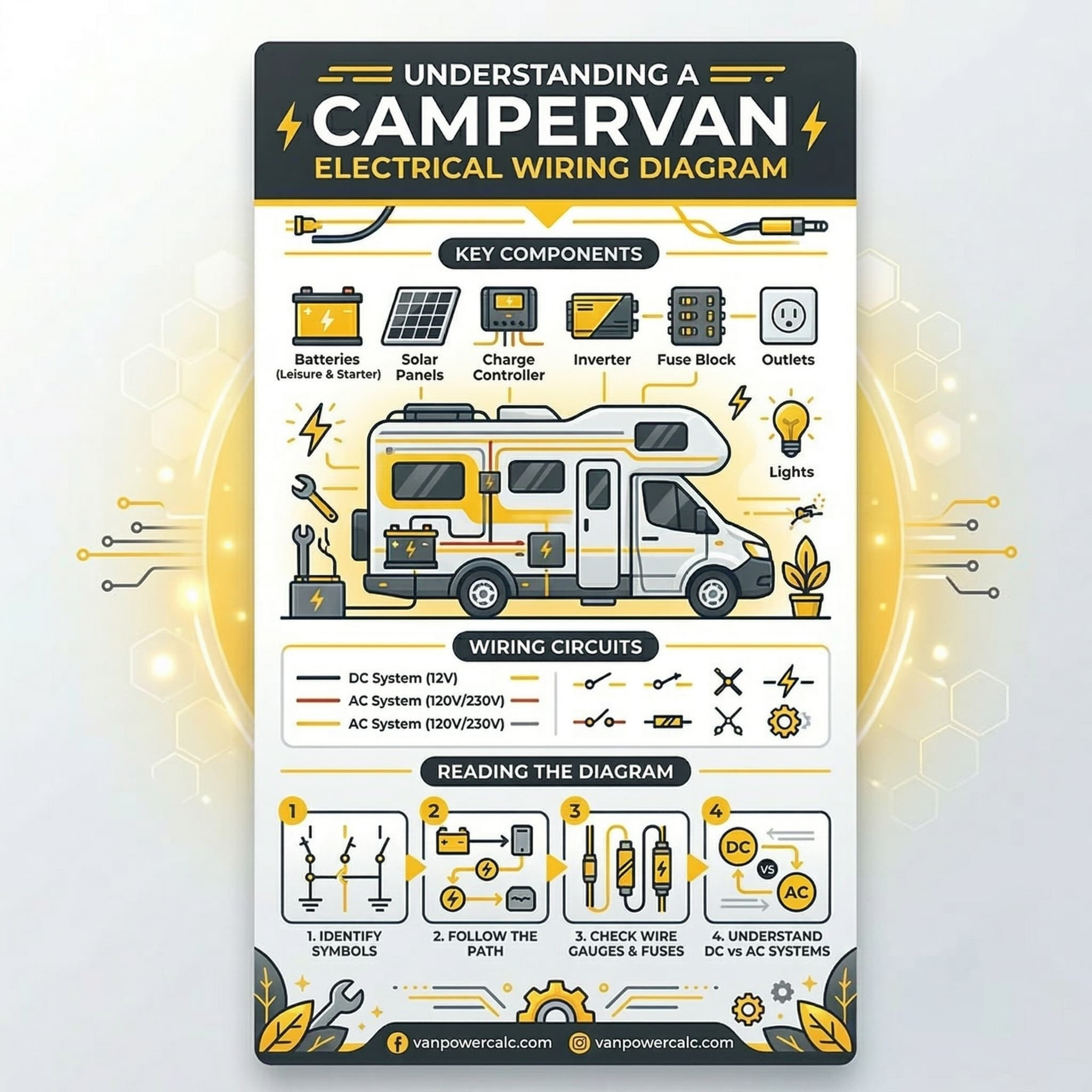
Expert tip
Take photos of your entire electrical installation during the build — clear shots of the fuse box, cable runs, battery mounting, and any 230V wiring. If you ever need to make an insurance claim or sell the van, these photos prove the installation was done properly.
Example calculation for your setup
Results based on a typical use case
| Appliance | Power | Usage/day | Wh/day |
|---|---|---|---|
| Compression fridge | 45W | 24h | 1080 |
| LED lighting | 20W | 4h | 80 |
| Water pump | 30W | 0.5h | 15 |
| Phone charging | 15W | 2h | 30 |
| Daily consumption | 1205 Wh | ||
Recommended LiFePO4 battery
151 Ah
(80% depth of discharge)
Recommended AGM battery
241 Ah
(50% depth of discharge)
Recommended solar panels
402 Wc
4h average sun hours
Recommended inverter
No 220V appliances — no inverter needed
Adjust these values with the calculator below
About this tool
Here's the practical reality: nobody is going to inspect your 12V LED wiring. What WILL get checked — and what can cause real problems if wrong — is your 230V AC wiring and your gas installation. These are the safety-critical systems. A missing RCD, wrong wire sizing, or no earth bonding on 230V circuits is both dangerous and an automatic inspection fail in every country. For 12V, follow best practices even without legal obligation: fuse every circuit, size cables correctly, use automotive-grade connectors, and keep the battery fused within 30cm of the positive terminal. Your insurance company will absolutely use "non-standard electrical installation" to deny a fire claim if your wiring is shoddy.
Country-by-Country: What Actually Gets Checked#
In the UK, a habitation check (required annually for motorhome insurance) covers gas and 230V. The tester follows BS 7671 (IET Wiring Regulations) and checks RCD trip time (must trip within 300ms at 30mA), earth loop impedance, and polarity. 12V is not formally tested but a visible mess can flag concerns. In Germany, TUV inspections for camper registration are strict — DIN VDE 0100-721 applies and they check everything from cable routing to IP ratings on outdoor sockets. In France, the VASP (vehicule automoteur specialise) conversion registration requires an APAVE or DEKRA electrical inspection. They test RCD, insulation resistance (must exceed 1 MOhm), and verify cable sizing against NF C 15-100. In the US, there's no federal standard for DIY van conversions. Some states require nothing. Others refer to NFPA 1192 (recreational vehicles) for 120V systems.
12V Best Practices That Protect You Legally#
Even though 12V systems aren't typically inspected, doing it wrong creates real liability. If your van catches fire and the investigation finds undersized wire, missing fuses, or loose connections, your insurance claim dies on the spot. Here's what I do on every build: fuse every positive wire within 30cm of the battery using appropriately rated blade or ANL fuses. Use only tinned copper marine-grade cable — regular automotive cable corrodes in the humid van environment. Crimp all terminals with a ratcheting crimper (not pliers) and add heat-shrink with adhesive lining. Label every circuit at the fuse box. Run cables through split conduit or protective loom where they pass through metal panels. Keep 12V and 230V cables separated by at least 50mm — mixing them in the same conduit is a code violation in every country I've checked.
Insurance and Registration: What Van Builders Miss#
The biggest legal trap: converting a panel van to a camper changes its vehicle category in most jurisdictions. In the EU, this means re-registration as an M1 or N1 special purpose vehicle, which triggers inspection requirements. In the UK, you need to notify DVLA of the body type change. In Australia, a camper conversion requires an engineer's compliance plate. Failing to re-register can void your insurance entirely — not just for electrical claims, but for everything. I always get the conversion officially registered before hitting the road. The inspection fee ($100-300 depending on country) is trivial compared to an uninsured accident. Keep receipts for all electrical components, photos of the installation process, and wiring diagrams. This documentation turns a potential insurance fight into a quick approval.

Frequently asked questions
Do I need an electrical inspection for my van conversion?▼
Depends on your country. UK: habitation check recommended but not mandatory for personal use. France: annual contrôle technique checks gas and electric on registered camping-cars. Germany: TÜV inspection required to register as Wohnmobil. US: no federal requirement but some states require RVIA certification for titled RVs.
What wire standard should I follow?▼
ABYC E-11 for US builds, BS 7671 for UK 230V wiring, IEC 60364-7-721 for EU caravan standards. For 12V, there's no mandatory standard in most countries — follow manufacturer recommendations and the 3% voltage drop rule.
Is an RCD required in a van?▼
For 230V systems: yes in every EU country, yes in the UK under BS 7671, and recommended under ABYC E-11 in the US (required for shore power circuits on marine/RV). 30mA Type A minimum, Type B recommended if you have an inverter.
Will insurance cover a fire from DIY electrical?▼
Only if the installation meets reasonable standards. A fire caused by a 10mm² cable on a 200A inverter circuit — clearly undersized — gives the insurer grounds to deny the claim. Follow cable sizing tables, fuse everything, and document your work with photos.
What about 12V wiring regulations?▼
Practically unregulated in most countries for personal vehicles. But that doesn't mean anything goes. Unfused circuits, undersized cables, and exposed connections are fire hazards regardless of legality. Build to a standard even if nobody checks.
Advertising
Independent and free thanks to your clicks
Links marked with * are affiliate links. If a purchase is made through them, I receive a commission at no extra cost to you. The editorial selection and product evaluation are not influenced by commission rates. Your click helps fund this free tool.
Recommended gear
Check price
LiTime 12V 100Ah Bluetooth LiFePO4 (Group 31)Leo's Pick
LiFePO4 12V 100Ah Group 31, Bluetooth monitoring, 100A BMS, low-temp cutoff protection. Up to 15000 deep cycles at 60% DoD. Marine, RV, off-grid use. 222 Amazon reviews. LiTime is a leading mainstream LiFePO4 brand on Amazon US.“This is the battery I've been using in my van for 2 years. Reliable, lightweight, and the best value for money out there.”View on Amazon* →Check price
ECO-WORTHY 200W 12V/24V Solar Kit + 20A Bluetooth MPPTLeo's Pick
Complete 200W solar kit with Bluetooth-monitored MPPT controller. 12V/24V compatible, 20A charge controller with smartphone app. Ideal for vans, RVs, off-grid setups. Single-product solution covering both solar panel and charge controller.“The kit I recommend to every beginner. Plug it in, it works, and the included MPPT controller makes a real difference.”View on Amazon* →$107Amazon
Digital Multimeter
Measures voltage, current, resistance — essential for 12V wiring.“First tool to buy before you even start your install. You'll pull it out 100 times to check voltages and connections.”View on Amazon* →$41Amazon
12V Fuse Box
Protects each circuit independently, easy installation.“One fuse per circuit is the golden rule. This box keeps your install clean and every line independently protected.”View on Amazon* →