Loading...
Fact-checked on Apr 3, 2026
VANPOWERCALC.COMYOUR ENERGY PROFILE
YOUR ENERGY PROFILE.
This document contains the sizing of your future electrical installation, calculated based on your appliances.
Minimum Daily Consumption
0 WH / DAY
Inventory:
SYSTEM SIZINGPage 2
Battery
To guarantee 0WH without damaging your bank (80% max discharge):
0 AH
LiFePO4 12V
Solar
Minimum power required to recharge your consumption:
0 W
via MPPT
220V AC
Maximum power (with 25% safety margin).
0 W
No Need
Safety & CablingPage 3
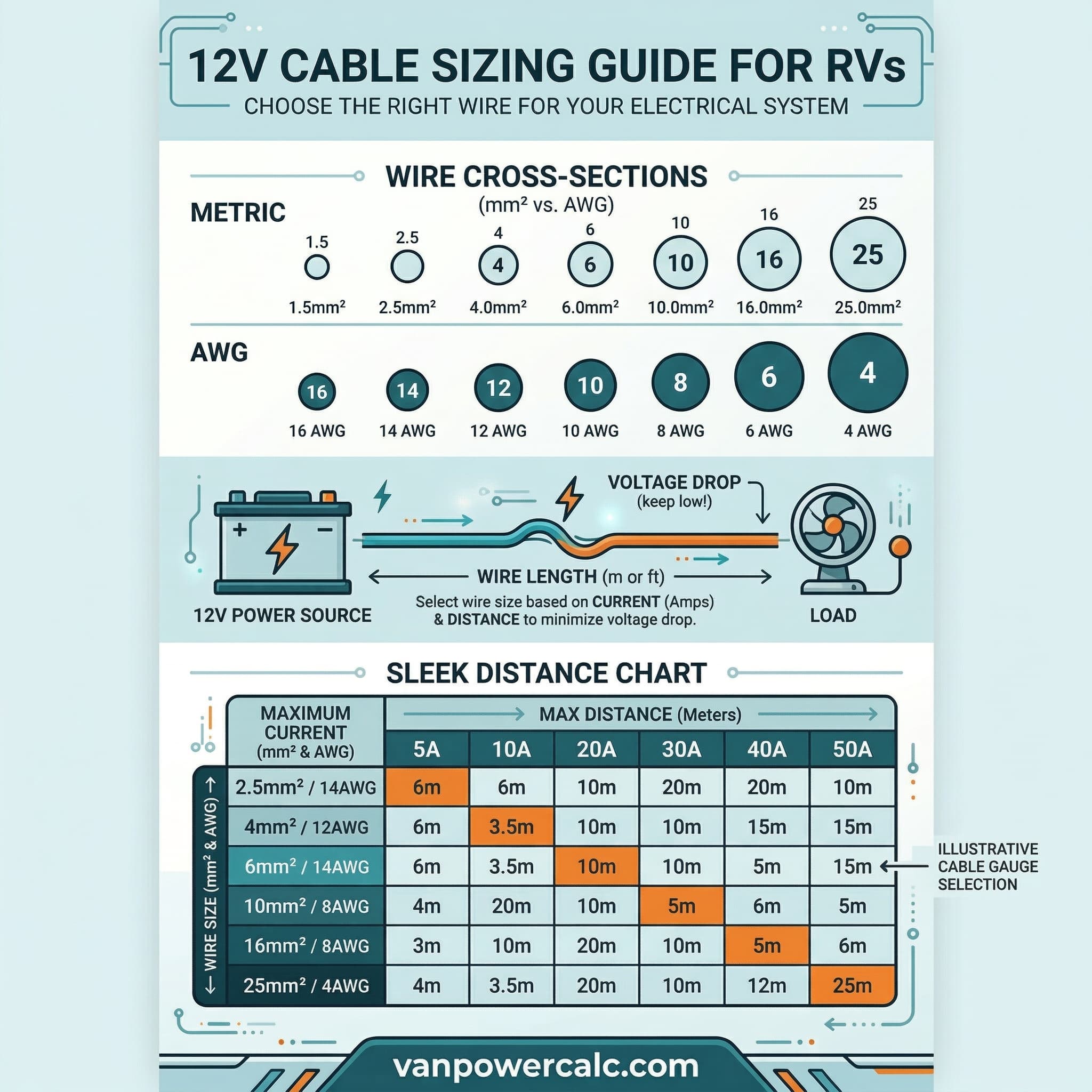
12V Cable Sizing Guide
Use this professional reference table to select the correct gauge (mm²) for your cables. For 12V in a van, the maximum tolerated voltage drop is 3%. Always use multi-stranded flexible automotive wire.
| Current (A) | Round trip < 2m | Round trip 4m | Round trip 6m |
|---|---|---|---|
| 5A (LEDs, USB) | 1.5 mm² | 2.5 mm² | 4 mm² |
| 10A (Fridge, Pump) | 2.5 mm² | 4 mm² | 6 mm² |
| 20A (Heater) | 4 mm² | 10 mm² | 10 mm² |
| 50A (DC/DC Booster) | 10 mm² | 16 mm² | 25 mm² |
| 100A (Inverter) | 25 mm² | 35 mm² | 50 mm² |
Fuse Sizing
The fuse protects the wire, not the appliance. Always place it as close to the power source as possible (battery or busbar).
- Wire 1.5 mm² → Max fuse 10A
- Wire 2.5 mm² → Max fuse 20A
- Wire 4 mm² → Max fuse 30A
- Wire 6 mm² → Max fuse 40A
- Wire 10 mm² → Max fuse 60A
SCHÉMA ÉLECTRIQUE
PANNEAUX SOLAIRES
0W
RÉGULATEUR MPPT
BATTERIE AUXILIAIRE
0 Ah
Lithium LiFePO4
FUSIBLE
FUSIBLE
BOÎTE À FUSIBLES 12V
Pompe, Leds, Frigo...
CONVERTISSEUR 220V
NON REQUI
PRO GEARPage 4
SHOPPING LIST
Where to find this equipment? Here is the community-approved selection.
12V 6-way Fuse Box
Mandatory protection
Digital Multimeter
Test your connections
Heavy Duty Crimping Tool
For perfect lugs
Heat Shrink Tubing
Insulation and safety
GENERATED BY VANPOWERCALC.COM
The fuse box is the least exciting part of a van build and the most important for safety. Every positive wire leaving your battery bank should pass through a fuse rated to protect the wire — not the appliance. Get this wrong and you're one chafed wire away from a fire behind your walls.
A typical van build needs 6-12 fused circuits: fridge, lighting (often split into zones), USB outlets, water pump, diesel heater, ventilation fan, stereo, and a few spares. I use a 12-way blade fuse block with negative bus bar — Blue Sea Systems 5026 or the cheaper Chinese clones that use the same ATC/ATO standard fuses. Mount it somewhere accessible but protected from water.
Expert tip
Label every fuse slot on day one with a label maker — not a Sharpie that fades in 6 months. When you're troubleshooting at 11 PM in a parking lot, you'll thank yourself. Also leave 2-3 empty slots for future circuits. Every build grows.
Example calculation for your setup
Results based on a typical use case
| Appliance | Power | Usage/day | Wh/day |
|---|---|---|---|
| Compression fridge | 45W | 24h | 1080 |
| LED lighting | 20W | 4h | 80 |
| Water pump | 30W | 0.5h | 15 |
| Phone charging | 15W | 2h | 30 |
| Daily consumption | 1205 Wh | ||
Recommended LiFePO4 battery
151 Ah
(80% depth of discharge)
Recommended AGM battery
241 Ah
(50% depth of discharge)
Recommended solar panels
402 Wc
4h average sun hours
Recommended inverter
No 220V appliances — no inverter needed
Adjust these values with the calculator below
About this tool
The most common mistake I see on forums: people fusing for the appliance instead of the wire. A fridge draws 5A, so they slap in a 5A fuse. But the wire is 2.5mm² rated for 20A. That's fine — the fuse protects the wire, and 5A is below the wire's rating. Where it goes wrong: someone runs a 10A circuit on 1mm² wire with a 15A fuse. The wire overheats before the fuse blows. Always match fuse to wire rating: 1mm² → 10A max fuse, 1.5mm² → 15A, 2.5mm² → 20A, 4mm² → 25A. Another thing: your main battery fuse (between battery and fuse box) should be within 30cm of the battery positive terminal. This protects the entire main cable run. I use an ANL fuse holder with a 60-100A fuse depending on total system draw.
Choosing the Right Fuse Box for Your Build#
I've used three types across different builds. Blade fuse panels (like the BlueSea ST Blade) are my go-to for most builds — they accept standard ATO/ATC automotive fuses, each circuit is individually fused, and you can get 6, 12, or 24-circuit versions. A 12-circuit panel runs $60-90 and covers most builds perfectly. Bus bar + individual inline fuse holders work well for simpler setups with fewer circuits — cheaper ($30-40 total) but messier with more wire joints. Combined fuse/switch panels give you a fuse and an illuminated toggle switch per circuit in one unit. They look clean but cheaper units have flimsy connections. Whatever you pick, mount it somewhere accessible — you'll be pulling fuses to troubleshoot at some point, guaranteed. I mount mine vertically on a panel behind the driver seat or under the bed platform where I can reach it without moving furniture.
My Standard Circuit Layout#
After building five systems, I've settled on a layout that works. Circuit 1: overhead LED lights (5A fuse, 1.5mm² wire). Circuit 2: rear/bed area lights (5A, 1.5mm²). Circuit 3: 12V fridge (15A, 2.5mm²). Circuit 4: water pump (10A, 1.5mm²). Circuit 5: USB charging outlets (10A, 1.5mm²). Circuit 6: 12V cigarette sockets (15A, 2.5mm²). Circuit 7: diesel heater (15A, 2.5mm²). Circuit 8: MaxxFan (10A, 1.5mm²). Circuit 9: inverter remote switch (5A, 1mm²). Circuit 10: spare. The inverter itself doesn't go through the fuse box — it connects directly to the battery through its own ANL fuse (typically 150-200A depending on inverter size, with 25-35mm² cable). Running a 2000W inverter through a blade fuse box would melt the traces.
Negative Bus Bar: The Forgotten Component#
Every positive wire needs a fuse. But people forget about the return path. All negative wires need a common grounding point — a negative bus bar. I use a 150A rated bus bar ($12-15) mounted near the fuse box. Every circuit's negative wire terminates here, and a single heavy-gauge cable (10mm² minimum) runs from the bus bar back to the battery negative terminal. Do NOT ground your 12V circuits to the van chassis like the factory wiring does. Van chassis grounds work fine for factory lights and sensors, but leisure circuits running through a corroded body panel connection will give you intermittent failures, voltage drop, and headaches. Run dedicated negative wires back to the bus bar for every circuit. It costs an extra $30 in wire and saves hours of troubleshooting later.

Frequently asked questions
What size fuse box do I need for a van?▼
A 12-way blade fuse block covers most builds. Typical circuits: fridge, lights (2-3 zones), USB, water pump, heater, fan, stereo, and 2-3 spares. If you run more than 12 circuits, add a second block rather than cramming wires.
What fuse size for each circuit?▼
Match the fuse to the wire, not the device. 1mm² wire → 10A fuse max. 1.5mm² → 15A. 2.5mm² → 20A. 4mm² → 25-30A. The fuse protects the wire from overheating. The appliance has its own internal protection.
Do I need a main fuse at the battery?▼
Absolutely, and it must be within 30cm (12 inches) of the battery positive terminal. This protects the entire cable run from battery to fuse box. Use an ANL or MEGA fuse holder rated for your total system current — typically 60-150A for a van build.
Blade fuses or ANL fuses?▼
Both — they serve different purposes. ATC/ATO blade fuses (1-40A) go in your distribution block for individual circuits. ANL or MEGA fuses (40-300A) protect high-current runs: battery main cable, inverter feed, DC-DC charger input. You'll typically have 2-4 ANL fuses and 8-12 blade fuses in a complete build.
Where should I mount the fuse box?▼
Somewhere accessible for troubleshooting but protected from water splashes and condensation. Under a bench seat, inside a cabinet near the battery, or on a vertical panel behind the driver seat are popular spots. Avoid the floor — condensation pools there in winter.
Advertising
Independent and free thanks to your clicks
Links marked with * are affiliate links. If a purchase is made through them, I receive a commission at no extra cost to you. The editorial selection and product evaluation are not influenced by commission rates. Your click helps fund this free tool.
Recommended gear
$33Amazon
Battery Cable 50mm² Red+Black
50mm² cable for 2000W+ inverter. Red and black, 1m each.“Between battery and inverter, you need heavy-duty cable. 50mm² handles big current draws without overheating.”View on Amazon* →$41Amazon
12V Fuse Box
Protects each circuit independently, easy installation.“One fuse per circuit is the golden rule. This box keeps your install clean and every line independently protected.”View on Amazon* →$25Amazon
Electrical Crimping Tool
Reliable crimp connections on 0.5mm²–16mm² cables, no soldering.“Forget soldering in a van — crimping is more reliable and vibration-proof. This one covers all the gauges you'll need.”View on Amazon* →$107Amazon
Digital Multimeter
Measures voltage, current, resistance — essential for 12V wiring.“First tool to buy before you even start your install. You'll pull it out 100 times to check voltages and connections.”View on Amazon* →