Loading...
Fact-checked on Jun 19, 2026
VANPOWERCALC.COMYOUR ENERGY PROFILE
YOUR ENERGY PROFILE.
This document contains the sizing of your future electrical installation, calculated based on your appliances.
Minimum Daily Consumption
0 WH / DAY
Inventory:
SYSTEM SIZINGPage 2
Battery
To guarantee 0WH without damaging your bank (80% max discharge):
0 AH
LiFePO4 12V
Solar
Minimum power required to recharge your consumption:
0 W
via MPPT
220V AC
Maximum power (with 25% safety margin).
0 W
No Need
Safety & CablingPage 3
12V Cable Sizing Guide
Use this professional reference table to select the correct gauge (mm²) for your cables. For 12V in a van, the maximum tolerated voltage drop is 3%. Always use multi-stranded flexible automotive wire.
| Current (A) | Round trip < 2m | Round trip 4m | Round trip 6m |
|---|---|---|---|
| 5A (LEDs, USB) | 1.5 mm² | 2.5 mm² | 4 mm² |
| 10A (Fridge, Pump) | 2.5 mm² | 4 mm² | 6 mm² |
| 20A (Heater) | 4 mm² | 10 mm² | 10 mm² |
| 50A (DC/DC Booster) | 10 mm² | 16 mm² | 25 mm² |
| 100A (Inverter) | 25 mm² | 35 mm² | 50 mm² |
Fuse Sizing
The fuse protects the wire, not the appliance. Always place it as close to the power source as possible (battery or busbar).
- Wire 1.5 mm² → Max fuse 10A
- Wire 2.5 mm² → Max fuse 20A
- Wire 4 mm² → Max fuse 30A
- Wire 6 mm² → Max fuse 40A
- Wire 10 mm² → Max fuse 60A
SCHÉMA ÉLECTRIQUE
PANNEAUX SOLAIRES
0W
RÉGULATEUR MPPT
BATTERIE AUXILIAIRE
0 Ah
Lithium LiFePO4
FUSIBLE
FUSIBLE
BOÎTE À FUSIBLES 12V
Pompe, Leds, Frigo...
CONVERTISSEUR 220V
NON REQUI
PRO GEARPage 4
SHOPPING LIST
Where to find this equipment? Here is the community-approved selection.
12V 6-way Fuse Box
Mandatory protection
Digital Multimeter
Test your connections
Heavy Duty Crimping Tool
For perfect lugs
Heat Shrink Tubing
Insulation and safety
GENERATED BY VANPOWERCALC.COM
Choosing between an all-in-one unit like the EcoFlow Delta 2 (1024Wh) and a traditional 100Ah LiFePO4 battery setup depends on your DIY skills. A power station offers plug-and-play simplicity with built-in inverters and MPPT controllers, while a custom build allows for easier repairs and massive scalability.
For weekend offenders or those renting a van, the portability of a Jackery is unmatched. However, full-time digital nomads often prefer 400Ah+ custom banks to power heavy loads reliably.
Expert tip
Start with a 500-1000Wh portable power station for your first 3-6 months of van life. After real-world use, you'll know exactly what power needs you have — and you can repurpose the portable unit as a backup system when you build your permanent leisure battery installation.
Example calculation for your setup
Results based on a typical use case
| Appliance | Power | Usage/day | Wh/day |
|---|---|---|---|
| Compression fridge | 45W | 24h | 1080 |
| LED lighting | 20W | 4h | 80 |
| Water pump | 30W | 0.5h | 15 |
| Phone charging | 15W | 2h | 30 |
| Daily consumption | 1205 Wh | ||
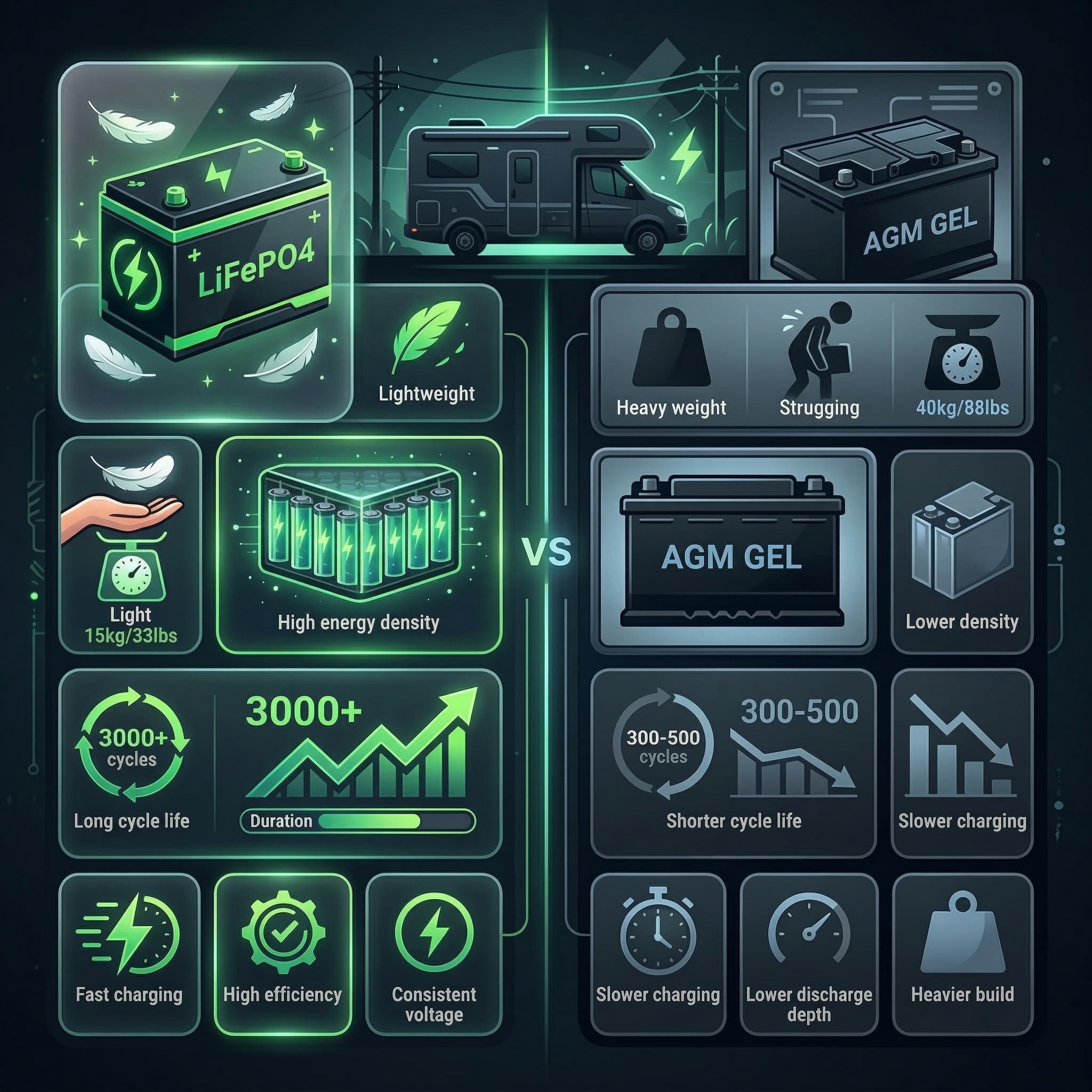
Recommended LiFePO4 battery
151 Ah
(80% depth of discharge)
Recommended AGM battery
241 Ah
(50% depth of discharge)
Adjust these values with the calculator below
Comparison table
| Feature | Power Station | Custom Setup |
|---|---|---|
| Install Time | 5 Minutes | 10-20 Hours |
| Scalability | Limited/Expensive | High/Modular |
| Portability | Excellent | None (Permanent) |
| Cost ($ per kWh) | $800 - $1,200 | $400 - $600 |
About this tool
Portable Power Station vs Leisure Battery: Which Is Right for Your Van?#
This comparison covers the two fundamental approaches to van electrical systems: the all-in-one portable power station (like EcoFlow Delta Pro, Jackery Explorer) vs a traditional built-in leisure battery setup. Both can work for van life — but for very different use cases.
Side-by-Side Comparison#
| Factor | Portable Power Station | Leisure Battery Setup |
|---|---|---|
| Setup time | Minutes (plug and play) | 1-3 days (DIY) or weeks (pro) |
| Cost for 1kWh | $800-1,500 (EcoFlow Delta Pro) | $400-800 (DIY LiFePO4) |
| Solar charging | Via built-in MPPT | Via external MPPT regulator |
| Expandability | Limited (add extra batteries) | Unlimited (add banks) |
| Portability | Carry between van and house | Fixed installation |
| Max solar input | 800W-1,600W | Unlimited |
| Repairability | Factory only | DIY repair possible |
| Depth of discharge | 80% (software limited) | 95%+ (LiFePO4 direct) |
When a Portable Power Station Makes Sense#
Portable power stations excel for weekend warriors and first-time builders who want:
- No electrical expertise required
- Flexibility to use the same unit at home, camping, or in the van
- Genuine "try before you fully commit" approach to van life
- A system that works out of the box in 10 minutes
The EcoFlow Delta Pro (3.6kWh, max 3,600W output, 1,600W solar input) is genuinely powerful enough for a full-time van build. At ~$3,000, it's more expensive per kWh than DIY — but zero wiring complexity.
When a Built-In Leisure Battery Setup Makes Sense#
A traditional leisure battery system wins for full-time van lifers and serious builders who want:
- Lowest cost per kWh (DIY LiFePO4 is 30-50% cheaper than equivalent portable stations)
- Maximum expandability (add more battery banks as needs grow)
- Custom solar arrays over 1,600W
- Direct 12V power for devices without converter losses
- 10-15 year lifespan with quality components vs 3-5 years for portable stations
A 200Ah LiFePO4 battery + Victron MPPT + Victron inverter/charger costs roughly $1,200-1,800 DIY for an equivalent system to a $1,500 portable station — with triple the lifespan.
The Hybrid Approach#
Many experienced van lifers use both: a small portable station (EcoFlow River 2, 256Wh) for portable convenience, plus a built-in leisure battery for the main system. The portable unit handles laptop charging, small appliances, and can be taken out for picnics or shore-power top-ups at friends' houses.
Expert tip: If you're just starting van life and aren't ready to commit to a full electrical build, start with a 500-1000Wh portable power station. After 3-6 months of real use, you'll know exactly what power needs you have — and you can use the portable unit as a backup battery when you build your permanent system.

Frequently asked questions
Is a portable power station better than a leisure battery for van life?▼
It depends on your use case. Portable power stations are plug-and-play and perfect for weekends and beginners. A built-in leisure battery system is 30-50% cheaper per kWh, more expandable, and better for full-time van life. Many experienced van lifers use both.
How long does an EcoFlow Delta Pro last in a van?▼
At 3.6kWh with 80% DoD usable (2.88kWh), the Delta Pro supports a typical couple's daily consumption of 600-800Wh for 3-4 days without solar. With 800W of solar in summer, you can run indefinitely.
Can I charge a portable power station from solar on a van?▼
Yes. EcoFlow, Bluetti, and Jackery all accept direct solar input (100-1,600W depending on model). You need compatible solar panels and the right connectors. The built-in MPPT is usually less sophisticated than a dedicated Victron MPPT, costing you 5-15% efficiency.
What is the lifespan of a portable power station vs a leisure battery?▼
Most portable power stations last 500-1,000 charge cycles (3-5 years with daily use). A quality LiFePO4 leisure battery lasts 3,000-5,000 cycles (10-15 years). For full-time van life, the built-in LiFePO4 will be significantly cheaper over 10 years.
Advertising
Independent and free thanks to your clicks
Links marked with * are affiliate links. If a purchase is made through them, I receive a commission at no extra cost to you. The editorial selection and product evaluation are not influenced by commission rates. Your click helps fund this free tool.
Recommended gear
Check price
LiFePO4 200Ah 12V Battery
200Ah true capacity, 200A built-in BMS, 5000+ cycles.“If you work remotely or run a fridge, go straight for 200Ah. You'll never regret having too much capacity.”View on Amazon* →Check price
ECO-WORTHY 200W 12V/24V Solar Kit + 20A Bluetooth MPPTLeo's Pick
Complete 200W solar kit with Bluetooth-monitored MPPT controller. 12V/24V compatible, 20A charge controller with smartphone app. Ideal for vans, RVs, off-grid setups. Single-product solution covering both solar panel and charge controller.“The kit I recommend to every beginner. Plug it in, it works, and the included MPPT controller makes a real difference.”View on Amazon* →$104Amazon
Pure Sine Inverter 2000W 12V
Runs induction cooktop, hair dryer, coffee machine.“The 2000W version for those who want to plug in everything: induction plate, hair dryer, pro coffee machine. Make sure your cables are properly sized.”View on Amazon* →$114Amazon
Victron BMV-712 Battery Monitor
Real-time SOC, history, Bluetooth alarms. Must-have.“Without a monitor, you're flying blind. This one gives you the exact battery % in real time — a total game-changer.”View on Amazon* →