Loading...
Fact-checked on Jun 19, 2026
VANPOWERCALC.COMYOUR ENERGY PROFILE
YOUR ENERGY PROFILE.
This document contains the sizing of your future electrical installation, calculated based on your appliances.
Minimum Daily Consumption
0 WH / DAY
Inventory:
SYSTEM SIZINGPage 2
Battery
To guarantee 0WH without damaging your bank (80% max discharge):
0 AH
LiFePO4 12V
Solar
Minimum power required to recharge your consumption:
0 W
via MPPT
220V AC
Maximum power (with 25% safety margin).
0 W
No Need
Safety & CablingPage 3
12V Cable Sizing Guide
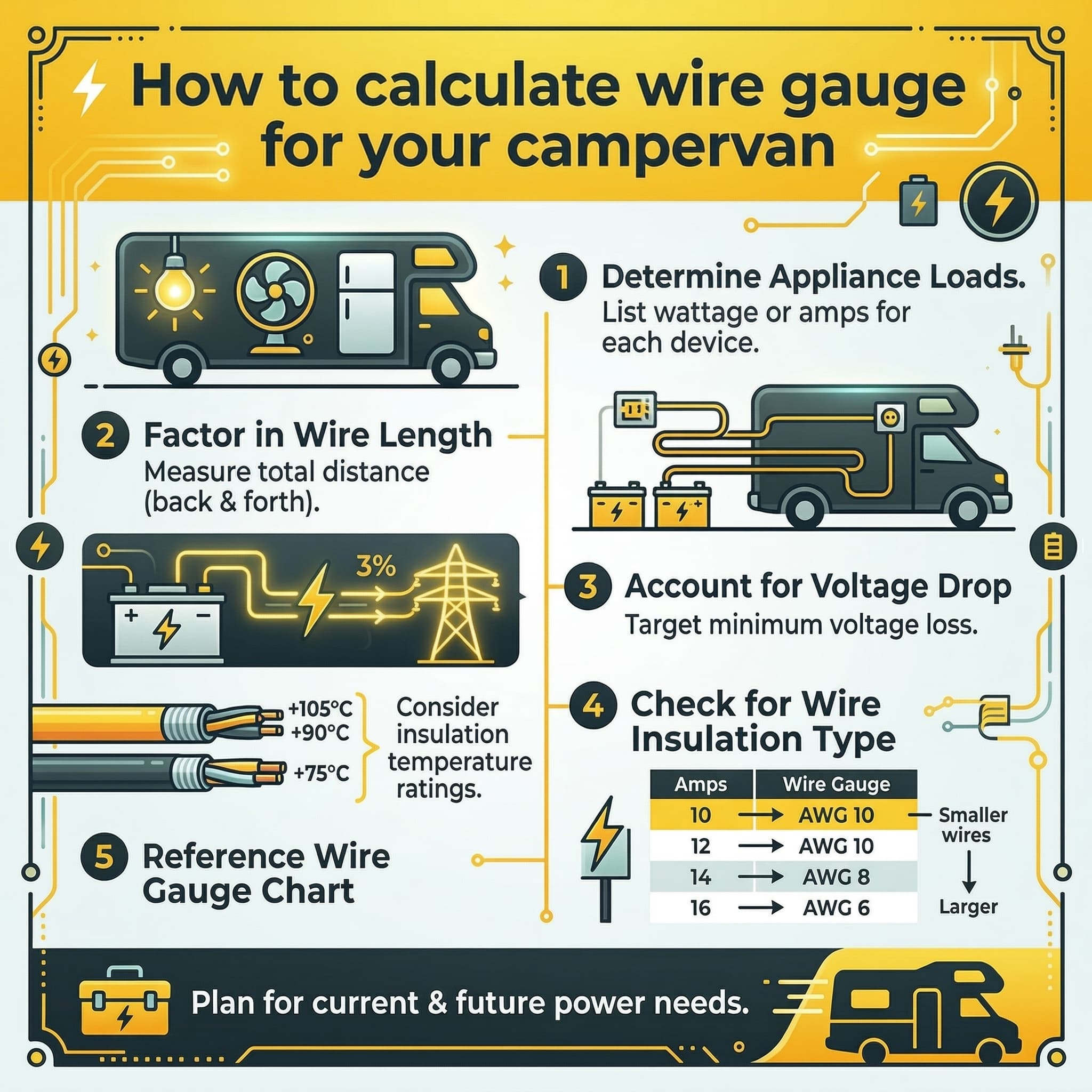
Use this professional reference table to select the correct gauge (mm²) for your cables. For 12V in a van, the maximum tolerated voltage drop is 3%. Always use multi-stranded flexible automotive wire.
| Current (A) | Round trip < 2m | Round trip 4m | Round trip 6m |
|---|---|---|---|
| 5A (LEDs, USB) | 1.5 mm² | 2.5 mm² | 4 mm² |
| 10A (Fridge, Pump) | 2.5 mm² | 4 mm² | 6 mm² |
| 20A (Heater) | 4 mm² | 10 mm² | 10 mm² |
| 50A (DC/DC Booster) | 10 mm² | 16 mm² | 25 mm² |
| 100A (Inverter) | 25 mm² | 35 mm² | 50 mm² |
Fuse Sizing
The fuse protects the wire, not the appliance. Always place it as close to the power source as possible (battery or busbar).
- Wire 1.5 mm² → Max fuse 10A
- Wire 2.5 mm² → Max fuse 20A
- Wire 4 mm² → Max fuse 30A
- Wire 6 mm² → Max fuse 40A
- Wire 10 mm² → Max fuse 60A
SCHÉMA ÉLECTRIQUE
PANNEAUX SOLAIRES
0W
RÉGULATEUR MPPT
BATTERIE AUXILIAIRE
0 Ah
Lithium LiFePO4
FUSIBLE
FUSIBLE
BOÎTE À FUSIBLES 12V
Pompe, Leds, Frigo...
CONVERTISSEUR 220V
NON REQUI
PRO GEARPage 4
SHOPPING LIST
Where to find this equipment? Here is the community-approved selection.
12V 6-way Fuse Box
Mandatory protection
Digital Multimeter
Test your connections
Heavy Duty Crimping Tool
For perfect lugs
Heat Shrink Tubing
Insulation and safety
GENERATED BY VANPOWERCALC.COM
Your inverter is the highest-current device in your van. A 2000W unit at 12V pulls over 185A — that's more current than your van's starter motor. Undersized cables at these currents don't just lose efficiency. They catch fire.
Here's the sizing table. 500W inverter: 46A draw → 10mm² (8 AWG), 60A fuse. 1000W: 93A → 25mm² (4 AWG), 125A fuse. 1500W: 139A → 35mm² (2 AWG), 175A fuse. 2000W: 185A → 50mm² (1/0 AWG), 250A fuse. 3000W: 278A → 70mm² (2/0 AWG), 350A fuse. These assume 90% inverter efficiency and cable runs under 1.5 meters.
Expert tip
Crimp your lugs, don't solder them. Solder wicks up the cable strands and creates a rigid point that's prone to fatigue cracking from vibration. A proper hydraulic crimp with heat-shrink over it is stronger, more reliable, and makes a better electrical connection. Every professional electrician crimps — soldering high-current connections is a DIY forum myth.
Example calculation for your setup
Results based on a typical use case
| Appliance | Power | Usage/day | Wh/day |
|---|---|---|---|
| Compression fridge | 45W | 24h | 1080 |
| LED lighting | 20W | 4h | 80 |
| Water pump | 30W | 0.5h | 15 |
| Phone charging | 15W | 2h | 30 |
| Daily consumption | 1205 Wh | ||
Recommended inverter
No 220V appliances — no inverter needed
Adjust these values with the calculator below
About this tool
That table assumes short cable runs. If your inverter is more than 1.5m from the battery, go one gauge thicker. Voltage drop at 185A over 2 meters of 50mm² cable is about 0.3V — that's 55W of heat being generated in the cable continuously. Over 3 meters, double that. At these currents, the cable is basically a resistive heater. The fuse must be an ANL or MEGA type — standard blade fuses max out at 40A. Mount the fuse holder within 30cm of the battery positive terminal. This protects the entire cable run, not just the inverter. If the cable shorts against the chassis anywhere along its length, the fuse blows before the cable melts. One detail people miss: the negative cable must be the same gauge as the positive. Current flows in a loop — the return path carries the same amps. I've seen builds with 50mm² positive and 16mm² negative. That 16mm² cable was warm to the touch under load.

Frequently asked questions
What cable size for a 2000W inverter?▼
50mm² (1/0 AWG) minimum for cable runs under 1.5m. For longer runs, go to 70mm² (2/0 AWG). Both positive AND negative cables must be the same gauge. Use flexible multi-strand cable rated for the current — not solid-core household wire.
What fuse for a 2000W inverter?▼
250A ANL or MEGA fuse. It must be mounted within 30cm (12 inches) of the battery positive terminal. Don't use the inverter's internal fuse as the only protection — that fuse protects the inverter, not the cable from battery to inverter.
Can I use regular blade fuses for an inverter?▼
No. Standard ATC/ATO blade fuses max out at 30-40A. You need ANL fuses (40-300A) or MEGA fuses (100-500A) for inverter circuits. These are bolt-in fuses with a dedicated holder, not the snap-in blade type.
Should I solder or crimp inverter cable lugs?▼
Always crimp. Hydraulic crimp tools create a gas-tight joint that handles vibration better than solder. Solder wicks into the cable strands creating a stiff spot that cracks over time. At 185A, a bad crimp or cold solder joint creates heat and resistance — exactly what you don't want.
Why does my inverter cable get warm?▼
Cable is undersized for the current, too long, or has a bad connection (loose crimp, corroded terminal). At 185A, even a small increase in resistance generates significant heat. Check voltage at the battery vs at the inverter under load — if you lose more than 0.5V, the cable or connections need attention.
Advertising
Independent and free thanks to your clicks
Links marked with * are affiliate links. If a purchase is made through them, I receive a commission at no extra cost to you. The editorial selection and product evaluation are not influenced by commission rates. Your click helps fund this free tool.
Recommended gear
$104Amazon
Pure Sine Inverter 2000W 12V
Runs induction cooktop, hair dryer, coffee machine.“The 2000W version for those who want to plug in everything: induction plate, hair dryer, pro coffee machine. Make sure your cables are properly sized.”View on Amazon* →$33Amazon
Battery Cable 50mm² Red+Black
50mm² cable for 2000W+ inverter. Red and black, 1m each.“Between battery and inverter, you need heavy-duty cable. 50mm² handles big current draws without overheating.”View on Amazon* →$13Amazon
ANL Fuse 250A + Fuse Holder
Mandatory inverter protection. 250A with integrated fuse holder.“The ANL fuse protects your battery-to-inverter cable. It's a few bucks that can prevent a fire. Non-negotiable.”View on Amazon* →Check price
LiFePO4 200Ah 12V Battery
200Ah true capacity, 200A built-in BMS, 5000+ cycles.“If you work remotely or run a fridge, go straight for 200Ah. You'll never regret having too much capacity.”View on Amazon* →