Loading...
Fact-checked on Apr 1, 2026
VANPOWERCALC.COMYOUR ENERGY PROFILE
YOUR ENERGY PROFILE.
This document contains the sizing of your future electrical installation, calculated based on your appliances.
Minimum Daily Consumption
0 WH / DAY
Inventory:
SYSTEM SIZINGPage 2
Battery
To guarantee 0WH without damaging your bank (80% max discharge):
0 AH
LiFePO4 12V
Solar
Minimum power required to recharge your consumption:
0 W
via MPPT
220V AC
Maximum power (with 25% safety margin).
0 W
No Need
Safety & CablingPage 3
12V Cable Sizing Guide
Use this professional reference table to select the correct gauge (mm²) for your cables. For 12V in a van, the maximum tolerated voltage drop is 3%. Always use multi-stranded flexible automotive wire.
| Current (A) | Round trip < 2m | Round trip 4m | Round trip 6m |
|---|---|---|---|
| 5A (LEDs, USB) | 1.5 mm² | 2.5 mm² | 4 mm² |
| 10A (Fridge, Pump) | 2.5 mm² | 4 mm² | 6 mm² |
| 20A (Heater) | 4 mm² | 10 mm² | 10 mm² |
| 50A (DC/DC Booster) | 10 mm² | 16 mm² | 25 mm² |
| 100A (Inverter) | 25 mm² | 35 mm² | 50 mm² |
Fuse Sizing
The fuse protects the wire, not the appliance. Always place it as close to the power source as possible (battery or busbar).
- Wire 1.5 mm² → Max fuse 10A
- Wire 2.5 mm² → Max fuse 20A
- Wire 4 mm² → Max fuse 30A
- Wire 6 mm² → Max fuse 40A
- Wire 10 mm² → Max fuse 60A
SCHÉMA ÉLECTRIQUE
PANNEAUX SOLAIRES
0W
RÉGULATEUR MPPT
BATTERIE AUXILIAIRE
0 Ah
Lithium LiFePO4
FUSIBLE
FUSIBLE
BOÎTE À FUSIBLES 12V
Pompe, Leds, Frigo...
CONVERTISSEUR 220V
NON REQUI
PRO GEARPage 4
SHOPPING LIST
Where to find this equipment? Here is the community-approved selection.
12V 6-way Fuse Box
Mandatory protection
Digital Multimeter
Test your connections
Heavy Duty Crimping Tool
For perfect lugs
Heat Shrink Tubing
Insulation and safety
GENERATED BY VANPOWERCALC.COM
Everyone talks about rooftop solar for houses, but nobody runs the numbers for vans. Thing is, the ROI on van solar is way better than residential. I did the math with 2026 prices, and the figures speak for themselves. Spoiler: payback is faster than you think.
A complete van solar kit costs between $800 and $1,200 (panels + MPPT controller + wiring). If you live in a van full-time, you save $3–5/night in campground hookup fees. Over 200 nights a year, that's $600–1,000 in savings. The kit pays for itself in 12 to 18 months. Residential solar payback? More like 7–10 years. The van wins hands down.
Expert tip
Keep a spreadsheet of your actual savings: log every night where solar was enough and you would have otherwise paid for a hookup. After 6 months, you'll have your personal ROI — and the motivation to optimize the setup.
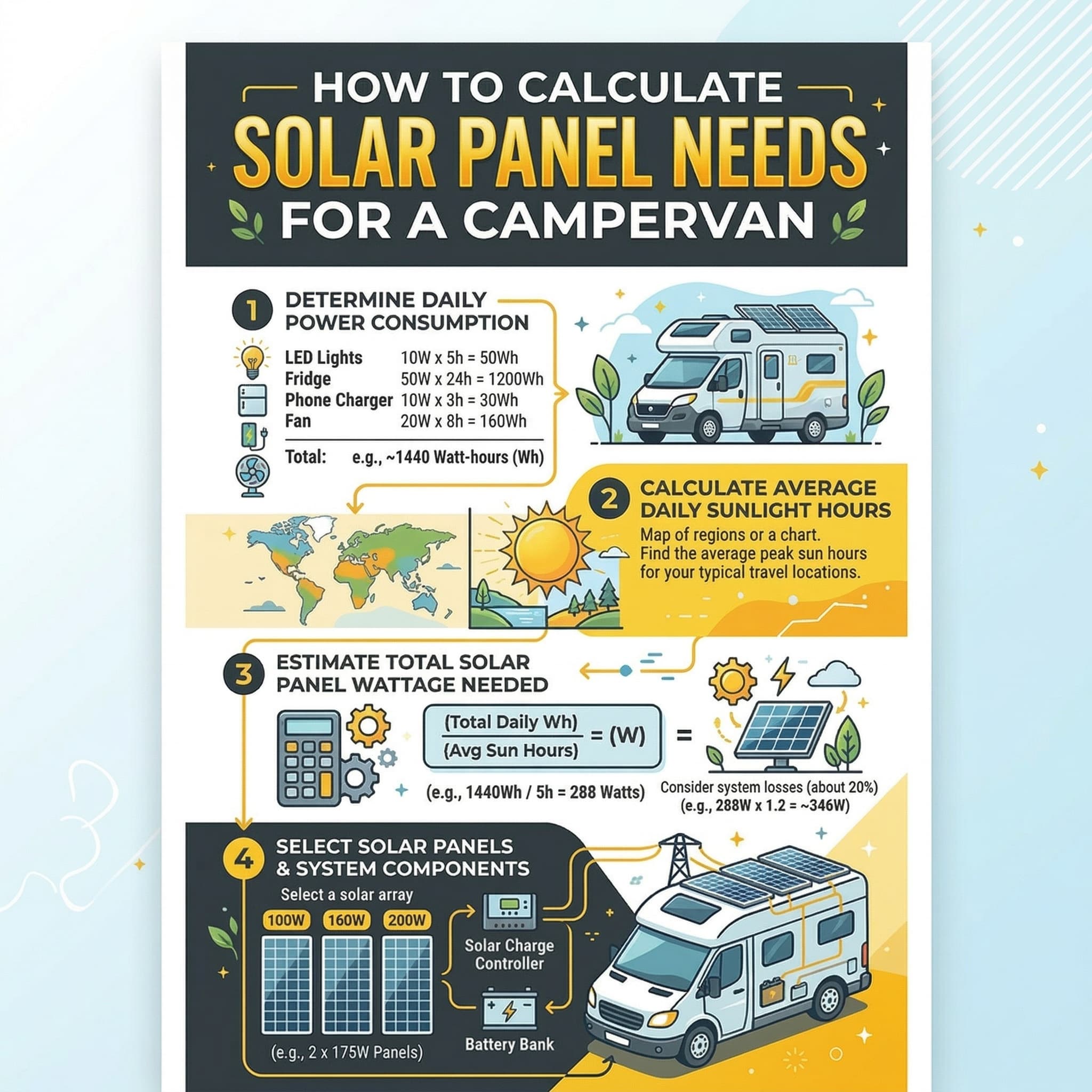
Example calculation for your setup
Results based on a typical use case
| Appliance | Power | Usage/day | Wh/day |
|---|---|---|---|
| Compression fridge | 45W | 24h | 1080 |
| LED lighting | 20W | 4h | 80 |
| Water pump | 30W | 0.5h | 15 |
| Phone charging | 15W | 2h | 30 |
| Daily consumption | 1205 Wh | ||
Recommended solar panels
402 Wc
4h average sun hours
Adjust these values with the calculator below
About this tool
Let's do the full calculation including the battery. A complete solar + storage setup for a van runs $2,000-4,000: panels ($400-600), MPPT controller ($100-200), 200Ah LiFePO4 ($400-800), wiring and fuses ($100-200), inverter ($150-400).
Annual savings for a full-time vanlifer:
- Campground hookups avoided: $600-1,000/year ($3-5 x 200 nights)
- No residential electricity bill: $2,000/year (if alternative = apartment)
- Total savings: $2,600-3,000/year
Payback on the complete setup: 12 to 24 months. After that? Pure profit for 8-10 years (LiFePO4 lifespan). Compare that to a residential 3kW system at $7,000-9,000 that takes 7-10 years to break even. The van hits payback 4-5x faster.
Breaking Down the ROI by Component#
Not every component pays back equally. The solar panels have the best ROI — a $300 pair of 200W panels produces roughly 1,600Wh/day in summer. At $0.20/kWh grid equivalent, that's $0.32/day or $117/year. Payback: about 2.5 years. The battery is the most expensive component but also the enabler — without storage, solar only works in real time. A $600 200Ah LiFePO4 stores 2,560Wh and lasts 3,000+ cycles. Amortized over its 8-10 year lifespan, it costs $0.02-0.03 per kWh stored — cheaper than any grid rate in 2026. The MPPT controller extracts 15-20% more energy than a PWM controller. On a 400W array, that's an extra 240-320Wh per day, worth about $20/year. A $150 MPPT pays for itself in 7-8 years versus PWM — but since you're buying a controller anyway, the $50-80 premium over PWM pays back in under 4 years.
Weekend Warrior vs Full-Timer: Different Math#
Full-time vanlifers see the fastest payback because they use the system daily. But what about weekend warriors who camp 50-80 nights per year? The savings are smaller but still solid. Hookup fees avoided at 60 nights: $180-300/year. Generator fuel saved (if you'd otherwise run a portable generator): $150-250/year. No generator maintenance or replacement: $50-100/year. Total: $380-650/year for a weekend user. A $2,500 system pays back in 4-6 years — still well within the battery's lifespan. Plus, solar adds resale value to the van. I've seen vans with complete electrical systems sell for $3,000-5,000 more than identical vans without. The electrical system essentially pays for itself at resale even if you never save a dime on hookup fees.
When Solar Doesn't Make Financial Sense#
I'll be honest about the edge cases. If you camp exclusively at full-hookup RV parks and never boondock, solar ROI drops significantly — you're paying for hookups regardless. If you're in the Pacific Northwest from October through March, production drops to 400-700Wh/day from a 400W array — barely enough to run a fridge and charge phones. For short-term van ownership (less than 2 years), the financial ROI doesn't close unless you recover the cost at resale. And if your daily consumption is under 300Wh (just a fridge, lights, and phone charging), a simple dual-battery setup with alternator charging ($150-200 total) handles the load without solar. Know your usage patterns before committing $2,000+ to a solar system.

Frequently asked questions
How long until van solar pays for itself?▼
Between 12 and 24 months for a full setup (panels + battery + inverter) if you live in the van full-time. Just panels + controller ($800–1,200) breaks even in 8–12 months. Payback depends mostly on how many nights you go autonomous vs paying for hookups.
How much money does van solar save?▼
On average $3–5 per night in avoided campground hookups. Over 200 nights/year, that's $600–1,000. If you add the savings vs a fixed residence ($2,000/year in electricity), the total hits $2,600–3,000/year.
Is residential solar more profitable than van solar?▼
No, it's the opposite. Van solar has a 1–2 year payback, versus 7–10 years for residential. The van benefits from much lower installation cost and immediate savings. Residential produces more in absolute terms but costs far more.
How much solar production can I expect on a van?▼
With 400W of panels, expect 1,600–1,900Wh/day in summer (southern latitudes) and 500–700Wh/day in winter. Annual average around 1,100–1,300Wh/day. That's enough for standard use: fridge, laptop, lights, device charging.
Do I need a huge battery to maximize solar ROI?▼
Not necessarily. A 200Ah LiFePO4 ($400–800) is the sweet spot. Going to 300–400Ah only improves ROI if you frequently spend 3+ days without sun. Better to invest in quality panels and a good MPPT controller.
Advertising
Independent and free thanks to your clicks
Links marked with * are affiliate links. If a purchase is made through them, I receive a commission at no extra cost to you. The editorial selection and product evaluation are not influenced by commission rates. Your click helps fund this free tool.
Recommended gear
Check price
LiTime 12V 100Ah Bluetooth LiFePO4 (Group 31)Leo's Pick
LiFePO4 12V 100Ah Group 31, Bluetooth monitoring, 100A BMS, low-temp cutoff protection. Up to 15000 deep cycles at 60% DoD. Marine, RV, off-grid use. 222 Amazon reviews. LiTime is a leading mainstream LiFePO4 brand on Amazon US.“This is the battery I've been using in my van for 2 years. Reliable, lightweight, and the best value for money out there.”View on Amazon* →Check price
ECO-WORTHY 200W 12V/24V Solar Kit + 20A Bluetooth MPPTLeo's Pick
Complete 200W solar kit with Bluetooth-monitored MPPT controller. 12V/24V compatible, 20A charge controller with smartphone app. Ideal for vans, RVs, off-grid setups. Single-product solution covering both solar panel and charge controller.“The kit I recommend to every beginner. Plug it in, it works, and the included MPPT controller makes a real difference.”View on Amazon* →$107Amazon
Digital Multimeter
Measures voltage, current, resistance — essential for 12V wiring.“First tool to buy before you even start your install. You'll pull it out 100 times to check voltages and connections.”View on Amazon* →$41Amazon
12V Fuse Box
Protects each circuit independently, easy installation.“One fuse per circuit is the golden rule. This box keeps your install clean and every line independently protected.”View on Amazon* →