Loading...
Fact-checked on Apr 21, 2026
VANPOWERCALC.COMYOUR ENERGY PROFILE
YOUR ENERGY PROFILE.
This document contains the sizing of your future electrical installation, calculated based on your appliances.
Minimum Daily Consumption
0 WH / DAY
Inventory:
SYSTEM SIZINGPage 2
Battery
To guarantee 0WH without damaging your bank (80% max discharge):
0 AH
LiFePO4 12V
Solar
Minimum power required to recharge your consumption:
0 W
via MPPT
220V AC
Maximum power (with 25% safety margin).
0 W
No Need
Safety & CablingPage 3
12V Cable Sizing Guide
Use this professional reference table to select the correct gauge (mm²) for your cables. For 12V in a van, the maximum tolerated voltage drop is 3%. Always use multi-stranded flexible automotive wire.
| Current (A) | Round trip < 2m | Round trip 4m | Round trip 6m |
|---|---|---|---|
| 5A (LEDs, USB) | 1.5 mm² | 2.5 mm² | 4 mm² |
| 10A (Fridge, Pump) | 2.5 mm² | 4 mm² | 6 mm² |
| 20A (Heater) | 4 mm² | 10 mm² | 10 mm² |
| 50A (DC/DC Booster) | 10 mm² | 16 mm² | 25 mm² |
| 100A (Inverter) | 25 mm² | 35 mm² | 50 mm² |
Fuse Sizing
The fuse protects the wire, not the appliance. Always place it as close to the power source as possible (battery or busbar).
- Wire 1.5 mm² → Max fuse 10A
- Wire 2.5 mm² → Max fuse 20A
- Wire 4 mm² → Max fuse 30A
- Wire 6 mm² → Max fuse 40A
- Wire 10 mm² → Max fuse 60A
SCHÉMA ÉLECTRIQUE
PANNEAUX SOLAIRES
0W
RÉGULATEUR MPPT
BATTERIE AUXILIAIRE
0 Ah
Lithium LiFePO4
FUSIBLE
FUSIBLE
BOÎTE À FUSIBLES 12V
Pompe, Leds, Frigo...
CONVERTISSEUR 220V
NON REQUI
PRO GEARPage 4
SHOPPING LIST
Where to find this equipment? Here is the community-approved selection.
12V 6-way Fuse Box
Mandatory protection
Digital Multimeter
Test your connections
Heavy Duty Crimping Tool
For perfect lugs
Heat Shrink Tubing
Insulation and safety
GENERATED BY VANPOWERCALC.COM
A 1200W solar array on a van is serious power — expect around 4,500-5,500Wh per day in summer after the ~15% real-world losses. But 6 panels at 200W each give you a ton of wiring options, and picking wrong means frying your controller or wasting 30% of your harvest. The answer for most setups is a 3S2P configuration feeding a properly sized MPPT controller rated for your string's VOC.
Let's talk numbers. A typical 200W 12V panel has a VOC around 24.3V and an Isc around 11.1A. Wire all 6 in series (6S): 145.8V VOC, 11.1A Isc — needs a high-voltage MPPT, and a single shaded panel kills the whole string. All parallel (6P): 24.3V VOC, 66.6A Isc — massive cable needed and most MPPTs can't handle that current. The sweet spot is 3S2P: 72.9V VOC, 22.2A Isc. This keeps voltage manageable, doubles current capacity versus pure series, and lets you use a standard Victron 150/60 or 150/70 MPPT. For the wire run from panels to controller, at 22A and say 5m distance, you need at least 6mm² cable to keep voltage drop under 3%.
Expert tip
Run two separate MPPT controllers instead of one massive unit. Split your 6 panels into two groups of 3S. Each controller handles 3 panels, and if one fails or gets shaded, the other keeps charging. Total cost is similar, reliability is way higher.
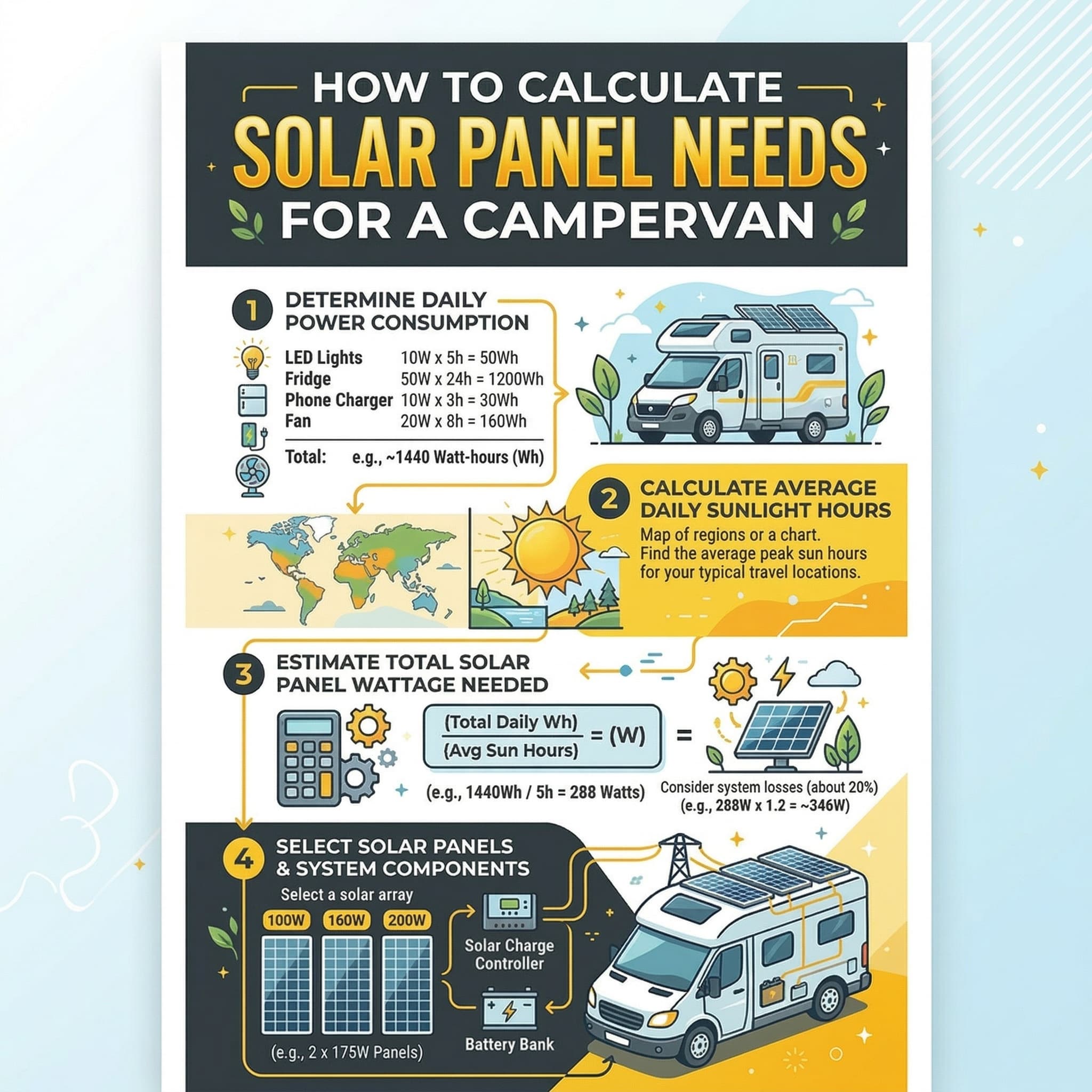
Example calculation for your setup
Results based on a typical use case
| Appliance | Power | Usage/day | Wh/day |
|---|---|---|---|
| Compression fridge | 45W | 24h | 1080 |
| LED lighting | 20W | 4h | 80 |
| Water pump | 30W | 0.5h | 15 |
| Phone charging | 15W | 2h | 30 |
| Daily consumption | 1205 Wh | ||
Recommended solar panels
402 Wc
4h average sun hours
Adjust these values with the calculator below
About this tool
I've wired three different van solar setups now, and the 1200W range is where things get interesting because you actually have to think about your wiring topology.
First rule: never wire all 6 in pure series unless your MPPT is rated for 150V+ input AND you're confident about shade management. One shaded panel in a series string drags the entire string down to its weakest output. With 6 panels on a van roof, partial shade from trees, bridges, or roof vents is basically guaranteed.
Pure parallel sounds safe but creates a nightmare. At 66.6A Isc, you'd need 16mm² cable minimum for a short run, and good luck finding an affordable MPPT that handles 70A+ input current at 24V.
3S2P is what I'd run: three panels in series per string (72.9V VOC per string), then two strings in parallel (22.2A combined Isc). Your MPPT sees a comfortable voltage that it steps down to 14.6V for LiFePO4 charging, and current stays reasonable.
Alternative: 2S3P gives you 48.6V VOC at 33.3A. Also works, but needs thicker cable and a controller rated for higher current. The Victron 100/50 would handle the voltage but might clip on current on a perfect day.
For the MPPT controller, size it for the output side too. A 1200W array charging a 12V battery bank: 1200W / 14.6V = 82A output current. You need at least a 150/85 MPPT, or realistically two 150/45 controllers splitting the array into two 3S strings. Running two controllers is actually my preferred approach — redundancy, better shade handling, and easier wiring.
Don't forget the fusing. Each parallel string needs its own fuse (15A for panels with 11.1A Isc). Without string fuses, a fault in one string can backfeed through the other and start a fire. I use inline MC4 fuse holders — cheap and effective.

Frequently asked questions
What MPPT controller do I need for 6x200W solar panels?▼
For a 3S2P configuration (72.9V VOC, 22.2A), a Victron SmartSolar 150/70 handles it with headroom. But on the output side at 12V, you're looking at 82A max charge current. A single 150/85 works, or better yet, split into two 150/45 controllers with 3 panels each.
Should I wire 6 solar panels in series or parallel?▼
Neither. Use series-parallel. Pure series (6S) creates dangerously high voltage and shade vulnerability. Pure parallel (6P) creates unmanageable current at 66A+. The 3S2P config (three in series, two strings in parallel) gives you 72.9V at 22.2A — the practical sweet spot.
What wire gauge do I need for a 1200W solar array?▼
Depends on your configuration. For 3S2P at 22A with a 5-meter run, 6mm² cable keeps voltage drop under 3%. For 2S3P at 33A, step up to 10mm². Always calculate based on your actual run length using: section (mm²) = (2 x length x current) / (57 x max voltage drop).
How much power will 6x200W panels actually produce per day?▼
In summer with good sun, expect 4,500-5,500Wh per day — not 7,200Wh (6x200Wx6h). Real-world losses eat about 15%: MPPT conversion, wiring resistance, heat, non-optimal angle on a flat van roof. In winter, halve those numbers.
Do I need fuses between parallel solar panel strings?▼
Absolutely yes. Without string fuses, a short circuit in one string can cause reverse current from the other strings, potentially melting wires or starting a fire. Use a 15A fuse per string (rated just above your panels' Isc of 11.1A). Inline MC4 fuse holders work great and cost under $10 each.
Advertising
Independent and free thanks to your clicks
Links marked with * are affiliate links. If a purchase is made through them, I receive a commission at no extra cost to you. The editorial selection and product evaluation are not influenced by commission rates. Your click helps fund this free tool.
Recommended gear
Check price
ECO-WORTHY 200W 12V/24V Solar Kit + 20A Bluetooth MPPTLeo's Pick
Complete 200W solar kit with Bluetooth-monitored MPPT controller. 12V/24V compatible, 20A charge controller with smartphone app. Ideal for vans, RVs, off-grid setups. Single-product solution covering both solar panel and charge controller.“The kit I recommend to every beginner. Plug it in, it works, and the included MPPT controller makes a real difference.”View on Amazon* →$107Amazon
Digital Multimeter
Measures voltage, current, resistance — essential for 12V wiring.“First tool to buy before you even start your install. You'll pull it out 100 times to check voltages and connections.”View on Amazon* →$25Amazon
Electrical Crimping Tool
Reliable crimp connections on 0.5mm²–16mm² cables, no soldering.“Forget soldering in a van — crimping is more reliable and vibration-proof. This one covers all the gauges you'll need.”View on Amazon* →$41Amazon
12V Fuse Box
Protects each circuit independently, easy installation.“One fuse per circuit is the golden rule. This box keeps your install clean and every line independently protected.”View on Amazon* →