Loading...
Fact-checked on Apr 7, 2026
VANPOWERCALC.COMYOUR ENERGY PROFILE
YOUR ENERGY PROFILE.
This document contains the sizing of your future electrical installation, calculated based on your appliances.
Minimum Daily Consumption
0 WH / DAY
Inventory:
SYSTEM SIZINGPage 2
Battery
To guarantee 0WH without damaging your bank (80% max discharge):
0 AH
LiFePO4 12V
Solar
Minimum power required to recharge your consumption:
0 W
via MPPT
220V AC
Maximum power (with 25% safety margin).
0 W
No Need
Safety & CablingPage 3
12V Cable Sizing Guide
Use this professional reference table to select the correct gauge (mm²) for your cables. For 12V in a van, the maximum tolerated voltage drop is 3%. Always use multi-stranded flexible automotive wire.
| Current (A) | Round trip < 2m | Round trip 4m | Round trip 6m |
|---|---|---|---|
| 5A (LEDs, USB) | 1.5 mm² | 2.5 mm² | 4 mm² |
| 10A (Fridge, Pump) | 2.5 mm² | 4 mm² | 6 mm² |
| 20A (Heater) | 4 mm² | 10 mm² | 10 mm² |
| 50A (DC/DC Booster) | 10 mm² | 16 mm² | 25 mm² |
| 100A (Inverter) | 25 mm² | 35 mm² | 50 mm² |
Fuse Sizing
The fuse protects the wire, not the appliance. Always place it as close to the power source as possible (battery or busbar).
- Wire 1.5 mm² → Max fuse 10A
- Wire 2.5 mm² → Max fuse 20A
- Wire 4 mm² → Max fuse 30A
- Wire 6 mm² → Max fuse 40A
- Wire 10 mm² → Max fuse 60A
SCHÉMA ÉLECTRIQUE
PANNEAUX SOLAIRES
0W
RÉGULATEUR MPPT
BATTERIE AUXILIAIRE
0 Ah
Lithium LiFePO4
FUSIBLE
FUSIBLE
BOÎTE À FUSIBLES 12V
Pompe, Leds, Frigo...
CONVERTISSEUR 220V
NON REQUI
PRO GEARPage 4
SHOPPING LIST
Where to find this equipment? Here is the community-approved selection.
12V 6-way Fuse Box
Mandatory protection
Digital Multimeter
Test your connections
Heavy Duty Crimping Tool
For perfect lugs
Heat Shrink Tubing
Insulation and safety
GENERATED BY VANPOWERCALC.COM
Series vs Parallel: The 30-Second Answer#
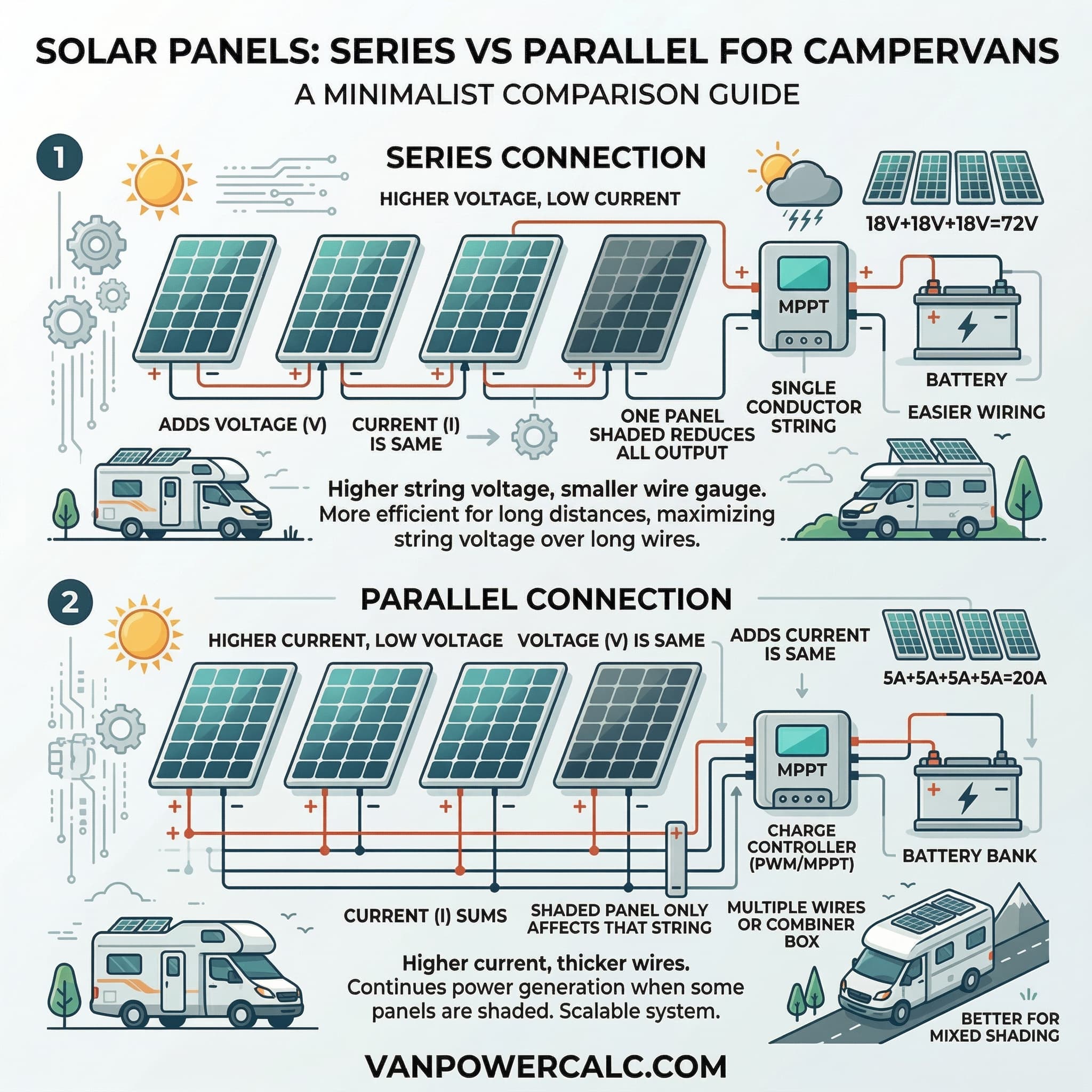
Series wiring adds voltages together while keeping current the same. Parallel wiring adds currents together while keeping voltage the same. For most van builds with a 12V battery bank and an MPPT controller, series is better — higher voltage means lower current in your roof cables, which means you can run thinner, cheaper wire and lose less energy to heat. Two 200W panels in series give you 40V at 10A. The same two panels in parallel give you 20V at 20A. Same power, but the parallel setup needs twice the cable cross-section to carry the same wattage with acceptable losses.
That said, series isn't always the right call. If one panel gets partial shade — say, a roof vent blocks the corner — series wiring tanks the output of the entire string. Parallel keeps the shaded panel's losses isolated. Most real-world van roofs have some shade risk, so a series-parallel hybrid often wins.
Reading Your Panel's Datasheet: Vmp, Imp, Voc, Isc#
Every solar panel has four key specs stamped on the back label: Vmp (voltage at max power, typically 18–20V for a 100W panel or 36–40V for a 200W panel), Imp (current at max power, typically 5–6A for 100W or 9–11A for 200W), Voc (open-circuit voltage, ~20–25% higher than Vmp — this is what your MPPT sees on a cold morning before it starts charging), and Isc (short-circuit current, ~5–10% above Imp, used for fuse sizing). A standard Renogy 200W mono panel, for example, shows Vmp 20.2V, Imp 9.9A, Voc 24.3V, Isc 10.4A. Wire two of those in series and you get Vmp 40.4V at 9.9A — your MPPT input is 40V, which fits easily in a Victron SmartSolar 75/15 or 100/30.
Expert tip
Cold mornings are your Voc worst case — panels produce their highest open-circuit voltage at 0°C, roughly 10% above the rated Voc. I always add 10% to the total series Voc before sizing an MPPT controller. Three 200W panels at 24.3V Voc each = 72.9V × 1.10 = 80.2V. A 75V-rated MPPT would blow its input MOSFETs on the first frosty morning.
Example calculation for your setup
Results based on a typical use case
| Appliance | Power | Usage/day | Wh/day |
|---|---|---|---|
| Compression fridge | 45W | 24h | 1080 |
| LED lighting | 20W | 4h | 80 |
| Water pump | 30W | 0.5h | 15 |
| Phone charging | 15W | 2h | 30 |
| Daily consumption | 1205 Wh | ||
Recommended solar panels
402 Wc
4h average sun hours
Adjust these values with the calculator below
Comparison table
| Configuration | Example | Vmp | Imp | Voc (cold) | MPPT needed | Cable size |
|---|---|---|---|---|---|---|
| Series | 2× 200W in series | 40.4V | 9.9A | 53.5V | 75V / 20A | 4mm² |
| Series | 3× 200W in series | 60.6V | 9.9A | 80.2V | 100V / 30A | 4mm² |
| Parallel | 2× 200W in parallel | 20.2V | 19.8A | 26.7V | 75V / 30A | 6mm² |
| Parallel | 3× 200W in parallel | 20.2V | 29.7A | 26.7V | 75V / 45A | 10mm² |
| Series-Parallel (2S2P) | 4× 100W (2S2P) | 36V | 11.2A | 48.4V | 75V / 20A | 4mm² |
| Series-Parallel (2S3P) | 6× 100W (2S3P) | 36V | 16.8A | 48.4V | 75V / 30A | 4mm² |
About this tool
Here's what actually matters when you're standing on a stepladder with MC4 connectors in your hand.
Section 1 — Series wiring: double the voltage, keep the current
In series, you connect the positive of panel 1 to the negative of panel 2 (and so on). Voltages add up; current stays the same as a single panel. Two Renogy 200W panels (Vmp 20.2V, Imp 9.9A) wired in series: Vmp = 40.4V, Imp = 9.9A, Voc = 48.6V. Peak power = 400W. Your roof cable only carries 9.9A, so 4mm² solar cable is fine even on a 5m run (voltage drop: 2 × 5m × 9.9A ÷ (57 × 0.6V) = 2.9mm² → 4mm² covers it). This is why I almost always wire in series first — it's just cheaper cable.
Section 2 — Parallel wiring: double the current, keep the voltage
In parallel, positive connects to positive, negative to negative. Current adds up; voltage stays at one panel's Vmp. Same two 200W panels in parallel: Vmp = 20.2V, Imp = 19.8A, Voc = 24.3V. Now your cable carries 20A — you need 6mm² at minimum for a 5m run, and ideally a combiner box with individual 15A inline fuses on each panel. The big advantage: partial shade only hits the shaded panel. The other one keeps producing at full output. If your roof has a Maxxair fan, a Starlink mount, or overhanging tree shadow issues, parallel's isolation property is genuinely valuable.
Section 3 — Series-parallel (the hybrid)
Four 100W panels (Vmp 18V, Imp 5.6A each) wired 2S2P — two pairs in series, then the two pairs in parallel: Vmp = 36V, Imp = 11.2A, Voc = 44V. This gives you 400W total with moderate voltage (safe for most MPPT controllers), moderate current (manageable cable size), and partial shade tolerance — if one panel is shaded, only half the array is affected instead of all or nothing. This is my recommended config for a 4-panel setup on a Sprinter L3 roof.
Section 4 — MPPT controller compatibility
Your MPPT controller has two limits: maximum input voltage (Voc limit, typically 75V, 100V, or 150V) and maximum charge current (output side, in amps). For a 12V battery system: three 200W panels in series give Voc = 3 × 24.3V = 72.9V — right at the limit of a 75V MPPT on a cold morning (panels produce higher voltage when cold, up to ~10% over rated Voc). Go to a Victron 100/30 instead — its 100V input handles 72.9V × 1.1 cold factor = 80.2V with headroom. The SmartSolar 150/35 or 150/45 opens up three 200W panels in series on 12V or 24V systems comfortably.
Section 5 — Real-world configs and what I'd actually do
2× 200W on a SWB van (e.g. Transit 130): wire in series → 40V, 10A, 4mm² cable, Victron SmartSolar 100/20. Done. 3× 200W on a LWB: series → 60.6V Vmp, Voc 72.9V → use 100/30 MPPT. Still 10A to the battery at 30A output rating. 4× 100W mismatched angles (2 on flat, 2 on tilt rack): 2S2P → 36V Vmp, 11.2A, 4mm² cable, Victron 75/15. If you have shading on the flat panels and sun on the tilted ones, you keep half your array productive. The worst config I see on forums: mixing different panel wattages in series. A 100W and a 200W in series pulls the whole string down to the weaker panel's current — you end up with a 200W array performing like 180W. Buy identical panels, or use separate MPPT inputs.

Frequently asked questions
Should I wire my van solar panels in series or parallel?▼
Series is better for most van builds. It keeps cable current low — two 200W panels in series run at 10A, while parallel doubles that to 20A, forcing you to upsize your roof cable from 4mm² to 6mm². The only reason to choose parallel is if you have consistent partial shading on one panel. If shading is a risk, use a series-parallel configuration or add bypass diodes.
What happens if I mix different wattage panels in series?▼
The whole string runs at the weakest panel's current. A 100W panel (5.6A Imp) wired in series with a 200W panel (9.9A Imp) forces the entire string to 5.6A — you lose nearly half your 200W panel's output. Never mix wattages in the same series string. If you have mismatched panels, wire them to separate MPPT inputs, or use individual MPPT optimizers.
How do I calculate the right MPPT controller for my series array?▼
Take your panels' Voc, multiply by the number in series, then multiply by 1.10 for cold-weather margin. That's the minimum MPPT input voltage rating you need. For current: total panel watts ÷ battery voltage = max charge current. Three 200W panels on a 12V bank = 600W ÷ 12V = 50A max — so a Victron SmartSolar 150/45 or a Renogy Rover 60A fits. The 150V rating handles 3 × 24.3V × 1.1 = 80.2V Voc.
Can I add a third panel to an existing 2-panel series setup?▼
Yes, if your MPPT controller's input voltage rating has headroom. Two 200W panels in series give Voc = 48.6V. Adding a third: 72.9V × 1.10 cold = 80.2V. A Victron 75V controller won't survive that. Upgrade to a 100V or 150V model first. The charge current side also changes: 600W ÷ 12V = 50A — check your controller's output amp rating too.
What size cable do I need for solar panels in series vs parallel?▼
Series wiring keeps current equal to one panel's Imp, so 4mm² cable handles most setups up to 6m. Parallel wiring doubles (or triples) the current, so 6mm² is the minimum for two panels in parallel on runs over 3m. Always calculate: Section (mm²) = 2 × length(m) × current(A) ÷ (57 × max_voltage_drop). For solar, use Vmp as the voltage basis — a 3% drop on 20V Vmp = 0.6V — not the 12V battery voltage.
Advertising
Independent and free thanks to your clicks
Links marked with * are affiliate links. If a purchase is made through them, I receive a commission at no extra cost to you. The editorial selection and product evaluation are not influenced by commission rates. Your click helps fund this free tool.
Recommended gear
Check price
ECO-WORTHY 200W 12V/24V Solar Kit + 20A Bluetooth MPPTLeo's Pick
Complete 200W solar kit with Bluetooth-monitored MPPT controller. 12V/24V compatible, 20A charge controller with smartphone app. Ideal for vans, RVs, off-grid setups. Single-product solution covering both solar panel and charge controller.“The kit I recommend to every beginner. Plug it in, it works, and the included MPPT controller makes a real difference.”View on Amazon* →$115Amazon
Victron MPPT Controller 100/30
Extracts 97% solar power, Li & AGM compatible.“The Victron is pricey, but you install it once and forget about it. The Bluetooth app is a real plus for tracking solar output.”View on Amazon* →$38Amazon
Solar Cable 6mm² MC4 10m
6mm² solar cable with pre-crimped MC4 connectors, 10m.“Don't cheap out on solar cables. 6mm² between panels and controller is the minimum to avoid power losses.”View on Amazon* →$107Amazon
Digital Multimeter
Measures voltage, current, resistance — essential for 12V wiring.“First tool to buy before you even start your install. You'll pull it out 100 times to check voltages and connections.”View on Amazon* →