Loading...
Fact-checked on Apr 21, 2026
VANPOWERCALC.COMYOUR ENERGY PROFILE
YOUR ENERGY PROFILE.
This document contains the sizing of your future electrical installation, calculated based on your appliances.
Minimum Daily Consumption
0 WH / DAY
Inventory:
SYSTEM SIZINGPage 2
Battery
To guarantee 0WH without damaging your bank (80% max discharge):
0 AH
LiFePO4 12V
Solar
Minimum power required to recharge your consumption:
0 W
via MPPT
220V AC
Maximum power (with 25% safety margin).
0 W
No Need
Safety & CablingPage 3
12V Cable Sizing Guide
Use this professional reference table to select the correct gauge (mm²) for your cables. For 12V in a van, the maximum tolerated voltage drop is 3%. Always use multi-stranded flexible automotive wire.
| Current (A) | Round trip < 2m | Round trip 4m | Round trip 6m |
|---|---|---|---|
| 5A (LEDs, USB) | 1.5 mm² | 2.5 mm² | 4 mm² |
| 10A (Fridge, Pump) | 2.5 mm² | 4 mm² | 6 mm² |
| 20A (Heater) | 4 mm² | 10 mm² | 10 mm² |
| 50A (DC/DC Booster) | 10 mm² | 16 mm² | 25 mm² |
| 100A (Inverter) | 25 mm² | 35 mm² | 50 mm² |
Fuse Sizing
The fuse protects the wire, not the appliance. Always place it as close to the power source as possible (battery or busbar).
- Wire 1.5 mm² → Max fuse 10A
- Wire 2.5 mm² → Max fuse 20A
- Wire 4 mm² → Max fuse 30A
- Wire 6 mm² → Max fuse 40A
- Wire 10 mm² → Max fuse 60A
SCHÉMA ÉLECTRIQUE
PANNEAUX SOLAIRES
0W
RÉGULATEUR MPPT
BATTERIE AUXILIAIRE
0 Ah
Lithium LiFePO4
FUSIBLE
FUSIBLE
BOÎTE À FUSIBLES 12V
Pompe, Leds, Frigo...
CONVERTISSEUR 220V
NON REQUI
PRO GEARPage 4
SHOPPING LIST
Where to find this equipment? Here is the community-approved selection.
12V 6-way Fuse Box
Mandatory protection
Digital Multimeter
Test your connections
Heavy Duty Crimping Tool
For perfect lugs
Heat Shrink Tubing
Insulation and safety
GENERATED BY VANPOWERCALC.COM
If you're charging into the high 80s every day with your Jackery 5000 Plus maxed on panels, you're not doing anything wrong — you're hitting the open-circuit voltage (VOC) ceiling. The 5000 Plus has a solar input limit of 150V VOC. Once your panels in series approach that number, the MPPT controller throttles intake to protect itself. With 4 battery packs, you've got roughly 20kWh to fill, and your panels physically can't push enough current at that clipped voltage to top it off before the sun dips.
Here's what's actually happening electrically. Each solar panel has a VOC rating — typically 22-24V for a 12V panel and 45-49V for a 24V panel. Wire 4 panels in series at 24V each and you're already at ~180V VOC, which blows past the 150V limit. The Jackery's MPPT will either refuse the input or hard-clip it. Meanwhile, wiring in parallel keeps voltage low but stacks current. The 5000 Plus accepts up to 12A per solar input port. So parallel wiring gives you headroom on voltage but you hit the current cap instead. The sweet spot is a series-parallel hybrid: 2S2P or 3S2P configurations that balance voltage under 150V while maximizing current across both input ports.
Expert tip
Wire your panels in 2S3P or 3S2P and split across both Jackery input ports. But honestly? Staying at 85-90% SOC daily will give your LiFePO4 cells way more than the rated 3000 cycles. Full charges stress them unnecessarily.
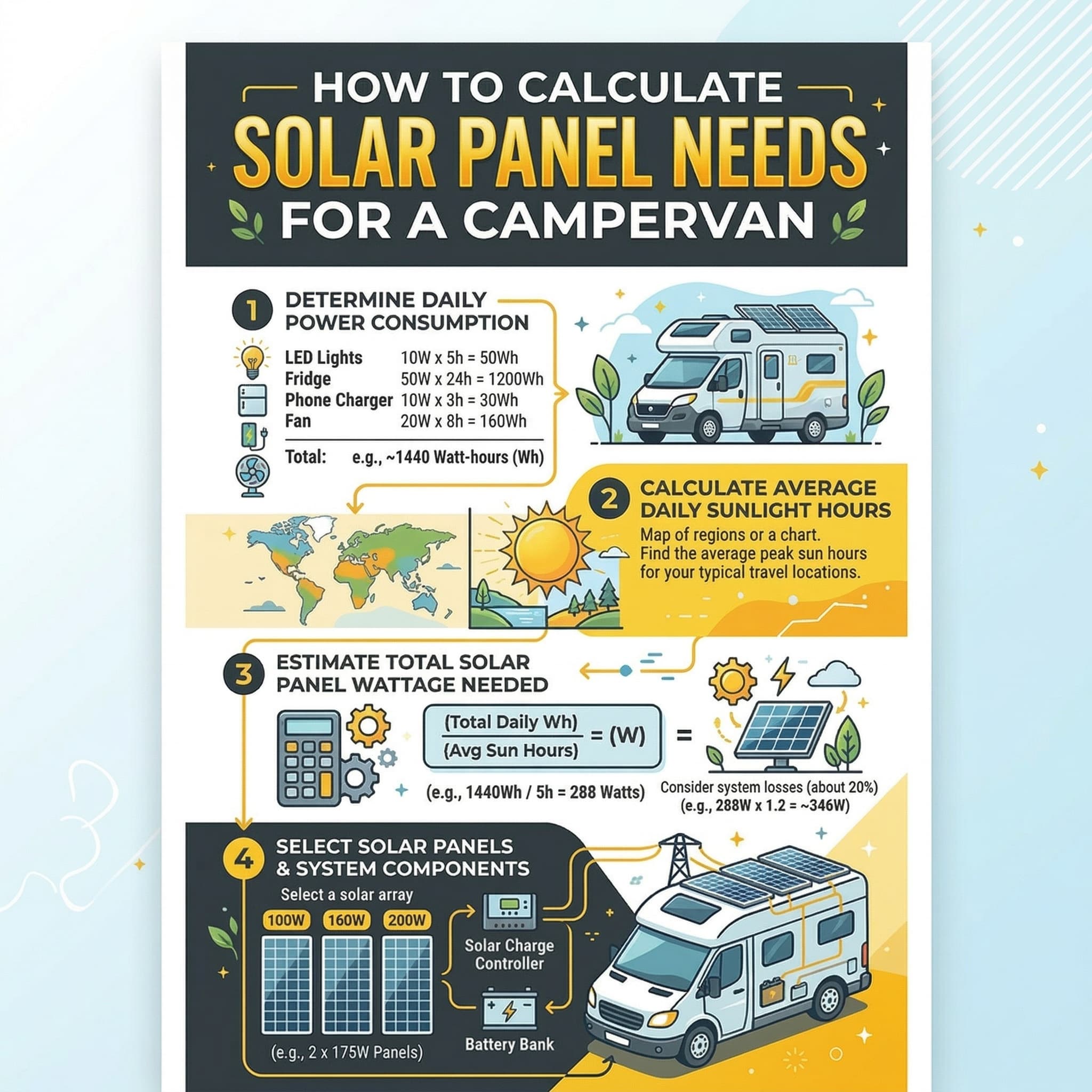
Example calculation for your setup
Results based on a typical use case
| Appliance | Power | Usage/day | Wh/day |
|---|---|---|---|
| Compression fridge | 45W | 24h | 1080 |
| LED lighting | 20W | 4h | 80 |
| Water pump | 30W | 0.5h | 15 |
| Phone charging | 15W | 2h | 30 |
| Daily consumption | 1205 Wh | ||
Recommended solar panels
402 Wc
4h average sun hours
Adjust these values with the calculator below
About this tool
I've seen this question pop up constantly from Jackery 5000 Plus owners running the 4-battery expansion, and the frustration is real. You've spent serious money on panels and batteries, and the thing parks at 87% every evening.
The root issue is that portable power stations aren't designed like custom van systems. With a DIY setup, I'd pick an MPPT controller rated for my exact panel string voltage and optimize accordingly. The Jackery locks you into its fixed 150V / 12A input specs per port.
So here's what actually works. First, check your panel VOC ratings on the back label — not the wattage, the VOC. Add up every panel wired in series. If that number is anywhere near 150V, you need to rewire into a series-parallel configuration. For example, if you have 6 panels at 24V VOC each, don't run 6S (144V — dangerously close). Run 3S2P instead: two parallel strings of 3 panels each gives you ~72V VOC and double the current.
Second, use both solar input ports. The 5000 Plus has two, each rated at 1200W. Split your array across both ports to maximize total intake.
Third — and this is the part nobody talks about — charging the last 10-15% is always slow. LiFePO4 cells (which the Jackery uses internally) switch from constant-current to constant-voltage charging around 90% SOC. The charge rate drops dramatically regardless of how much solar you throw at it. That's not a panel problem, that's battery chemistry.
If you truly need 100% every day, consider charging from shore power or your vehicle's alternator for that last stretch. Or honestly, just live with 85-90%. I run my van system between 20% and 90% SOC on purpose — it extends cycle life significantly.

Frequently asked questions
What is the maximum solar input voltage for the Jackery 5000 Plus?▼
The Jackery 5000 Plus accepts up to 150V VOC per solar input port, with a maximum of 12A per port. If your series string exceeds 150V, the unit will throttle or reject the input entirely.
Why does my Jackery 5000 Plus stop charging at 85-90%?▼
Two things are happening. First, if your panels are near the VOC limit, the MPPT is clipping power intake. Second, LiFePO4 batteries naturally slow down charging above 90% SOC — they switch from constant-current to constant-voltage mode, which dramatically reduces charge speed. Even with unlimited solar, that last 10% takes disproportionately long.
Should I wire my solar panels in series or parallel for the Jackery 5000 Plus?▼
Neither exclusively. Use a series-parallel hybrid. Pure series risks exceeding the 150V VOC limit. Pure parallel keeps voltage low but you'll hit the 12A current cap quickly. A 2S2P or 3S2P configuration balances both limits and maximizes real power delivery.
Can I add more solar panels to my Jackery 5000 Plus?▼
You can add panels up to 2400W total (1200W per port), but voltage and current limits per port are the real bottleneck. Adding panels in parallel to an existing string adds current without raising voltage. Just make sure each port stays under 150V VOC and 12A.
Is it bad to keep my Jackery 5000 Plus at 85% instead of 100%?▼
It's actually better. LiFePO4 cells last longest when cycled between 20-90% SOC. Constantly pushing to 100% adds stress. I intentionally keep my own system at 90% max — the extra 10% capacity isn't worth the cycle life trade-off.
Advertising
Independent and free thanks to your clicks
Links marked with * are affiliate links. If a purchase is made through them, I receive a commission at no extra cost to you. The editorial selection and product evaluation are not influenced by commission rates. Your click helps fund this free tool.
Recommended gear
Check price
ECO-WORTHY 200W 12V/24V Solar Kit + 20A Bluetooth MPPTLeo's Pick
Complete 200W solar kit with Bluetooth-monitored MPPT controller. 12V/24V compatible, 20A charge controller with smartphone app. Ideal for vans, RVs, off-grid setups. Single-product solution covering both solar panel and charge controller.“The kit I recommend to every beginner. Plug it in, it works, and the included MPPT controller makes a real difference.”View on Amazon* →$107Amazon
Digital Multimeter
Measures voltage, current, resistance — essential for 12V wiring.“First tool to buy before you even start your install. You'll pull it out 100 times to check voltages and connections.”View on Amazon* →