Loading...
Fact-checked on Apr 7, 2026
VANPOWERCALC.COMYOUR ENERGY PROFILE
YOUR ENERGY PROFILE.
This document contains the sizing of your future electrical installation, calculated based on your appliances.
Minimum Daily Consumption
0 WH / DAY
Inventory:
SYSTEM SIZINGPage 2
Battery
To guarantee 0WH without damaging your bank (80% max discharge):
0 AH
LiFePO4 12V
Solar
Minimum power required to recharge your consumption:
0 W
via MPPT
220V AC
Maximum power (with 25% safety margin).
0 W
No Need
Safety & CablingPage 3
12V Cable Sizing Guide
Use this professional reference table to select the correct gauge (mm²) for your cables. For 12V in a van, the maximum tolerated voltage drop is 3%. Always use multi-stranded flexible automotive wire.
| Current (A) | Round trip < 2m | Round trip 4m | Round trip 6m |
|---|---|---|---|
| 5A (LEDs, USB) | 1.5 mm² | 2.5 mm² | 4 mm² |
| 10A (Fridge, Pump) | 2.5 mm² | 4 mm² | 6 mm² |
| 20A (Heater) | 4 mm² | 10 mm² | 10 mm² |
| 50A (DC/DC Booster) | 10 mm² | 16 mm² | 25 mm² |
| 100A (Inverter) | 25 mm² | 35 mm² | 50 mm² |
Fuse Sizing
The fuse protects the wire, not the appliance. Always place it as close to the power source as possible (battery or busbar).
- Wire 1.5 mm² → Max fuse 10A
- Wire 2.5 mm² → Max fuse 20A
- Wire 4 mm² → Max fuse 30A
- Wire 6 mm² → Max fuse 40A
- Wire 10 mm² → Max fuse 60A
SCHÉMA ÉLECTRIQUE
PANNEAUX SOLAIRES
0W
RÉGULATEUR MPPT
BATTERIE AUXILIAIRE
0 Ah
Lithium LiFePO4
FUSIBLE
FUSIBLE
BOÎTE À FUSIBLES 12V
Pompe, Leds, Frigo...
CONVERTISSEUR 220V
NON REQUI
PRO GEARPage 4
SHOPPING LIST
Where to find this equipment? Here is the community-approved selection.
12V 6-way Fuse Box
Mandatory protection
Digital Multimeter
Test your connections
Heavy Duty Crimping Tool
For perfect lugs
Heat Shrink Tubing
Insulation and safety
GENERATED BY VANPOWERCALC.COM
The Jackery Explorer 1000v2 has 1070Wh. A 50L compressor fridge draws roughly 500Wh per day — so you get about two days before you're hunting for a socket. That's the honest starting point. Jackery works brilliantly for weekend trips and as a first step into van life, but treating it as a full-time 12V system replacement has real limits that I've hit personally.
The Explorer 1000v2 delivers 1070Wh usable (Jackery rates them at 80% DoD in practice). The Explorer 1500 steps up to 1534Wh, and the 2000 Plus hits 2042Wh. Solar recharge via the built-in MPPT tops out at 400W for the 1000v2 and 800W for the 2000 Plus — which means on a decent summer day with 200W of panels, you're adding ~800Wh back in 5-6 hours. That's enough to run the fridge indefinitely in good sun, but a cloudy week in November will drain you to zero in 2-3 days.
Expert tip
The Jackery's built-in MPPT controller is competent but conservative — it won't push panels as hard as a Victron SmartSolar in partial shade or low-angle winter sun. I measured 15-20% less harvest on the same 200W panel connected to a Jackery vs a Victron MPPT 75/15 under identical conditions. If solar is your primary charge source, a dedicated MPPT controller with a LiFePO4 bank will outperform any portable station on the days that matter most: cloudy winter afternoons.
Example calculation for your setup
Results based on a typical use case
| Appliance | Power | Usage/day | Wh/day |
|---|---|---|---|
| Compression fridge | 45W | 24h | 1080 |
| LED lighting | 20W | 4h | 80 |
| Water pump | 30W | 0.5h | 15 |
| Phone charging | 15W | 2h | 30 |
| Daily consumption | 1205 Wh | ||
Recommended LiFePO4 battery
151 Ah
(80% depth of discharge)
Recommended AGM battery
241 Ah
(50% depth of discharge)
Adjust these values with the calculator below
Comparison table
| Model | Capacity | Max Output | Max Solar In | Weight | Price (2026) |
|---|---|---|---|---|---|
| Explorer 1000v2 | 1,070Wh | 1,000W | 400W | 9.1kg | ~$799 |
| Explorer 1500 | 1,534Wh | 1,800W | 500W | 15.4kg | ~$1,099 |
| Explorer 2000 Plus | 2,042Wh | 2,200W | 800W | 28.1kg | ~$1,599 |
About this tool
The Real Autonomy Numbers#
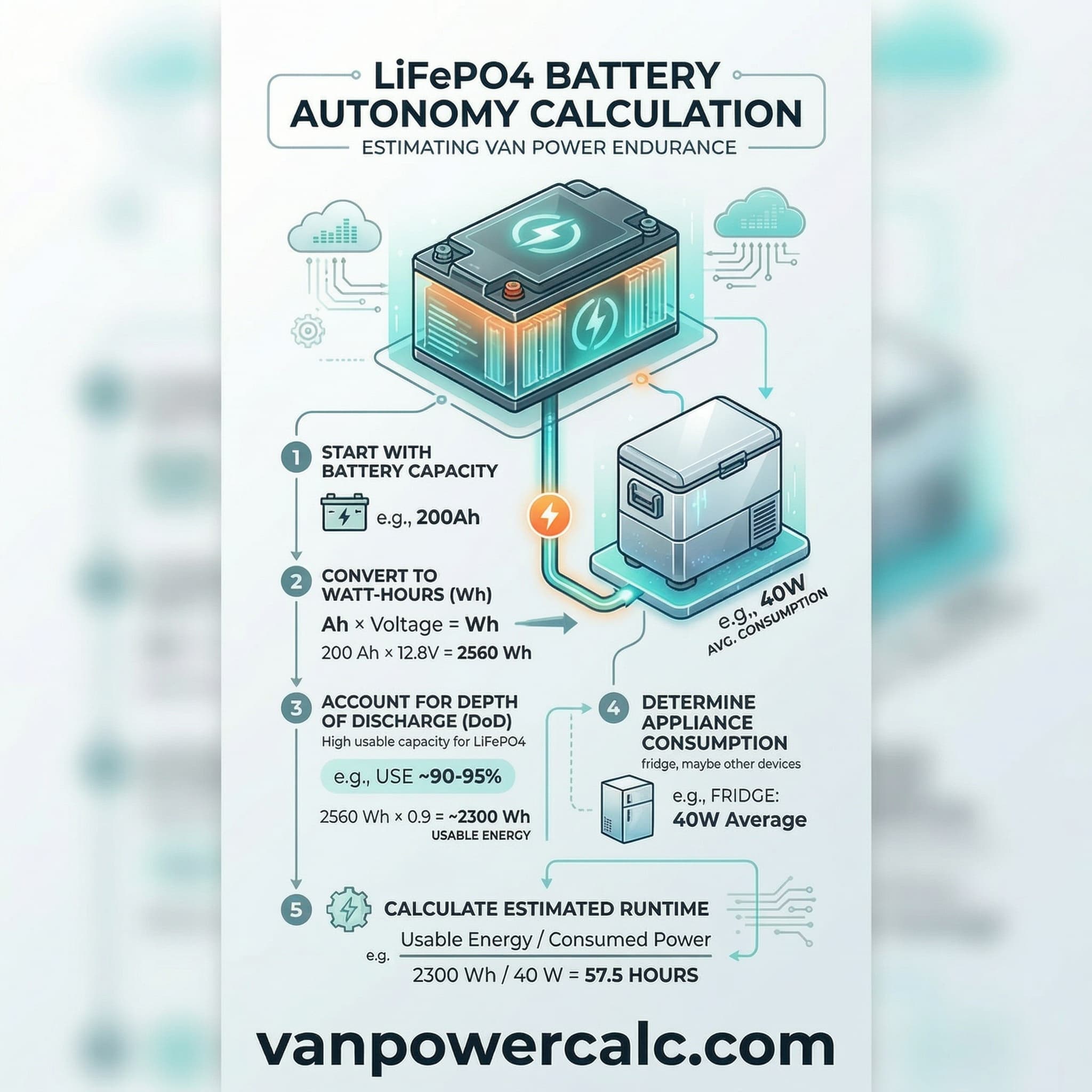
Let me show the math rather than just give you a headline figure. A typical 50L compressor fridge (think BougeRV or Alpicool) draws around 40Ah/day at 12V — that's 40 × 12 = 480Wh/day, call it 500Wh with cable losses. Add LED lights at 20W for 5 hours (100Wh), two phone charges (30Wh), and a laptop for 3 hours at 65W (195Wh), and you're looking at roughly 825Wh/day for a light-use setup.
Against the Explorer 1000v2 (1070Wh): that's about 1.3 days. Fridge only? 2.1 days. The Explorer 1500 gets you to 1.9 days with full light use, 3.1 days fridge-only. The 2000 Plus hits 2.5 days full use, 4.1 days fridge-only.
Those numbers assume you start full and use nothing for charging. In real life you'll have some solar — a 200W panel adding 800Wh on a good day essentially covers your full daily load on the 2000 Plus. That's genuinely usable for summer van life.
Charging Options and Their Limits#
Four ways to top up a Jackery in a van: shore power (fastest, 1-3 hours to full), solar panels (400-800W input depending on model), the car's 12V socket (slow — 12V at ~120W means 9+ hours for the 1000v2), and the dedicated car charger cable that uses the 12V cigarette port at up to 120W. The car charger is the slow link — it takes most of a driving day to make a meaningful dent.
The SolarSaga 200W panel pairs neatly with the Jackery ecosystem. Two of them give you 400W input — maxing out the 1000v2's solar limit, recovering about 1,600Wh on a 5-6 hour summer day. On the 2000 Plus with its 800W input limit, you can hook up four panels and be genuinely self-sufficient in summer.
What Jackery Can't Run Long-Term#
Here's where the sealed-ecosystem problem bites. You cannot run an induction cooktop (1,800-2,000W) for more than 30-40 minutes before draining the 1000v2 flat. An electric kettle (1,000-1,500W)? One boil costs ~150Wh — that's 14% of the 1000v2 gone per cup. A diesel heater electric draw is fine (10-20W running), but the startup glow plug spikes to 60-70W for 2-3 minutes — no problem.
High-draw 230V appliances are where portable stations reveal their ceiling. The 2000 Plus handles 2,200W output so technically runs a small induction hob, but burning through 2042Wh in under an hour cooking dinner is painful. Full-time van cooks will be miserable — you need a proper LiFePO4 bank with a real inverter for that.
The Sealed Ecosystem Problem#
Jackery uses proprietary connectors, a closed BMS you can't configure, and no external battery expansion on the 1000v2 and 1500. The 2000 Plus supports one extra battery pack (adding another ~2kWh) — that's it. By contrast, a DIY LiFePO4 setup scales to whatever your budget allows: 100Ah today, 400Ah next year, parallel banks if needed.
Cells degrade. After 500 cycles (roughly 1.5 years of daily use), Jackery rates their units at 80% original capacity. A 1070Wh Explorer becomes an effective 856Wh. With a DIY LiFePO4 at 3,000+ cycles, the same degradation takes 8-10 years.
When Jackery Makes Sense#
I'd recommend Jackery to someone who does van life 2-4 weekends per month, isn't sure if they'll stick with it long-term, wants zero wiring complexity, or already owns one and wants to start slowly. The 1500 is the sweet spot of the range — enough for 2+ days fully off-grid with light use, manageable weight at 15.4kg, and a price that doesn't hurt as much if you later upgrade to a proper system.

Frequently asked questions
How long does a Jackery Explorer 1000 last with a fridge in a van?▼
A 50L compressor fridge draws roughly 500Wh per day (40Ah × 12V). The Explorer 1000v2 has 1070Wh, so fridge-only you get about 2.1 days. Add lights, phone charging, and a laptop and that drops to around 1.3 days. With a 200W solar panel in summer you can cover the fridge load indefinitely on a sunny day.
Can a Jackery Explorer 2000 Plus power a van full-time?▼
For light users — fridge, lights, devices — yes, especially with solar. At 2042Wh and 800W solar input, a sunny summer day fully recharges it. The problem is cooking, heating water electrically, or running high-draw gear. It also degrades to ~80% capacity after 500 cycles (~1.5 years of daily use), where a LiFePO4 bank lasts 3,000+ cycles.
What is the Jackery Explorer 1500 capacity in Wh?▼
The Explorer 1500 has 1534Wh total capacity. Jackery operates it at roughly 80% DoD, so expect around 1,200-1,300Wh of practical use per cycle. That covers about 3 days fridge-only, or 1.9 days with fridge, lights, and a laptop.
Can I charge a Jackery from my van's alternator while driving?▼
Yes, using the included car charger cable via the 12V cigarette socket — but it's slow. At ~120W input, charging the Explorer 1000v2 from empty takes 9+ hours of driving. The car charger tops up maybe 500-600Wh on a typical 4-5 hour drive day. It works as a supplement, not a primary charge source.
Jackery Explorer vs EcoFlow Delta 2 for van life — which is better?▼
The EcoFlow Delta 2 (1024Wh) charges faster via AC (80% in 50 min vs Jackery's ~1.8h) and supports external battery expansion — a major advantage for van life scalability. Jackery's ecosystem is simpler and the panels integrate more cleanly. For van life specifically, EcoFlow's faster charging and expandability give it an edge if you plan to stay in the portable station ecosystem long-term.
Advertising
Independent and free thanks to your clicks
Links marked with * are affiliate links. If a purchase is made through them, I receive a commission at no extra cost to you. The editorial selection and product evaluation are not influenced by commission rates. Your click helps fund this free tool.
Recommended gear
$176Amazon
Pure Sine Wave Inverter 1000W
Pure sine wave, sensitive devices compatible, 12V→110V/230V.“If you need to run a microwave or coffee machine, this is the one. Pure sine wave = zero risk for your gear.”View on Amazon* →Check price
ECO-WORTHY 200W 12V/24V Solar Kit + 20A Bluetooth MPPTLeo's Pick
Complete 200W solar kit with Bluetooth-monitored MPPT controller. 12V/24V compatible, 20A charge controller with smartphone app. Ideal for vans, RVs, off-grid setups. Single-product solution covering both solar panel and charge controller.“The kit I recommend to every beginner. Plug it in, it works, and the included MPPT controller makes a real difference.”View on Amazon* →